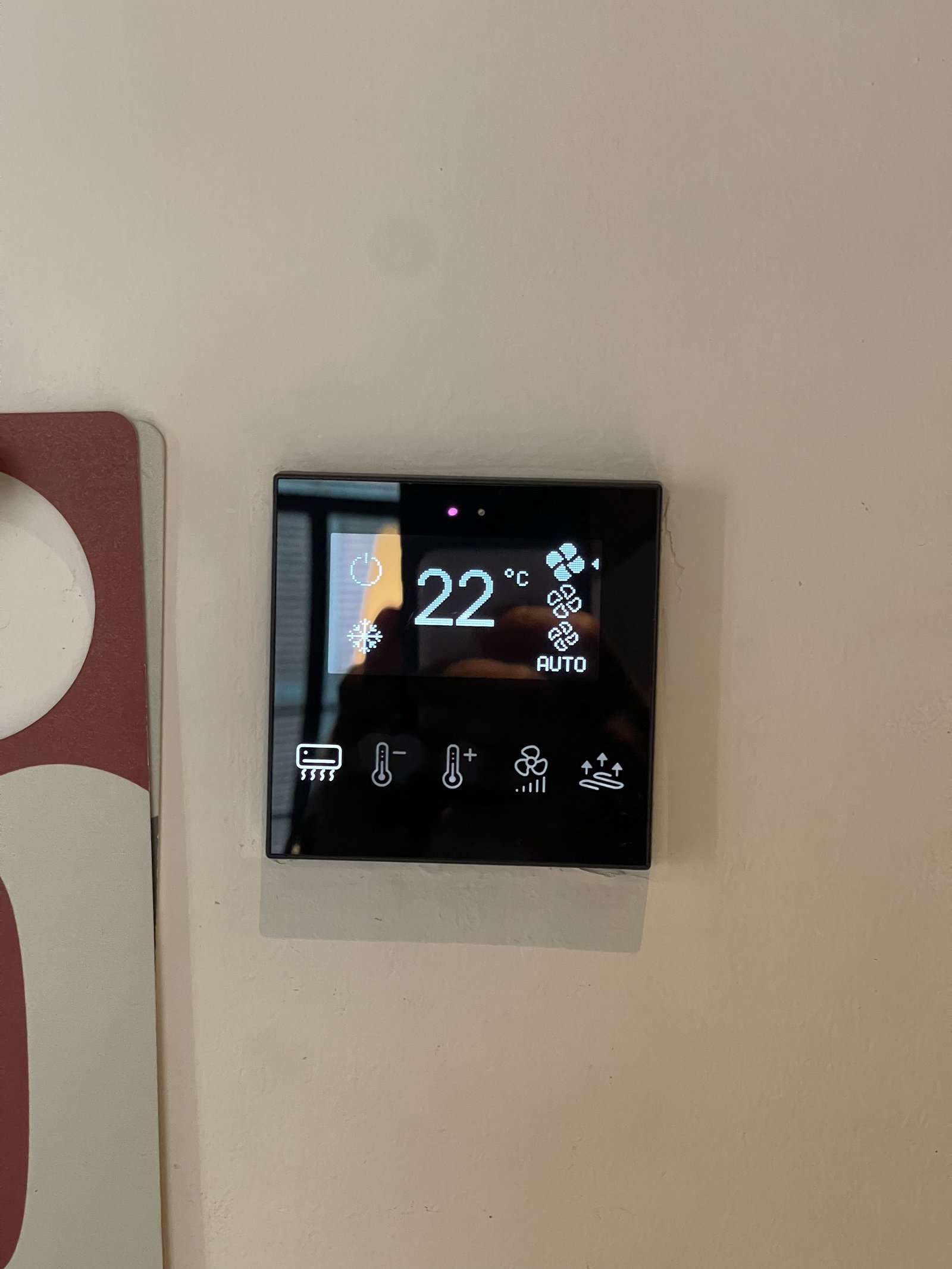
We are staying in our 6th hotel of this trip right now. And only 50% of these hotels have had air conditioning. This had led to a few restless sleeps where it was simply too hot. In one of our hotels, we had to ask them to bring a fan up to our room. But hey, this is Europe. I’m sure everyone thought we were spoiled North Americans. Interestingly enough, not having AC forces you to be more aware of the environment around you. Very quickly you learn that if you don’t shut the blinds or shutters when the afternoon sun is shining in, you are going to end up with a room that is too hot to sleep in. I try to be mindful of this back home in Toronto, where we do have AC, but there really isn’t the same imperative to both design and then operate around climate and local conditions. Active mechanical systems do much of this for us.
Tag: air conditioning
-
Turn off the AC

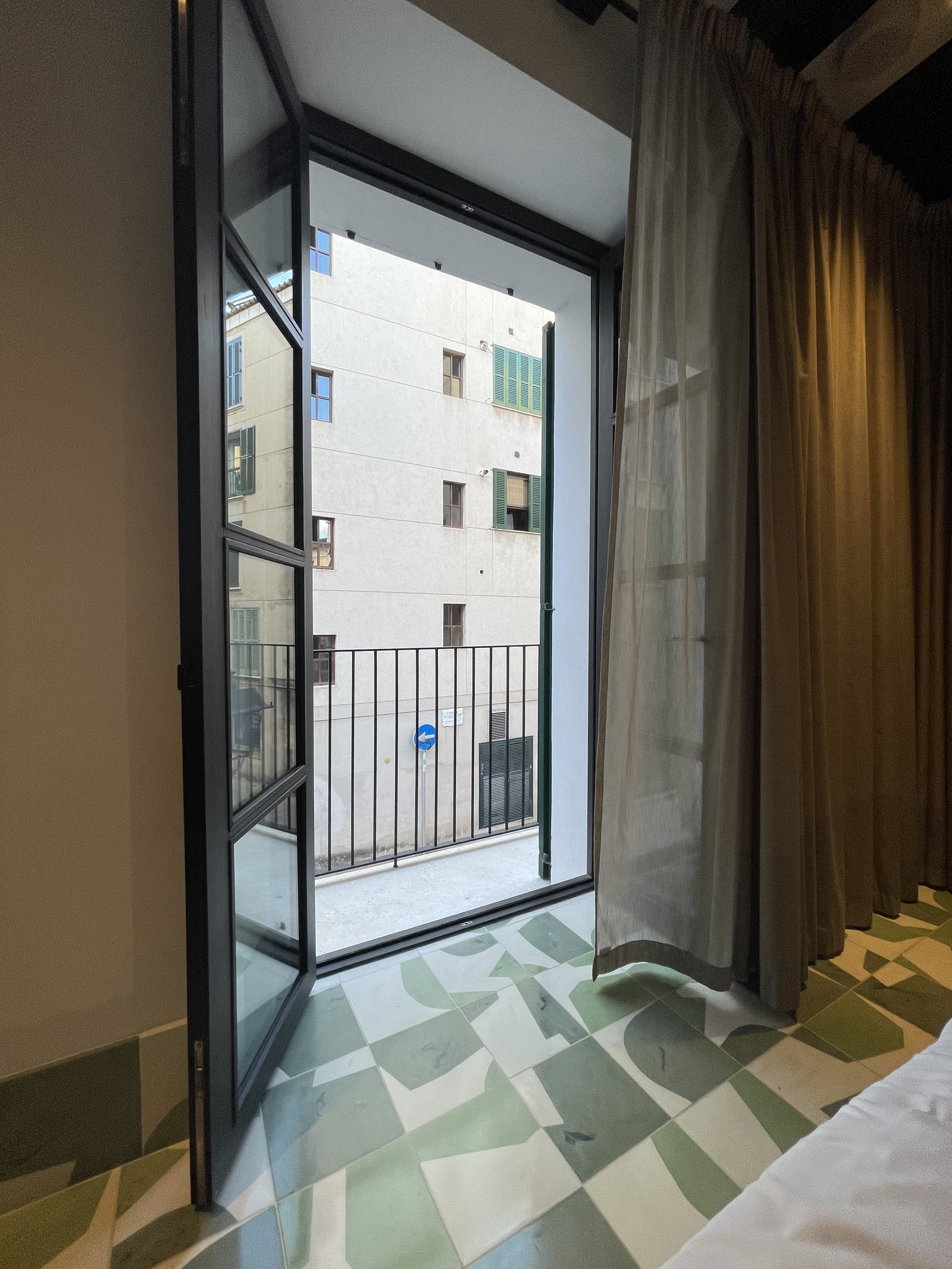
We just checked into our hotel in Palma and one of the first things I noticed is that as soon as you open any of the windows/doors, the AC automatically turns off. A message on the thermostat then alerts you that it will come back on once you close the windows. I haven’t yet figured out how this particular hotel room is sensing that things are open, but it’s relatively easy to do this at home through smart thermostats and sensors like these. I make a real concerted effort to do this manually, and so it’s great to see it automated in a hotel room, where people are naturally going to care less about wastage. Europe is so far ahead of North America when it comes to energy efficiency.
-
Harnessing air conditioning condensate
We spent yesterday and today at the Venice Biennale (both the Giardini and the Arsenale). I really enjoyed it and I’m glad that I was finally able to attend. One of my favorite exhibits was Bahrain’s. It is called “Sweating Assets”, and it’s a demonstration of how air conditioning condensate might be harnessed from the country’s significant cooling infrastructure.
Here’s a video of it in action:
In the middle of the exhibit is a big glass box. This is meant to represent a ubiquitous conditioned space. And as the humid Venice air hits this glass box, condensation is created. This water is then channeled to various soil deposits, where greenery is already starting to grow. And presumably it will continue to grow over the life of the exhibit.
They were careful not to come across as encouraging excessive air conditioning. This was not the point. Instead, the message was: Air conditioning is already an omnipresent necessity in the country, and here is how something that is mostly ignored today — AC condensate — could be turned into a meaningful asset.
I thought it was clever. And they also gave out a nice book for free.
-
Water supply and air conditioning
This past weekend I was reminded that Phoenix is largely what it is today — the 5th biggest city in the US — because of two very important things.
Firstly, the city had to figure out water supply.
About 50% of the city’s water supply comes from surface and groundwater, specifically the Verde River and the Salt River watersheds that are to the north and east of the city. And about 40% comes from the Central Arizona Project, which is a 541 km diversion canal that pulls water from the Colorado River and brings it through the state (terminating in Tucson). From what I have read, the CAP canal serves about 80% of the state’s population.
Secondly, Phoenix needed A/C.
Air conditioning was first invented at the beginning of the 1900s, but it really didn’t become ubiquitous until the second half of the century. And not surprisingly, it made the southwest of the US far more appealing. In 1950, Phoenix had just over 100,000 people. By 1960, the city had grown by about 311% to reach nearly 440,000 people. Apparently there was more construction in 1959 alone than from 1914 to 1945 combined. Air conditioning made Phoenix’s summers bearable.
Air conditioning is such an interesting topic because it’s one of those things that many of us take for granted. When you walk into a store or an office building in the summer, you expect it to be cool. But it hasn’t really been around all that long and its invention has, in many ways, been instrumental in defining the modern city. Even something as common and banal as a glass office tower with large floor plates would not be possible/practical without air conditioning.
We can certainly debate how sustainable it is to urbanize and air condition desert climates like Phoenix, but there’s no denying that air conditioning has had a profound impact on our urban landscapes. Diversion canals are pretty important too.
-
Cities with perfect climates
Last year Nolan Gray mapped out “the cities of the world where you don’t need AC or heat.” And just recently he updated his data with the help of Guardian Cities for their “sweltering cities” series. As part of the study, they projected out average temperatures, in both the summer and winter, to 2059, showing which cities may become more dependent on air conditioning. The answer looks to be many.
In his original study, Gray had 9 climatic categories, all of which were based on average high and low temperatures throughout the year. Category 1 was you definitely don’t need AC or heat. These cities are essentially perfect year round. And category 9 was you definitely need heat and AC. These cities are basically the worst places on earth to occupy from a climate perspective.
Here is that climate classification system in lovely chart form (note his caption):
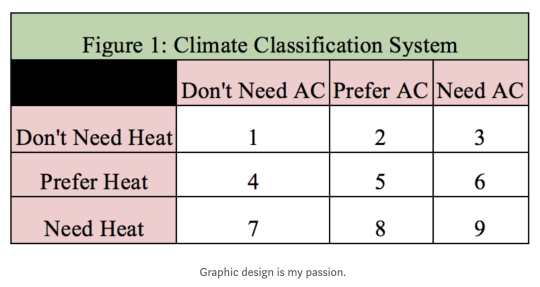
The climatic utopias ended up being places like Bogotá, Guatemala City, Lima, Mexico City, San Diego, São Paulo, and Sydney. The worst places were the southeastern United States, Central Asia, and northern East Asia.
But one factor that is not included in the study is humidity, which Gray rightly points out has a meaningful impact on comfort. Toronto, for example, is classified in his system as category 7. Heat needed. But AC definitely not needed. Personally, I would bump us up to category 8: AC preferred, but not needed.
Still, this is an interesting study. There are relatively few cities with so-called perfect climates. And I have always found these sorts of climates fascinating because they empower a very different kind of relationship to outside spaces.
-
How Energy Recovery Ventilation units work in a condo building
Lately I’ve been thinking that I don’t talk enough about architecture and about buildings on Architect This City. So today I’m going to step away from transit, driverless cars, and the other topics I’ve been discussing lately, and instead talk about something a bit more technical: mechanical systems and Energy Recovery Ventilation (ERV) units. If you’re thinking about buying or investing in a condo, I think you’ll find it useful.
Buildings work in many ways just like people do. They breathe in fresh air and they exhale out stale air. And just like you and I, once air has been exhausted out, it needs to be replaced, or made up, with more fresh air. In the world of buildings, this replacement air is called “makeup air.”
It’s for this reason that you’ll often see no smoking signs directly outside of buildings. It’s because if you happen to be smoking next to a fresh air intake, you’d actually be distributing cigarette smoke throughout the entire building. The same goes for idling trucks and other pollutants.
The amount of fresh air that needs to be pumped into a building will vary. For some uses – like hospitals and laboratories – the requirement for fresh air can be significantly higher. Sometimes as high as 100%. And that’s because you don’t want a building with toxic smells or lots of sick people to be relying on too much recirculating air.
You might then be wondering why we don’t rely on 100% fresh air in all buildings. And the reason is that it is incredibly expensive to do so. When you take in fresh air from outside, it needs to be conditioned before it can be distributed. And that takes energy. In the winter when it’s -10 degrees outside (hello Toronto), you need to heat up that air. Whereas recirculating air is already conditioned. So you just, well, recirculate it.
In most condo buildings, makeup air is supplied by dumping air into the corridors. To check if your condo functions like this, just look for a big vent outside in your hallway. This air then gets sucked into the individual suites by way of slits or openings around your front door.
So another way to check if your building operates this way is to see if your front door is letting in air from the hallway (or if it’s sealed). There’s nothing necessarily wrong with this approach, but sometimes you might end up pulling in smells from outside of your suite.
This now brings us to Energy Recovery Ventilation (ERV) units.
The way an ERV works is very simple. Let’s use our winter example, where it’s -10 outside (and you’re questioning why you live in a place that’s so cold). In this scenario, you’d be pulling in freezing air and exhausting out warm air from your apartment.
What the ERV does is transfer some of the warmth from the warm exhaust air to the cold intake air. This means the fresh air ends up coming inside your place at a warmer temperature and doesn’t need to be heated up as much. It’s “preconditioned.”
This saves energy. And it saves in utility costs.
But the other benefit of these ERV units is that, instead of pulling fresh air (or makeup air) from the corridor, it pulls it directly from outside of your condo suite. In other words, your front door is sealed and each suite is responsible for its own fresh air demands. The overall result is typically better indoor air quality, better energy efficiency, and lower utility costs.
At both DUKE and Kingston&Co, which are two condo projects that I’m currently working on a TAS, we’re putting an ERV unit into every suite. We think it make sense. But there are always questions around how much purchasers actually care about measures like this. Things like fancy countertops and appliances are usually what sells. Not some hidden mechanical unit that you’ll never see or even know exists.
But I think details like this matter. What about you?