Daily insights for city builders, delivered every morning at 6 AM ET. I’m Brandon Donnelly — a Toronto-based real estate developer and founder of Globizen. I’ve been writing here since 2013.

Tag: agglomeration economies

  • Cities and contagion

    The Penn Institute for Urban Research has just launched a new initiative called, Cities and Contagion: Lessons from COVID-19. The inaugural piece is a special edition of its Urban Link publication. But going forward, the initiative is planned to include not only publications, but a resource library, convenings (online and offline, when appropriate), and research projects. The objective is to bring together experts from different disciplines to discuss the impacts of this pandemic on cities, as well as the possible responses going forward. You can find the first set of articles, here. Some of the contributions include, “Agglomeration economies are not going away” (Jessie Handbury) and, “There’s no substitute for cities” (Richard Voith and Susan Wachter). The titles alone should give you a taste of what you can expect from this first publication.

    Photo by Patrick Mueller on Unsplash

  • Economies of agglomeration in London

    The media tends to describe agglomeration economies — one of the benefits of big urban areas — as being entirely serendipitous. Minimize travel. Maximize chance encounters at the local coffee shop. And then all of a sudden patents will go up and new startups will emerge. That does that happen, I’m sure, but there’s a bit more structure to a lot of these encounters. Economies of agglomeration is not just about serendipity. It is about the benefits of and the decision to concentrate economic activity.

    Last week, a think tank in the North of England (IPPR North) published a report outlining, among other things, job creation and productivity across England. Based on these metrics, London and the South East dominate, with “productivity” in London being by far the highest. Almost half of England’s new jobs over the last decade were in these two regions. Above is a chart from the Financial Times. The trade-off is wealth and income inequality. And the report does look to how the government could address this centralization of power and wealth.

    Like Singapore’s low fertility rate, this is an instance of leaning into the wind.

  • Toronto’s tech cluster(s)

    A recent study by the City of Toronto has looked at why tech firms cluster (agglomeration economies) and where they cluster in the city. Here are maps of what they found:

    Downtown captured almost half (49.2%) of all tech employment in the city with some 29,701 jobs. The South Employment Monitoring Area, which is the area outlined above in blue, captured 63.4% of the city’s tech base.

    I usually shy away from headlines touting some total number of tech jobs because I feel that it can become a bit of a vanity metric. What about the quality of those jobs? How much venture capital have the companies raised?

    But this report is different and it is interesting to see the extent in which tech has concentrated itself in the core of the city. As of 2019, jobs in tech establishments represented about 4% of all jobs in Toronto.

    To download a copy of the report, click here.

  • The world’s biggest fishing port

    Here is an excerpt from a Guardian article that was published last year (by Tim Burrows) about Grimsby, England:

    In Grimsby’s 1930s heyday, fishermen used to head to Freeman Street as soon as they were off the trawler, straight to the Lincoln or the Corporation Arms to spend their bountiful earnings. A century previously, Grimsby had been a fairly sleepy fishing village, but by the 1890s it was on the way to becoming the biggest fishing port in the world. In the mid 20th-century, trawlers were bringing in 500 tonnes of fish a day.

    Today, Grimsby still has a thriving indoor market (paid for by the EU and the Enrolled Freemen of Grimsby, an organisation that dates back to the 13th century), but the further north towards the docks you walk, the emptier and more dilapidated things get. A local businessman says sex workers wait around at night for lorries to take them to the deserted docks. “It’s a legacy of the old fishing days.”

    There is scant legacy to be found elsewhere. After a long decline, the fishing industry died in the mid 1980s, its owners selling their trawlers to companies in Aberdeen or Japan. Unlike Hull across the river, currently basking in its year as Capital of Culture, Grimsby is the Humber city that never was.

    More than 70% of people in Grimsby, England voted to leave the European Union in the 2016 “Brexit” referendum. It was one of the highest shares in the country. But with one of the highest unemployment rates in the country, that outcome is not all that surprising.

    Supposedly, at its peak, there were eight onshore jobs for every one at sea in Grimsby. And like all thriving cities, there were economies of agglomeration, which resulted in things like the largest ice factory in the world. The fishing fleets needed crushed ice — and lots of it.

    The Grimsby story is, of course, not a unique one. You just have to replace fishing with some other industry. Many cities have managed to diversify their economies either out of necessity or because they saw the writing on the wall. But for others it has been a real struggle.

    It’s one of those things that is perhaps simple, but far from easy.

  • The new studio geography

    If any of you have gone to architecture school (or know someone who went to architecture school), you’ll know that everything revolves around something called studio. Studio – that’s really all you need to say – is worth many multiples of your other classes and consumes an even greater multiple of your time. What time will you be in studio? How’s studio going? I was in studio really late last night. This is how the conversations go.

    So I was intrigued by Seth Godin’s post this morning comparing “working in a studio” to working in a factory. The latter, he says, relies on compliance: “More compliance leads to more profits. Do what you’re told, faster and cheaper, repeat.” And this was very much the narrative of the 20th century and was the model that empowered small-town America to thrive (see yesterday’s post).

    However, the studio is different. Here is how Godin defines it:

    The studio, on the other hand, is about initiative. Creativity, sure, but mostly the initiative to make a new thing, a better thing, a process that leads to better.

    It’s peer to peer. The hierarchy is mostly gone, because the tasks can be outsourced. So all that’s left is leadership.

    Initiative plus responsibility. Authority is far less important, as are the traditional measures of productivity.

    It is not difficult to tell the two apart, which is how Godin ends his post. But it is worth noting that the studio model also thrives in a different kind of geography, compared to the factory model. So not only is the studio itself a different place, it also wants to situate itself in a different kind of place. So in a way, what we are seeing today is the new studio geography.

  • Cities are labor markets

    Eduardo Porter recently published this piece in the New York Times on the “relentless economic decline” of small-town rural America. We often talk about rising income inequality, but the greater concern is the alarming rate of joblessness in many of these communities. Earning less than others is not as bad as earning nothing.

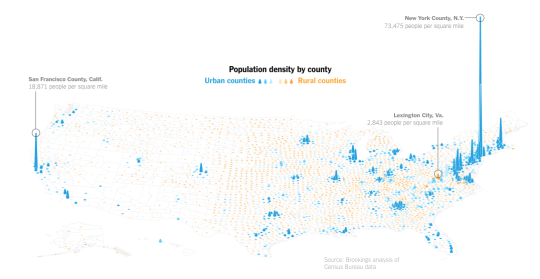
    I think the below map from the article, depicting population density by county, starts to show how uneven the economic landscape is across the US. Porter puts it this way: “This is the inescapable reality of agglomeration, one of the most powerful forces shaping the American economy over the last three decades.”

    image

    But, of course, we don’t really have a solution to this problem. Some are suggesting employment subsidies, such as the earned-income tax credit. While others are suggesting that we need to make it easier to build in the large blue spikes shown above. That way we’ll be able to more affordably accommodate the people who will ultimately need to move from rural to urban.

    While this latter suggestion may seem grim for small-town America, it is perhaps a reminder of what cities really are at their core: Cities are labor markets. They are the places where people come to get a job and make money.

  • The vertical city

    We often talk about agglomeration economies in terms of their horizontal clustering within cities. But a new paper in the Journal of Urban Economics – summarized here by Richard Florida – has looked at the other dimension: the vertical clustering of economic activity within tall buildings. 

    Here is an excerpt from Florida’s piece in CityLab:

    Economic activity is also sorted vertically, with higher-profile and more profitable firms occupying higher building floors. Law offices are disproportionately represented on the highest floors, taking up more than a third of floor space above the 40th floor, compared to 12 percent of floor space between the second and 40th floors. Finance, insurance, and real estate take up roughly 20 percent of floor space above the 40th floor, compared to 23 percent between the second and 40th floors. Business services, engineering, and miscellaneous other industries are also more likely to take up more space below the 40th floor.

    The other takeaway is that there appears to be a greater rent premium attached to higher floors (vertical movement) than for being located closer to the central business district (horizontal movement). This surprised me. But I also don’t have access to the full paper. Is the dataset just US cities?

    Nevertheless, the idea of a vertical city interests me a lot. And I agree with the authors of the report that, for perhaps obvious reasons, it is far less studied compared to horizontal development patterns.

  • Local rail-driven agglomeration economies

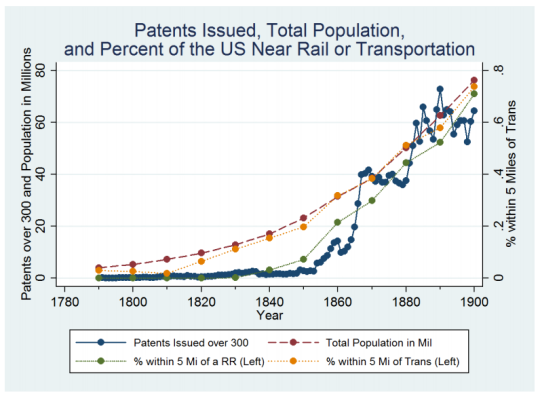
    This morning I came across the below graph in a Medium article by Eric Jaffe of Sidewalk Labs. It is taken from a research paper by Elisabeth Ruth Perlman called, Dense Enough To Be Brilliant: Patents, Urbanization, and Transportation in Nineteenth Century America.

    What this chart shows is patents issued – a proxy for innovation – in all U.S. counties between 1790 and 1900. This data is then compared against access to transport, such as rail. The discovery is a statistically significant relationship between innovation (patents issued) and rail (transport) access.

    The spike in the 1850s (shown above) is as a result of increased rail access.

    But Perlman takes it a step further and asks: what is causing this spike in innovation? Is it because inventors and creators started responding to the larger market now accessible to them because of rail connectivity? Or did transportation somehow improve productivity and the flow of information?

    To answer this question, she dug into the patents themselves (over 700,000 of them) to try and identify how ideas and key words were spreading. What she found is that rail access alone doesn’t encourage innovation. References to new technologies did not increase.

    What mattered was what happened locally. Transportation improvements promoted urbanization and density during her study period, and that’s what drove innovation. Connectivity created agglomeration economies at the local level.

    Obviously a lot has changed since the 19th century. But whether it’s rail connectivity or internet connectivity, have the rules really changed? Place still matters. What happens locally still matters. Perhaps even more. 

    This is an important lesson to consider as we build our cities and invest in transportation. Rail alone isn’t enough. What matters more is what we build around it. Are we dense enough to be brilliant?

  • The Toronto startup ecosystem in numbers

    When I met with all of the lovely folks from Amsterdam last week, one of the things that I mentioned about intensification is that it is almost certainly a contributing factor towards innovation, agglomeration economies, and the overall startup ecosystem here Toronto. 

    I don’t know to what extent, but I feel it happening. And there’s lots of research correlating urban density with innovation

    The continued densification of Toronto means it is constantly becoming easier to schedule that morning coffee before going into the office or to pop into that meetup after work. And those sorts of things are hugely valuable in today’s economy.

    I talked about a number of local startups in my presentation, including 500px, Wattpad and Wealthsimple. But I didn’t show any hard data. So I’d like to do that today. Below is a chart showing total venture funding (internet/software) and the number of deals (Seed to A/B/C/D) in Toronto since 2009:

    image

    It was taken from this Medium post. Supposedly this places us 12th in the world as far as startup cities go.

    Again, who knows how much of this venture growth has been helped along by intensification. After all: “Silicon Valley proper is soul-crushing suburban sprawl.” But I would bet money that it’s moving the needle in the right direction.

    Here is another relevant post by venture capitalist Albert Wenger where he talks about the great startup ecosystem that Toronto is growing. He posted it earlier today.

    All of this is important because some of these deals will spawn big companies. And those companies will the hire lots of people, as well as consume space. 

    Real estate developers like to talk about how they create jobs. And we do. But we can’t have a city of people just building buildings. People and businesses need to fill that space and that hinges on entrepreneurs who are willing to go out there and forge something new for themselves. Fortunately, Toronto seems to have a growing number of those kinds of people.

  • Knowledge is more important than space

    I don’t always agree with economist Edward Glaeser, but I really enjoyed the talk that he gave at the Vancouver Urban Forum back in 2012 (at least part 2 of it). I came across it on Twitter today and, since it only has about 300 views, I figured that some of you also haven’t seen it.

    The argument he makes is that knowledge and education are the bedrock of cities. And since we continue to cluster in cities, despite all of our technological advances, knowledge is clearly more important than space. One of the ways he defines cities is by their lack of space and the closeness of the people.

    Of course, this isn’t anything new. If you’ve read his book Triumph of the City, you’ve heard all of this before. But that didn’t stop me from enjoying his talk. It’s a great overview of declining transportation costs, locational advantages, agglomeration economies, the importance of urban density, the impact of small and large firms in a city, and so on.

    I also really liked this idea that knowledge is worth more than space. So if you have 20 minutes and you want to get geared up about cities, have a watch.

    Click here if you can’t see the video below.

    [youtube https://www.youtube.com/watch?v=zg7aITkTNe8?rel=0&w=560&h=315]