Daily insights for city builders, delivered every morning at 6 AM ET. I’m Brandon Donnelly — a Toronto-based real estate developer and founder of Globizen. I’ve been writing here since 2013.

Tag: africa

  • Shaping Cities in an Urban Age

    Shaping Cities in an Urban Age is the third book to come out of the London School of Economic’s Urban Age project. It was published last fall. The first two titles were, Living in the Endless City (2011) and The Endless City (2007).

    If you’re familiar with the first two publications, you’ll know that these books are heavily illustrated. Lots of maps, charts, and diagrams. So they make great coffee table books. But they’re also filled with insightful essays — this one has 37 of them.

    In this particular book the focus is on the following:

    “It identifies current trends that are making cities more fragmented, less equitable and environmentally more damaging, and argues powerfully for a more integrated social, environmental and spatial approach that can inform and inspire city-makers that are shaping an increasingly urban world.”

    I am sharing this with all of you today because I have always really enjoyed these books. They have a way of quickly putting things into perspective globally.

    Around 2.5 billion more people are expected to live in an urban agglomeration by 2050. And 90% of this growth is expected to happen in just two places: Asia and Africa. This is an unprecedented shift that will obviously create many challenges and many opportunities.

    This book is about that.

    Image: Phaidon

  • Relationship between female literacy and total fertility rate

    This recent post by Sam Karam at NewGeography illustrates the relationship between female literacy and total fertility rates in Sub-Saharan Africa, India, and China. The overarching argument, which won’t surprise any of you, is that, “higher female literacy is a reliable predictor of lower fertility and improved prosperity.”

    The following graph uses data from populyst, the UN Population Division and UNESCO. The time period for the dataset varies by country but approximately corresponds to the latest 2000′s. All Sub-Saharan countries are represented, except for the Congo, Somolia, and South Sudan.

    image

    Noteworthy about this dataset is that the biggest decline in the total fertility rate happens precipitously after female literacy reaches and exceeds 80%. What is also interesting, but not surprising, if that the countries with the lowest gender equality rankings tend to also have high fertility rates. And that’s because low gender equality tends to translate into lower female literacy rates. 

    According to populyst, the above phenomenon – precipitous decline in TFR with rising female literacy – has already proved itself out in China. 

    Based on data from the World Bank, China’s total fertility rate dropped from 6.38 in 1966 to 2.75 in 1979. And since the one-child policy was only enacted in 1979, it doesn’t appear to be driven by that. (I would have initially expected some sort of surge in births prior to that policy.) From 1982 to 2000, the female literacy rate in China rose from 51% to 87%. Today it is 99.6%, which is basically the same as it is for males.

    For a more detailed look at the above data, check out this populyst post.

  • The 100 million city

    The Guardian recently published this reminder that the real population growth in the world today is happening in Asia and Africa. The article is called, “The 100 million city: is 21st century urbanisation out of control?” Much of the data is from this 2016 paper by Daniel Hoornweg and Kevin Pope, which projected the populations of the world’s biggest cities by 2100.

    The standout example is that of Lagos, Nigeria, which went from under 200,000 people in the 1960s to an estimated 20 million people today. Though, I would imagine that the ubiquity of informal settlements makes it difficult to come up with an accurate number.

    Still, it is one of the world’s top 10 largest cities and, by 2100, it may be the largest city in the world. The Guardian described the population as young, fertile, and increasingly urban. The median age in Nigeria is 18 and the fertility rate for the content is 4.4 births per woman.

    I am mentioning all of this today because I think it grants some perspective. This is an immense city building challenge, not only because of the unprecedented growth rate, but also because it remains largely poor. Lagos, a city, may add more than 2.2x the population of Canada, a country, during the balance of this century.

  • The world in 2050

    The United Nations recently released its 2015 version of World Population Prospects. It looks as if they put out and revise this report every 5 years.

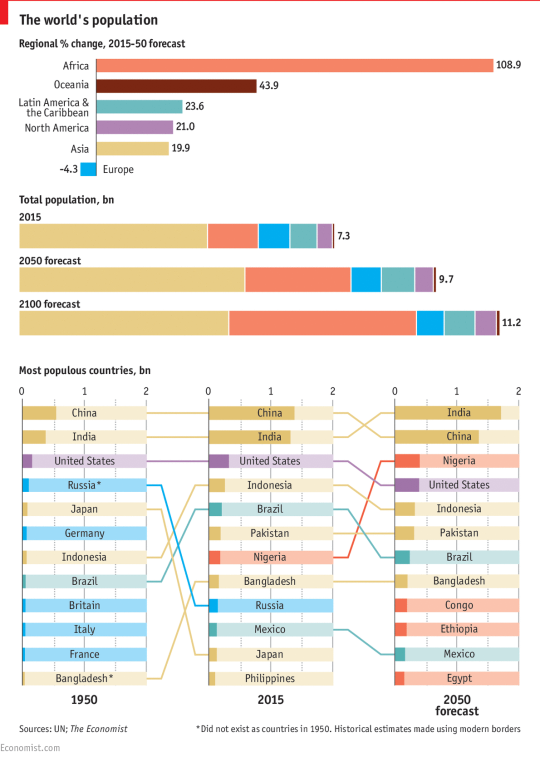
    The Economist then took some of their data and assembled it into the following charts:

    image

    It’s obviously extremely difficult to predict what will happen in the world by 2100, but to the extent that forecasting is possible, the world’s population is expected to reach somewhere around 11.2 billion people. Today it’s 7.3 billion.

    The bulk of this growth is expected to happen first in Africa, and then in Asia. By 2100, Africa’s share of the global population is expected to grow to 39% and Asia’s share is expected to decline to 44%.

    If you’ve been following population trends, most of this shouldn’t come as a surprise to you. The meaningful population growth happening in the world today is happening in the developing world. 

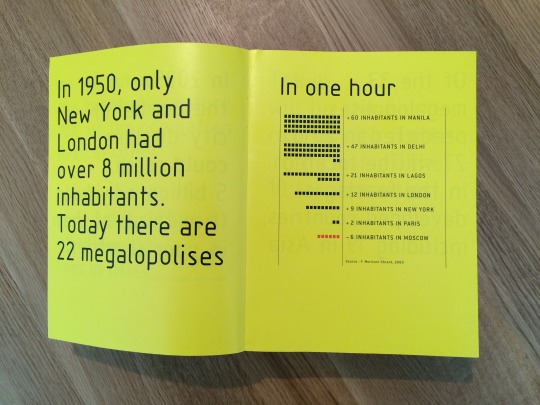
    That’s why architects, such as Rem Koolhaas, have been studying cities like Lagos (Nigeria) since the late 1990s and early 2000s. Below is a photo from a book/research project that I love called Mutations (2000). I pulled it from my bookshelf this morning.

    image

    It’s interesting to think about what all of this will mean for the global economy and for global governance. 

    The United States is about to be alone when it comes to advanced economies with a globally competitive population. Europe is shrinking, which leads me to believe that a strong EU is likely important. And we now have lots of megalopolises with big populations, but with very low income levels.

    Nigeria is the largest economy in Africa, but per capita income is somewhere around $3,000.