Daily insights for city builders, delivered every morning at 6 AM ET. I’m Brandon Donnelly — a Toronto-based real estate developer and founder of Globizen. I’ve been writing here since 2013.

Tag: affordable housing

  • Show some laneway love

    I just want to do a quick follow-up to my recent post about the momentum currently developing around laneway housing here in Toronto. 

    In the post, I mentioned that two councillors have come out in support of this housing typology. However, I neglected to mention that Evergreen CityWorks is also at the table, as well as a housing advocacy group called Lanescape. It was mentioned in the comments, but I know that not everyone checks that part of the blog.

    I say this for two reasons:

    1) I thought about starting a similar initiative to Lanescape. (I’ve had lanewaylove.com registered for many years. Brand identity shown above.) But after meeting one of the Lanescape founders this past week, I think it only makes sense for me to instead throw my support behind them. They are accomplishing a lot in this space.

    2) Lanescape has a survey up on their website and the results will be used to guide a laneway suite planning framework that will (hopefully) be implemented by the City of Toronto. So I wanted to encourage you all to complete it. Even if you don’t live in Toronto, still fill it out. It’s important for cities to learn from each other.

    Your support will go a long way in making laneway housing a reality in the city.

  • New political support for laneway housing

    There’s some great news in the Toronto Star this week.

    (Thank you Mike for bringing this to my attention.) 

    Two councillors – Mary-Margaret McMahon and Ana Bailao – have come out in support of allowing laneway housing in Toronto. Some cities call them detached accessory dwelling units (DADUs). 

    If you’re new to laneway housing, check out this post and this post (both are 2+ years old). I’ve been on this horse for over a decade.

    Because going beyond their small space cool factor, laneway housing has the potential to fundamentally alter the housing supply constraint that I wrote about a few weeks ago – namely the yellowbelt. It’s a way to gently allow for new housing, while at the same time preserving the character of our “stable” neighborhoods. 

    And frankly, I can’t think of any other way to add new ground related housing at any sort of meaningful scale within the city limits – not unless we’re willing to give up the “stability” of our neighborhoods. So this is it.

    If you’re on the same page, I would encourage you to reach out to Councillor McMahon and Bailao and let them know that. There’s also a public workshop scheduled for Monday, December 5th at 7pm at the Evergreen Brick Works (550 Bayview Avenue).

  • Building new, better cities

    Earlier today my friend Saadat sent me the following tweet:

    //platform.twitter.com/widgets.js

    It’s a link to a new research project by Y Combinator – the famed Silicon Valley seed accelerator. They want to explore the possibility of building new and better cities.

    I don’t have the time for something like this, but if any of you are city experts (I know a lot of you are) and you’re based in or willing to be based in San Francisco (I think they are flexible on this), you should absolutely consider applying to be their full time “Cities Researcher.” The deadline is July 30, 2016.

    Here’s a taste of what they are thinking about…

    There are many high-level questions we want to think through, for example:

    – What should a city optimize for?

    – How should we measure the effectiveness of a city (what are its KPIs)?

    – What values should (or should not) be embedded in a city’s culture?

    – How can cities help more of their residents be happy and reach their potential?

    – How can we encourage a diverse range of people to live and work in the city?

    – How should citizens guide and participate in government?

    – How can we make sure a city is constantly evolving and always open to change?


    And there are tactical questions we want to dig into, for example:

    – How can we make and keep housing affordable? This is critical to us; the cost of housing affects everything else in a city.

    – How can we lay out the public and private spaces (and roads) to make a great place to live?

    – Can we figure out better zoning laws?

    – What is the right role for vehicles in a city?

    – Should we have human-driven cars at all?

    – How can we have affordable high-speed transit to and from other cities?

    – How can we make rules and regulations that are comprehensive while also being easily understandable?

    – Can we fit all rules for the city in 100 pages of text?

    – What effects will the new city have on the surrounding community?

    The convergence of city building and tech is something that I’m deeply interested in. I also think it’s inevitable. And I think that Toronto – thanks to our robust real estate industry – is in an ideal position to be a leader in this space. So I would love to see someone from here take on this job.

    But even if you’re not from Toronto, you should still apply because it’s an exciting initiative 🙂

  • Market vs. subsidized

    Miriam Zuk and Karen Chapple of the University of California, Berkeley, recently published a research brief called Housing Production, Filtering and Displacement: Untangling the Relationships

    It’s a nuanced look at the impact of both market-rate and subsidized housing production on affordability and displacement within the San Francisco Bay Area.

    The report is essentially a response to the debate around whether increasing market-rate housing production alone can address affordability and displacement concerns, or whether the only way to do it is through subsidized housing. What they found was that both matter, but…

    “What we find largely supports the argument that building
    more housing, both market-rate and subsidized, will
    reduce displacement. However, we find that subsidized
    housing will have a much greater impact on reducing displacement
    than market-rate housing. We agree that market-rate
    development is important for many reasons, including
    reducing housing pressures at the regional scale and housing
    large segments of the population. However, our analysis
    strongly suggests that subsidized housing production is even
    more important when it comes to reducing displacement of
    low-income households.”

    If you’re interested in this topic, I recommend reading the full brief. It’s only 12 pages. I particularly liked the information around filtering and how new housing steps down over time to ultimately serve lower-income households.

  • Young, educated, and urban

    The Wall Street Journal recently published this article talking about how the young and educated are flocking to high-density urban areas all across the United States. Here’s a set of charts from the article:

    There are many people who will point out – probably rightly – that despite the “return to cities” that we are currently seeing, the world is still suburbanizing. But, it doesn’t appear to be suburbanizing in quite the same way as it did for prior generations. There’s also a socioeconomic shift taking place.

    As an example, and to drive home the point that it’s not just the expensive coastal cities that are seeing rising home prices, the WSJ article focuses quite a bit on Ohio City – a neighborhood in Cleveland. Here’s what has been happening:

    In the Ohio City neighborhood, the median income skyrocketed to $93,000 from $23,000 since 2006, according to Ohio City Inc., a local nonprofit development group. Median home values shot up 800% since 2000 to $270,000, according to Ohio City Inc. Median rental prices in downtown Cleveland as a whole jumped 47% from late 2010 to late 2015, according to the Center for Population Dynamics at Cleveland State University.

    These are pretty dramatic increases – though $270,000 feels cheap to someone from Toronto. Still, it speaks to a trend. You and I both know that Ohio City isn’t the only neighborhood seeing those sorts of numbers.

  • More thoughts on inclusionary zoning

    Alan Ehrenhalt recently published a balanced piece in Governing that largely reflects my own views on inclusionary zoning. It’s called: Why Affordable Housing Is So Hard To Build.

    His argument is that there are lots of cities trying to build more affordable housing, but that most strategies have not yet proven to be all that successful.

    I’ve written a few posts on inclusionary zoning. The most recent is this one. And though I believe that a mix of incomes is a critical component of good city building, I am having a hard time believing that inclusionary zoning is the silver bullet that will get us there. Admittedly, it sounds like a great idea. But how does that translate into reality?

    Here’s a snippet from Alan’s article (shout out to Daniel Hertz of City Observatory who seems to get cited in almost every article I read these days):

    Just about every city that has tried an inclusionary zoning law in recent years has had a similar experience. In some cases, the results have been much worse. According to BAE, Chicago’s inclusion law produced $19 million in 11 years, but only 760 affordable units. Thirteen years of inclusionary zoning in Seattle brought the city $31.6 million in fees and a grand total of 56 units. As the urbanist Daniel Hertz wrote recently, inclusionary zoning has been “more powerful as a symbol than as a way of helping people.”

    Of course, the devil is in the details. Many inclusionary zoning policies allow cash in lieu of actual housing:

    San Francisco actually has had an inclusionary zoning law since 2002, and it has been a flop. It mandates a 12 percent affordable set-aside, but allows developers to escape the mandate by paying a fee to the city. As in Arlington, this is what they have done. A study by the research firm BAE Urban Economics found in 2014 that after 12 years the San Francisco law had brought in $58.8 million in developers’ fees and had generated 1,560 units. That’s better than nothing, but it’s a drop in the bucket for a city facing an affordability problem in virtually every neighborhood.

    All this said, I’m still not so sure that it’s as simple as eradicating the cash in lieu option and forcing mandatary inclusionary zoning. As Alan rightly points out in his article, if we set the bar too high, then all of a sudden it starts making some market rate housing infeasible to build. 

    And if this ends up lowering the overall supply of new housing, then we could be hurting affordability while at the same time trying to mandate more of it. Does that make sense? Clearly this is not as simple as it may seem.

    I get the appeal for cash poor cities. It sounds like free affordable housing. But I’m always suspect of “free” lunches. In any event, I think we can all agree that this is an important discussion to be having.

  • Thoughts on inclusionary zoning

    Ontario is looking to pass legislation that would allow municipalities in the province to implement something known as inclusionary zoning. If passed and should municipalities decide to use this tool (Toronto almost certainly would), developers would then be required and/or incentivized to include some percentage of affordable housing in their new market rate developments. 

    Politically, inclusionary zoning tends to be popular. It’s believed to be a way for governments to create new affordable housing using relatively small public subsidies. Not surprisingly though, the development industry generally hates IZ. It’s another cost that needs to be added to the development pro forma – though some municipalities rightly offset these additional costs with additional density, breaks on levies, and so on.

    What I always think about when this topic comes up is the broader economic impact of the land use policy. Because I’m suspect that it’s as simple as: mandate affordable housing; get more affordable housing for free. Generally there are always trade-offs.

    So here’s some reading material for you all this morning.

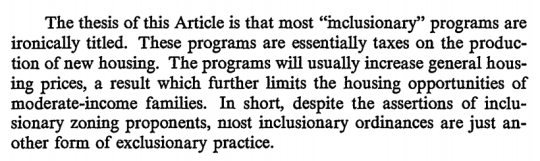
    In a classic paper (1981) by Yale Professor Robert C. Ellickson – called The Irony of Inclusionary Zoning – he argues that these practices can actually increase general house prices:

    image

    As a counterargument Owen Pickford over at The Urbanist argues that IZ simply reduces land prices as a result of the new tax. Land, after all, is the residual claimant. Therefore, he believes it’s an effective affordable housing policy. (I’m not so sure I believe that land prices would decrease in practice.)

    There’s also debate about the effectiveness of inclusionary zoning to actually deliver affordable housing at a meaningful scale. City Observatory wrote a post that looked at the total number of units produced (through IZ) across a number of American cities and the results were spotty. It should, however, be noted that not all inclusionary zoning policies are mandatory.

    Finally, the Furman Center for Real Estate & Urban Policy at New York University published a housing policy brief back in 2008 that looked at this exact topic. While they admit that the data is scarce, they come to the conclusion that IZ had no meaningful impact on the prices and production of single-family housing in San Francisco, but that IZ seems to have slightly decreased production and slightly increased pricing in the suburbs of Boston.

    What this last point suggests is that inclusionary zoning policies are not all created equal. So like all difficult questions, the answer to this one is likely: it depends. If anyone can point me to better data on inclusionary zoning, I would love to see it.

  • NO TOWER on Commercial Drive

    For the past week or so I’ve been seeing the proposed Kettle Boffo Project in Vancouver make the rounds online. Here’s a rendering of the project, which is located at Commercial Drive and Venables Street:

    image

    The reason it has been making the rounds is that a community group called NO TOWER (written in all caps) has come out in fierce opposition of the 5 to 12-storey building. They have over 3,500 signatures.

    As an outsider looking in, this is surprising. The scale of the project seems appropriate. The height roughly matches the existing building shown above to the right. It may even be lower. And the project will provide somewhere around 30 social housing units, as well as additional space for the Kettle Friendship Society non-profit, who are currently on the site. (Note: An application to the city hasn’t yet been made.)

    What this has me thinking about is the push and pull between bottom-up and top-down planning. 

    When architect Bjarke Ingels talks about his Dryline project in New York, he likes to refer to it as the love child of Robert Moses (top-down planning) and Jane Jacobs (bottom-up planning). In the case of this project, it’s because it’s a large infrastructure project that they are trying to root into the local neighborhoods. Makes sense.

    But this same thinking could also apply to overall city building. Local communities rightly have their own wants. But at the same time, cities need to be thinking about the overall. The challenge is finding that right balance.

    I would be curious to hear your thoughts on the Kettle Boffo Project in the comment section below – especially if you’re from Vancouver.

  • How should cities manage their own awesomeness?

    Conor Maguire introduced me to an interesting site today called Airbnb vs. Berlin. The site does a deep dive into Berlin’s Airbnb market with the hope of answering the question: Is Airbnb contributing to a shortage in affordable housing?

    The site is very well done. It’s filled with lots of great market stats and diagrams such as this one here: 

    Of course, the impetus for a site like this is that cities all around the world, from San Francisco to Berlin, are grappling with rising home prices. If you happen to live in a successful, growing city, that’s probably what is happening.

    But when this happens, we seem to want to look for something or someone to blame. In San Francisco it’s the tech workers. They’re the ones driving up homes prices. In Vancouver, it’s the foreign Chinese buyers. And in Berlin, it’s those Airbnb users who are just out to make a profit. In all of these cases, we like to tell ourselves that if we could just get rid of “X”, everything would be much better. 

    But I think sometimes we forget that this is also the result of doing many things right.

    If Berlin wasn’t a brilliantly cool place to visit, then tourists wouldn’t come. And if tourists didn’t come, then Berlin wouldn’t have, by far, the largest Airbnb market in Germany. If Vancouver wasn’t one of the most enjoyable places in the world to live, you wouldn’t have the same attention from overseas buyers looking to snatch up properties. 

    So in a way, we should be asking ourselves: How do we, as a city, manage our own awesomeness?

    The other thing that Airbnb vs. Berlin reminded me of is the viewpoint that profits are some dirty little secret. I hear it all the time in the real estate development business. People will say: “That developer is just out to make money.” Of course she/he is! They operate a business. And like all for-profit businesses, one of the objectives – it may not be the only one – is to make money.

    I say all this not as a direct response to the website. They remained fairly neutral in their analysis. Instead, I raise it as an alternate viewpoint in the seemingly universal battle against “X.”

    In case you’re wondering about Berlin’s Airbnb market, the site estimates that there are roughly 11,701 Airbnb listings in the city out of a total of about 1.9 million flats. Of these listings, it is estimated that somewhere around 30% are by “professional users” who are only out to make a profit and are not participating in the “sharing economy” in its purest sense. That equates to about 0.18% of all Berlin flats.

    Based on this number, I’d say that Berlin’s cool factor probably has a lot more to do with the city’s rising rents than do the profit seeking Airbnb users.


  • 50% of New York City’s population is estimated to be single. Here’s what that means for housing.

    Here in Toronto there’s a push for more family-sized apartments. That’s what the planners want to hear.

    Because the city has been trying to encourage developers to build more of them for years, but the challenge has always been that they didn’t sell or that they took a long time to sell. The market wasn’t ready.

    But as I discussed earlier this week, that is starting to change. I think Toronto is reaching a tipping point where low-rise housing has simply become too expensive and people are starting to look to alternatives, mostly at the mid-rise scale.

    It’s interesting though that something of the opposite appears to be happening in New York. I don’t know enough about the New York new construction market to really comment on overall unit mixes and sizes, but there definitely seems to be a push to create more affordable micro-units.

    Curbed published this last October:

    “…a report currently under public review, called Zoning for Quality and Affordability, recommends relaxing density caps and eliminating the 400-square-foot minimum for studio apartments, thereby creating more housing for single people. Almost 50 percent of the city’s population is estimated to be single, but only seven percent of the housing stock is studios.”

    And just recently, New York completed its first all-micro-unit apartment building called Carmel Place. Rents start at $2,650 per month for a 265 square foot apartment. 

    As a point of reference, that works out to be $10 per square foot per month and more than 3x the highest rents you could reasonably achieve in the more desirable areas of Toronto, today.

    The model suite is 302 square feet and looks like this:

    All of the above photos are via Curbed.