Daily insights for city builders, delivered every morning at 6 AM ET. I’m Brandon Donnelly — a Toronto-based real estate developer and founder of Globizen. I’ve been writing here since 2013.

Tag: acquisition

  • Prada just bought a lot of real estate in New York

    We have spoken before about how hotel brands don’t typically own their real estate. But the same is also true of many other businesses. And one common reason for this is that it ties up a lot capital that could be otherwise deployed in the core business. If, for example, you’re in the business of producing exclusive handbags, it usually makes sense to spend your excess cash on making better handbags. And if you find that you’re actually making more money on real estate, then it could be a sign that you’re in the wrong business.

    There are, however, instances where owning your own real estate may make the most sense. Maybe you have an irreplaceable location that you want to secure for the long term. And so there’s real strategic value. Or maybe you keep having annoying legal fights with your landlord and you just want to get back to focusing on luxury handbags. There are other motivating factors to consider here, but these two seem to be behind Prada’s recent acquisition of 724 Fifth Avenue in New York.

    Prada has had a flagship 5-storey retail store at this location since 1997 (and most recently was paying US$22 million in rent). In December, they announced that they had acquired the entire 12-storey building for US$425 million. (That works out to be about $5,395 psf on the gross building area!) And then shortly after, they announced that they had acquired next door — a hard corner — for another US$410 million (total US$835 million).

    All of this makes the deal one of the largest in New York last year. But was it a good deal? I would need some more information to answer from a quantitative real estate perspective. But if I’m Prada, I know that I need to be on Fifth Avenue for the foreseeable future. And now I get access to a hard corner and I no longer have to deal with my landlord. These are clearly strategic things. Last year was also a pretty good time to be buying retail/office buildings with all cash, which is what Prada did.

  • Summit County, Utah to vote on acquisition of 8,576-acre ranch

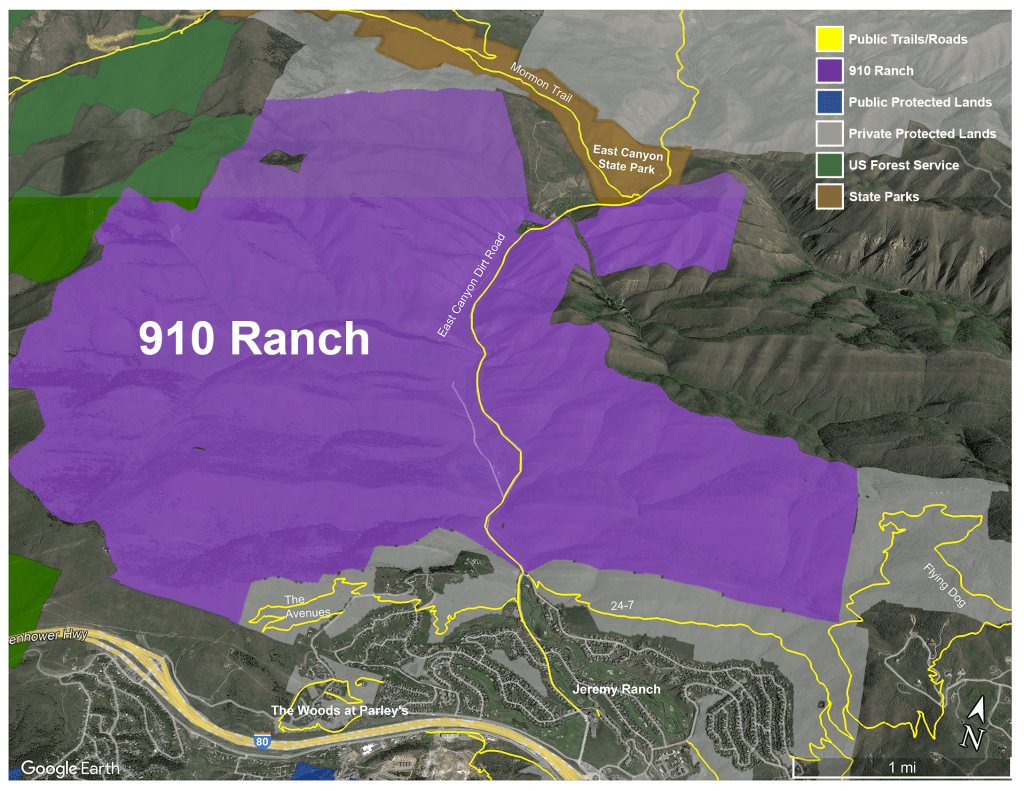
    Summit County Council is holding a special meeting this week to vote on the acquisition of an 8,576-acre property next to Jeremy Ranch and around the corner from Parkview Mountain House.

    The County Manager has recommended approval of the deal and these are the terms:

    – $55 million total purchase price (about $6,413 per acre)

    – Structured through a $15 million three-year option to purchase, with a right to extend for another year for an additional $5 million (option fees to be applied toward the purchase price)

    – During the option period, the County will have control of the property and pay $5,000 per month in rent

    Another way to look at this deal is that Summit County needs to initially come up with $15 million of equity. This is because they are getting seller financing for the remaining $40 million. (Implied loan-to-value of about 73%.)

    After 3 years, they will have to put in another $5 million, which lowers the implied LTV to about 64%. But in both cases, and assuming the $5k per month is all the County needs to pay, there’s effectively no interest on this 4-year “financing”. ($60k per year on $40-45 million.)

    The purchase price is also only ~$6k per acre, which should tell you that this is not development land. Its value is what you see here:

    And this is exactly what Summit County intends to do with the land: conserve it. As one of the last contiguous mountain ranches in the area that is privately owned, this sure seems like a win for the community. It’s a pretty good deal, too.

    Images: Summit County, Utah

  • Essential food logistics

    Blair Welch, co-founding partner of Slate Asset Management, was recently interviewed by Don Wilcox of RENX about the company’s recent acquisition of the Commercial Real Estate Business of New York-based Annaly Capital Management. As part of the deal, we also acquired $0.4 billion of grocery-anchored real estate assets across the US. These were purchased by Slate Grocery REIT (TSX: SGR.UN). What some of you maybe don’t know, though, is how we as a company view these kinds of assets as being essential food infrastructure, more so than as being retail assets. So here are a few excerpts from the article and quotes from Blair that explain why, in our view, this distinction matters.

    “We started buying grocery-anchored real estate in a big way in the financial crisis and I think we always looked at grocery-anchored real estate as food logistics, rather than a retail play,” Welch explained. “In the pandemic it’s really proven the local food store, or the spoke in the hub, is just as valuable as the hub itself.”

    Despite an increase in online grocery shopping (to about 10 per cent in the U.S.), people are still going to the stores. Or, at least, (are) getting their products from the local stores. Again, think “food logistics.”

    “That (10 per cent bought online) means 90 per cent is done in store,” Welch observed. “Now, here’s the interesting thing. Over 90 per cent – probably closer to 95 per cent – of the online sales are done at the local store.

    “So what we are saying is over 99 per cent of all the sales are done at the local stores, whether it is click and collect, or someone delivers. You are not changing the distribution pattern.”

    Here are a few more words and a comparison to what Amazon is and has been doing when it comes to food logistics:

    “If I’m Kroger or Walmart if I have to pay $10 (per square foot) for my warehouse what’s the difference if I’m paying $10 for my store? It’s the same cost, they just look at it as a distribution cost,” he said.

    However, those stores are in the middle of most neighbourhoods. Exactly where Amazon wants to be.

    “I think Amazon is an amazing company. I think their acquisition of Whole Foods and others is actually to get closer to the consumer. And the Whole Foods (acquisition) was just under 400 grocery stores in a market of 35,000 stores.

    “If I am Walmart with 5,000 stores or Kroger with about the same under different banners, that infrastructure is extremely valuable.”

    Slate will soon own more of it.

    For the full article, click here.

  • Amazon might be buying Zoox

    This week the FT reported that Amazon is in “advanced talks” to acquire the self-driving startup Zoox. This would be Amazon’s first acquisition in the space, though it did lead a $530M funding round in Aurora in early 2019.

    Zoox last raised two years ago and was valued at $3.2 billion. Rumor has it that its valuation will be less than that today. Some of its investors, according to FT, include Breyer Capital and the Canadian Pension Plan Investment Board.

    The move seems reasonable. Amazon wants to build out its (driverless) logistics capabilities. It’s also in keeping with what we have been seeing from big tech. Companies that can are using this environment to be acquisitive, invest in the future and, hopefully, gain market share. It’s probably also inevitable that the self-driving space will see some consolidation going forward.

    If you go back to this post from earlier this year, Zoox and Aurora weren’t near the top in terms of R&D spending on autonomy. And it has become increasingly clear that this a giant problem/opportunity requiring giant funding capabilities. It’s going to take time.

    I recently heard Chamath Palihapitiya refer to Jeff Bezos as the greatest investor of our time — even more so than Warren Buffet. Why? Because he is consistently, and sometimes exclusively, investing in the future. Is this one of those moments?

  • Bye Tumblr. Hi WordPress.

    I finally did it. Over the weekend I ported this blog over from Tumblr to WordPress. I had been thinking about doing this for a while, but kept putting it off (1) because of the work involved and (2) because I was worried about my permalinks changing. About 35-40% of the visits to this blog come from organic search. I’m on the first page when you Google “real estate developer.”

    I had been using Tumblr since I first started writing this daily blog back in August 2013. But it started feeling increasingly limited. It isn’t great for longish-form blogs like this one and it is terrible at handling photos and other embedded content. (I plan to post more of my photography now.) The last straw for me was the inability to blog from a mobile device. I tried that over the weekend and it was bad.

    I was also starting to feel like the product was on the decline. Yahoo acquired Tumblr in 2013 for $1.1 billion. Tumblr hadn’t yet figured out how to effectively monetize its platform and Yahoo needed a cool social product in their portfolio. But that deal doesn’t seem to have gone as planned, at least not for Yahoo.

    So here I am on WordPress. I’m still working out some of the kinks, but I think we’re almost there. If you’re reading this post in your inbox, it should be business as usual. If you’re reading this post on the web, you’ll notice a few differences (I’m still fine tuning the design).

    Regularly scheduled programming will resume tomorrow now that we’re just about setup.

  • Blackstone enters Canadian multi-family sector

    image

    A few days ago it was announced that Blackstone has entered the multi-family space in Canada through a JV with Starlight Investments. They are buying 6 undisclosed multi-family buildings. 5 in Toronto. And 1 in Montréal. The total is 746 units.

    The message in the press release is that apartment buildings in Canada are difficult to find and buy at meaningful scale. Most are held by small private investors and those owners are reluctant to sell. 

    At the same time, places like Toronto and Montréal have built relatively little purpose-built rental over the past few decades. Supply is restricted. 

    This is an interesting stat from the announcement: The Canadian rental market is about 2 million housing units. Dallas, alone, is 500,000 units. But this must only be purpose-built, investment grade, and/or some other subset of units. Because there are over 14 million private households and over 4.4 million rented households in Canada (2016 data).

    They also hint at a longer-term relationship between Blackstone and Starlight. Perhaps that will translate into some purpose-built rental development in the future.

    On a related note, I recently picked up the book, King of Capital: The Remarkable Rise, Fall, and Rise Again of Steve Schwarzman and Blackstone. It was published in 2012, so it’s not new. But as soon as I stumbled upon it, I picked it up. It was new to me.

    Once I’m finished it maybe I’ll report back here on the blog.

    Photo by Warren Wong on Unsplash

  • Amazon buys video doorbell company

    So Amazon is buying Ring (they make video doorbells, among other things) for north of $1 billion. Supposedly, it is the second largest acquisition that Amazon has ever made – the first was Whole Foods.

    If you consider that Amazon is also looking to enter the delivery business, it should be obvious that they want to control everything related to the home delivery process.

    For one, it likely enhances Amazon Key and helps with the “porch pirate” problem. Apparently Amazon has had to restrict same-day delivery from some high crime neighborhoods because of this exact problem.

    And there’s already speculation about what this could mean for grocery deliveries. Amazon needs to find a frictionless way to get your food orders into your refrigerator. 

    There are also many possible tie-ins to Alexa/Echo. It’s probably safe to assume that Jeff Bezos sees a lot more than just a doorbell with a camera in it.

  • InsurEye acquires the Dirt

    Back in 2013, my friend Mike Lerner and I designed, developed, and launched a condo review platform called the Dirt (thedirt.co). It’s hard to believe that it’s already been five years.

    Our mission was to empower real estate consumers through greater transparency in the marketplace. And we did this by crowdsourcing condo building reviews, as well as pricing comps.

    Today we are excited to announce that InsurEye Inc. has acquired the Dirt. InsurEye began as a moderated insurance review platform for home, auto, and life insurance, but it has since grown to include condo reviews.

    The team at InsurEye shares a very similar goal of creating greater transparency in the marketplace, and so we are thrilled that they will be picking up where we left off.

    Press release, here.

    P.S. The Dirt is the reason why I started the daily blog that you are reading right now. I started writing for the company and fell in love with it as a discipline and practice. Life is lived forwards, but understood backwards.

  • Trying out the Oculus Rift virtual reality headset

    image

    This week on Architect This City is turning out to have a big focus on technology. And it’s not going to stop today, because this evening I had the chance to try the Oculus Rift virtual reality headset for the first time (many thanks to Dave Payne of Invent Dev for the demo). As a reminder, Oculus is the company that Facebook recently acquired for $2 billion.

    Now virtual reality certainly isn’t a new idea and lots of people have been promising – for a long time – that it was going to revolutionize the world. Which may be why I had somewhat low expectations going into this. But I have to say that I was blown away. Despite being a bit choppy (to get good visuals it ran at around 15 frames per second), I was shocked at how immersive the experience was.

    Here’s a picture of Rick exploring the (virtual) space behind him:

    image

    It was actually really strange watching somebody move around as they explored another world. The demo that Dave showed us was of an apartment suite. You could walk around the living room. Turn around and see the front door. Walk up to the window and admire the view outside. It was incredible, but somewhat scary at the same time.

    Obviously there are ton of potential use cases for this. I’m imagining a buyer touring a condo suite and picking their finishes before it’s even built. I’m imagining an architect designing a building in 1:1 scale by waving their hands around in a virtual world. I’m imagining “traveling” to a beach to treat seasonal affective disorder. And the list goes on.

    This isn’t going to happen overnight. I actually got a bit nauseous because of how choppy the video got at times. But I can certainly see the potential. Virtual reality is coming. It’s clearly the future of gaming. And I’m sure it’ll get applied to many other areas of the economy. I guess that’s why Facebook bought these guys for $2 billion.

    If you have an interest or need in the 3D visualization space, I would encourage you to reach out to Dave at Invent Dev. He’s super passionate about the work that he’s doing and is looking to collaborate with more people in the design and real estate spaces. Thanks again Dave.

  • Biggest US real estate website to acquire 2nd biggest US real estate website

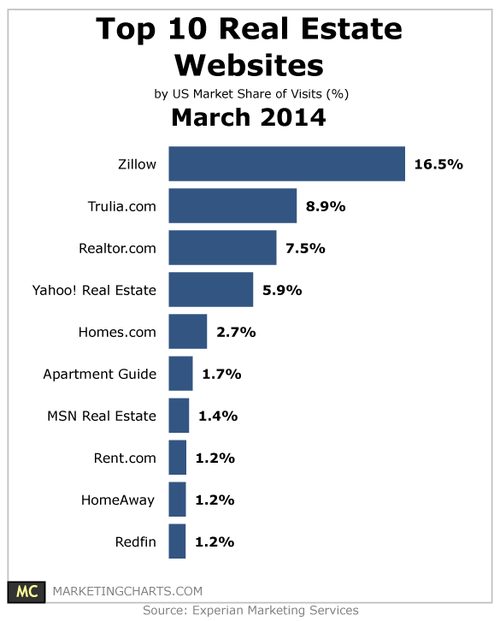
    Today it was announced that Zillow.com will be buying Trulia.com for $3.5 billion in a stock-for-stock transaction. Based on share of web visits, the biggest real estate website in the US has just acquired the 2nd biggest.

    image

    Both companies make the bulk of their money through advertising sales to real estate professionals (i.e. agents and brokers). But what was interesting to read in their press release is that, even with this merger, the combined revenue of both Zillow and Trulia still only represents about 4% of the estimated $12 billion that US real estate professionals spend on marketing each year. 

    Zillow says it’s because the real estate industry hasn’t fully made the switch to online and mobile – and thus it represents a huge market opportunity for them. And from my experience I would say that this is likely the case. But it could also be because the real estate community is putting their marketing dollars elsewhere online. 

    Whatever the case may be, Zillow.com (and its portfolio of companies) is now firmly positioned as the largest real estate website in the US. But even still, Zillow.com has never felt fully “net native” to me. It has never felt as if it were specifically built for the internet and that it’s only possible because of the internet. Instead, it feels like an offline model ported over to online. And the two are quite different.

    The reason I feel this way is because there’s an inherent tension to the way the online residential real estate market works today. Virtually every lead generation tool (that agents use) is intended to funnel buyers and sellers to them. That’s why so many real estate websites have sucked for so long. Because the goal wasn’t to keep you locked into a website, it was to get you to connect, in person, with an agent.

    Zillow and Trulia started to break with that tradition by offering a lot more information online. Before they came along, it was a lot harder for real estate consumers to do their own research. But at the end of the day, Zillow makes money when it’s an effective sales funnel for agents. And since that’s always been the way the market has worked, it doesn’t feel net native to me.

    If my gut is right, then it means there’s still lots of opportunities in this space.