
Daily insights for city builders, delivered every morning at 6 AM ET. I’m Brandon Donnelly — a Toronto-based real estate developer and founder of Globizen. I’ve been writing here since 2013.

Tag: a16z

  • A universal language for global trade

    This article by Ryan Petersen is a good history lesson on how shipping containers came to be. Here is an excerpt:

    The idea for containerization came from a trucker, not a shipper. Malcolm McLean started out hauling empty tobacco barrels with his family in North Carolina in 1935. At that time, entire trucks would drive onto ships, wasting both a ton of potential cargo space, plus a chassis that could be on the road moving goods. McLean developed plans to use the so-called trailerships for travel from North Carolina to New York, but U.S. regulations didn’t allow one person to own both a trucking and a shipping company at the same time. So McLean did what any innovation-minded entrepreneur would do: He dumped the trucking company, took out a $22 million loan, and, in January 1956, bought two World War II T-2 tankers. 

    The magic of shipping containers is that they created a standard. Now all of a sudden you had standardized boxes that were intermodal. They could fit on ships, rail, and trucks. Ryan refers to containers as the “unsung hero of logistics.”

    He also likens them to the HTTP standard that helped give us the internet that we know today. Before HTTP, computers could only communicate with each other if they were on the same local network. Now we are, of course, connected globally.

    But while containers standardized a part of our physical infrastructure, there’s a lot that remains fragmented and manual:

    The same way data passes between devices via the internet, goods pass between ocean ports, airports, warehouses, and other entities to reach their final destination. Without a logistics standard to act as a request-response protocol, all the players — suppliers, drayage, ports, warehouses, buyers — have to stitch their networks together manually. 

    Information gets lost; layers of redundancy, designed as backups given low visibility, slow the exchange: connections end up being very brittle. Let’s say there’s a shipment scheduled to arrive in Long Beach on Tuesday. But which terminal exactly and what pier number? What time is pickup? How long before late charges are incurred? Finding these answers is labor-intensive and imprecise. Logistics managers end up consulting different sources on websites, via email, or in person. 

    The dirty secret of the industry is that no one really knows where their stuff is.

    I’ll be honest in that I was expecting the article to transition into talk of blockchains. But that’s okay. The underlying message remains the same. Better software and more standardization is needed to improve our physical world.

    For some added context: Ryan Petersen is the founder of a company called Flexport.
  • The next wave of computing innovation

    Venture capital firm Andreessen Horowitz (a16z) has just launched a new site called Future. It is a site for “understanding the future, how tech shapes it, and how we build it.” I just subscribed to it and, if you’d like to do the same, click here. At the same time, the company also just announced their latest crypto fund (a $2.2 billion fund). Here’s an excerpt from the release:

    We believe that the next wave of computing innovation will be driven by crypto. We are radically optimistic about crypto’s potential to restore trust and enable new kinds of governance where communities collectively make important decisions about how networks evolve, what behaviors are permitted, and how economic benefits are distributed. 

    I’ve been reading a lot more about crypto over the last few months (which is something that I mentioned I was doing here.) I am not in this world day-to-day, but I am now fully convinced that we are in the very early innings of a profound shift. So pretty soon this is going to become my day-to-day, whether I like it or not.

  • A transactional real estate marketplace

    I would like to revisit the post that I wrote last week about the Brazil-based real estate startup, Loft. In it, I said that they are doing in Brazil what Opendoor, and others, are doing in the US. They are buying and flipping homes using algorithms. This has become known as “iBuying” and we’ve talked about it a lot here on the blog.

    But we have also talked about how this is probably not the end game. These companies are seeding a marketplace, because in every new two-sided marketplace you are always faced with a chicken-and-egg problem. You can’t attract supply if you don’t have demand. And you can’t attract demand if you don’t have supply.

    In reading the investment announcement by a16z, this larger vision is pretty clear:

    They [Loft] are building a transactional marketplace for the biggest asset class in the world, starting in the biggest market in Latin America, on a time horizon that makes it hard to believe it’s been less than a year since the PowerPoint. They buy homes, fix them (often according to formulaic specifications provided by active buyers), and sell them — what is now known as “i-buying,” with the vision of turning this into a transactional marketplace.

    If successful, these companies will transform from just “iBuyers” to fully fledged marketplaces for the buying and selling of homes. And when that happens (I believe it’s a when), it is likely to mean dramatic changes to the commissions landscape. Today, over $100 billion in residential real estate commissions are paid out across the United States each year.

  • Software eats real estate

    At the beginning of this year, a16z announced that they co-led a $175 million investment in the real estate company Loft. Based in São Paulo, Loft is doing in Brazil what Opendoor is doing in the US. They are bringing more liquidity to the residential real estate marketplace, and it turns out that the need for this is even greater in Brazil. That has apparently made Loft one of the fastest growing real estate companies in the world today. Here are some interesting facts about residential real estate in São Paulo. And here is a talk by Alex Rampell (general partner at a16z) on how software is going to eat the real estate world.

  • Shoppable videos

    Sometimes I think that writing a blog has become a bit old fashioned. I should probably be making videos. But the reality is that I like writing. Getting up in the morning, reading, having a coffee, and writing my thoughts down is a ritual that I really enjoy. Making videos is also a bigger time commitment, and I would rather focus my energy elsewhere.

    But there’s no question that user-generated videos have and will continue to change ecommerce and many other aspects of society. This recent blog post by Connie Chan and Avery Segal called, “Ecommerce as video’s killer app,” is a perfect example of that. In it, they talk about a handful of Chinese companies that are pioneering “shoppable videos.”

    What these platforms are doing is allowing consumers to buy things natively within their app and through a “video-centric checkout flow.” In other words: watch a story being told (from an individual, as opposed to a company); become interested in a particular product or service; and then immediately purchase it with only a few taps.

    Another use case, which I think many of you will find interesting, is the creation of “crowdsourced video city guides.” Instead of checking for hotel reviews on TripAdvisor, simply find someone who has already vlogged a stay and book it that way. The individual who uploaded the video will then earn a commission.

    This behavior already exists. Discovery and buying decisions — for many products and services — have moved to social platforms. Just today a friend reached out asking me about a bar that she saw on my Instagram stories a few weeks. She’s planning to go next week. Now where’s my commission?

    Shoppable videos are a natural extension. They may also lower the barriers to participation. And so maybe I will end up making videos, after all.

  • The next 20 years

    image

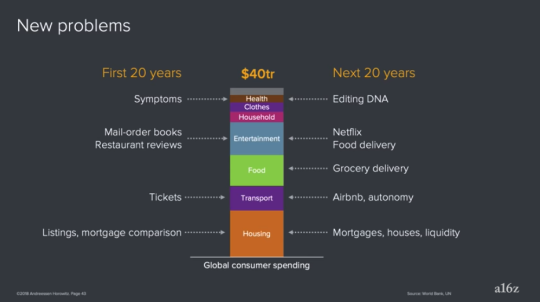
    Above is a screenshot from a presentation about the future of tech that Benedict Evans gave last week at venture capital firm a16z’s annual conference. And below is a video of the talk. If you can’t see it, click here.

    [youtube https://www.youtube.com/watch?v=RF5VIwDYIJk&w=560&h=315]

    The talk is positioned as “the end of the beginning.” In other words, here is where the internet and smartphones have taken us, but that’s just the beginning. Quote: “We used to do apartment listings [online] and now Opendoor will buy your home.”

    It’s only 24 minutes and well worth a watch.

  • How we make the decisions that matter most

    I’m listening to the below podcast right now with Sonal Chokshi, Chris Dixon, and Steven Johnson. Steven recently published a new book called, Farsighted: How We Make the Decisions That Matter Most. If you can’t see the embedded podcast below, click here.

    [soundcloud url=”https://api.soundcloud.com/tracks/497128947″ params=”color=#ff5500&auto_play=false&hide_related=false&show_comments=true&show_user=true&show_reposts=false&show_teaser=true&visual=true” width=”100%” height=”300″ iframe=”true” /]

    It is about the big and meaningful decisions that we make as individuals – such as where to live or who to marry – as well as the big and meaningful decisions that we make as a collective – such as how to plan a city or fight climate change. But most importantly, it is about how we can get better at them.

    Supposedly, part of the science (and art) behind deliberative decision making is using tricks to get our minds to see problems and their complexities differently. That could involve scenario planning and even considering the weirdest possible outcomes. In fact, Steven finds a lot of value in fictional storytelling.

    There could also be implications for city building. Tech is allowing us to collect a lot more data about the ways in which our cities operate today. But as we get better at running complex simulations, we should also get a lot better at understanding the long-term implications of our decisions.

    I may just have to get Steven’s new book.

  • Is Tesla the new iPhone?

    image

    Benedict Evans just published a great post on his blog about “Tesla, software and disruption.” I recommend a full read. In it, he tries to answer whether Tesla is really “the new iPhone” and if it will be as disruptive to the car landscape as some/many people think.

    In his line of thinking, electric (as opposed to an ICE vehicle) feels a lot more like a sustaining innovation, rather than a disruptive innovation. In other words, it something that incumbents will be able to incorporate. So it will not change the “basis of competition.”

    The more critical aspect is instead autonomy. Here are two snippets from the piece:

    All of this takes us to autonomy. Electric is compelling but will probably be a commodity, whereas Tesla’s improvements on top of electric may not be commodities but are not necessarily decisive. Autonomy changes the world in profound ways (I wrote about this here), and it’s a fundamentally new technology that doesn’t look at all like a commodity. And Tesla is doing this, too. Sort of.

    In this competition, Tesla’s thesis is that the data it can collect from its cars will give it a crucial advantage. The only reason that anyone is interested in autonomy today is that the emergence of machine learning (ML) in the last 5 years probably gives us a way to make it work. Machine learning, in turn, is about extracting patterns from large amounts of data, and then matching things against those patterns. So how much data do you have?

    But even if we are to all agree that autonomy is the “disruptive innovation”, it is not yet clear who will get there first. Maybe it is Tesla. Maybe it is Waymo. Regardless, many or most people seem to agree that it will arrive in 202x.

    Image: Tesla

  • A new kind of homeownership

    Yesterday Andreessen Horowitz announced an investment in the startup Point. They led an $8.4 million Series A round.

    Point is an alternative to traditional home equity loans and HELOCs. The way it works is that you actually sell a portion of your property. Here’s an example:

    In this scenario, the home is worth $1M. Point makes an offer to buy 10% of today’s value in exchange for 20% of the home’s future appreciation on a 5 year term. You pay a 3% fee when the $100,000 (10%) is paid out, but you don’t make any monthly payments. You just give up potential future appreciation. (If the home doesn’t appreciate, Point doesn’t make money.)

    What’s interesting about this model is that traditionally “housing” has meant one of two things. Either you own 0% of the home (i.e. you rent) or you own 100% of the home (usually with the help of a mortgage).

    Point is making it easier for you to potentially own 95% or 90% of your home. They are taking an equity stake, which is why there are no monthly payments associated with it. 

    The investment angle is that homeowners get to diversify their wealth out, and (Point) investors get to diversify in, without having to worry about actually managing the property.

    Would you use this as a tool to unlock your home equity wealth?

  • I can’t spend unrealized gains

    image

    Earlier this week the Wall Street Journal published an article claiming that the celebrated venture capital firm Andreessen Horowitz was lagging behind its elite peers in terms of returns.

    The firm then responded with a well-written blog post explaining why this accusation is off the mark. Their response was simply that you can’t measure returns on “unrealized gains.” Until there is a liquidity event – that is, the company gets sold or goes public – it’s just paper returns. And what matters is cash. 

    As the post clearly states: “I can’t spend unrealized gains.”

    But beyond just a rebuttal, the blog post is a great primer on how the venture capital industry works. We talk a lot about the tech space on this blog, so I thought some of you might find it interesting. 

    One of the reasons I like to follow the VC space is that there are many similarities to real estate development. Not only in the way that the funds are structured, but also in the way that the gestation periods are incredibly long.

    The post talks about this as a “J curve.” In the early years of a fund, the returns are negative. Money is going out the door to invest in immature and risky startups. And it’s not until the harvesting period (7+ years later) that the realized gains start getting paid out to investors (LPs).

    It’s also interesting to note that the exit timing for companies – at least according to Andreessen Horowitz – seems to be increasing (10+ years). This is yet another similarity to real estate development where it seems to be getting harder and harder to build and deliver new supply.