Daily insights for city builders, delivered every morning at 6 AM ET. I’m Brandon Donnelly — a Toronto-based real estate developer and founder of Globizen. I’ve been writing here since 2013.

Tag: 500px

  • Nobody wants to collect NFTs anymore

    Back when everyone wanted to buy and trade crypto, my friend Evgeny started a marketplace for NFT photography called Sloika. This, to me, felt like an obviously good idea, both in general and for him specifically. Evgeny had previously cofounded the photo company 500px, and so Sloika was initially conceived of as 500px, but for web3. This is a good story.

    I have collected a number of photos via Sloika and, in general, I continue to regularly collect NFTs. Of course today, relatively few people want to trade and collect NFTs. The market is largely dead. What is obvious is that there was a giant NFT bubble and it popped in 2022, along with some other asset bubbles.

    But does this necessarily mean that NFTs and NFT art are bad ideas?

    When I think of bubbles I often think of something that Fred Wilson wrote on his blog. His argument was that bubbles tend to be directionally right; it’s the magnitude that we get wrong. A good example of this is the dot com bubble. Yes, it was a massive bubble. But it was directionally right. The internet was going to matter — a lot it turns out.

    Even if we go back to “tulip mania” during the Dutch Golden Age — which is often brought up as the pinnacle of dumb bubbles — one could argue that it was still directionally right. Today, tulips remain the most sold flower in the US. So we still love them; we just got a little too excited back in the 17the century.

    When it comes to NFT art, I like to think in terms of these questions:

    • Will humans continue to appreciate art? (Seems obvious.)
    • Will humans continue to want to collect things? (This is arguably a fundamental human instinct.)
    • Will provenance and authenticity continue to matter in art? (Blockchain technologies are really good at this.)

    Perhaps the only question that remains is whether people will want to collect digital art. But even this feels fairly obvious to me. The challenge, I think, is that the display side of the market needs to be more built out. Because alongside the instinct to collect things is the instinct to display them. That’s why NFTs initially took off as profile pics on social media.

    So as a start, I think more, better, and cheaper displays would be a big help. There’s something very different about projecting an NFT in your living room versus having it live in a crypto wallet on your phone or computer. You need to really experience it, just as you would a conventional piece of art. And like all art, context matters.

    I haven’t yet invested in a dedicated NFT display, but I plan to do that in the near future. And I’m looking forward to displaying my collection of NFTs, including the one at the top of this post. It’s a drone shot of the west side of Toronto in the middle of winter, and it was gifted to me by Evgeny. Thank you for that. It’s an honor to have it as part of my art collection.

    Photo: Six Bling (via SuperRare)

  • Urban jungle

    Keeping with yesterday’s theme of urban density, here is a photo by Andy Yeung that I am embedding via his 500px page:

    Urban Jungle #04 by Andy Yeung on 500px.com

    https://500px.com/embed.js

    The photo is of Hong Kong and it was taken using a drone. Click here for other photos from his “Urban Jungle” drone series.

    If you remember the maps from yesterday, you might remember that Hong Kong had a peak residential density of around 111,100 people per square kilometre (2013).

    Above is what that generally looks like.

  • Made in Toronto: 500px

    https://500px.com/embed.js

    If you’re a regular reader of Architect This City, you’ll know that I generally like to include at least one photo with every post. Sometimes I run out of time and I don’t always do that, but that is at least the intent.

    You might have also noticed that my go-to for stock photography is 500px. That is the case for a few reasons. 

    I find the photos to be of higher quality than any other service. I can easily “embed” them into my posts while giving appropriate credit to the author and linking back to 500px. The company was founded by a good friend of mine and snowboarding compadre. And the company is made in Toronto.

    That’s why it’s exciting to report that yesterday the company announced an additional $13M in funding (Series B). To date the company has raised $23M of outside funding, from some big names like Andreessen Horowitz. This is great for the everyone in the company, and I believe it’s great for this city.

    Why is that?

    Well, here’s a video from the New York Times’ Cities For Tomorrow conference, where Andrew Ross Sorkin and Fred Wilson talk about creating startup hubs. It’s about 20 minutes long and well worth a watch.

  • Revisiting electronic road pricing as a way to fight traffic congestion

    https://500px.com/embed.js

    As disappointing as this week’s vote on Toronto’s Gardiner Expressway East was, there is one good thing that has come to the forefront and that is the will to explore road pricing. At this point, I have almost no confidence that this City Council would ever vote it in, but at least we’re talking about it. That’s better than not talking about it.

    If you’ve been reading Architect This City since the beginning, you might know that I’ve been a vocal supporter of road pricing. I wrote two posts on the topic: The case for electronic road pricing (which was based on an HBS case I did as part of my MBA) and More on electronic road pricing (which was a Lunch & Learn I did while I was at TAS).

    I continue to believe that road pricing is a highly sensible solution to big city traffic congestion. But I do think that an electronic/variable pricing model is preferable to and more equitable than a flat toll model. A variable model means that the price of using the road adjusts based on congestion levels and/or the time of day. I also think that we should use as much of the revenues as possible to fund continuous transit improvements.

    If you’re interested in learning more about this topic, check out the two posts mentioned above. I’d also love to hear your thoughts on road pricing in the comment section below. Would you welcome it in your city?

  • A new chapter

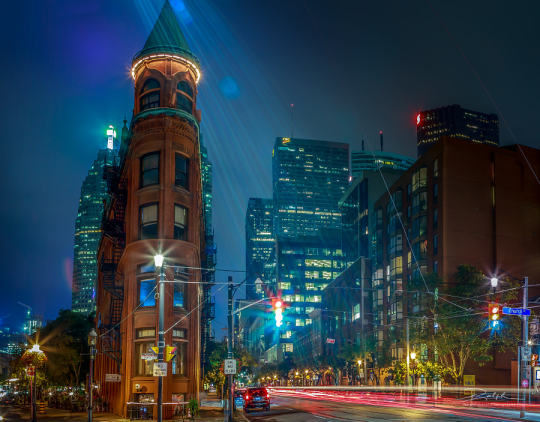
    Photograph St. Lawrence by Ralph Sobanski on 500px

    St. Lawrence by Ralph Sobanski on 500px

    I have an announcement to make on Architect This City today.

    Next week I’m joining the development team at CAPREIT (TSE: CAR.UN) here in Toronto. CAPREIT is one of Canada’s largest residential landlords. They are a growth-oriented real estate investment trust with over 41,839 residential units in major urban centers across both Canada and Ireland.

    They also happen to be headquartered in the St. Lawrence Market area, which means I now live and work in the same neighborhood. As we discussed here, location matters a lot.

    So here’s to a new chapter. I’m looking forward to diving into the multi-family business. Change is good.

  • The value of cheap housing

    Photograph Houston Sunrise by Cliff Baise on 500px

    Houston Sunrise by Cliff Baise on 500px

    Urbanists generally don’t like to talk about cities like Houston. It sprawls. It’s car oriented. It’s over air-conditioned. In other words, it’s the antithesis of the dense and walkable cities that urbanists today like to tout as being exemplary. 

    But despite all this, Houston is one of, if not the, fastest growing city in America. According to The Economist, the population of the Houston metro area grew faster than any other city in America between 2000 and 2010. And between 2009 and 2013, its real GDP grew by 22%.

    So why is that? Here’s a snippet from that same Economist article (“Life in the sprawl”):

    Paradoxically, perhaps the city’s biggest strength is its sprawl. Unlike most other big cities in America, Houston has no zoning code, so it is quick to respond to demand for housing and office space. Last year authorities in the Houston metropolitan area, with a population of 6.2m, issued permits to build 64,000 homes. The entire state of California, with a population of 39m, issued just 83,000. Houston’s reliance on the car and air-conditioning is environmentally destructive and unattractive to well-off singletons. But for families on moderate incomes, it is a place to live well cheaply.

    So while Houston may not check off all of Jane Jacobs’ boxes, it does provide one important thing: cheap housing. And that’s clearly valuable for a huge number of people.

    But the other interesting thing about the snippet above, is that it starts to illustrate how frequently supply constrained markets operate with housing deficits. 

    The fact that the entire state of California issued only about 30% more building permits than the Houston metro – which you could easily argue is closer to a “perfect market” – tells me that there’s probably a lot of people bidding for the same housing in California.

    That’s less so the case in Houston.

  • 8 tips for building better cities

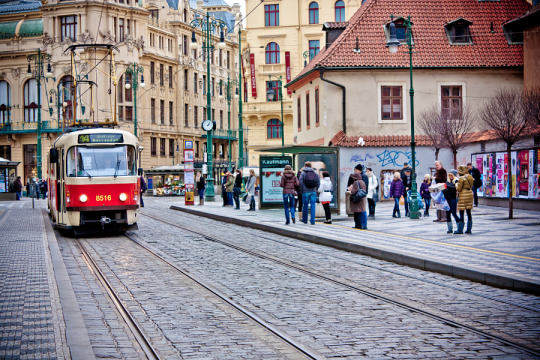
    Photograph Tram by Federico Venuda on 500px

    Tram by Federico Venuda on 500px

    My friend Alex Bozikovic of the Globe and Mail recently wrote a great article called: Expert advice on building the city of the 21st century. It’s a nice tie-in to a post I wrote a few weeks ago talking about the need for an urban agenda.

    For Alex’s article, the Globe asked “prominent urbanists, architects, and scholars” from around the world to comment on what Canadian mayors should be focused on right now as we build the cities of tomorrow.

    Here’s a list of what they said:

    1. Make people, not cars, happy
    2. Decrease speed limits
    3. Empower city governments
    4. Leverage density
    5. Embrace the science of big data
    6. Mix residences and workspace
    7. Turn streets into destinations
    8. Redevelop the inner suburbs

    It’s a great set of recommendations. So I would encourage you to check out the full Globe and Mail article.

  • Toronto’s “Instagram for doctors” raises $4 million

    image

    Earlier this week it was announced that Fred Wilson and his firm Union Square Ventures have just led a $4M Series A round of venture funding in the Toronto-based startup Figure1. Figure1 is essentially “Instagram for doctors.” Here’s how it works (via WSJ):

    Today, more than 125,000 health-care professionals use Figure 1 to view or share free medical imagery, including photos of patients with personally identifiable details blurred out or excluded; x-rays; charts; and still images taken from MRI or CAT scans, for example.

    The app’s users include board-certified doctors, registered nurses, medical and nursing students, physicians’ assistants, and others who use the app and share images for teaching and studying purposes, or even to request community feedback about a possible diagnosis.

    With this round, USV is now up to 3 investments in the Toronto/Waterloo region (I think of us as one center). The other 2 are Kik (out of Waterloo) and Wattpad, which is actually headquartered here in the St. Lawrence Market.

    What’s exciting to me about all of this is that it’s further evidence of a growing and thriving Toronto/Waterloo startup ecosystem. And while to some it may not seem like a big deal for yet another mobile app to receive funding, it’s actually great news.

    Because as these companies grow and become successful, they’ll not only create new jobs in the region, but also create a tremendous amount of wealth and expertise. And when this wealth and expertise gets reinvested into future startups, you end up with a powerful snowball effect. That’s how startup ecosystems are built.

    It’s also great to see companies staying put, because the pull towards more established startup hubs can be significant. When my friend Evgeny raised a Series A round from Andreessen Horowitz last year, he told me that they asked him to move 500px down to California. As is the case with a lot of VCs, they like their portfolio companies to be nearby.

    But ultimately 500px decided to stay headquartered here in downtown Toronto. And they did that for a few reasons: There’s lots of great engineering talent here and it usually comes at a discount relative to California (5-15%). He also finds that employees here are more loyal. There’s less turnover. In California, everyone is looking for that next best startup to join. Here 500px gets to be that big fish in a small pond.

    Anyways, a big congratulations to the Figure1 team. I hope they continue crushing it and that they stay put in Toronto. If you’re a healthcare professional, you can click here to download the app.

  • What to do when a car is blocking your bike lane

    I was out for a bike ride last night and, on my way home, I decided to try out the new dedicated bike lane on Adelaide Street. Usually I would take King Street, but it was completely full because of Caribana parties.

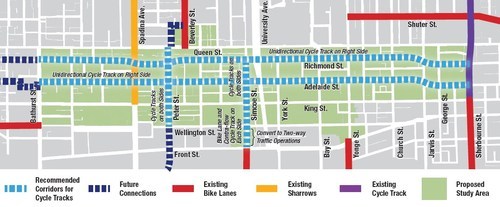
    For those of you who may not be aware, the city of Toronto is currently piloting two dedicated bike lanes on Adelaide Street and Richmond Street in the downtown core. Both streets are one-way and because the lanes were so big to begin with (highway-like spacing), I’m told that these new bike lanes didn’t even eat up a driving lane.

    Here’s a map of the pilot area:

    image

    Given that dedicated bike lanes are a scarce resource here in Toronto, I have to say that it was rather luxurious having my own piece of road. And because there’s no longer any fear of parked car doors swinging open, I was able to ride a lot faster than I normally would. 

    But as my friend Evgeny pointed out earlier this week, there’s a big difference between dedicated and grade separated bike lanes. Indeed, on my trip from Bathurst Street to Church Street last night, I encountered 3 cars parked in my lane.

    //platform.twitter.com/widgets.js

    So, I hope that these bike lanes become a permanent fixture downtown, but that the city makes them grade-separated. I’m sure people will use them. At the same time, I think they could also act as a catalyst for more pedestrian life along both of these streets.

    If you haven’t yet tried them out, I would encourage you to do so. The city is tracking usage and so you would be supporting the cause. And if there’s anybody parked in your lane, below is one way to handle it. It’s a video by Casey Neistat out of New York. If you can’t see it below, click here.

    [youtube https://www.youtube.com/watch?v=bzE-IMaegzQ?rel=0]

  • Are the suburbs really cheaper?

    image

    Smart Growth America released a report this month called Measuring Sprawl 2014. It’s an update to a report they did back in 2002 and it’s worth a read if you’re into urban planning. You can download it here

    The report looks at 221 metro areas in the US and develops a “sprawl index ranking.” The higher the number, the more compact the metro area. Not surprisingly, New York tops the list with San Francisco coming in second. But more interesting are the correlations they discovered. As you go up their sprawl index ranking (that is, as the cities become more compact), they found the following:

    • People have greater economic opportunity in compact and connected metro areas.
    • People spend less of their household income on the combined cost of housing and transportation in these areas.
    • People have a greater number of transportation options available to them.
    • And people in compact, connected metro areas tend to be safer, healthier and live longer than their peers in more sprawling metro areas.

    If you’re a follower of smart growth, then some of these will sound familiar. But they’re worth repeating and I’d like to focus on the second one for a minute (not to undermine the importance of living longer). Conventional wisdom dictates that as you sprawl out from the center of a city, the cost of housing drops. And indeed, that’s what they found. There’s a correlation between density and housing costs, and more compact cities generally have more expensive housing.

    However, they also found that the percentage of income spent on transportation is much less in compact metros:

    Each 10 percent increase in an index score was associated with a 3.5 percent decrease in transportation costs relative to income. For instance, households in the San Francisco, CA area (index score: 194.3) spend an average of 12.4 percent of their income on transportation. Households in the Tampa, FL metro area (index score: 98.5) spend an average of 21.5 percent of their income on transportation.

    But here’s where it gets interesting: they found that transportation costs dropped faster than housing costs increased as metro areas became more compact. Meaning if you consider both housing costs and transportation costs in aggregate, it’s actually cheaper to live in more compact areas. From what I can tell, they’re also only considering direct transportation costs and not indirect costs such as the time people waste sitting in traffic. 

    Either way, it’s something to consider the next time you’re thinking about where to live and how much you should be willing to spend on housing. That cheaper suburban home may not be as cheap as it seems.

    Photo by Aythami Perez on 500px