Daily insights for city builders, delivered every morning at 6 AM ET. I’m Brandon Donnelly — a Toronto-based real estate developer and founder of Globizen. I’ve been writing here since 2013.

Tag: 3D printing

  • 3D-printed homes for under $99,000

    ICON, the 3D-printing home company that I wrote about a few months ago, has just launched a new global architecture competition called Initiative 99. As the name starts to suggest, the goal is to generate new ideas for “accessible, beautiful, and dignified 3D-printed homes that can be built for under US$99,000.”

    The competition is open to all: architects, designers, builders, students, and/or people who are just interested in finding new ways to deliver affordable housing. However, the current website does ask for a zip code. So maybe you need to live in the US.

    In any event, if you’re selected, you might get money and you might get to see your design built. The total prize fund for the competition is US$1 million and ICON has also committed to building a selection of the winning designs. Registration begins May 23, 2023, but if you’d like to enter your zip code now and “stay informed,” you can do that here.

  • World’s largest 3D-printed community

    I’m not sure how I missed this before, but ground has just been broken on what is being called “the world’s largest 3D-printed community.” Co-designed by ICON and Bjarke Ingels Group and “implemented” by Lennar, the community, which is located north of Austin, Texas, will consist of 100 homes ranging from 1,500 to 2,100 square feet. There are 8 different floor plans and 24 different elevations to choose from. Each home will also come with rooftop solar panels.

    Here’s a short description on how the overall construction process is working:

    To automate the manufacturing of homes ICON is using its Vulcan robotic construction system, a large, transportable printer that can be used in tandem with Magma, a cement mixing machine. The homes are being constructed out of Lavacrete, a durable-concrete polymer added in layers to form the structure’s facade and foundation by Vulcan. Their design blends Texas ranch vernacular with sustainable technology, providing a model for the future of large-scale 3D construction. The residences will adhere to a common design, featuring metal roofs, concrete floors, and distinct curvilinear and rib-textured concrete walls, which are the product of 3D printing.

    It is quite a different looking construction site:

    Now, there is certainly a conversation to be had about what these machines are building as a housing typology: This is still suburban sprawl, regardless of how the homes are being made and if there are solar panels on the roof. But if you ignore all of this for a minute, there is obviously something pretty incredible about 3D printing being able to now deliver stuff at the scale of a suburban housing project. It represents a fundamental change in how we build, in an industry that has a long history of changing very little.

  • The world’s first 3D-printed home, kind of

    Habitat for Humanity recently announced that they have completed, in partnership with additive construction company Alquist, the first 3D-printed owner-occupied house in the world. I’m pretty sure that I’ve seen other 3D-printed homes kicking around, but this is still a big deal and one of the first of such homes for Habitat for Humanity. (It also 3D-printed a house in Arizona this year, but I guess that one wasn’t owner-occupied.)

    The 1,200 square foot three-bedroom home is located at 129 Forest Heights Road in Williamsburg, Virginia. And it was “printed” in just 22 hours, which Habitat and Alquist are claiming reduced their construction schedule by approximately weeks compared to a traditionally framed house. Overall, this translated into an estimated savings of 15% on the total construction costs. (Again, according to Habitat and Alquist.)

    These kind of savings are particularly important in many rural communities where it is not uncommon for homes to sell below their replacement cost. Not surprisingly, when you have a market dynamic like this, there’s zero incentivize to build new. I mean, why would you when you can just buy something that already exists for less money, and with less risk.

    Alquist uses a patented concrete to print its homes. The concrete can be left exposed, or it can be finished with traditional building materials. For any load-bearing or structural walls, I understand that they print two walls with a cavity and then use typical reinforcing bars. I would imagine that this approach is particularly helpful when lumber costs are high, but there’s an obvious question around embodied carbon (concrete in lieu of wood).

    Still, it’s hard not to believe that we will be seeing more, rather than less, 3D-printed homes in the future.

  • New 3D-printed bridge erected in Amsterdam

    This 12-meter 3D-printed stainless steel bridge was recently erected in Amsterdam. As is par for the course, some people hate it and some people love it. I’m in the latter camp.

    Designed by Joris Laarman Lab in collaboration with MX3D and Arup (engineering), the bridge was printed off-site over a 6 month period and then craned into place.

    3D printing stuff isn’t new; but it is interesting to see the technology being used for this real world application. Supposedly it’s the first 3D-printed stainless steel bridge. There are claims out there for other materials.

    What is also interesting is that the entire bridge has been outfitted with sensors so that things like pedestrian usage, corrosion, and load changes can be measured going forward.

    Construction is generally a messy process. And it’s kind of amazing how little it has changed over the years. I don’t think that there’s any question that this represents the future of building.

    Images: Thea van den Heuvel via Dezeen

  • 3D printing and de-globalization

    This evening I stumbled upon an interesting article by T.X. Hammes talking about “de-globalization” and the impacts that this may have on international security. (He served 30 years in the US Marine Corps.)

    One of his points is that 3D printing (additive manufacturing) is going to transform not only how things are made, but also where things are made. This is perhaps an obvious point, but it’s valuable to think about what all of this will mean when production moves from global to local.

    Here’s an excerpt from the article:

    “Currently we ship raw materials to one country. It puts together the sub-assemblies, packs them, and ships them to another country for assembly. There they complete the assembly and packaging, then ship the packaged product onward to the consuming country. With the emergence of additive manufacturing, we will ship smaller quantities of raw materials to a point near the consumer, produce them, and then ship them short distances for consumption. Thus reducing international trade. The localization of energy production and return of high value agriculture to developed nations will further reduce global trade.”

    Indeed, UPS seems to be predicting that the international shipping market will be significantly impacted by these shifts and has started investing in 3D printing. But going even further, T.X. Hammes believes that declining trade could dramatically alter the international security picture.

    To me, it’s yet another reminder of what Marshall McLuhan was getting at when he argued: “The medium is the message.” Don’t stop at the obvious changes. Look for deeper structural changes. Look for the unanticipated.

  • Weekend architecture roundup

    image

    Things have been far too serious around here this week with talk of interest rates, unrealized gains, flooding, and the EU referendum. So let’s change that and do a bit of an architecture roundup. It has been on my agenda for a few weeks now to move toward some sort of regular post about architecture and design.

    1.

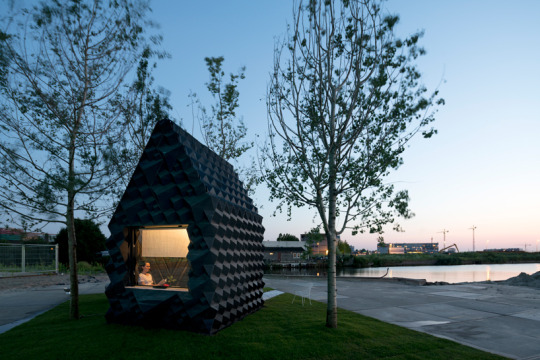
    DUS architects of Amsterdam recently completed a fully 3D printed urban cabin (pictured above). It totals 8 square meters and was printed using “bio-plastic,” which means the entire structure could be shredded and reprinted into something else. The Urban Cabin is a research experiment, but the thinking is that 3D printed homes could serve as an “on-demand housing solution” in rapidly urbanizing cities, in disaster areas, and so on. That said, the niche use case can quickly become the mainstream use case.

    2.

    REX has just released their design for a Performing Arts Center on the World Trade Center site. The design is a minimalist “mystery box” that provides an infinitely customizable interior canvas for directors. I have long been interested in the work of REX because of the hyper-rationale approach they quite often bring to architecture. It’s about allowing architecture to emerge from the project’s constraints, programmatic requirements, and so on. Here’s a video of the project.

    3.

    Finally, this Swiss chalet (not the restuarant) in the town of Anzère has got me pretty excited about the upcoming snowboard season. It was designed by the Amsterdam-based firm SeARCH. And I love the dichotomy between the raw exposed concrete and the softer wood details. Also note how the garage, situated beneath the house, is built into the mountain. It is connected to the house above via an elevator that is also carved into the mountain. Sadly, my ski retreats don’t typically involve James Bond-style lairs.

    Image: Copyright Ossip