Daily insights for city builders, delivered every morning at 6 AM ET. I’m Brandon Donnelly — a Toronto-based real estate developer and founder of Globizen. I’ve been writing here since 2013.

Search results for: “laneway housing”

  • How not to build missing middle housing

    Here is a good example of why “missing middle” housing is so challenging to build in Toronto, despite everyone talking about how great it would be if only we could build more of it.

    It’s the story of a minor variance application that was asking to sever a 50-foot lot at 2165 Gerrard Street East so that two semi-detached buildings and two laneway suites could be built. It would have added 10 family-sized rental units to a site that is on a streetcar line and that is within walking distance of both the subway and regional rail. And yet the consent to sever was denied.

    How come you ask?

    “I don’t believe dividing the property is in the best interest of the community,” said committee member Carl Knipfel, himself an architect and planner who complimented the beauty of the existing house and critiqued the design of the new buildings. “What is proposed is too dense … I really have serious concerns as to where this consent may lead us.”

    The last sentence is the best part.

    The article then goes on to argue that this is really all about the supremacy of single family homes and the desire to keep renters out of these neighborhoods. (Hey Airbnb, it’s not just short-term rentals that people have a problem with; it’s also long-term rentals.)

    The kicker, for Mr. Galbraith [the project’s planner], is he knows if he wanted to sever the lot for two single-family homes he could get that permission without delay and likely also get permission to build more than local zoning allows.

    “I can get variances for a one-unit McMansion every day of the week,” he said. “Lot coverage variances are very common; you want to take a bungalow down and make some big ugly house with a weird roof and a high first floor? You see those all over East York and Etobicoke.”

    If missing middle-type housing is “too dense” for sites that are endowed with every form of fixed rail transit that we have available in this city, then your guess is as good as mind as to where the hell it’s supposed to go. It’s time to grow up Toronto.

  • Deferring development charges on a laneway suite

    Currently, if you’re building an Ancillary Secondary Dwelling Unit (such as a laneway suite) in the City of Toronto, you can defer the payment of any development charges for 20 years from the date that a building permit is issued for the unit. But really what this means is that, if you don’t do anything bad for 20 years (event of default), you won’t have to pay anything. The payable charge goes to $0 at the end of the term and the agreement goes away. Cool.

    So what are some of the bad things that you’re not supposed to do?

    Well the main thing is that you’re not allowed to create a new lot at any point during the 20-year deferral period. This is because the laneway suite policies are designed to encourage the creation of new rental housing and not new for sale housing. So you can’t sever off the back of your lot. The other thing you need to do is make sure that if you were to ever sell your property that the new owner(s) assumes these same obligations.

    This all makes sense.

    There is some fine print to consider. The payable development charge amount that the City enters into these agreements is the rate for single detached dwellings. Currently that figure is $76,830. This is more than double what you would have to pay if you, well, just paid the DCs for your ancillary secondary unit instead of deferring them. The reason for this is because, if you do do something bad such as sever your property, you’ve now no longer built an ancillary secondary unit. You’ve built a detached dwelling. Rates go up.

    Moral of the story: Don’t create a new lot. For more information on the program, click here.

    P.S. I’m not a lawyer. Please don’t take this post as any sort of legal advice. This post was also revised from its original version to correct a misunderstanding on my part.

  • Nelson, BC is running a laneway house design competition

    The City of Nelson, BC — which happens to be the launching pad for some of the best snowboarding in the world — is currently conducting a laneway house design competition. The objective is to come up with a set of “pre-reviewed” design options that homeowners can then purchase and build themselves. Here’s more about what they’re trying to achieve:

    The objective is to provide easy access to high-quality designs and code-compliant plans that strike the right balance between affordable construction and ecologically-sound design. They will be plans designed for Nelson, offering exceptional value-for-money for homeowners and making it easier for them to build a laneway house on their property. The contest evaluation criteria emphasise (sic) adaptability to various lots and topographies.

    Three designs will be selected, as well as a “people’s choice award.” Payment for a winning design will come in the form of a monetary prize and a $1,000 royalty each time the design is purchased by a homeowner. I’m not sure how many houses there are in Nelson, but I would imagine there are enough to make this a worthwhile exercise.

    I also think this is a good approach to making laneway housing more accessible to homeowners. The simpler they are to build, the more housing we will see. Nelson clearly understands that. If you’d like to submit, you have until September 2, 2019. More details, here. Apologies for the short notice.

    Thank you to Mason Studio for sharing this competition with me.

  • Toronto approves city-wide expansion of laneway suites

    This a big month for laneway (housing) advocates in Toronto. Last week, City Council voted in favor of expanding the policy provisions for laneway suites to all Neighbourhoods within the city. (Neighbourhood is a defined term in the city’s Official Plan.)

    Previously, the policies — which allow laneway suites to be built as-of-right — only applied to the Toronto & East York Districts. Here’s a copy of the recent staff report in case you would like more information.

    On Monday, my friend Alex Sharpe (of Lanescape) was on BNN Bloomberg talking about why this is a good thing for the city. Alex and the rest of the team at Lanescape have been instrumental in these policy changes.

    If you’re a Toronto homeowner with a property that fronts onto a laneway, I would encourage you to consider this opportunity. It’s a way to increase the value of your home and it’s a way to create more rental housing in this city.

  • Laneway suites all across the city

    As of August 2018, the City of Toronto has allowed laneway suites (accessory dwelling units) to be built as-of-right in the Toronto and East York area of the city (subject to meeting some criteria).

    This was a tremendous step forward for the city. And I know a number of people who are currently taking advantage of these new planning permissions.

    Toronto is now looking at expanding these permissions across the entire city and they have just started their community engagement phase. The first public meeting took place today and the next three will be taking place over the course of this month. Click here for the when and where.

    This is a natural extension of the policies that have already been put in place around laneway suites and I’m excited to see this moving forward.

    For those of you who already own property in Toronto & East York and are considering building a laneway suite, there are two programs that you should be aware of.

    The first one allows eligible property owners to defer development charges on the new secondary dwelling unit for up to 20 years. This is meaningful. And the second is a $50k forgivable loan if you make the laneway suite an affordable rental for at least 15 years. (The cap is the City of Toronto Average Market Rent.)

    I still remember what happened when I tried to build a laneway house almost 10 years ago. I was told, by the city, that a house cannot be built behind another house. I knew that would change. Now look at how far we’ve come.

    Image: Lanescape

  • Vancouver revisits laneway house program

    Vancouver is light years ahead of Toronto when it comes to laneway housing/suites. And by light years I mean that their Laneway House (LWH) Program is about a decade old now.

    Last month the City of Vancouver published this staff report which outlined recommendations for improving the program. It includes simplifying the regulations, reducing processing timelines, and improving livability in LWHs.

    This aligns with their Housing Vancouver Strategy (2018-2027), which has set a target of 4,000 new LWHs over the coming ten years. That may not seem like a lot and certainly it won’t solve everything, but I reckon that 4,000 is better than 0.

    The city also estimates that approximately 50% of these new LWHs will be two and three bedroom homes, which makes them a viable housing solution for families who want to remain in the city. (Related post: Where are all the kids?)

    There’s a lot of good stuff in the staff report if you’re so inclined, but I’ll leave you with a few facts about the current LWH program in Vancouver. 90% of LWHs are built along with a new house. And 45% of all new houses, so almost half, are now built with a LWH.

    Only 10% of LWHs are single storey, which certainly helps to support the above percentage of two and three bedroom homes. And in both 2016 and 2017 over 500 building permits for LWHs were issued each year.

    So 4,000 LWHs over the next decade may actually be a fairly conservative estimate. Thank you to Michael Geller for sending me this staff report.

    Photo by Spencer Watson on Unsplash

  • Toronto Community Council voted unanimously in favor of laneway suites

    It happened.

    Today, Toronto and East York Community Council voted unanimously in favor of adopting a planning framework that would allow laneway suites on lands within the Toronto and East York District that are designated as “Neighbourhoods.” 

    If you’d like to see the actual vote (and the clapping that ensued), check out this YouTube video at the 41 minute mark. There are also some great speeches prior to the vote by Councillor Bailão, Councillor Perks, and others.

    Now, it still needs to go through City Council, but today remains an important milestone and a positive step forward. So kudos to everyone who has been working tirelessly to push this initiative forward.

    I would also like to take this opportunity to address some of the comments that I recently received about this blog, one of which is that I continue to offer a one-sided perspective on this issue of laneway housing in Toronto.

    Think of this blog – and I’m stealing this analogy from another blogger – as a bar. I am the bartender and I show up here pretty much every day. I’ve been doing that consistently for almost 5 years now.

    At this bar I sip on negronis – okay, it’s probably beer – and I talk about topics and issues that excite me and that are usually related to city building. If it doesn’t excite me, I don’t talk/write about it. And I get lots of emails every day asking me to write about things that do not excite me.

    If you would like to take a seat at the bar, have a drink, and join the conversation, you are more than welcome to do that in the comment section at the bottom of every post. In fact, it’s encouraged. I make a mean vodka soda.

    So maybe I’ll see you at the bar. The bartender is a fairly open-minded guy who enjoys good conversation.

  • Toronto laneway suites go back to Community Council

    Last month the Official Plan Amendment and Zoning By-law Amendment that would have permitted laneway suites as-of-right in Toronto was deferred by Community Council. 

    So the “Changing Lanes” policy has been updated – to obviously make it more restrictive – and it will head back to Toronto and East York Community Council this week on Wednesday, June 6th. 

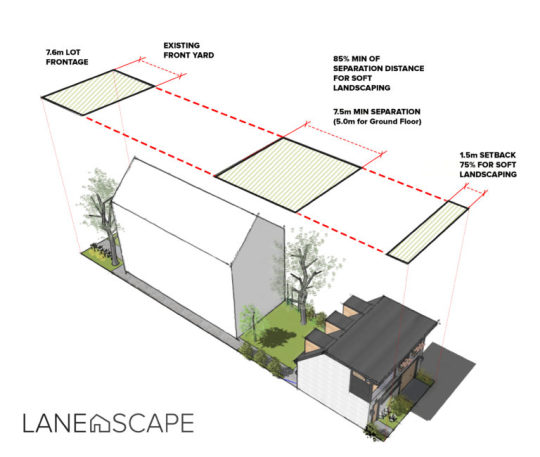
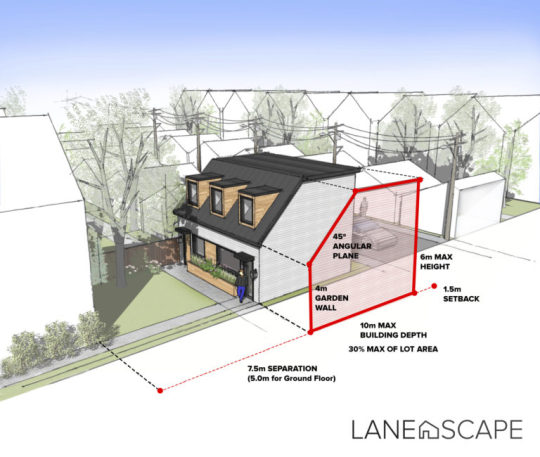
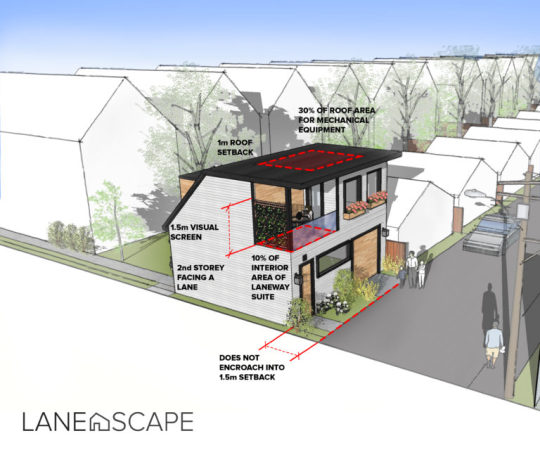
    Lanescape did a great job summarizing some of the updates on their blog. Here are a couple of their images:

    If you haven’t already, now is the time to write your local Councillor and TEYCC to tell them that you support laneway suites and the proposed Changing Lanes policy. I did that last month and I did it again this month. I hope that many of you will do the same.

  • Less, rather than more, housing

    Earlier this year I wrote about the California housing bill (827) intended to dramatically increase housing supply around transit stations all across the state. Well that bill was rejected last month and the Los Angeles Times wrote this post post-mortem explaining why and how it went wrong. Their argument is that it came down to opposition from low-income residents who feared that an increase in housing supply would lead to greater displacement.

    On a related note, the Official Plan Amendment and Zoning By-law Amendment that would permit laneway suites in Toronto went to Community Council this week. They voted to defer the decision for a month. Only 3 of 13 councillors voted to pass the proposal, despite there being 185 letters of support and only 4 letters of opposition. For more information on what the hell happened, check out this Lanescape post.

  • Toronto is finally ready to permit laneway suites

    Some of you might remember that last summer the city refused my laneway house/suite here in Toronto.

    Well that was last summer and this is this summer.

    On May 2, 2018 – which just so happens to be my birthday – Toronto and East York Community Council will consider a staff report for a City-initiated Official Plan Amendment and Zoning By-law Amendment that would permit laneway suites in the Toronto & East York District.

    Here are a couple of excerpts from the summary section (full report, here):

    This report recommends establishing a planning framework to permit laneway suites on lands within the Toronto and East York District that are designated as Neighbourhoods by amending both the Official Plan and City-wide Zoning By-law.

    A second unit can take many forms but is generally considered to be subordinate to the primary dwelling unit on a lot. Second units are an important part of the City’s rental housing stock. Laneway suites are one form of second unit.

    This report contains a detailed planning rationale for the introduction and regulation of laneway suites within the Toronto and East York area and discusses the policy implications and intent of proposed performance standards and criteria. 

    These performance standards and criteria intend that laneway suites will provide a new form of ground-related, rental and extended family housing that will fit appropriately within the scale of established Neighbourhoods, and limit their impact on the existing physical character, while contributing to the growth of the City’s rental housing stock.

    What a thoughtful birthday gift. Thank you.