
Daily insights for city builders, delivered every morning at 6 AM ET. I’m Brandon Donnelly — a Toronto-based real estate developer and founder of Globizen. I’ve been writing here since 2013.

Search results for: “inclusionary zoning”

  • Tools for promoting healthy, responsive, affordable, high-opportunity housing markets

    This month the White House released a Housing Development Toolkit. The report starts by talking about the local barriers to building and makes this statement:

    “The growing severity of undersupplied housing markets is jeopardizing housing affordability for working families, increasing income inequality by reducing less-skilled workers’ access to high-wage labor markets, and stifling GDP growth by driving labor migration away from the most productive regions.”

    It then goes on to highlight a number of tools that American cities have adopted or should adopt “to promote healthy responsive, affordable, high-opportunity housing markets.” 

    They are:

    • Establishing by-right development
    • Taxing vacant land or donate it to non-profit developers
    • Streamlining or shortening permitting processes and timelines
    • Eliminate off-street parking requirements
    • Allowing accessory dwelling units
    • Establishing density bonuses
    • Enacting high-density and multifamily zoning
    • Employing inclusionary zoning
    • Establishing development tax or value capture incentives
    • Using property tax abatements

    None of this will be news to regulars of this blog. We have spoken about almost every single tool in the above list. 

    I’m not necessarily sold on all of them (good discussion to have), but I have gone on ad nauseam about eliminating parking minimums (off-street parking); the value of accessory dwelling units (commonly called laneway housing here in Toronto); and the negative impacts of barriers to building.

    The good news is that there’s growing alignment around a similar set of actions. Change takes time. There’s usually a heavy bias towards the status quo.

  • Lessons on the transforming city

    image

    Last week, Detroit hosted the 24th annual Congress for the New Urbanism. The theme was: The Transforming City. 

    I wasn’t there, but I would have loved to attend. So many interesting things going on, but so little time. Attention is scarce.

    For those of you who also did not attend, below is a copy of a speech that was delivered by Carol Coletta – senior fellow at the Kresge Foundation’s American Cities Practice. I found it on City Observatory

    The speech does a great job of addressing many of the common misconceptions that people have about cities. I can tell you that I heard many of them just this past weekend.

    Also, if you aren’t familiar with The Kresge Foundation, they are a large private philanthropic foundation based in Troy, just outside of Detroit. You might not recognize the name, but Kresge is the K in Kmart.

    And now Carol Coletta…

    ———————————————————

    Could there be a more apt place to observe “The Transforming City” than Detroit?

    On behalf of Rip Rapson and my colleagues at the Kresge Foundation, welcome to Detroit. If you travel to Detroit regularly, as I have over the past 15 years, you see that Detroit changes quickly.

    The speed of change here sometimes takes your breath away.

    How many of you have walked the Detroit Riverfront or ridden the Dequindre Cut?

    Visited the expanding Eastern Market?

    Seen the Q Line construction on Woodward?

    Eaten a meal at Selden Standard or Wright & Company, one of those meals so special that it deserves its own social media channel?

    Walked the streets of downtown or Midtown and discovered Great Lakes Coffee, City Bird, or the El-Moore Lodge?

    Or met Claire Nelson at the Urban Consulate, or any one of Detroit’s arts and civic innovators responsible for some of the most exciting urban work in the country?

    This is the Detroit you can see right outside this theatre.

    But there is another Detroit, one that is harder to see. It’s the Detroit that feels threatened by the pace of change in the city, suspicious of newcomers eager to be part of the change, and wondering when their loyalty to Detroit will be rewarded.

    Such feelings are not unique to Detroit. Every morning my Google Alerts brings a new batch of headlines from around the country detailing the gentrification battles.

    Because “new urbanism” is the butt of some of this criticism, I want to spend the next few minutes unpacking the myths and the realities of gentrification and what those of us who care about great places can do about it.

    First, let me share some numbers.

    In 1970, about eleven hundred urban Census tracts were classified as high poverty.

    By 2010—40 years later—the number of high poverty Census tracts in urban America had increased from 1100 to more than 3,000. (3165)

    The number of people living in those high poverty Census tracts had increased from 5 million to almost 11 million. And the number of poor people in high poverty Census tracts had increased from 2 million to more than 4 million.

    So over a 40-year period, the number of high poverty Census tracts in America’s core cities had tripled, their population had doubled, and the number of poor people in those neighborhoods had doubled.

    Given that record, I’ll bet a lot of people are hoping for a little gentrification– if gentrification means new investment, new housing, new shops without displacement.

    The idea that places might benefit from gentrification runs against the popular narrative. But here’s the really startling fact: only 105 of the eleven hundred Census tracts that were high poverty in 1970 had rebounded to below poverty status by 2010. That’s only ten percent! Over 40 years!

    A similar study of Philadelphia by Pew found almost exactly the same result in that city’s neighborhoods. There, ten times as many poor neighborhoods (164) experienced real declines in income as experienced gentrification since 2000.

    It is the lack of gentrification that we rarely count and never see. The deterioration happens too slowly for us to notice. But it doesn’t mean the deterioration isn’t devastating. In fact, the high poverty neighborhoods of 1970 lost 40 percent of their population in 40 years.

    You could make the case that poor people are displaced from poor neighborhoods because of their poor schools, their lack of jobs, their more chaotic public spaces, their lack of opportunity.

    Understand, this is not the fault of the people who live there. This is a public policy failure.

    But… when a combination of government intervention, philanthropic support, community development, and market forces combine to change a place as quickly as Detroit—even when that change means new residents, new jobs, and new places to live—it also rightfully generates concern.

    See, we are conflicted about change. Many of us wish we could fix place in time.

    But neighborhoods do change. You know that. You change them. And when change results in mixed income neighborhoods—in other words, when we achieve investment without displacement — it’s good for everybody.

    The research on this is quite clear: The ability of people to improve their economic status from one generation to the next is strongly correlated with mixed-income neighborhoods.

    Many of the public policy interventions to achieve economically integrated neighborhoods have supported poor people moving to wealthier neighborhoods. But that is an expensive, slow political slog that is hard to scale.

    But what if we flipped that script? What if… we could lure people with financial options about where they live to disinvested neighborhoods—resulting in the kinds of places that enable opportunity?

    And what if we also made a special effort to insure that the people remaining in low-income neighborhoods—people without options about where they live—what if an extra effort were made to insure they benefited from new people and new investment in their neighborhoods?

    The research tells us that mixed-income neighborhoods benefit poor people naturally. But can we double down to accelerate those benefits?

    Think of it this way: Can we get gentrification with broadly-shared benefits.

    I think so. But it’s not easy. Remember: Only 10 percent of high poverty neighborhoods “gentrified” over the past 40 years. And today we have triple the number of high poverty neighborhoods than we had 40 years ago.

    Clearly, mixed income neighborhoods won’t happen if we don’t work at it.

    So how can we do that?

    First, let’s acknowledge that, for the first time in 50 years, the market is moving in our favor. People (and jobs) are moving to cities. We need to see that as the opportunity it is to get mixed-income neighborhoods and not fear good, thoughtful development.

    That means we can’t let NIMBYs win the day. The same people who complain about high prices also complain when developers show up to build more supply. We have to make the connection between supply and demand for the protesters and the press.

    But attention must be paid to creating more mixed income housing. Our success on this has been mixed, and I’m struck by the comparison on methods used in NYC and in Portland, Oregon’s Pearl District to create more affordable housing in mixed income settings.

    As City Observatory reported today, The City of New York, one of the nation’s hottest housing markets, has had inclusionary zoning for the past 10 years. And over that time, the city has produced an average of 280 units per year for a total of 2800 units.

    In contrast, Portland took a very different approach. Portland used additional property tax revenue from construction in one neighborhood to subsidize affordable housing. Using just a third of such revenues from The Pearl District (along with Low Income Housing Tax Credits), Portland has built more than 2300 units of affordable housing—almost as many units as the much larger New York.

    Portland’s Pearl District is an example of a desirable neighborhood. The cost of desirable neighborhoods goes up. And it is the fear of rising costs, new investment, (and sometimes a changing demographics) that spawned the “just green enough” movement.

    Think about that: Disinvested neighborhoods lack access to parks and quality public space. But wait! Let’s not make it too nice for fear it will attract new investment. That’s craziness born out of legitimate frustration when prices start going up.

    The fact that buyers and renters are willing to pay more for quality neighborhoods means we need to build more of them, not fewer of them.

    How do we do that at scale?

    When Paul Krugman or—the American electorate willing—the next president calls for new investments in infrastructure to stimulate the economy, will we be ready with a plan that defines infrastructure as something more than roads and bridges?

    Why can’t “infrastructure” include new and redesigned parks and libraries, neighborhood community and cultural centers, trails and gardens—a reimagined civic commons? That’s the defining line I want to hear from our next president. I want so many desirable neighborhoods that people will have good choices at all price points.

    The way we live today is changing so fast. We are decoupling and recoupling. We have mothers raising kids alone, and people delaying childbearing—some forever—who want to help. We are sharing jobs, cars and homes. We are retiring later and living longer. And our lives, increasingly, are lived in public.

    We need to ready our cities for these changes. We need to figure out how to revalue what exists and give new life to the material, the buildings, the neighborhoods, the cities and the people we too often discard and write off.

    Equity does not sit in opposition to a thriving, appealing city. It is central to it.

    This is the work of CNU. This is your work. And that’s why I’m happy to be with you here in Detroit to celebrate and learn alongside you this week. Thank you for inviting me.

  • The effects of new housing supply in Switzerland

    February 24, 2026 · View original


    Last month, we talked about how even “luxury” housing can improve overall housing affordability in a market. In that post, we spoke about a recent study that looked at the downstream effects of a new condominium tower in Honolulu. Today, let’s look at Switzerland.

    I stumbled upon this working paper on Twitter. The authors are Lukas Hauck and Frédéric Kluser, both from the University of Bern. In it, they look at the country-wide effects of new residential housing supply in Switzerland and, more specifically, the “moving chain” that new supply produces.

    Moving chains work generally as follows:

    – A household moves into a newly constructed home – Their previous home becomes vacant – Another household moves into this vacant unit, leaving their previous home vacant – And the process continues, until someone breaks the chain (which can happen by way of a new household being formed or someone moving in from out of the market)

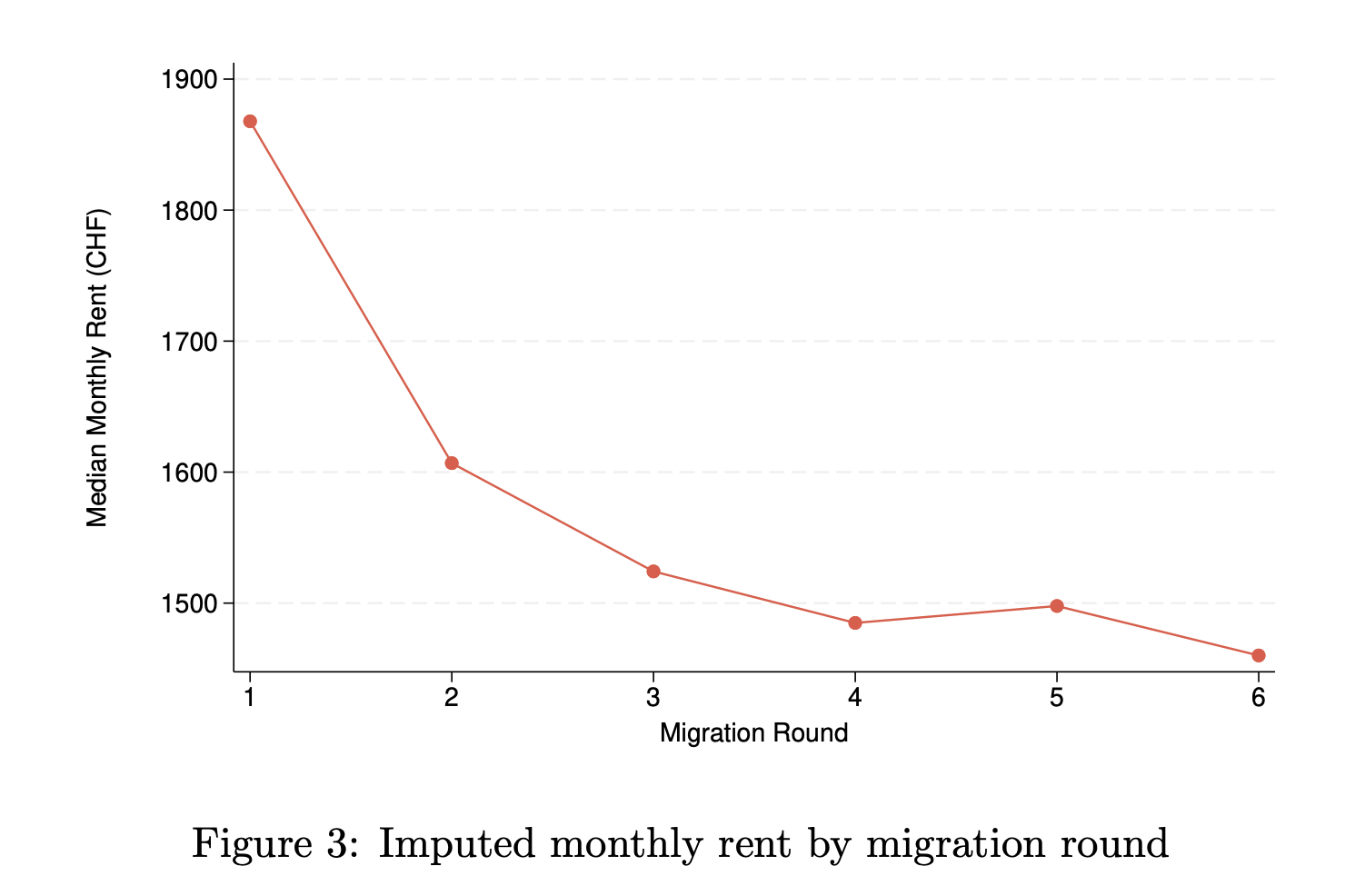
    The authors found that these moving chains are relatively short in Switzerland. Approximately 75% of them terminate within three migration rounds. But this doesn’t mean that these chains aren’t critical for the market.

    Importantly, they found that every new market-rate unit typically results in 0.75 moves for households with below-median incomes. So, that is 75 moves for every 100 new homes constructed.

    The reason why new supply ends up also benefiting lower-income households is because there’s a clear income and rent gradient across the moving chain:

    New housing (migration round 1) is typically priced at the highest end of the market. This makes sense because we know that development happens on the margin. But by migration rounds 2 and 3, median rents fall off noticeably, creating housing opportunities for other people.

    New market-rate housing is sometimes criticized for only serving one segment of the market. But once again, we see evidence that it helps to ease overall housing pressures. There are other indirect benefits that shouldn’t be ignored.


    Cover photo by Henrique Ferreira on Unsplash

    Chart from “Country-wide effects of new housing supply: Evidence from moving chains.”

  • Do not freeze rents

    June 29, 2025 · View original


    > “Rent control is the second-best way to destroy a city, after bombing.” —Lawrence H. Summers

    Zohran Mamdani, the Democratic nominee for the mayor of New York City, clearly ran a good campaign. He used social media and short-form videos to find his audience and win with the message that the city has become unattainable to most.

    But it is also clear that the stock market really does not like his message. Shares of firms with exposure to New York City’s real estate market reacted immediately: Vornado Realty Trust, SL Green, Equity Residential, Empire State Realty Trust, LXP Industrial Trust, and others, were all down. At the same time, the wealthy vowed to leave New York for places like Florida, as they so often do these days.

    One of reasons for this negative reaction was Mamdani’s commitment to not just cap rent increases, but freeze rents in rent-stabilized units for the entire duration of his term. We’ve spoken a lot about rent control over the years (here, here, here, and other places) but, at a high level, the problem with rent controls is that they create a strong disincentive for landlords to invest and maintain their homes and for developers to build new homes. So what ultimately happens is that you get a more rapidly aging inventory of existing homes and a reduced amount of new supply.

    A full-out rent freeze takes this even further. A rent freeze does not mean that utility costs will also be frozen, that insurance and taxes will be frozen, that interest rates will be capped, and that all other landlord operating expenses will be restricted from inflating. (If this were the case, we really wouldn’t have market economy.) So what a rent freeze does is ensure that, in real dollars, a landlord is able to collect less money from tenants, while operating costs continue to increase under the line.

    The same is true in condominiums and other ownership structures. Whenever somebody talks about frozen maintenance or common element fees, I immediately remind them that this is a bad thing, not a feature. It means the condominium corporation is on an unsustainable path and will eventually run out of money. Something is being sacrificed in order to keep up with rising operating and capital expenses. At the very least, you need to keep up with inflation.

    I can appreciate that rents are too high. As a developer, I would love to be able to build to lower rents. It reduces absorption risk and it’s better for the city. But rather than just freeze rents, a more productive and sustainable approach would be to attack the underlying root causes for the problem. A rent freeze is a short-term political fix that will have second and third-order consequences. Problems for a different day and for a different mayor, perhaps. But problems nonetheless.

    Cover photo by Daryan Shamkhali on Unsplash

  • 1,688 new condominiums were sold last quarter in the Toronto region

    Urbanation just released its Q2-2024 condominium market survey for the Greater Toronto & Hamilton Area (GTHA), and we should probably talk about some of the data:

    • The new condominium market reported 1,688 sales in the quarter. Outside of Q2-2020 (the pandemic), this is the lowest in the past 20 years. Note: This number is self-reported by developers.
    • Of the 3,625 homes launched for pre-sale during the quarter, only about 17% got absorbed/sold. That’s about ~616 homes, which isn’t very much when you spread it out across the region’s projects.
    • Unsold inventory increased to 25,893 homes. Urbanation equates this to 34 months of supply, versus a more “balanced level” of 10-12 months. This number breaks down to 15,157 homes in pre-construction projects, 9,788 homes in projects under construction, and 948 homes in recently completed buildings.
    • This is higher than Urbanation’s 20-year average, but the way I see it is that the ~15k homes in pre-construction projects could very quickly evaporate. If those projects don’t get to construction (and most probably won’t in the short term), then that inventory will disappear from the market. On the other hand, the ~11k homes under construction or recently completed is a hard number. These homes exist, or will soon exist, and they’ll need to get absorbed at some point.
    • There are also going to be homes that are currently sold, but where buyers ultimately say “yeah, I’m not going to be able to close.” So there will be some non-zero percentage of homes that will need to be reabsorbed. I don’t know what this percentage will be, but if it’s something like 5%, that’s not nothing. (See below for the number of condominiums under construction right now.)
    • Not surprisingly, average asking prices for unsold homes only declined about 2.6% over the past year. Prices have remained markably sticky. And this is how you know that development happens on the margin. Because developers are infinitely better off selling homes and starting construction, compared to holding lots of unsold inventory and starting construction, whenever. The fact that developers aren’t dropping prices to sell more homes demonstrates that they can’t. They’re hitting the floor of financial feasibility.
    • Finally, last quarter saw 727 new condominium homes start construction. In theory, this could have been a single tall building, though that probably wasn’t the case. As new starts fall, the number of condominiums under construction will naturally also fall. The current number is 87,508 homes, which is almost 19,000 less than a year ago. I expect this number to keep coming down.
  • Housing supply in low-cost and high-cost municipalities

    Here is a housing study that looked at housing supply — in the US from 2000 to 2020 — relative to median housing values. And here is the key takeaway:

    What this chart is saying is that new housing is rarely added in cities with the lowest-value homes. The bar on the left represents municipalities whose median housing values are less than 50% of the metropolitan average. And this makes sense. If values are low there is likely little to no incentive to build. The math just doesn’t work.

    However, as home values increase, the incentive to build and the ability to finance new projects also increases, and that is what we see in the above chart. This also makes sense.

    But something interesting happens in the highest-value cities — housing supply once again starts to fall off. And it turns out that there is a bit of a sweet spot. Municipalities whose relative housing values are 110 to 130% of the metropolitan average actually produce the most overall housing. Any higher than that and things start to decline.

    Why is that? The answer likely has to do with restrictive land-use regulations. The highest-value cities (and wealthiest suburbs) often have a lot of large single-family lots, as well as policies to ensure that this kind of built form doesn’t change. This has the effect of both limiting supply and enshrining values.

    So when it comes to housing supply, what you don’t want are low-cost areas. But you also don’t want the highest-value areas. What you want are areas that are doing well, but no so well that they start really restricting new entrants. This is what our industry often refers to as exclusionary zoning.

    Now, one of the most common ways to respond to this problem is to develop an opposing policy, namely inclusionary zoning. But usually what this policy doesn’t do is direct more supply to these high-value and low-density areas. Instead what it typically does is force the segment that is producing the most housing — let’s call it the 110 to 130% band — to deliver more affordable housing.

    It’s a neat trick that sounds pretty cool, but it is not at no cost.

  • Disease-breeding tenements

    What do you think of this beautiful low-rise apartment building? It is called Spadina Gardens and it was built (allegedly illegally) on Toronto’s Spadina Avenue in 1906, shortly before the City enacted an outright ban on “disease-breeding tenements” (i.e. apartment buildings) in all residential neighborhoods.

    This, of course, is a form of exclusionary zoning. Our predecessors had decided that apartments were bad, they promoted disease and immorality, and that they were likely to destroy or at least corrupt Toronto by making it, you know, less waspy.

    Important studies are underway here in Toronto, and across North America, to determine whether we should do something about this longstanding city building tradition. Should we allow a mixture of different housing types in our residential neighborhoods, or should we keep things just the way that they are? That being low-rise and single-family.

    In the meantime, we are implementing things like inclusionary zoning, which I guess makes some people feel better about themselves and the current state of affairs. But in the end, it sits very much on top of our exclusionary past.

    Low-rise single-family home neighborhoods remain off limits. Apartments should only go in select locations (provided they don’t bother the single-family homes). And any efforts to create greater affordability and diversity should only impact the new apartments and not the low-rise single-family homes that already exist.

    I would encourage all of you to have a listen to 99% Percent Invisible’s recent episode about Toronto’s “missing middle.” It does a great job explaining why Toronto looks and performs the way that it does today, and why it’s time that we do something about it. It’s also highly relevant to not just Toronto, but many cities across North America.

  • Ontario proposes target of 1.5 million new homes over the next 10 years

    Yesterday I wrote about our housing doom loop.

    Today, the province of Ontario responded (maybe not to my post) by publishing this Housing Affordability Task Force report. In it, are 55 recommendations to improve overall housing supply across the province, with the end goal of adding 1.5 million homes over the next 10 years.

    I’m still making my way through the report, but the recommendations can basically be grouped into these five main buckets (taken verbatim from this press release):

    • Make changes to planning policies and zoning to allow for greater density and increase the variety of housing.
    • Reduce and streamline urban design rules to lower costs of development.
    • Depoliticize the approvals process to address NIMBYism and cut red tape to speed up housing.
    • Prevent abuse of the appeal process and address the backlog at the Ontario Land Tribunal by prioritizing cases that increase housing.
    • Align efforts between all levels of government to incentivize more housing.

    Reform is badly needed. And I have gone on and on and on and on over the years about a number of the problems associated with how we build new homes and how we expect them to suddenly become more affordable.

    Still, I think that most of the general public would be shocked to learn how long things take, how complicated we have decided to make land use approvals, and how a single person with a vested interested in seeing no development can hold up the delivery of thousands of new homes.

    Progress is measured in years and decades. Months simply evaporate while you wait for the next PDF document to grant you access to some other labyrinthian planning hurdle. It doesn’t need to be this way.