Daily insights for city builders, delivered every morning at 6 AM ET. I’m Brandon Donnelly — a Toronto-based real estate developer and founder of Globizen. I’ve been writing here since 2013.
Tadelakt is a plaster surface that you will find all throughout Moroccan architecture. It is used on floors, walls, sinks, showers, and more. It is made from lime plaster (sand, water, and lime). And it gets applied in stages with, as I understand it, wooden floats, trowels, and mechanical polishers. The last step is to apply a sealer, which then gives it a waterproof finish. This is why it is suitable for bathrooms and exterior walls. From the sounds of it, it’s a labor-intensive process, but apparently the result is a very durable finish. I also think it lends a modern feel because it’s a continuous application that can wrap corners and follow curves.
Marrakech is one of the most frenetic, vibrant, and exciting cities that I have been to in a long time. Walking through the Medina means walking on streets that are only a few meters wide, but that are still somehow filled to the brim.
Filled with a beautiful cacophony of people, smells, and merchants, selling everything from leather sandals to engine parts. Filled with an endless supply of people vying aggressively for your attention (and who all seem to coincidentally have a relative in Toronto). And filled with motorbikes that are liable to ride over your feet if only you let your guard down for a second.
Sensory overload. It is at the same time exhausting and one of the coolest experiences ever.
Another name for these streets would be “shared streets,” which is a way of saying that the formal distinctions between areas dedicated to pedestrians, cyclists, and motorists have been removed. While they are intended to be pedestrian-oriented, the overall approach is that all users just, you know, figure it out. Today, this is viewed as an enlightened approach to street design. Though it’s clearly not a new one.
I will, however, be the first to admit that it’s easy to feel like an uptight Canadian in the Medina of Marrakech. This thought definitely crossed my mind: “I can’t believe they let motorbikes rip through these tiny streets.” You can see why somebody at some point felt it might be a good idea to carefully segregate uses.
At the same time, the architecture of Morocco feels like the perfect complement to these chaotic streets. Notably inward facing, the central feature of a traditional riad is its courtyard. These spaces offer much-needed protection from the hot Moroccan sun, but they also allow for family privacy, which is something that is important in this culture.
The result is that you immediately feel it every time you walk inside. You have now entered a beautiful and calm oasis in the middle of a frenetic and exciting city.
Here are some photos from Caló del Moro, Cala s’Almonia, Cala Llombards, and Cala Pi (all in Mallorca). As I mentioned two days ago, these are some of the most beautiful public spaces that I have ever seen. We loved swimming in these coves. The Mediterranean is such a special place in the summer. But here’s a tip: If you’re planning to roam around on and jump off of the rocks, you’re going to want to invest in a good pair of water shoes.
The street in front of our hotel is about 8.3m wide. (I actually measured it.) And this is generous for Palma’s Old Town. The building directly in front of us is also 6 storeys tall and has exactly zero setbacks and stepbacks. It is one straight elevation all the way up. In other words, it is an urban condition that does not follow any of today’s generally accepted rules of planning. The street should be wider. And the building should have a bunch of stepbacks, right? Maybe not. Lots of people seem to love this kind of dense, unplanned, and walkable built form in Europe. Eating outside on a narrow street is a feature. But for whatever reason, when people return home, many don’t seem to want it anymore, or worse, they actively oppose it. It’s an interesting dynamic that I don’t fully understand. Because personally, I enjoy visiting places that I could see myself living in. What about you?
Today we rented a car so that we could go and explore other parts of Mallorca. We went to three different beaches and coves on the southeast coast, and they were some of the most beautiful public spaces I have ever seen.
Along the way, we stopped at an Aldi to grab picnic supplies. I love Aldi. It’s amazing how much less expensive everything is here compared to back in Toronto, even once you do the EUR to CAD conversion.
As soon as we pulled in, the first thing I noticed is that every single parking space had permeable pavers. Here are two photos. The second photo is to also show you their EV charging spaces and one of the two cats that seems to live at the store.
Permeable pavers are, of course, useful because they help to reduce surface runoff. Meaning, they allow some amount of water to filter into the ground, which is not the case with impermeable surfaces.
Considering that Toronto has already had two major flood events this summer alone, I think it behooves us to take note. When is the last time you’ve seen permeable pavers used in a public parking lot in Canada or the US? Serious question. I can’t think of an example.
Traveling is one of life’s greatest experiences. Pack a carry-on (so you bring only what you really need). Strip yourself of your regular surroundings. And explore the world with new eyes — maybe with a camera in your hand.
It’s hard to think of Barcelona and not think of its famed street, La Rambla. But this same street design (and name) also appears in other cities throughout Spain. The above two streets are in Palma. The first is also called La Rambla (which is supposedly derived from an old Arabic word meaning sandy riverbed) and the second is called the Paseo del Borne. Both follow the exact same urban design principles. They’re broad tree-lined streets with a large center median dedicated to only pedestrians. All car traffic is relegated to the sides. What’s great about this design is the following. One, it reallocates public space according to who uses it the most (i.e. pedestrians). Two, it consolidates the main pedestrian realm (in lieu of just having larger sidewalks on either side of the street). And three, it establishes a clear hierarchy for the street. Pedestrians are most important here, and that’s why they get the center position. It’s surprising that more cities don’t adopt this same design.
This is a beautiful apartment building in the center of Palma. Brutalist ground floor. Operable wooden slats up the rest of the facade. It feels right at home in this climate. It’s also a passive-energy building that uses 90% less energy compared to a “conventional” apartment building. The technical classification is nZEB (or a nearly zero energy building). It’s pretty amazing that with only 9 apartments, these kinds of projects pencil here. Perhaps it’s no surprise that it’s also a single-stair building.
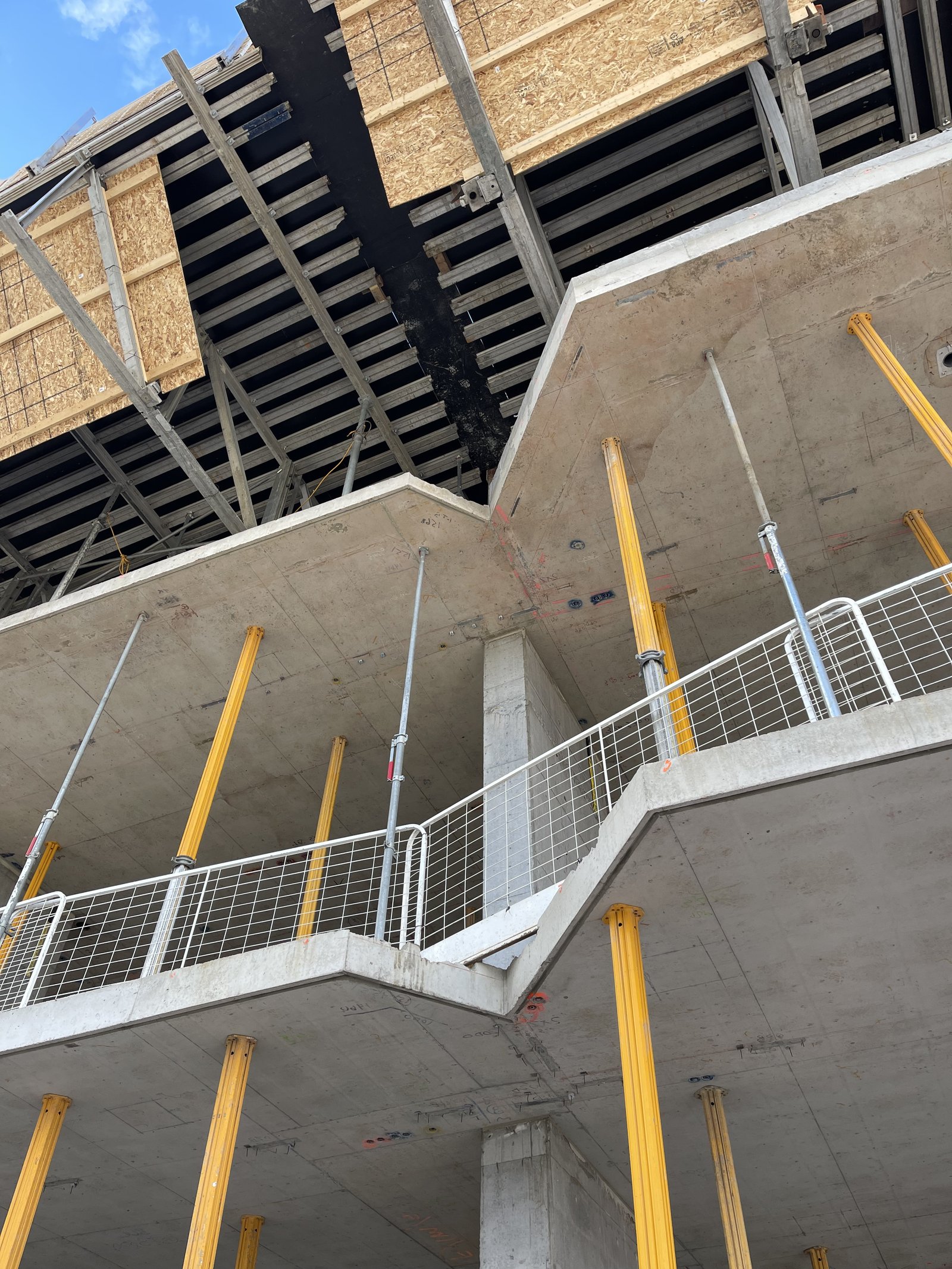
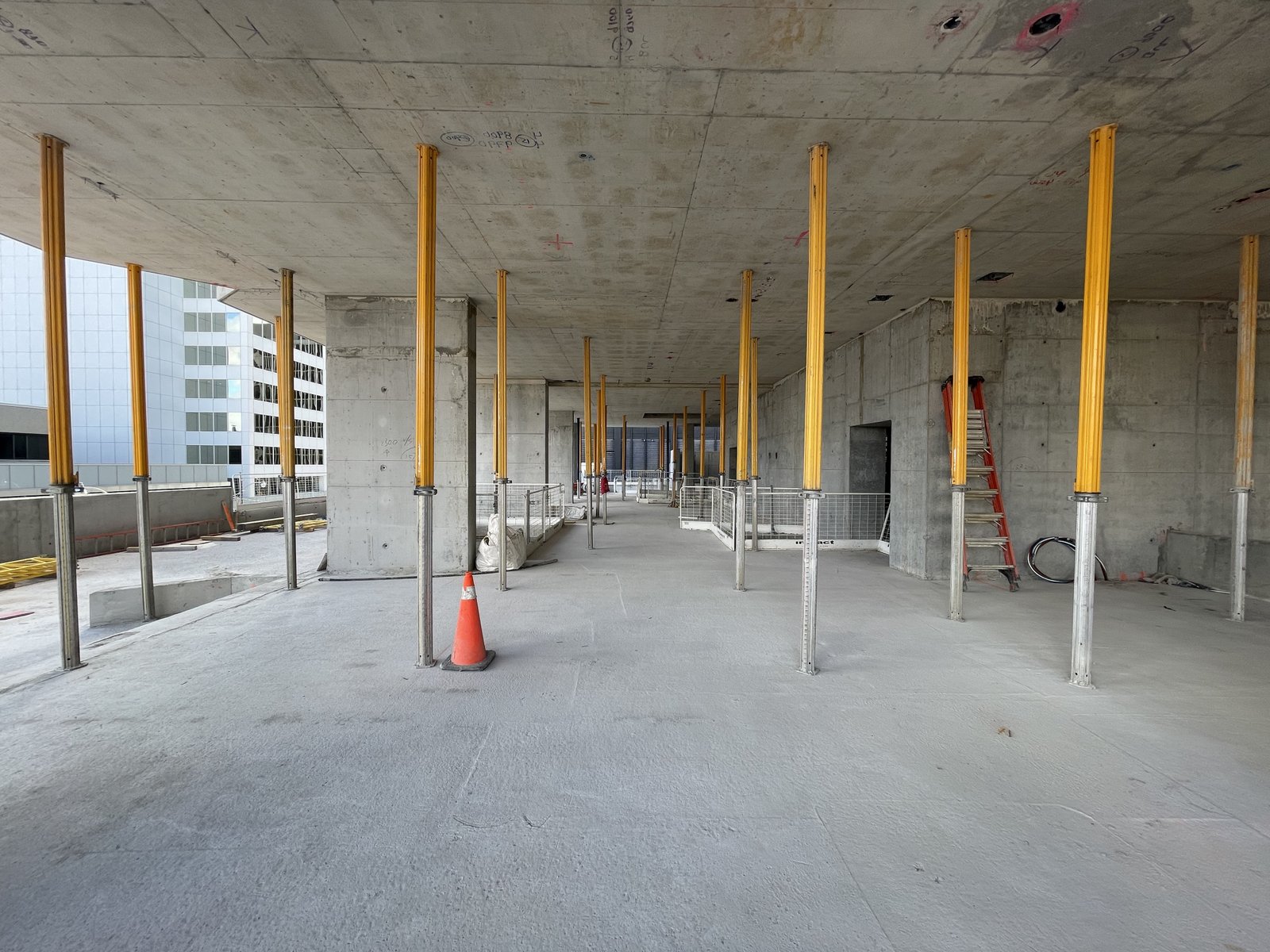
Today we are pouring our massive level two transfer slab at One Delisle. Delisle Avenue has been temporarily closed and the first concrete truck arrived at 6 AM. We’re currently averaging about 100 m3 per hour. There’s also a bit of light rain in Toronto right now, so that should help keep the slab cool. We’re a few weeks later than we were initially targeting back in June, but a lot of coordination has gone into this one slab. Our level three slab is also somewhat unique because of the double-height pool space and the gym; but following that, we’re on to our “typical” floors. And by “typical”, I mean as typical as one gets on a project like One Delisle.
We just checked into our hotel in Palma and one of the first things I noticed is that as soon as you open any of the windows/doors, the AC automatically turns off. A message on the thermostat then alerts you that it will come back on once you close the windows. I haven’t yet figured out how this particular hotel room is sensing that things are open, but it’s relatively easy to do this at home through smart thermostats and sensors like these. I make a real concerted effort to do this manually, and so it’s great to see it automated in a hotel room, where people are naturally going to care less about wastage. Europe is so far ahead of North America when it comes to energy efficiency.