Daily insights for city builders, delivered every morning at 6 AM ET. I’m Brandon Donnelly — a Toronto-based real estate developer and founder of Globizen. I’ve been writing here since 2013.

  • The 10 largest buyers of US single-family houses in 2024

    March 19, 2025 · View original


    Over the last few years, there’s been growing concern around institutional buyers (namely “Wall Street”) buying up too many single-family houses and then renting them out.

    But as we spoke about last year, the number of homes owned in this way is actually quite small. The vast majority of homes are owner occupied. And the second largest share of owners is what you might call “small landlords.” That is, people who own somewhere between 1-9 homes.

    So if the specific concern is that people are out there buying houses and then renting them out, the more fruitful target would be these small landlords. But nobody seems too fussed by them, which leads me to believe that this is an instance of symbolic politics theory. In other words, it’s the association with the big bad Wall Street that people don’t like.

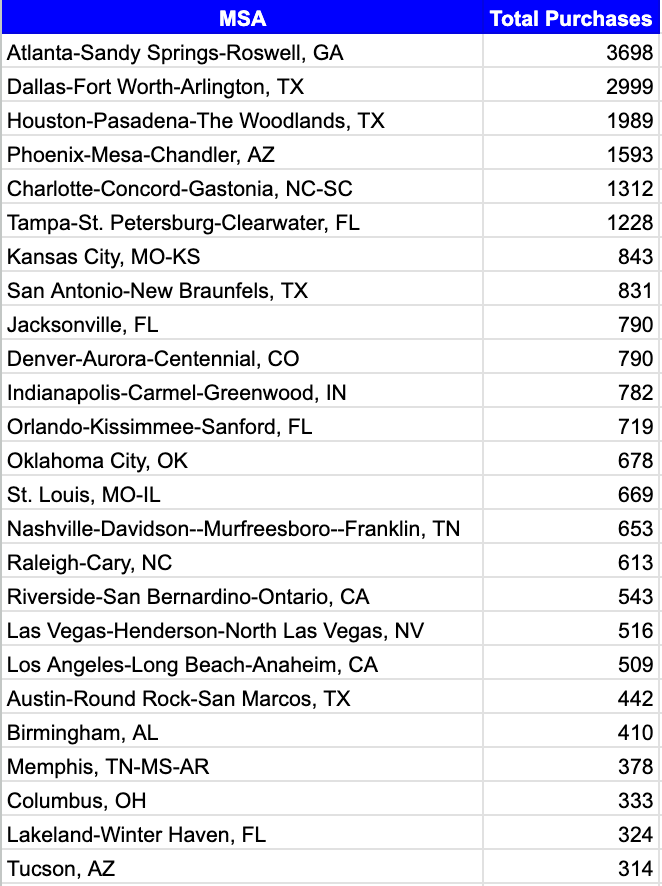
    Whatever the reason, here’s the data on the largest single-family house buyers in the US last year (2024) via SFR Analytics:

    Here are the metro areas where they transacted:

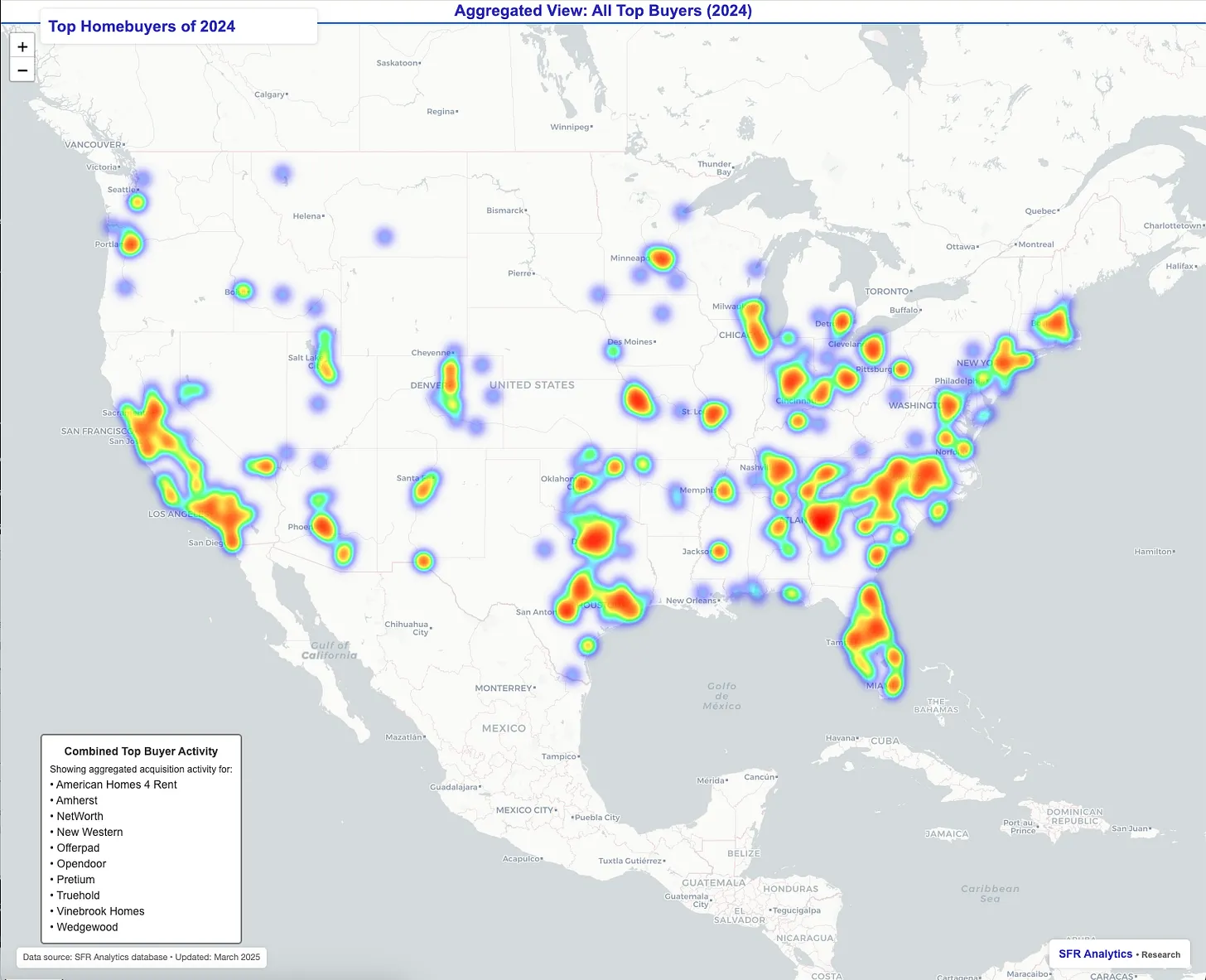
    And here’s this same data in heat map form:

    The largest buyer was Opendoor, which is a so-called iBuyer. We’ve spoken about this company a lot on this blog. They don’t actually want to hold any of the homes they buy. Instead, they buy, renovate, and then resell as quickly as possible.

    The second largest was New Western. They are a wholesaler or “double-close buyer.” These buyers want to own for an even shorter period of time and sometimes never actually own the home; instead they just assign their contract. What they’re trying to do is buy at a discount and then immediately turn around and sell for a profit.

    Note: SFR Analytics believes that New Western’s count might be meaningfully understated in the above data. The company uses lots of different LLCs and acquisition strategies and so it’s hard to aggregate the data. Assigning a contract also doesn’t show up in any county records, so it’s kind of impossible to track these. It’s just like assigning a pre-construction condominium agreement.

    Even still, what this data suggests is that single-family rental funds aren’t as dominant as some might think. The overall counts for all of the largest buyers also remain relatively small. Last year, over 4 million existing homes (including condominiums and co-ops) were bought and sold in the US. And this was a nearly 30-year low.

    Cover photo by Michael Tuszynski on Unsplash

  • Cameras vs. LiDAR — which is best for self-driving cars?

    March 18, 2025 · View original


    Back when Elon Musk was running Tesla, he was known for saying that LiDAR technology (basically laser beams that measure distances) was not needed to create full self-driving cars. And that’s why their cars instead use a bunch of cameras to monitor the outside world.

    Now, I’m not an engineer, but this never made much sense to me. Cameras can only see so far and they certainly can’t see at night. So wouldn’t laser sensing technology that can see 250-500 meters out — including at night — be greatly preferable when it comes to human safety, even if it costs more?

    I’m reminded of what I said to my eye doctor before getting laser eye surgery many years ago: “This is not a transaction where I’m looking to be price sensitive. Get me the absolute best.” And that’s exactly how I feel when it comes to self-driving cars. I don’t care if cameras are pretty good most of the time; I would prefer to have the best.

    So which is the best? Damned if I know, but here’s an interesting and also hilarious video by YouTuber and engineer Mark Rober where he compares the two technologies: cameras (i.e. Tesla) vs. LiDAR. I won’t spoil it for all of you, but his last test is the “Wile E. Coyote test” and it’s awesome.

    YouTube video

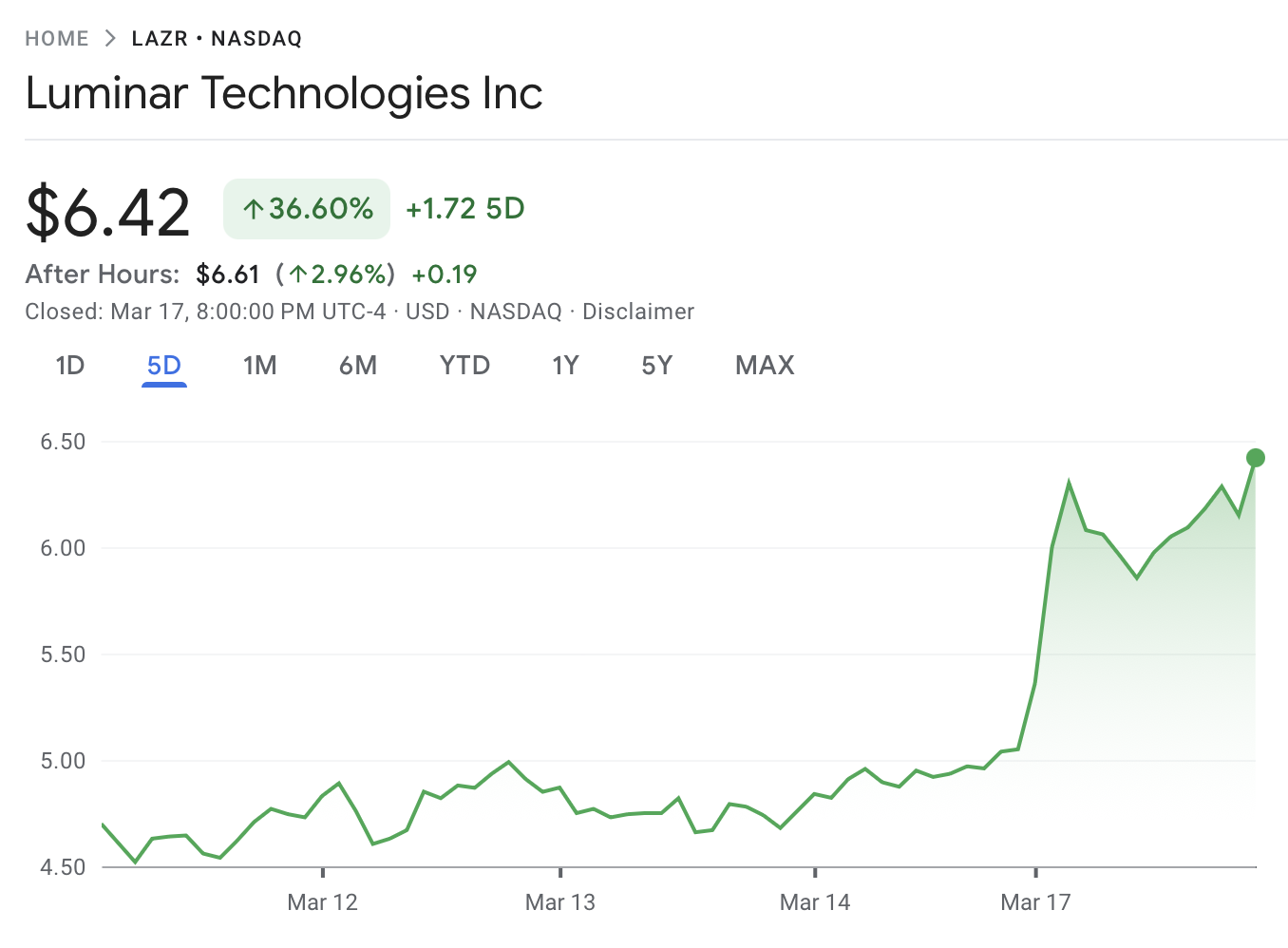
    At the time of writing this post, the video already has more than 11 million views and it seems to have been incredibly helpful to Luminar’s stock price:

    But now the internet is filled with speculation that he deliberately used the video to mislead people regarding Tesla’s Full Self Driving capabilities and maybe even to pump’s Luminar stock. (Full disclosure: I own a few shares, but this post is in no way any sort of investment advice.) I don’t know if this is true or not. But I do think that the cars of the future will all come equipped with LiDAR.

    Cover photo by Vlad Tchompalov on Unsplash

  • Canada must become a global superpower

    March 17, 2025 · View original


    The silver lining to the US starting a trade war with Canada and regularly threatening annexation is that it has forced this country out of complacency. Indeed, I’m hard pressed to think of a time, at least in my lifetime, when patriotism and nationalism has united so much of Canada.

    According to a recent survey by Angus Reid, the percentage of Canadians expressing a “deep emotional attachment” to the country jumped from 49% in December 2024 to 59% in February 2025. And as further evidence of just how unifying this moment in time is, the province with the biggest increase in attachment to country was Québec.

    What it means to be a Canadian is sometimes lazily defined according to who or what we are not. But this precarious moment in time is seemingly reminding us who we are. Of course, it also begs the questions: Where do we want to go from here? And do we have the leadership to take us there?

    Let’s start by looking at some, but of course not all, of the things that we have going for us as a country:

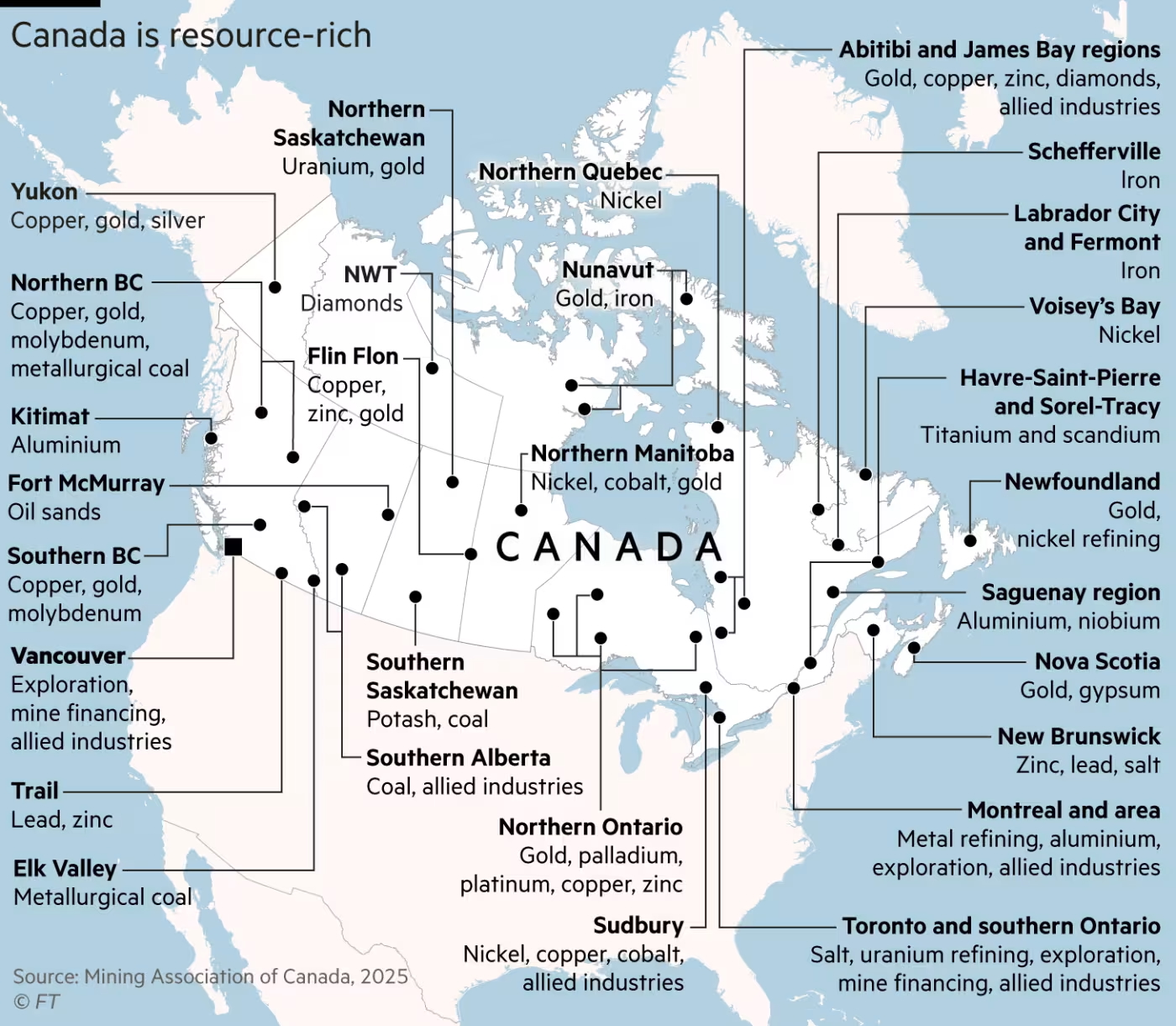
    – Second-largest country in the world by land mass. – World’s longest coastline, with access to both the Pacific and Atlantic Oceans, and increasingly the Arctic Ocean. – Third-largest proven oil reserves in the world (estimated at close to 300 billion barrels), behind Saudi Arabia. – World’s largest producer and exporter of potash (which is a key component in fertilizers). – Energy independent and broadly rich in resources (see below diagram). – A fifth of the planet’s surface freshwater. – Bilingual country — a quarter of the country reported using French at work in 2011 and, as of 2010, Canada had the 5th largest population of Francophones in the world (behind Morocco). – Multi-cultural country — over 20% of Canadians are foreign-born. – Robust immigration system that attracts top talent from around the world. – Highly-educated workforce with some of the world’s best universities — over 60% of Canadian adults have a post-secondary education which is one of the highest rates globally. – Average life expectancy of 82.3 years (2023 data), which is about 5 years higher than that of the US. – Leader in AI, quantum computing, green tech, and space robotics — Canada produces more AI research papers per capita than almost any other country and the Stanford AI Index (2023) ranked Canada 4th behind only the US, China, and the UK.

    Here’s some of our bounty (via the Financial Times):
    And yet, we are not a global superpower.

    Worse, we are lagging behind our G7 peers in GDP growth, we are plagued by declining productivity levels, we are not investing enough in new business creation and entrepreneurship, and we have one of the worst affordable housing shortages in the developed world, among other things. We have been complacent for far too long, and a big part of this is because we have, or at least had, the world’s largest economy next door demanding our goods.
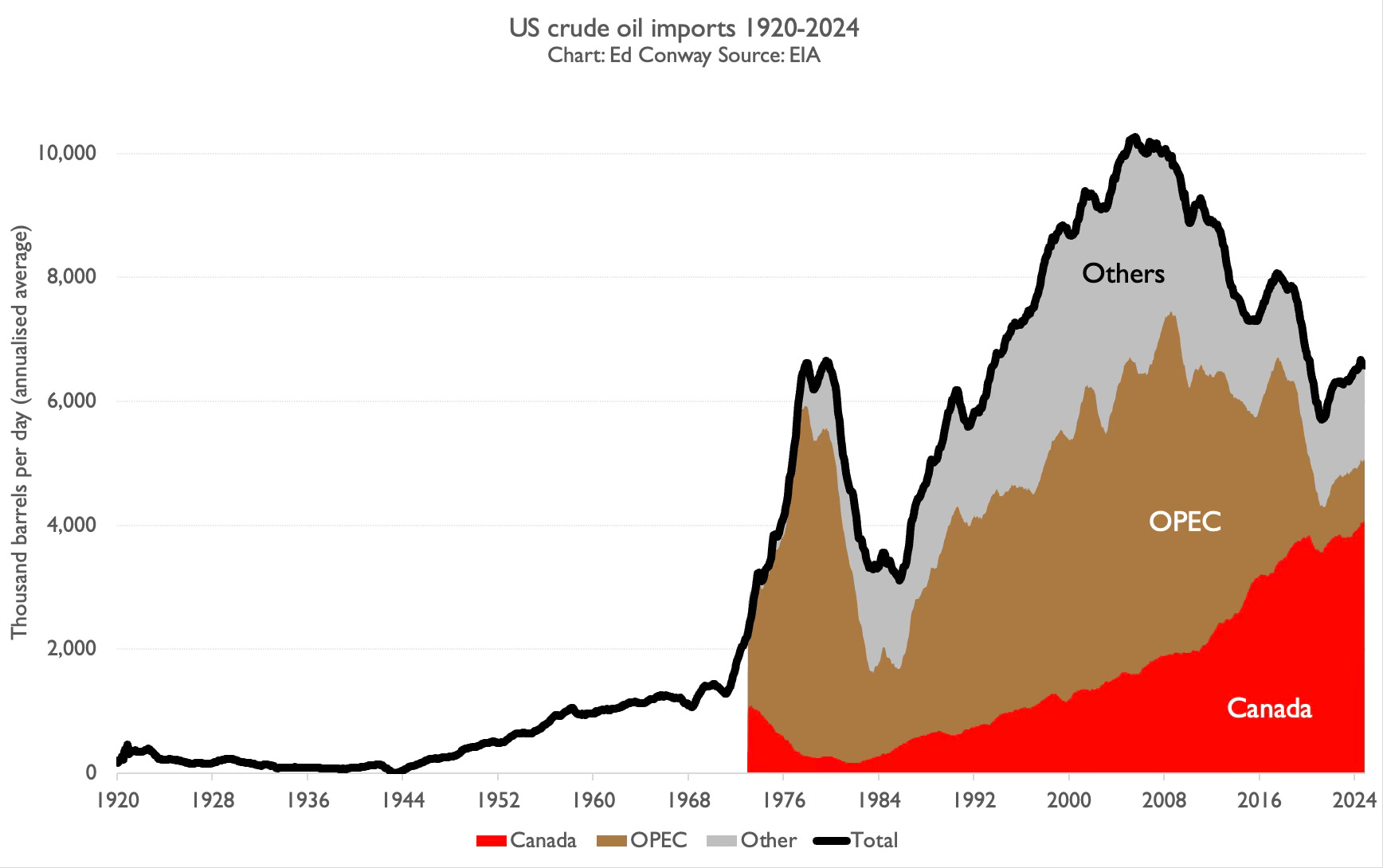
    As of 2024, 61% of all imported oil to the US came from Canada. And US refineries are specifically setup to refine our crude and viscous varietal. This is good for them. They buy our goopy oil at a discount, refine it, and then sell it for a profit. But now the US is clearly saying there’s nothing they need or want from Canada. They’ve also demonstrated through their actions that, under the current administration, they can no longer be trusted as an ally and trading partner. So it behooves us to evolve. It behooves us to take matters into our own hands.

    Here are some ideas:

    – Firstly, Canada should become a republic. For me, this is less about the monarchy being outdated (though it is) and more about the fact that a sovereign superpower like Canada should have its own head of state, and not a foreign King. – Canada needs to increase defense spending and exert much stronger sovereignty over its Arctic lands. For fiscal year 2024-2025, defense spending is projected to reach 1.37% of GDP. This obviously falls short of NATO’s 2% target. – Remove red tape and unleash the Canadian economy. Last year, Canada exported more to the US than between its own provinces and territories. Huh? By some estimates, our economy could grow by up to $5,100 per capita simply by eliminating internal trade barriers. – Barriers also need to be removed from the delivery of new housing. Canadians have been over-indexing on housing because of eroding affordability. Our current market environment is an ideal time for market reforms. Here’s just one recent post that offers a few concrete suggestions for how to do this. – Grow the Canadian population to 100 million people by 2100. Obviously there are two main ways to do this: We can help Canadians have more babies (more affordable housing certainly assists with this) and we can continue to attract the smartest and most ambitious people from around the world. As of 2022, Canada’s fertility rate sat at 1.33, which is below the OECD average of 1.5 births per woman. (The above population target is the focus of a charitable organization called the “Century Initiative.”) – Create a sovereign wealth fund akin to what Norway did. Today, Norway has the largest sovereign wealth fund in the world (based on assets under management) and it translates to over US$325,000 per Norwegian citizen and one of the highest GDPs per capita on the planet. Canada also has abundant natural resources as we know. The revenues generated from these resources should (1) accrue to the Canadian population and future generations and (2) steer the global economy toward a more sustainable future. – Invest heavily in new infrastructure. This includes everything from high-speed rail to oil pipelines. In 2020, Canada exported 82% of the crude oil it produced, with most of it going to the US via pipeline from western provinces. If the US no longer wants this, then we ought to find some new customers. – At the same time, we cannot let our abundant natural resources become a curse (see “the paradox of plenty“). We need to be a leader in the new economy. As I’ve written about before, I find it shocking, for example, that Canada is not stepping up more when it comes to new technologies like crypto. Vitalik Buterin, who is one of the founders of Ethereum and its most prominent figurehead, grew up in Toronto. He went to the University of Waterloo. We should be leveraging this homegrown talent to become a capital of crypto. And this is just one specific example. – Do everything we can to spur more innovation, more risk-taking, and more private investment. It’s one thing to have great Universities that publish a lot of research, but ultimately we need to turn this into thriving companies that employ Canadians and generate wealth for Canadians. Here’s a post I published in 2023 called, “Canada has an existential productivity problem.”

    This is obviously not a comprehensive list of all the things that Canada should be doing as a country. And invariably, some or many of you will disagree with some or most of what I have put forward here. But hopefully we can all agree that now, more than ever, we need a strong Canada. We need to start thinking of ourselves as an emerging global superpower.

    Cover photo by Juan Rojas on Unsplash

  • New website for Parkview Mountain House

    March 16, 2025 · View original


    We just did a complete overhaul of the landing page for Parkview Mountain House.

    If you’re a new reader, PMH is Globizen’s “creative retreat” in Park City, Utah. We completed it and opened it up for reservations at the end of last year.

    If any of you have feedback on the new page, I’d love to hear it. It was a lot of fun rummaging through all of the photos that I have taken there over the years during development and construction.

    And as much as I love snowboarding, I also really enjoy visiting during the summer months. It’s a close second. This year my plan is to get down there for some road biking.

  • Desert responsive car-free urbanism

    March 15, 2025 · View original


    This month’s issue of Monocle magazine is a special edition focused on property. And that’s because this month was also the annual MIPIM festival in Cannes, which is apparently the largest real estate boondoggle, I mean conference, in the world.

    One of the development projects that is featured in the special is Culdesac Tempe (which is located just east of Phoenix). This is a development that has received a lot of press over the years, including here on this blog, as it was developed as a car-free neighborhood in a city region known for the opposite.

    But to be fair, it does have some parking.

    There are 150 parking spaces (all surface) for 760 homes. So a parking ratio of just under 0.20 spaces per suite. This is still a remarkably low figure compared to what I would expect in Phoenix, which would be something closer to 1 to 1. I’d be curious to know how it’s leasing/performing.

    The entire development was also designed to be responsive to Arizona’s climate. The buildings are close together so they shadow the circulation spaces, and no asphalt was used anywhere in the project in order to minimize heat retention. The architect for the project, Dan Parolek, refers to this as “desert responsive urbanism.”

    I’d love to visit one day, but until then, there’s YouTube. Here’s a full walkthrough by Kirsten Dirksen.

    YouTube video

    Cover photo by Joe Cook on Unsplash

  • Waymo and Lyft now have the same market share in San Francisco

    March 14, 2025 · View original


    In August 2023, when Waymo first launched its self-driving vehicles in San Francisco, the market shares of Uber and Lyft were 66% and 34%, respectively.

    By the end of last year, these market shares had dropped to 55% and 22%, respectively, with Waymo on equal footing with Lyft. (These numbers specifically refer to rides that start and end within the boundaries of where Waymo operates and do not, for example, include rides to the airport.)

    So the result was low double-digit losses in market share for both companies. This is not all that surprising given that autonomous vehicles are a novel thing and that Waymo’s cars seem to be nicer than most Ubers and Lyfts. But it also shows that there maybe isn’t a great deal of customer loyalty between the various platforms, that is, as long as the wait times are reasonable.

    I think the more difficult questions remain: What does the ride-hailing space look like as AVs become more ubiquitous across our cities? Who is going to own what? And will individual car ownership fall?

    We’ve spoken before about the peak load problem that Waymo faces as a result of owning its own cars. It’s expensive to manage a fleet like this, especially relative to Uber’s variable supply model. So one scenario remains a close partnership between Waymo and Uber, where Uber handles any above-base spikes in demand with actual humans.

    But another scenario might be a hybrid approach where some of the AVs are owned by a ride-hailing company and some are owned by individuals who just contribute them to the network when they don’t need them. This is what Tesla has been promising and, who knows, maybe it’ll actually happen someday. Reilly Brennan recently wrote about this over here.

    Personally, I would love to not own a car. It’s also hard to imagine being able to make much money off a car that only goes to work during peak times, when the other robots are too busy. So I’m not convinced of this model. But I can see why Waymo is gaining market share. Privacy and a nicer cleaner vehicle are desirable features.

    Cover photo by gibblesmash asdf on Unsplash

  • New Vipp guesthouse opens in Tasmania

    March 13, 2025 · View original


    Eleven years ago, Danish homeware company Vipp opened its very first guesthouse in Sweden. Called Vipp Shelter, the house is a 55 m2 prefabricated steel pod that, today, can be rented starting from EUR 1,500 for two nights. Since then, Vipp has gone on to build and open 10 other guesthouses around the world and they have all been widely celebrated for their designs.

    Now, if you look on their website, you’ll see that they describe their guesthouses in the following way: “Not a hotel. Not a showroom. Not like any place you’ve ever stayed.” This is mostly true, but they are also like showrooms for the company. And I’ve always found this to be a clever strategy, because what better way to experience a brand then to live with it for a few days in some beautiful locale.

    Their latest guesthouse is called Vipp Tunnel (pictured above) and it’s located in the Tasmanian bush. In case you’re interested, it opened this week for bookings.

    Photos via Vipp

  • How “viager” transactions work in France

    March 12, 2025 · View original


    In the 9th century, France enacted into law a way to buy and sell property through something known as une vente en viager. My understanding is that there are other European countries that also allow this, but that it’s most popular in France, even if it still forms a relatively small portion of the market.

    Here’s how it typically works. You’re an older person (or older couple) and you want to use your home to generate some cash, but you also want to stay living in your home until the very end. So you offer it up for sale en viager occupé. (This is the most popular option, but there’s also le viager libre, where the seller moves out immediately.)

    Whoever buys it will usually pay you, the seller, in two ways. They will pay you an upfront lump sum (called le bouquet) and a recurring payment (called la rente viagère) up until the day you die (or both of you die). Once this happens, the buyer then gets full enjoyment of the property. The transaction is complete.

    So why would either party want to sell and buy in this way?

    Well, if you’re the seller, the obvious benefits are that (1) you get to continue living in your home and (2) you get some money now and for the rest of your life. This can be useful if you, say, run out of cash during retirement. It’s a means to financial independence.

    For buyers, it’s the opportunity to maybe acquire a property below its current market price. Because if you don’t have access to the home until some undetermined date in the future, well then a discount will obviously need to be applied. The initial lump sum payment is often around 30% of the current value. The other attractive feature is that it’s a form of financing for buyers who may not have all the money they need today.

    In the end, this is a bet on life expectancy. Because if the seller ends up living for a really long time, then they get the benefit of more annuity payments. However, if they end up living fewer years than expected, then the buyer benefits from having to pay less in annuity payments. They got to buy below market.

    It’s a fascinating pricing and time-value-of-money exercise, but it’s also a potentially morbid way to buy real estate. On the one hand, you could be helping someone live a dignified retirement. On the other hand, you stand to benefit if they die sooner than expected.

    Cover photo by Zach Dyson on Unsplash

  • Single stair sessions

    March 11, 2025 · View original


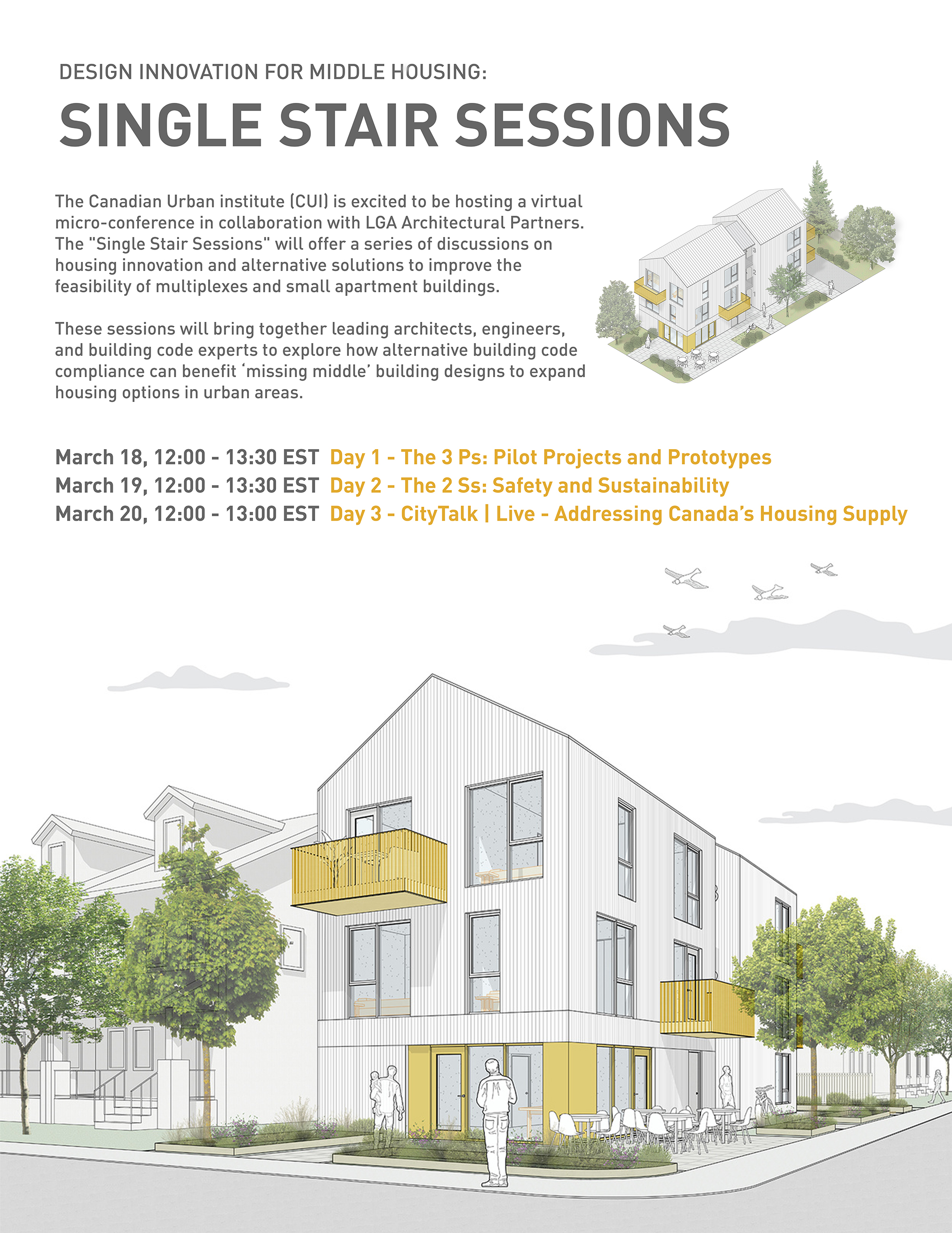
    One of the things I included in my list of “how to improve the feasibility of infill housing” was the adoption of single-stair buildings. So today I’m happy to share that next week the Canadian Urban Institute — in collaboration with LGA Architectural Partners — will be hosting a series of online micro-conferences covering this topic. If you’re a regular reader of this blog, you’ll know that LGA is one of the leading voices, if not the leading voice, advocating for this important building code change.

    Here are the event posters:

    And here are the links if you’d like to register for any of the sessions:

    Single Stair Sessions Day 1 — “The 3 Ps: Pilot Projects and Prototypes” – Single Stair Sessions Day 2 — “The 2 Ss: Safety and Sustainability” – CityTalk | Live — “Addressing Canada’s Housing Supply: Can Regulations Drive Housing Innovation?”

    We are actively underwriting new missing middle housing across central Toronto. And I can tell you that project feasibility would benefit enormously from this code change. Single-stair buildings are also allowed in many/most other parts of the world, and so we already know that it can make for better homes and that it doesn’t need to compromise life safety. It’s great that the city-building community is now increasingly focused on this opportunity.

    Cover photo by Mika Wegelius on Unsplash

  • Urban highways as urban barriers

    March 10, 2025 · View original


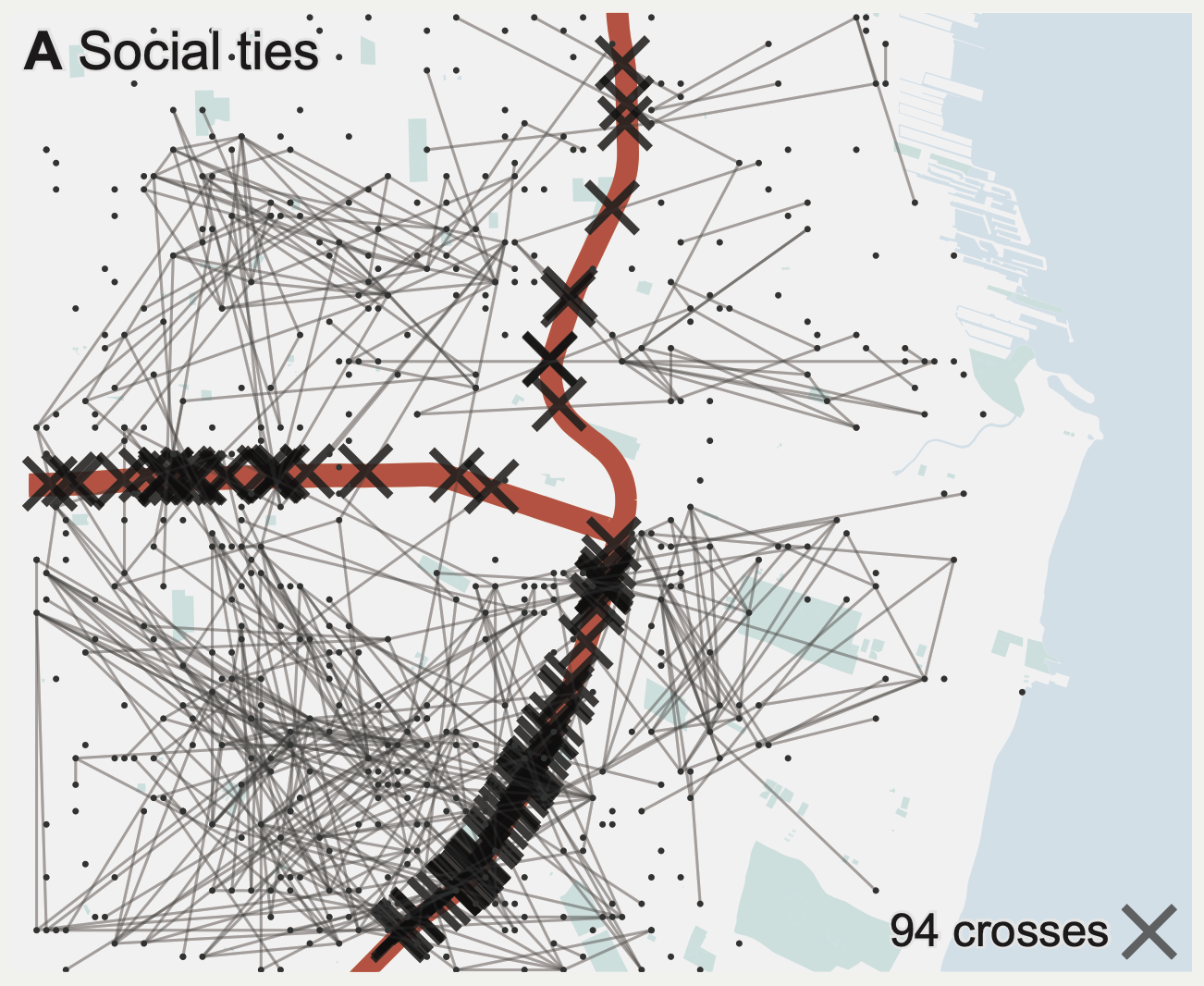
    Here is an interesting study that looked at the impact of urban highways on social connections within the 50 largest US cities. To measure this, the researchers used Twitter data from 2012-2013, which is a period of time where the default setting in the mobile app was to tag each tweet with the user’s precise geographic coordinates.

    This allowed the team to generally figure out where a user is likely to live. If you’re often tweeting from the same residential address, then there’s a good chance that’s home. They then looked at things like mutual followship as a measure of social ties. And what they ultimately found was that in all 50 cities, urban highways exhibit a strong barrier effect. They measured this using something they call a “barrier score.”

    Now this sounds right and supports lots of other evidence that highways divide cities; but Twitter isn’t necessarily a place where mutual followship means you actually know the person in real life and you regularly walk down the street to see if they can come out and play. So one of the things that the researchers also did was work to replicate their findings using data from another social network called Gowalla.

    I very vaguely remember this platform, but it is/was a social network where users are supposed to connect with people they actually know and share their locations through check-ins. With this data they found that their “barrier score” was even more pronounced, which makes sense given that the platform’s social graph should have had, in theory, stronger real-life ties.

    But even if you don’t believe the social data, these results should make intuitive sense. Highway underpasses and overpasses tend not to be the best environments for pedestrians. They’re usually a clear break in a city’s urban fabric, which can make people second guess whether they really want or need to cross it.

    Cover photo by Tom Barrett on Unsplash