Daily insights for city builders, delivered every morning at 6 AM ET. I’m Brandon Donnelly — a Toronto-based real estate developer and founder of Globizen. I’ve been writing here since 2013.

  • Sorry, I don’t have Venmo — stablecoin?

    April 18, 2025 · View original


    Back when Canadians used to travel to the US, it was common for a situation like this to arise: “Hey, I’ll send you money. Do you have Venmo?” And then, as a Canadian, you’d say, “sorry, we don’t have Venmo in Canada. We use our own proprietary system called Interac e-Transfer. Do you have PayPal? I think I still have an account. Let’s try.” Once this exchange was over, both parties would then sit there and wonder why the hell it’s still so expensive and awkward to move money around.

    As another example, take global remittances. These are payments sent by a person back to their country of origin, usually to a family member. And in 2024, it was estimated that some $905 billion was sent around the world for this reason, with about $685 billion of it being sent to low and middle-income countries. But it was also estimated that the average cost of doing this was around 6.62%, which is double the UN’s target of 3%.

    For anyone who has used crypto before, this feels painfully archaic. Sending a wire transfer can cost over $50 and it can take time to clear, assuming that you got in before the bank’s cut-off time. Sending things via a blockchain is cheap (it’s pennies now) and it happens instantly and securely — 24 hours a day, 365 days a year. This was always one of the promises of crypto, but now we’re seeing it play out very clearly with stablecoins. Here’s an example.

    > Tweet: I send money to my family every month (they are in Argentina) and I just need to send USDT to a wallet address and they get it instantly, no requirements, no issues and they can keep some of it in stables instead of our devalued currency. Without crypto, this would be a pain in

    Stablecoins are a type of cryptocurrency that have their value pegged to another asset, such as gold or a fiat currency. And at the time of writing this post, something like 99% of stablecoins are pegged to the US dollar. The benefits of this are twofold. Firstly, it creates price stability. You’re effectively holding US dollars. But now you have a US dollar on a blockchain (or a tokenized US dollar), meaning you can do crypto things with it, like send it around the world instantly and for free.

    The other benefit of this is that it can serve as a hedge against a problematic local currency. Would you rather hold the Argentine Peso or the US dollar? The use cases are powerful. So it’s not surprising that, by some estimates, a quarter of all global remittances now involve some form of cryptocurrency. Argentina also happens to be the leading crypto market in Latin America. Between July 2023 and June 2024, the country recorded about $91 billion in crypto transactions.

    It’s fascinating to think about how all of this will reshape the global financial landscape. Already stablecoin transactions are threatening Visa in terms of overall transactions. All someone needs is a mobile phone and a crypto wallet. And by the way, as soon as you link a wallet to a human, you can also quickly determine how much money they’ve been sending/receiving, figure out tax liabilities, and so on.

    Also noteworthy is the fact that the (vast?) majority of stablecoin transactions settle on Ethereum. It is the substrate powering this market, as well as many others. I don’t know what that exactly means for Ethereum as a crypto asset. But I do believe it means something meaningful. And in this instance, it stems from a fairly simple want: “I would like to send you money cheaply and securely, and I don’t want inflation to then kill my purchasing power.”

    Cover photo by Alistair MacRobert on Unsplash
  • Only 533 new condominiums were sold last quarter in the Toronto region

    April 17, 2025 · View original


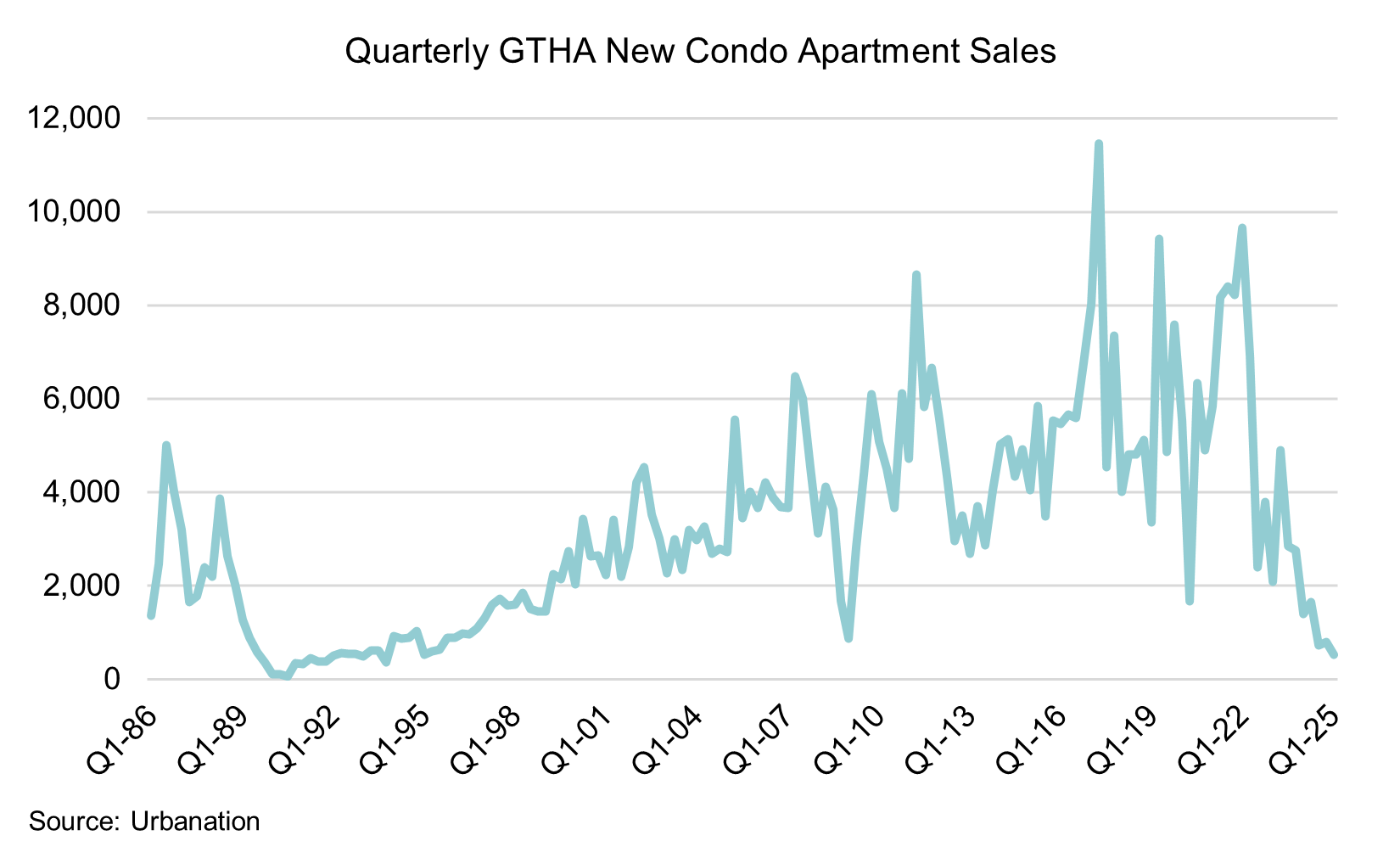
    Urbanation just released its Q1-2025 condominium market survey results for the Greater Toronto & Hamilton Area (GTHA). Here’s how things are looking:

    The entire GTHA recorded 533 new condominium sales and the City of Toronto recorded 215 new condominium sales in the quarter. Once again, and as you can see above, this is the lowest level since the early 90s.

    For all intents and purposes, I think you can look at these sales figures as mostly representing a zero. The numbers are relatively small and a sale doesn’t necessarily equate 1:1 to an eventual new home. The sale needs to be within a project that achieves its requisite pre-sales for construction financing.

    Since the beginning of 2024, Urbanation has tracked a total of 5,734 pre-construction condominiums that have been put on hold, cancelled, placed into receivership, or converted to purpose-built rental.

    So where does this leave us? It leaves us with:

    – 69,042 condominium homes under construction across the GTHA – 10,934 unsold condominiums in pre-construction projects – 11,073 unsold condominiums in projects under construction – 1,911 unsold condominiums in completed projects (standing inventory)

    One hypothetical could be that many/most of the projects currently in pre-construction never actually make it to construction, which would mean that the above 10,934 condominiums just disappear from the market. For argument’s sake, let’s assume this happens. That would leave projects under construction and standing inventory.

    Of the condominium’s currently under construction, 11,073 are unsold, which represents about 16% of the total. For the units that have sold, some will belong to end users, some will belong to investors who have an ability to close, and the rest will be buyers who, frankly, don’t want to close or who can’t close.

    I don’t know what this latter percentage might be, but let’s say that 40% of the condominiums sold and under construction become a problem and need to be “reabsorbed” in the market. That is, they need to find new buyers. That would equal 23,187 condominiums (and hopefully I’m being very conservative). In this scenario we would have:

    – 11,073 unsold condominiums in projects under construction – 23,187 condominiums that become a problem and need to reabsorbed in the market – 1,911 unsold condominiums in completed projects – Total of 36,171 “unsold” condominiums

    So, how long will it take to absorb these new homes? I don’t know. It depends on a bunch of factors, including immigration. But I think we need at least 2 more years just to physically deliver the homes that are currently under construction. Then there may be a period of reabsorption. That continues to suggest to me that 2028 could be the year where we’re on the other side of this.

    Cover photo by Brian Jones on Unsplash

  • Transportation geography of the Toronto region

    April 16, 2025 · View original


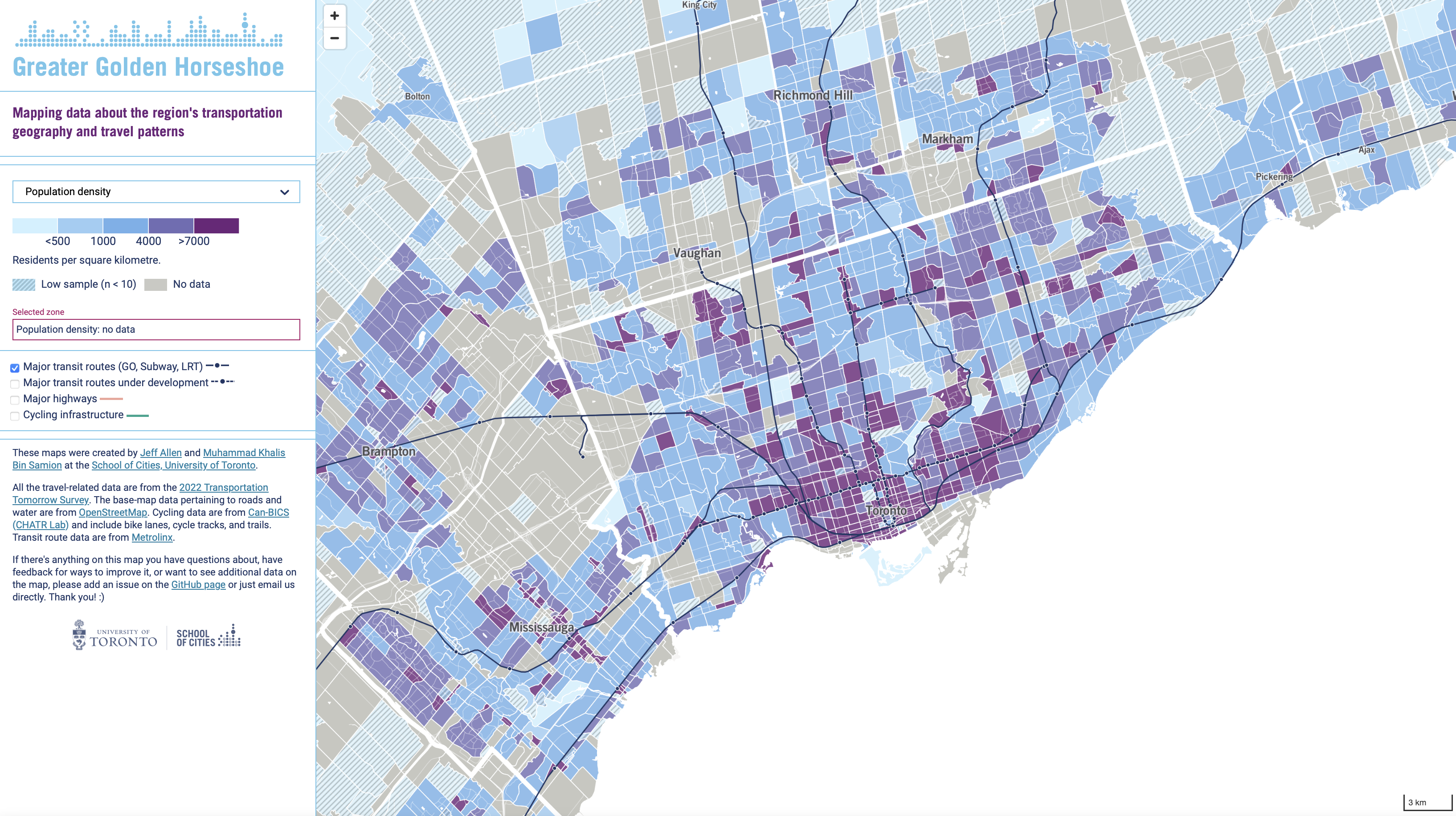
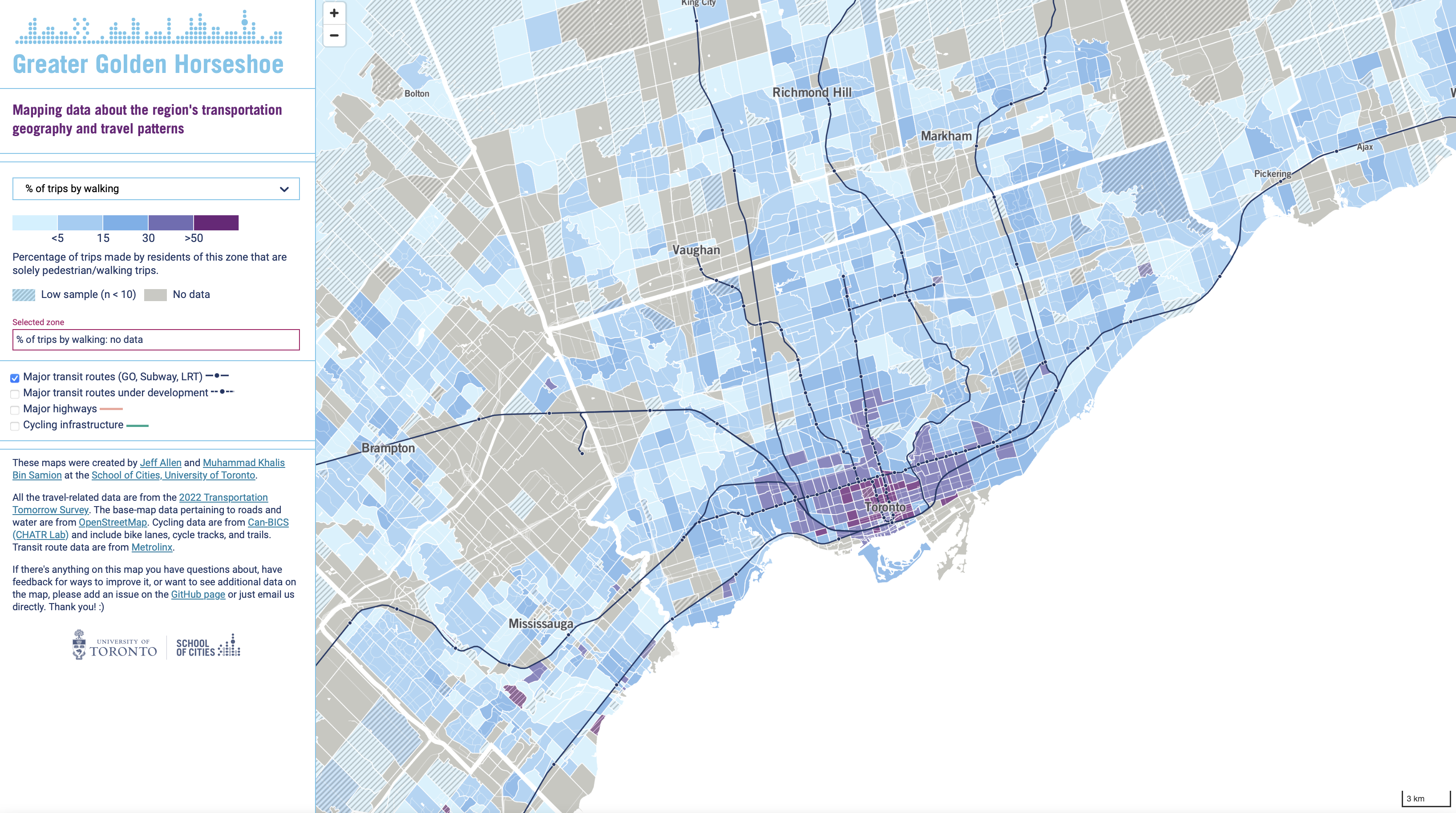
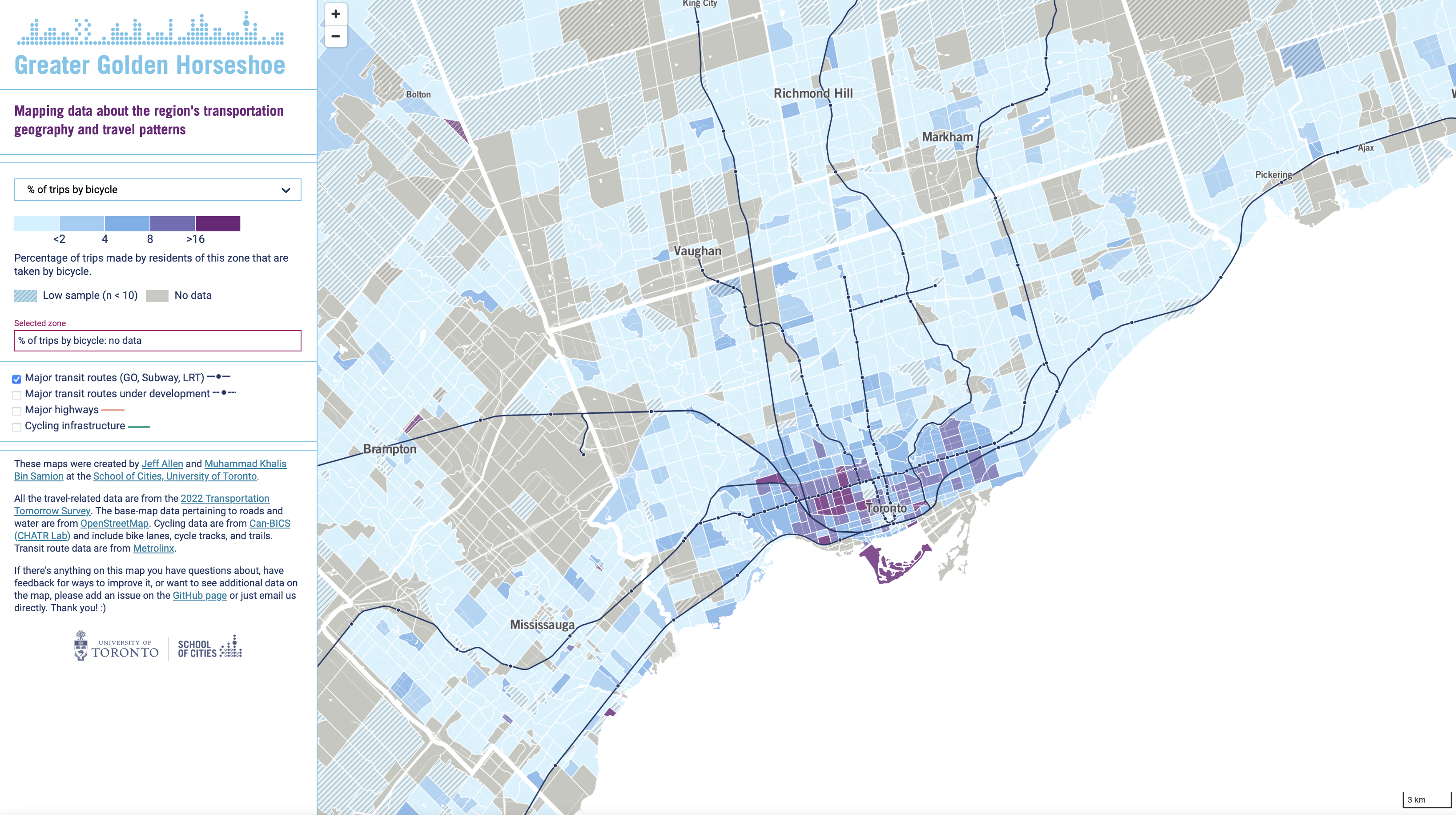
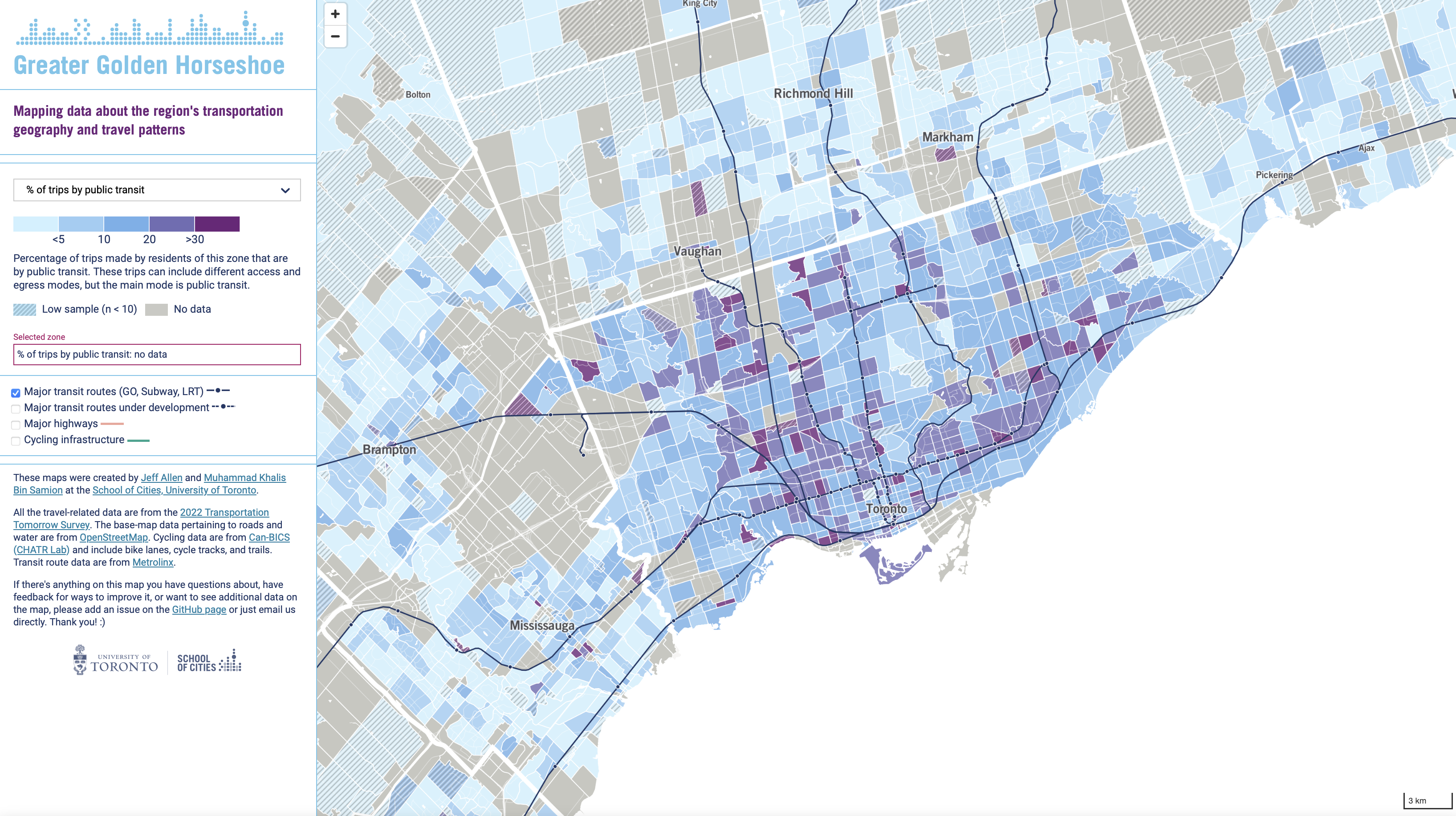
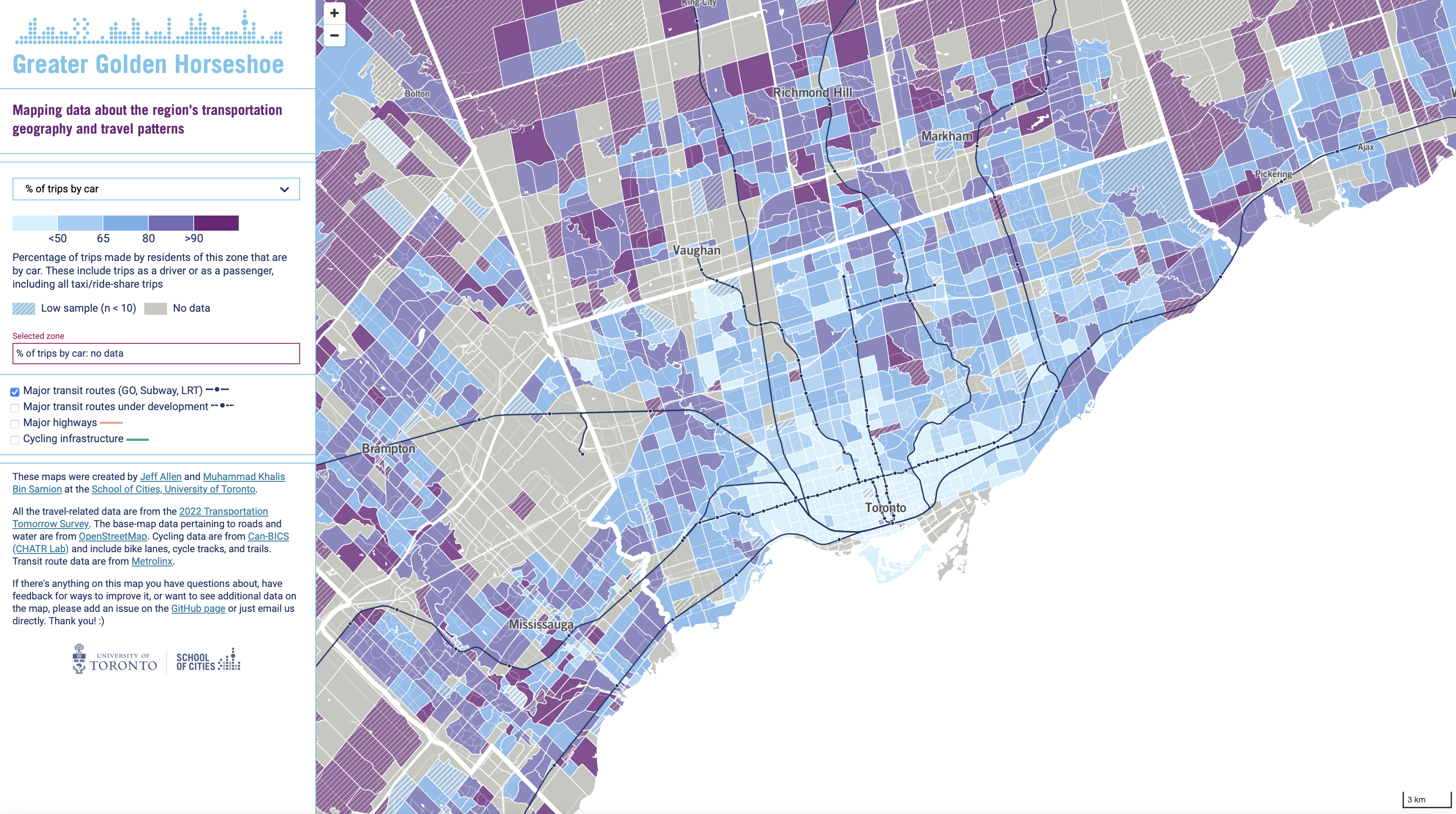
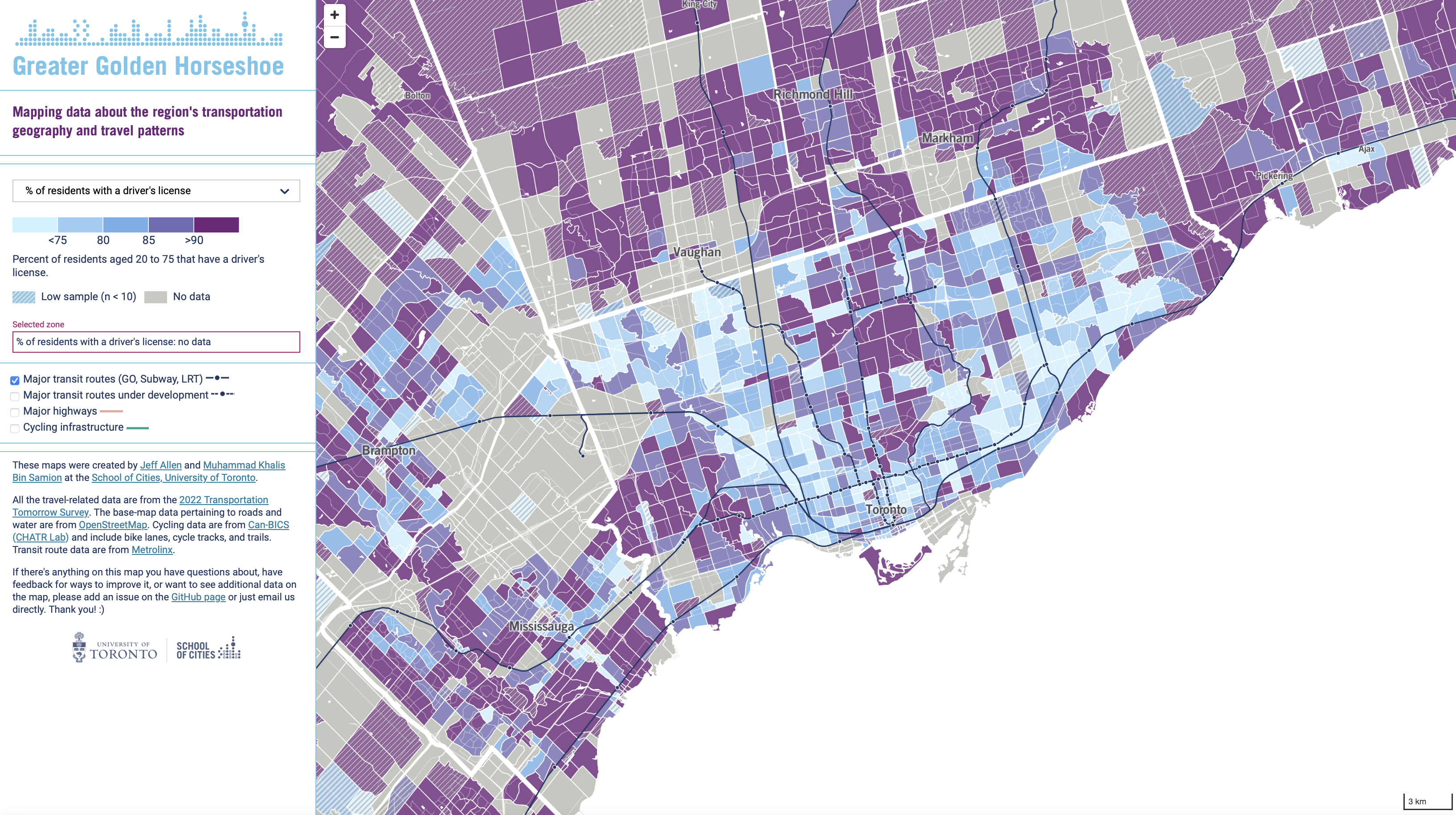
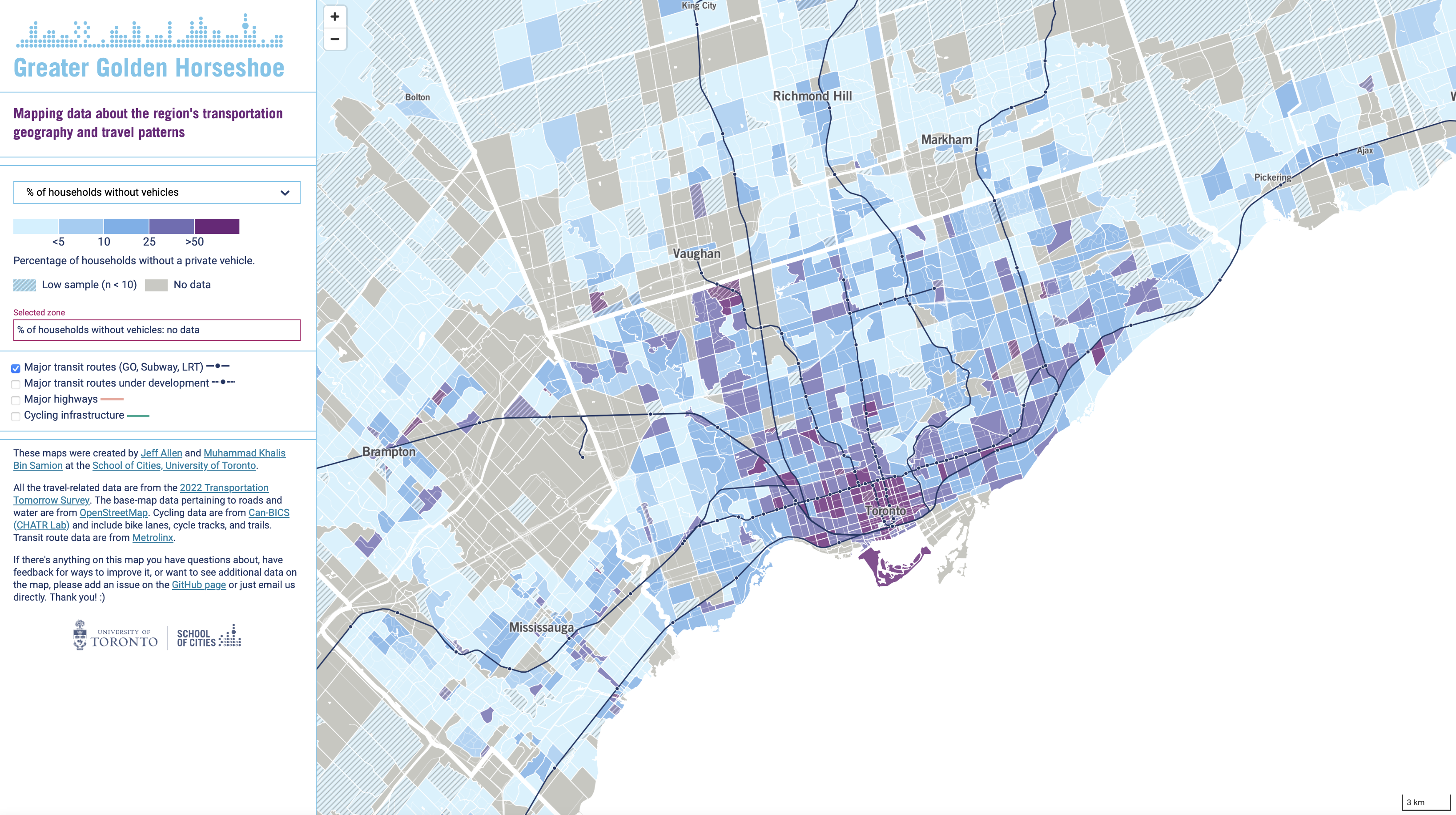
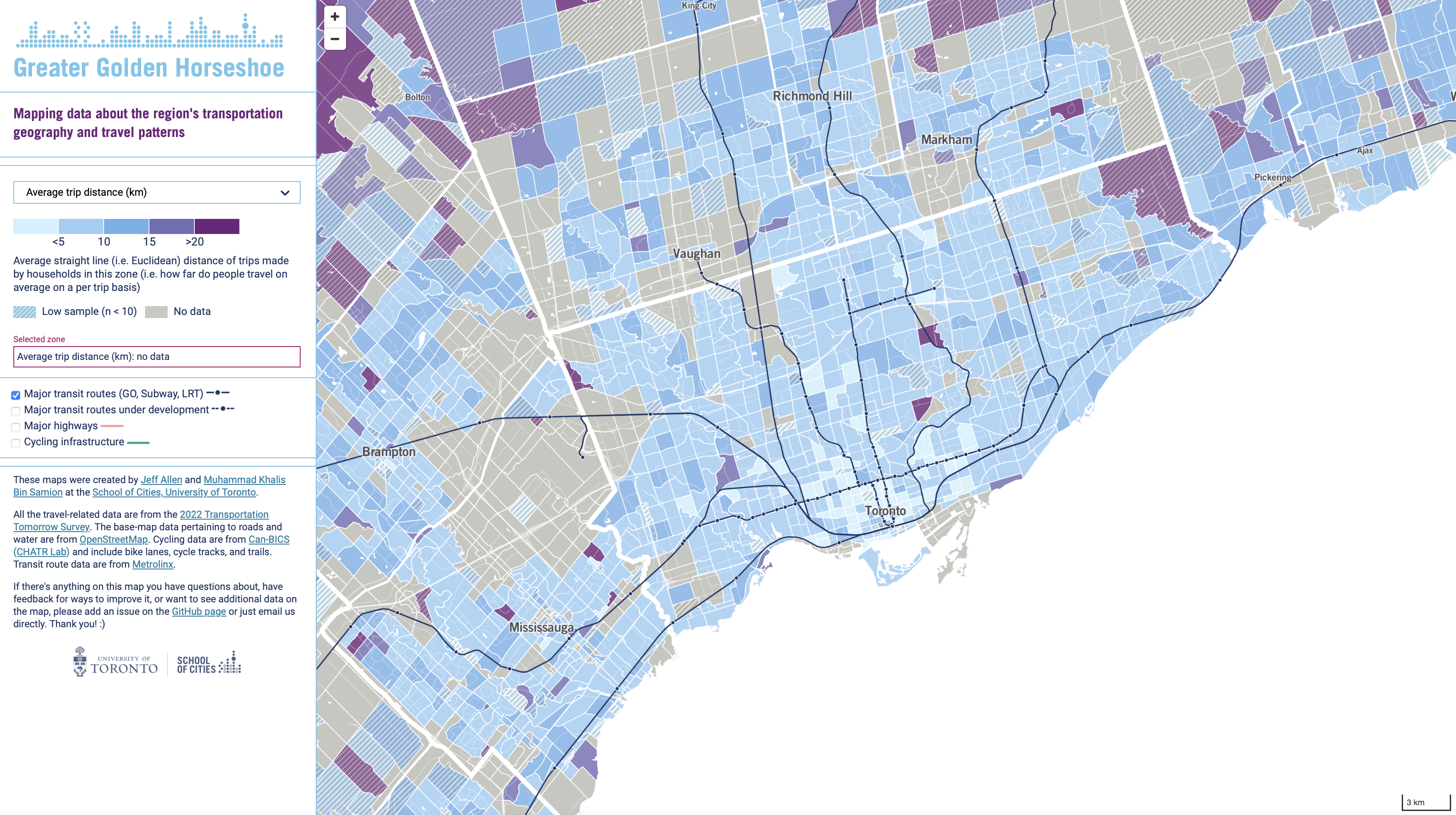
    Every five years, the Greater Golden Horseshoe Area (of southern Ontario) conducts something called a Transportation Tomorrow Survey. And I am told that it is the most comprehensive travel survey conducted anywhere in the world. So let’s look at some of the data. The last survey was completed in 2022 and a mapping of the data was prepared by the School of Cities at the University of Toronto.

    Population density:

    Percentage of trips by walking:

    Percentage of trips by bicycle:

    Percentage of trips by public transit:

    Percentage of trips by car:

    Percentage of residents with a driver’s license:

    Percentage of households without a car:

    Average trips by distance:

    Once again, these maps remind us that the starkest contrast is between active and non-active forms of mobility. In other words, we have a central core where many, and sometimes most people (>50%) walk to where they need to go, and then there’s absolutely everywhere else in the region where most people drive (>50%) and, in some cases, where people drive almost exclusively (>90%). Public transit ridership is more dispersed, but it’s really only dominant in Toronto, and not in any of the suburbs.

    Perhaps the only reasonably uniform finding is that average trip distances tend to be relatively short (<10 km) no matter where you live.

    Maps from the School of Cities at the University of Toronto; cover photo by Juan Rojas on Unsplash

  • US office market was showing signs of recovery until the tariffs arrived

    April 15, 2025 · View original


    According to the WSJ, the US office market saw a significant increase in leasing activity in the first quarter of this year. Approximately 115 million square feet of space was leased, which represents a 13% increase from the previous quarter and the highest level since before the pandemic in mid-2019.

    But then, tariffs for everybody! Now tenants are worried that a recession is coming, inflation is going to rise, and that so too will interest rates. Uncertainty is bad for business.

    Here’s where things broadly sit as of the beginning of this year:

    – The national office vacancy rate was 19.7% at the end of February 2025 – San Francisco had the highest vacancy at 27.8% – $7 billion worth of office sales were recorded in the first two months of the year and the average price was $177 per square foot – The cheapest markets are/were in the midwest with Minneapolis-Saint Paul recording the lowest average sale price of $50 per square foot (versus $215 psf a year ago) – Chicago averaged $67 psf – The most expensive markets were places like San Diego ($662 psf), Manhattan ($450 psf), San Francisco ($282 psf), Miami ($239 psf), and Los Angeles ($207 psf) — we continue to see a flight to quality

    Maybe things will get better later this year, or maybe they won’t. It’s impossible to know what comes next in this trade war.

    Cover photo by Delia Little on Unsplash

  • From urban sprawl to a real city

    April 14, 2025 · View original


    Urban sprawl is how much of the US provides new housing. And here’s Conor Dougherty in the New York Times arguing that America needs more of it to fix its housing shortage:

    > Even if all the regulatory restraints were removed tomorrow, developers couldn’t find enough land to satisfy America’s housing needs inside established areas. Consequently, much of the nation’s housing growth has moved to states in the South and Southwest, where a surplus of open land and willingness to sprawl has turned the Sun Belt into a kind of national sponge that sops up housing demand from higher-cost cities. The largest metro areas there have about 20 percent of the nation’s population, but over the past five years they have built 42 percent of the nation’s new single-family homes, according to a recent report by Cullum Clark, an economist at the George W. Bush Institute, a research center in Dallas.

    The obvious benefit is that the resulting housing tends to be cheap. The above article is filled with examples of people buying large homes for a few hundred thousand dollars in newly formed communities across Texas. And if you live in a high-cost city, the social algorithms have almost certainly found you at some point with a shockingly cheap house in one of these places. But, Dougherty also admits that sometimes this may be the only redeeming quality:

    > Escobar told me he moved to Princeton because he could find a big house there for less than $300,000, but now the city is home, and he didn’t like where it was headed. Over the next four years, he said, his goal is to redevelop the downtown, try to attract offices where locals can work and build out a park system that voters recently funded with a bond measure. “You ask anybody what they love about Princeton, and it’s simply just the affordability,” Escobar told me. “We need to be more than that.”

    According to the article, this isn’t necessarily a problem, because it’s just how cities are built in this day and age. What you do is start with low-cost housing in fringe locations. You grow as quickly as possible until traffic becomes “godawful” and vital infrastructure can’t keep up. Then you implement moratoriums on new housing, and start working on other uses like, you know, employment. Eventually, after all this chaos is complete, you end up with something that possibly resembles a real city.

    Yeah, I don’t know, this seems like a roundabout way of getting to where you want to go. Why not build and plan for something with a high quality of life right from the start?

    Cover photo by Leon Hitchens on Unsplash

  • Global electricity production by source

    April 13, 2025 · View original


    I never used to listen to very many podcasts. But lately I’ve started doing it while heading to/from meetings, either in the car or on the train. This past week I listened to a Bankless podcast talking about crypto and AI, and one of the arguments that was made was that it’s probably a safe bet to assume that we’re going to need dramatically more compute and electricity in the future.

    This seems obvious enough. If you recall, there’s no such thing as a wealthy, low-energy nation. If you’re a wealthy country, you consume a lot of energy. And that’s why Build Canada recently argued that we need a kind of energy revolution. By 2050, it’s likely Canada will have 2-3x the electricity demand that we have today. So today I thought I would share a few related charts.

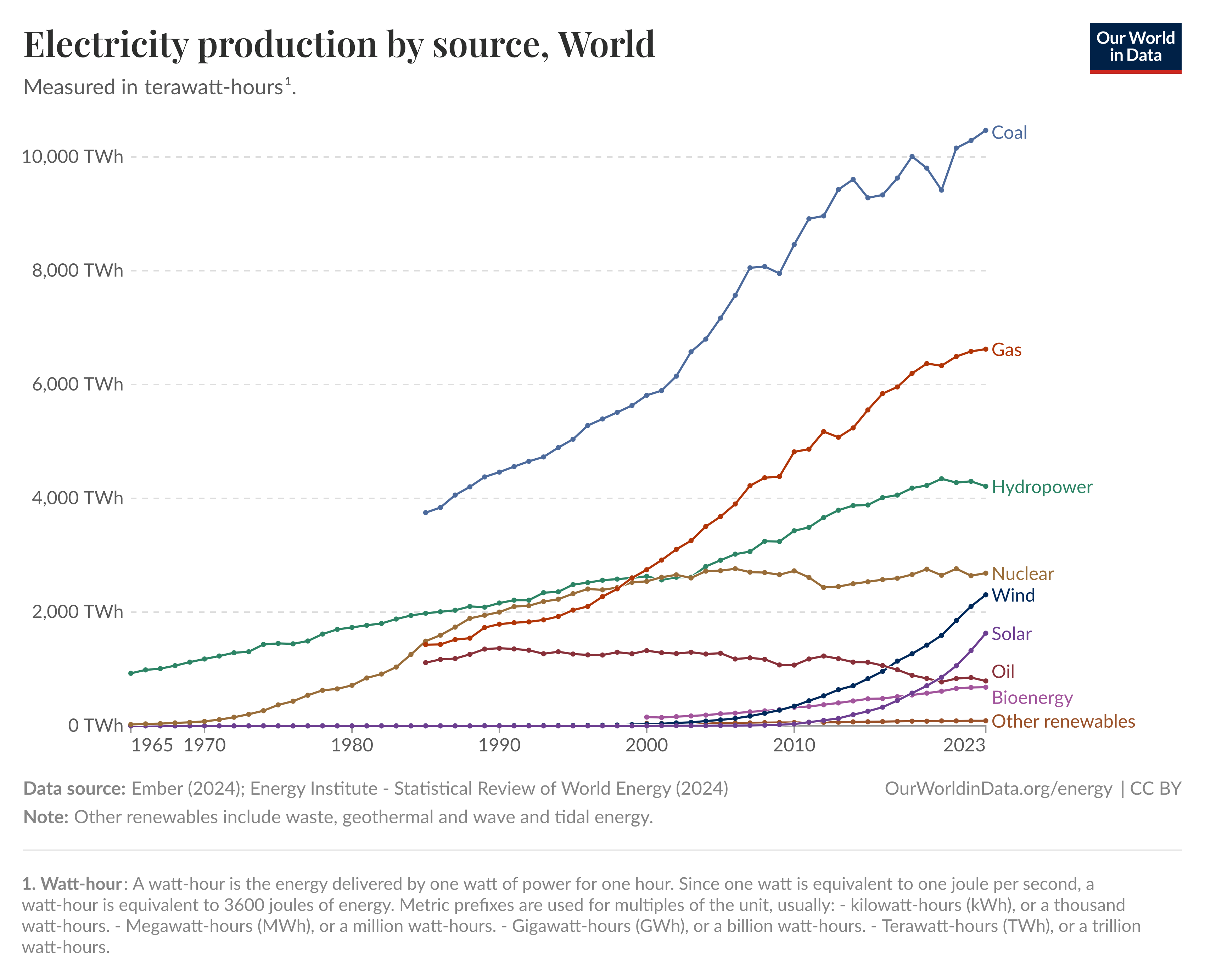
    Here’s electricity production by source across the world. Coal dominates.

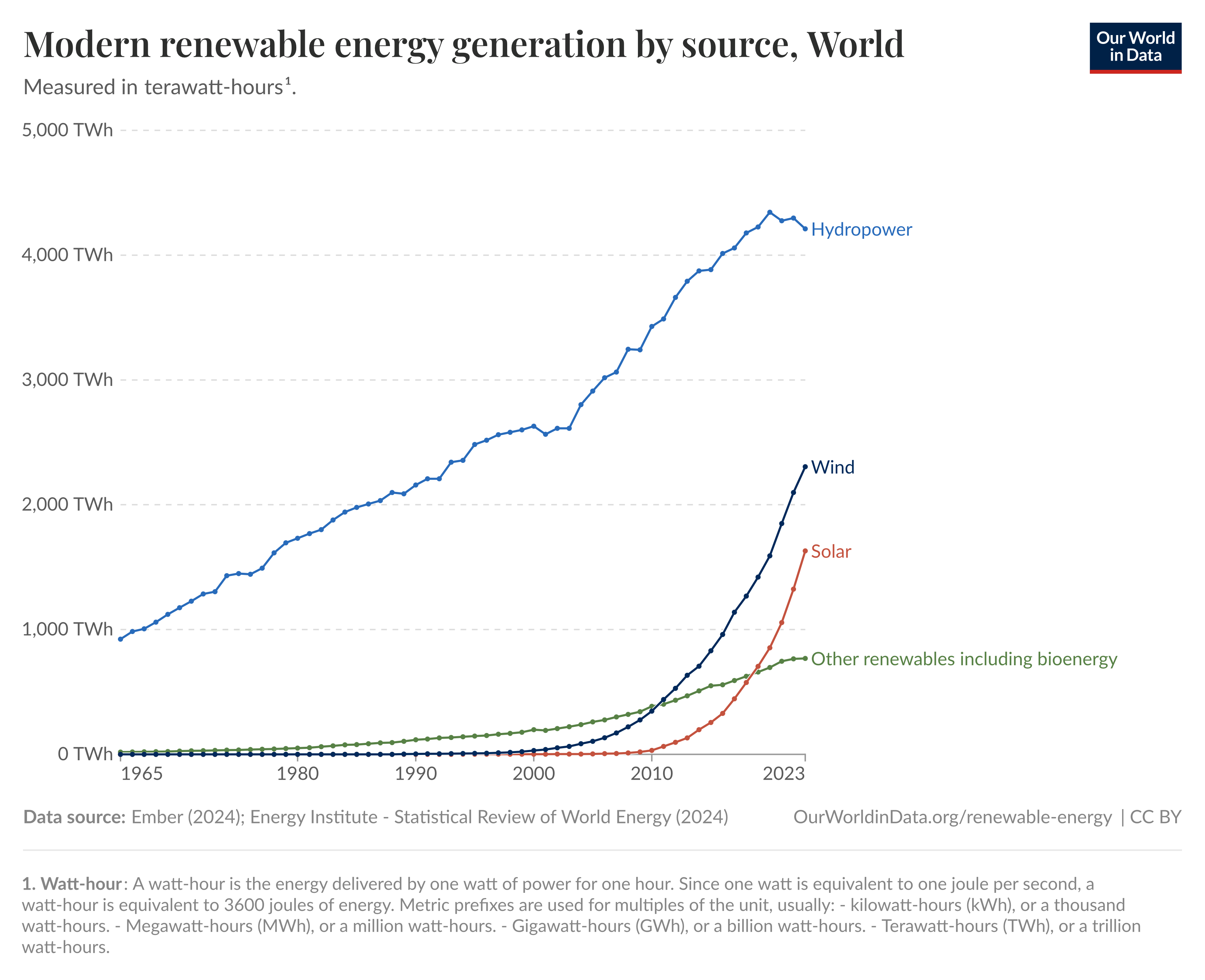
    Looking at renewables more closely, we again see that wind and solar are making a run for it. And if you consider that solar is one of the fastest growing energy sources, it’s not inconceivable that it will start to become a more dominant source in the near term. In the US, solar PV projects make up the largest share of new planned generation capacity.

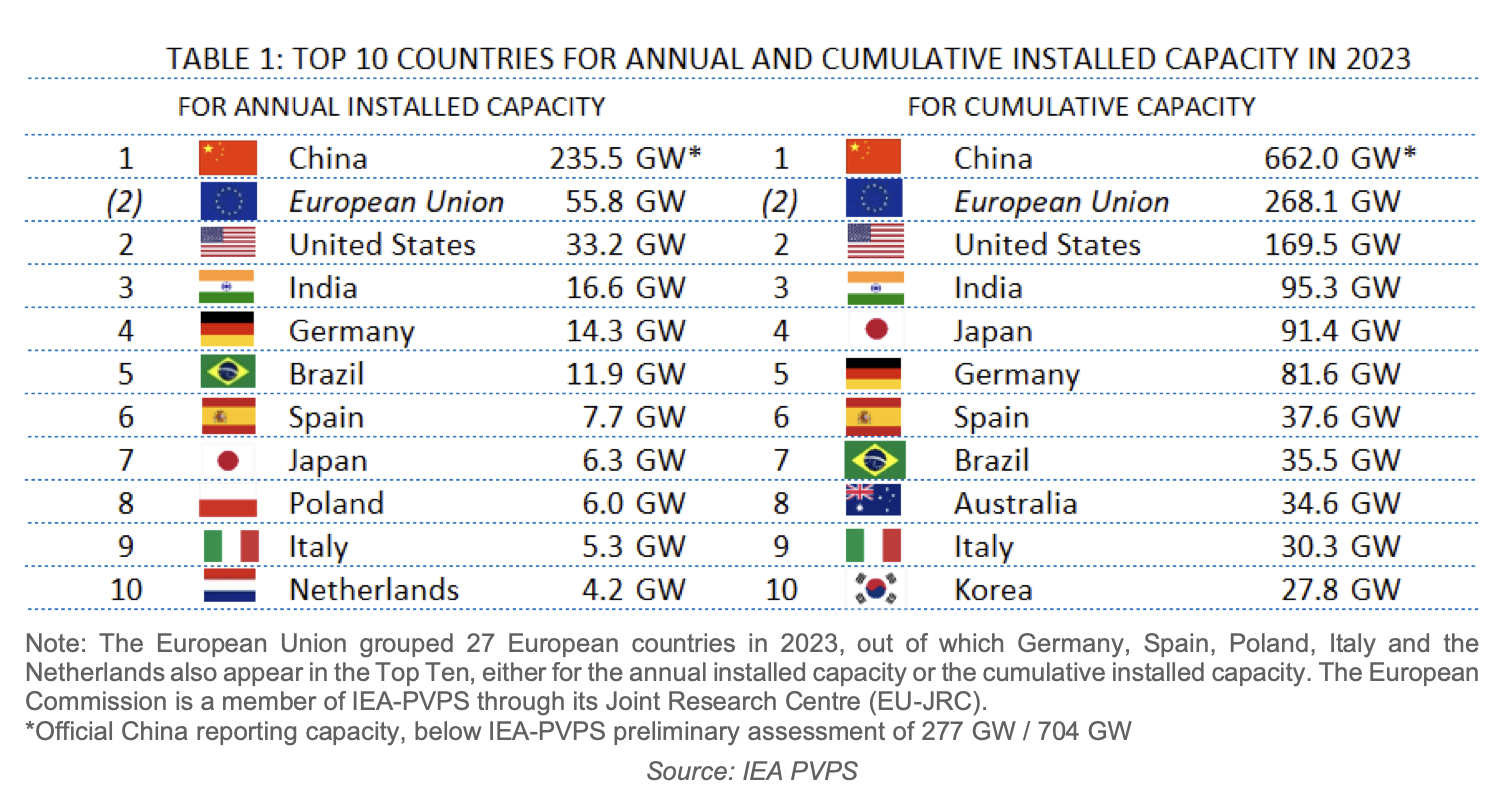
    But the US is not winning this race today. Right now it’s China. (Chart below sourced from here.) They have the largest cumulative solar capacity, followed by the EU, and then the US. That said, coal still forms a dominant part of China’s energy mix, and the country continues to construct coal-fired power plants to meet its short-term energy needs.

    It’s unfortunate that Canada is not on this list. That needs to change.

    Cover photo by Benjamin Jopen on Unsplash

  • Impact of foreign buyer restrictions

    April 12, 2025 · View original


    Banning foreigners from buying real estate tends to be popular policy.

    In a recent public opinion survey conducted in British Columbia, 77% of respondents said they approve of the provincial foreign buyer tax increasing from 15 to 20%, and 75% said they agree with the federal government’s temporary ban on foreign buyers. This is consistent with what I’d expect. But for obvious reasons, the development industry doesn’t like these policies.

    Foreign-buyer bans are a demand-side measure. Meaning, they are intended to ease home prices by reducing demand. The development industry doesn’t like this because low demand is bad when you’re trying to build things. A better scenario is something involving high demand and high supply, which is why supply-side measures tend to be more popular with industry. Even though there’s always the risk of overbuilding.

    But it’s pretty hard to argue that more supply will help to lower home prices and then not argue the same with reduced demand via the banning of certain buyers. Both levers should, in theory, have an impact, even if the former is suboptimal for builders. That said, there remains the important question of whether there’s enough foreign demand for a foreign-buyer ban to actually have an impact or whether it’s just political theater.

    Anecdotally, I can tell you that we have not typically seen a lot of foreign buyers in our pre-construction condominium projects. The deposit structure we use is different for non-Canadians and it tends to be a very very small percentage of buyers. But for resales in markets like Vancouver, the numbers do seem to be higher, at least based on some historical data.

    According to this recent research paper, once BC started tracking the nationality of buyers in June 2016, they discovered that in the 5-week period that immediately followed, about $885 million was spent by foreigners in the Greater Vancouver Area and that they represented about 10% of all sales. It was also discovered that of these foreign buyers, about 90% of them were from China.

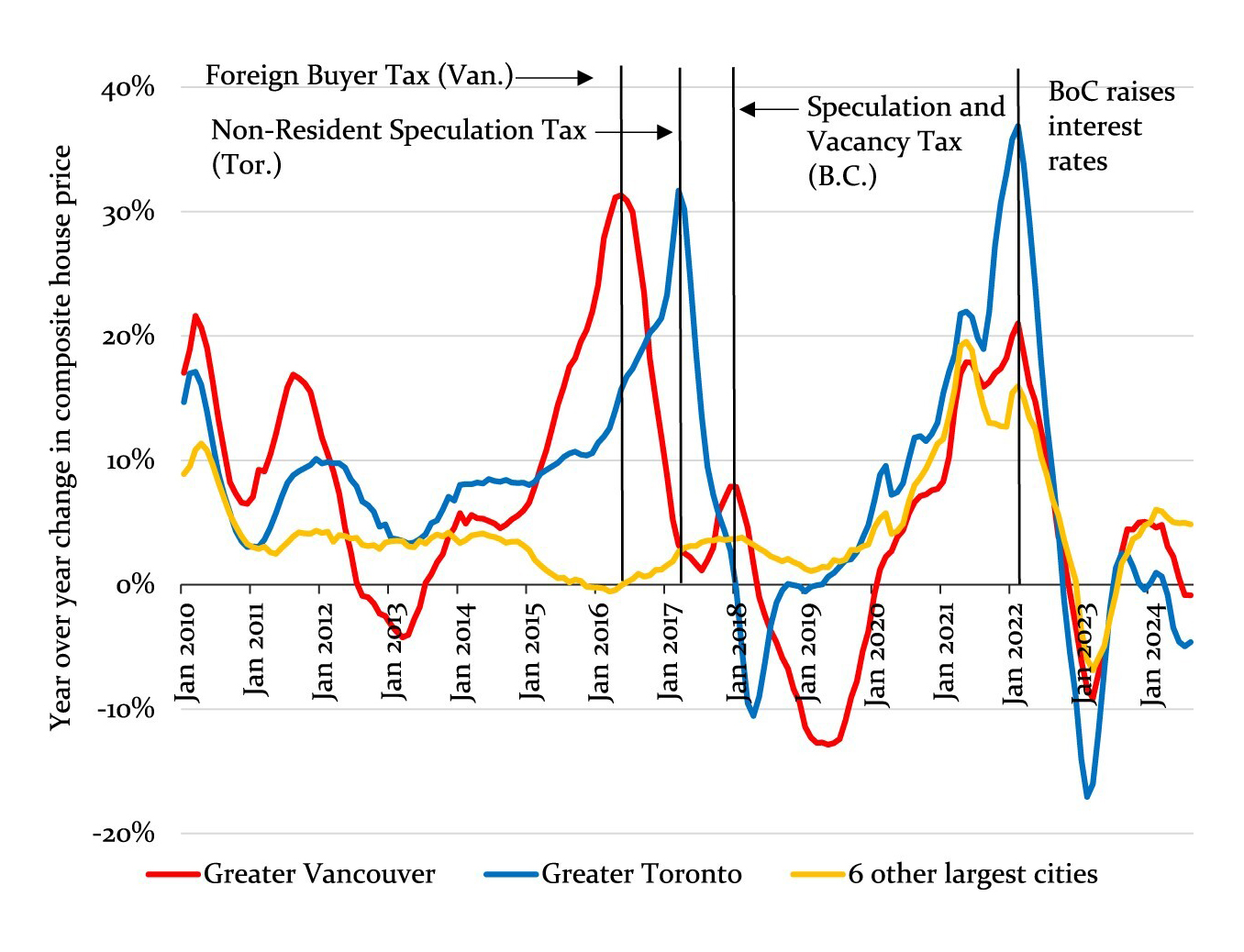
    This data was so impactful to policy makers that it is allegedly what led to BC’s foreign buyer tax in August 2016. And since then, there’s further data to suggest that it has worked to temper home prices. Here’s a chart from the same research paper:

    As a developer and proponent of open markets, I don’t love this policy. It’s a form of protectionism that discourages or flat-out blocks this kind of foreign investment from entering the country. I also worry that it can be a crutch or excuse not to expand the overall housing supply of a market. But this is seemingly not how many or most voters feel. And I can certainly appreciate why that would be the case.

    Cover photo by Alejandro Luengo on Unsplash

  • Austin legalizes single-stair apartment buildings up to 5 storeys

    April 11, 2025 · View original


    Yesterday, Austin City Council voted 10-1 in favor of a building code amendment that will allow single-stair apartment buildings up to five storeys and with 4 homes per floor. This is progress. Austin now joins Seattle, New York, and possibly other US cities in allowing this building type, which is a type that is widespread outside of North America. Paris, for instance, allows single-stair buildings up to 50m.

    In all of these newly allowable cases, there’s usually a requirement to sprinkler the building and cap the number of homes per floor, among other life safety requirements. What I’m not clear on, though, is how flexible these new codes are in allowing larger apartment buildings.

    In my opinion, it’s better (and hopefully more accurate) to think about unit maximums on a per stair basis as opposed to a per floor basis. Because that’s how you create larger point-access block buildings: you cluster multiple blocks together, each with its own exit stair. Is that allowed in these building codes? I’m not exactly sure, but one would hope.

    Regardless of this important detail, I continue to be impressed by Austin’s willingness to drive positive change in its housing market. It makes you wonder: What the hell is taking Toronto so long? Single-stair buildings up to 6 storeys should already be permissible. We should be leading.

    Cover photo by Clark Van Der Beken on Unsplash

  • The more you give, the more you get

    April 10, 2025 · View original


    Just in case you’re looking for an opportunity to read some more about tariffs, Howard Marks has a new memo out titled “Nobody Knows (Yet Again).” In it, he talks about comparative advantage, how global trade has benefited Americans, and what this could mean for the future.

    Here’s an excerpt that I found interesting specifically because I’ve also been thinking about the parallels with Brexit:

    > I consider the tariff developments thus far to be what soccer fans call an “own goal” – a goal scored for the other side when a player accidentally puts the ball into his own team’s net. In this way, they’re highly analogous to Brexit, and we know how that turned out. Brexit cost the British mightily in terms of GDP, morale, and alliances, and it harmed their reputation for governance and stability. All of this damage was self-inflicted.

    In the memo, he also provides an important history lesson:

    > To cite one more factor that has made the world a better place, I describe the behavior of the U.S. in the post-World War II period as “generosity toward the rest of the world stemming from enlightened self-interest.” Under the Marshall Plan, we gave (not loaned) billions of dollars with which Western Europe rebuilt. Likewise, between 1945 and 1952, General Douglas MacArthur oversaw the reconstruction of Japan and the strengthening of its economy. Since then, the U.S. has (a) distributed extensive foreign aid, (b) invested heavily in healthcare in developing nations, (c) created programs that bring foreign students to the U.S. and vice versa, and (d) beamed positive messages to people throughout the world. These are all instances of generosity. In each “transaction,” we gave more than we directly got, and a cynic might say we acted like suckers. > > Yes, these things can be described as largesse, but as the National Archive puts it, the Marshall Plan “provided markets for American goods, created reliable trading partners, and supported the development of stable democratic governments in Western Europe.” That’s a pretty good payoff. People in other countries received lots of freebies, but certainly these programs helped the U.S. by restraining communism, bringing nations into defensive alignment with the U.S., and contributing to the U.S.’s position as the world’s most prosperous nation. I have no interest in seeing the U.S. turn isolationist.

    Unfortunately, greater isolation will almost certainly be one of the consequences of Trump’s tariffs. It doesn’t matter that many of them have now been paused; the damage has been done. We’ve seen this spastic movie before. In fact, they could all go to zero tomorrow, and there would still be damage.

    This is an enormous change to the world order.

    Cover photo by taro ohtani on Unsplash

  • Make Toronto a 24-hour city

    April 9, 2025 · View original


    Reece Martin is perhaps best known for his YouTube channel focused on transit. He has over 330,000 subscribers, and I have mentioned him a few times over the years on this blog. But he has since retired from YouTube and he now has a new blog called “Next Toronto,” which you should all subscribe to. I just did that today.

    In his latest post, he makes “the case for a 24-hour Toronto” and compares our city to various other global cities around the world including New York and Tokyo. This post really resonates with me and I agree with his view that there’s something quintessentially urban about things being open all the time, or at the very least open late.

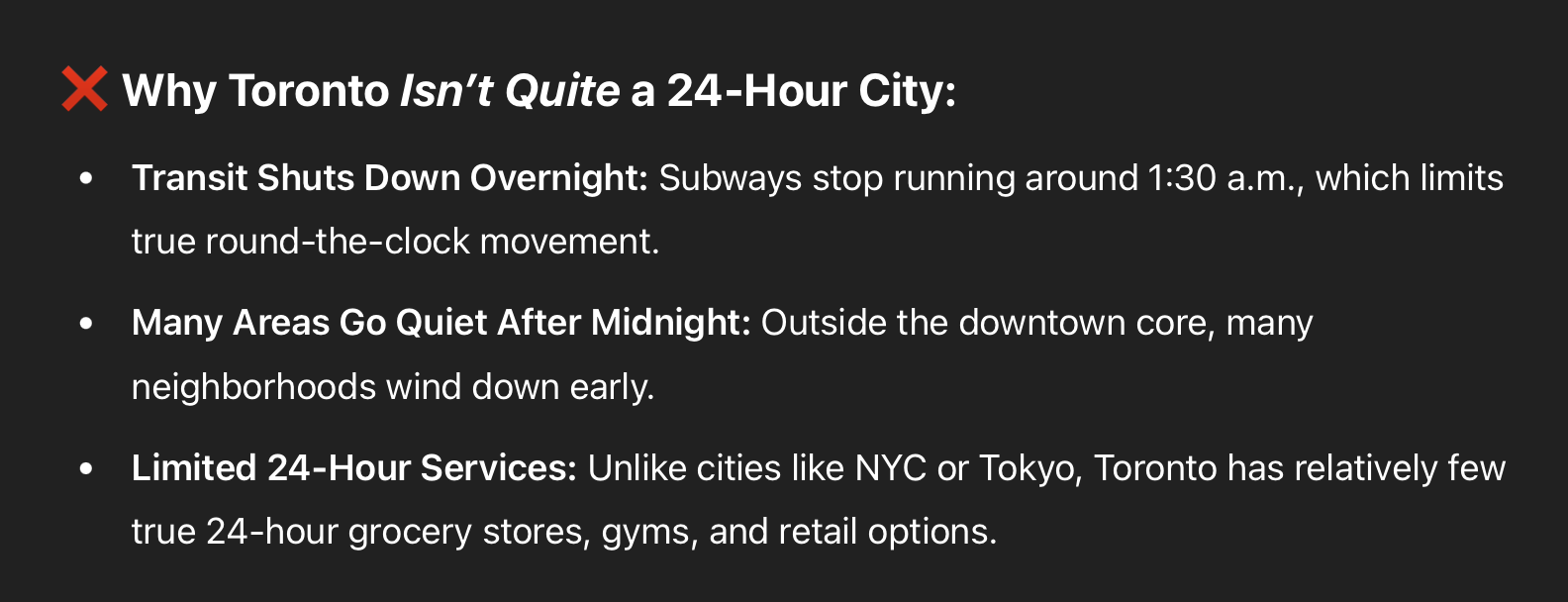
    According to ChatGPT, Toronto is a “semi 24-hour city.” Its deficiencies:

    Here’s how I generally think about it.

    Step 1 is reasonable daytime hours. As a North American, I still find it frustrating how some/many restaurants in Europe close between lunch and dinner. Call me spoiled, but what if I got held up at work and couldn’t eat during the generally accepted time? Or if I went to the gym in the morning and now I suddenly have a dire caloric deficit?

    Step 2 is staying open kind of late, including on Sundays. A few weeks ago I was driving around the suburbs of Toronto — on a Sunday — and I decided to take advantage of this rare occurrence to stop in at what’s called an enclosed shopping mall. So I got all the way there, pulled confidently on one of the front doors, and then realized it had closed 2 hours ago.

    Step 3 is the rarified big leagues; you’re a “24-hour city.” Reece gives the example of Apple’s Fifth Avenue store, which, in case you forgot, never closes. I don’t typically shop for consumer electronics at 3AM, but I might. And there’s something oddly comforting about knowing I could. This isn’t possible in all cities, but it is in New York. That says something.

    Cover photo by Jan Weber on Unsplash