Daily insights for city builders, delivered every morning at 6 AM ET. I’m Brandon Donnelly — a Toronto-based real estate developer and founder of Globizen. I’ve been writing here since 2013.

  • Why Norway loves Tesla Motors

    Norway imposes big levies on the sale of fuel burning vehicles. They can amount to more than 100% of the sale price—effectively doubling the price of a vehicle. It’s a supertax.

    Exempt from these taxes, however, are electric vehicles. This has not surprisingly made Elon Musk’s Tesla Motors an incredibly popular choice. In fact, Norway has become Tesla’s best overseas market with the highest per capita sales.

    And it’s because it makes economic sense, at least for some. Here’s how a Norwegian would save by buying the Tesla Model S

    “EV drivers enjoy breaks on levies the government imposes on vehicle purchases to the tune of about $135,000 for the Model S, which has a local starting base price of about $112,000. In other words, if the Model S had a gas engine, like comparable luxury cars, it would cost nearly $250,000 to own one in Norway.”

    But this approach has been criticized as a subsidy for the wealthy. People are buying a Tesla S instead of a Porsche. However, you could argue that the intent of the supertax is being fulfilled: more people are buying electric vehicles. Which is why the per capita fleet of plug-in electric vehicles as a whole in Norway is the largest in the world.

    So the lesson here is that if you want people to adopt sustainability, just make it cheaper.

    Credit to Evgeny of 500px for giving me the idea for this post.

  • Condo maintenance fees explained

    One of the objections I often hear from people regarding condominiums is that they don’t like the idea of paying maintenance fees. So I’ve been meaning to do a post for some time now that breaks down and explains exactly where that money goes.

    Here is a simplified example. It ignores some of the miscellaneous income that buildings usually receive (from guest suites, the party room, public parking and so on). And of course, these numbers will vary based on the age of the building, specific amenities, and any deficiencies it may have. Nonetheless, it should give you an idea.

    image

    So assuming you pay $400 per month as a common element fee, a percentage of that will—or at least should—get immediately stripped away as a reserve fund contribution. Again this will depend on the age the building and the periodic reserve fund study that’s typically required to be done.

    After that you have the operating expenses. The biggest items you’ll notice are contracts and utilities. Contracts are things like janitorial services, snow removal, property management fees, security/concierge services and so on. They’re contracted items. Utilities are self explanatory. 

    Once all the operating expenses have been paid, any remaining money then goes to retained earnings and sits in the condo corporation to handle any other expenses that may arise.

    Looking at the total operating expenses ($263), you should notice that it’s only about 66% of the total common element fee ($400). A big chunk of your common element fee is actually going towards saving for the future. Assuming the building is being properly managed, I’m okay with this.

    If you have any feedback on my numbers, I’d love to hear from you in the comment section below or on twitter.

  • SKATE city videos

    Two weeks ago I wrote a post called “Skateboarding and the city.” If you liked that post, I recommend you take a look at this 5 minute video called SKATE Toronto. It’s part of a series where local skateboarders provide a guided tour of their city.

    [youtube=http://www.youtube.com/watch?v=SEb4QvJzFVU&w=560&h=315]

    You’ll find similar videos for New York, Los Angeles, Miami, Philadelphia, Hong Kong, etc. What I like about them (other than the skating, of course) is that they clearly demonstrate the unique way in which skateboarders examine and engage with cities.

  • Car as prosthetic

    I spent a lot of time in the suburbs over the holidays and it got me thinking.

    For all the talk about intensification here in Toronto, adapting our car dependent suburbs to become, well, less car dependent is going to be an enormous challenge. Once you’ve built out an area around the car, it’s almost impossible to go back. 

    One of the biggest challenges is going to be figuring out how to turn the suburbs from inward to outward. If you think about it, the suburbs are an incredibly inward type of development pattern.

    Retail plazas typically have their entrances—not off main streets—but off internal parking lots. And residential areas often have backyards facing the main streets because nobody wants a house fronting on a major thoroughfare. These are the design principles we’ve used to create our suburbs.

    But the result is that we’ve created environments that are inhospitable to pedestrians. What enjoyment would you get out of walking along a street where everything has its back turned to you? This is the anthesis of animated street life. And in this case, Margaret Thatcher would probably be right: I would feel like a failure taking the bus.

    To compensate for this kind of environment, we’ve made it virtually mandatory to have a car. It’s the only reasonable way to get around. Writer Rebecca Solnit put it best when she said:

    “In a sense the car has become a prosthetic, and though prosthetics are usually for injured or missing limbs, the auto-prosthetic is for a conceptually impaired body or a body impaired by the creation of a world that is no longer human in scale.”

    And that’s precisely it. We built around the car and not around people. And in doing so, we made ourselves dependent. I don’t know about you, but there’s something liberating about being able to walk to all the things I commonly want—food, money, coffee and so on. But maybe that’s just me.

  • Innovating amongst the haters

    Whether you’re developing a building, planning transit, starting a company or just trying to do something different, there will always be haters. But pessimists don’t change the world—optimists do.

    I came across a great post last night by venture capitalist Ben Horowitz. It’s called, “Can-Do vs. Can’t Do Culture.” And I think you’d be well served to keep a copy of it on file and read it before every single meeting where you’ll be asked to provide input on something new.

    He’s specifically talking about a growing and discouraging trend of naysaying in the tech community, but the lessons apply more broadly to innovation as a whole.

    I love these lines:

    “The trouble with innovation is that truly innovative ideas often look like bad ideas at the time. That’s why they are innovative — until now, nobody ever figured out that they were good ideas.”

    “From a psychological standpoint, in order to achieve a great breakthrough, you must be able to suspend disbelief indefinitely. The technology startup world is where brilliant people come to imagine the impossible.”

    But the best part of Horowitz’s post is an excerpt from an internal Western Union report (then the largest telegraph provider in the US) recommending that the company not purchase Alexander Graham Bell’s invention (the telephone) and patents for $100,000.

    The Telephone purports to transmit the speaking voice over telegraph wires. We found that the voice is very weak and indistinct, and grows even weaker when long wires are used between the transmitter and receiver. Technically, we do not see that this device will be ever capable of sending recognizable speech over a distance of several miles.

    Messer Hubbard and Bell want to install one of their “telephone devices” in every city. The idea is idiotic on the face of it. Furthermore, why would any person want to use this ungainly and impractical device when he can send a messenger to the telegraph office and have a clear written message sent to any large city in the United States?

    The electricians of our company have developed all the significant improvements in the telegraph art to date, and we see no reason why a group of outsiders, with extravagant and impractical ideas, should be entertained, when they have not the slightest idea of the true problems involved. Mr. G.G. Hubbard’s fanciful predictions, while they sound rosy, are based on wild-eyed imagination and lack of understanding of the technical and economic facts of the situation, and a posture of ignoring the obvious limitations of his device, which is hardly more than a toy …

    In view of these facts, we feel that Mr. G.G. Hubbard’s request for $100,000 of the sale of this patent is utterly unreasonable, since this device is inherently of no use to us. We do not recommend its purchase.

    It’s a classic example of The Innovator’s Dilemma (a book written by management guru and HBS professor Clayton Christensen). Many firms see their businesses disrupted because they blindly stick to the innovation that made them successful in the first place—ignoring what’s coming up on the horizon.

    In the case of Western Union, they could not imagine “telephone devices” in every city. The idea was pure lunacy to them. Of course to us today, they look like myopic fools. We now not only have telephone devices in every city, but a full fledged computer in every pocket. Imagine that.

    Which is why I think it’s important to remember that the way to drive the world forward is—to use Horowitz’s terminology—through hope and curiosity. Suspend disbelief. Think big. Dare to be crazy. Because you’re only crazy until you’re proven to be a genius.

  • Measuring urban form

    Last night the Toronto Transit Commission offered free service starting at 7pm. This is typical of Toronto on New Year’s Eve, as it is with many other cities. I think it’s great thing to do and I love seeing so many people taking transit to get around. I took it everywhere last night.

    Since I knew I would be doing a lot of walking, I charged up my Fitbit Flex and strapped it on around lunch time. Here is my New Year’s Eve according to Fitbit. I took 11,239 steps yesterday afternoon/evening.

    Activity tracking and health monitoring devices have really taken off over the past year. And I absolutely do think they help motivate. But beyond an individual level, I also think this data could be really interesting in aggregate and overlaid with other data points, such as where people live, where they work, how they travel/commute, and so on.

    Many have speculated that urban sprawl makes people fat since it privileges driving over walking. But with all the data that companies such as Fitbit and Nike are collecting, it would be interesting to see some hard data on how much more urbanites really walk compared to suburbanites.

    One idea would be to use Walk Score and examine the correlation between the walkability of a person’s neighbourhood and the average number of steps they take everyday. Intuitively, it seems like there would be a strong one. But it would be cool to see it quantified. I’d happily share my data if somebody would like to take this on.

    Happy New Year, everyone. Welcome to 2014.

  • Why New Year’s resolutions suck

    It’s nearly 2014. And I suspect many of you are about to begin pursuing your New Year’s resolutions (or are at least contemplating the idea). Unfortunately, I’m here to deliver some bad news: they don’t work. Statistically, the odds are against you. In fact, a 2007 survey done in the UK found that 88% of all resolutions end in failure!

    So why do we keep making them? Well, old habits die hard.

    But to be perfectly honest with you, I’ve never been a fan of New Year’s resolutions. They strike me as silly. If I smoked (which I don’t), why would I wait until the New Year to “quit”? Because I don’t really want to quit and this prolongs it. It’s a form of procrastination.

    If you really want to do something, do it right now—whether it’s May or October. It’s that simple. And if you’re not willing to do it right now, then, to be honest, you probably don’t want it that bad. And if you wait until the New Year, you’ll almost certainly fail.

    But I will say that I do enjoy and believe in goal setting. I keep lots of lists (using apps like Clear and Evernote). In particular, I like to actively manage two sets of goals. I call them “My Progressive Goals” and “My Disciplines.”

    Progressive goals are things, like the name suggests, that grow and evolve over time. For example, completing my MBA, ahead of schedule, was one of my progressive goals for 2013. Check.

    My Disciplines, on the other hand, are activities that in and of themselves don’t change. They’re just things I’ve committed to doing and I use the list as both a reminder and as a way of ensuring I don’t take on too much (which I have a tendency of doing).

    These are things like blogging here everyday, going to the gym regularly, and doing one big snowboard trip with the guys from Penn every year. I’ll still set progressive goals within each discipline, but the disciplines themselves stay the same. They are, after all, disciplines.

    So as much as I scoff at New Year’s resolutions, I have been tuning up my goals and disciplines for 2014. Blogging became a big part of my life in 2013 and I look forward to getting better at it in the New Year. Thanks for reading Architect This City. Don’t forget to subscribe to my newsletter.

    Onwards my friends!

  • Toronto’s concession roads

    I’m late in writing this blog post because I was up in Collingwood for the day snowboarding. I’m exhausted, but I do have something to say.

    One of the things I always find interesting when I’m driving north of the city is how far Toronto’s major north-south streets extend. Go out to Aurora or Newmarket and you’ll still come across many familiar faces such as Jane, Keele, Dufferin, Bathurst and Yonge Street. And the distance between each of them is exactly the same as it is in the city: 2 kilometres.

    This may not seem like much of a big deal, but have you ever wondered how this street grid was established?

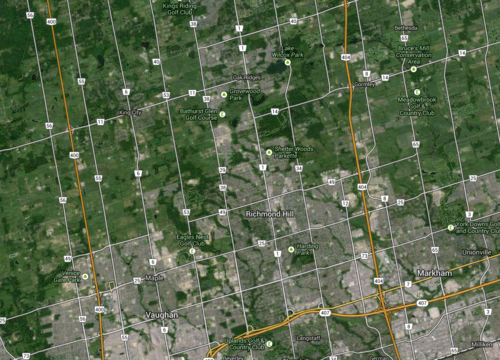
    These streets are actually concession roads. And they were used to subdivide undeveloped land in Upper and Lower Canada into a grid that could then be further subdivided into farming lots. Each square of the grid is 2 km x 2 km, or 1,000 acres.

    Look at a map of the Greater Toronto Area and you’ll see it:

    image

    But what I find most intriguing about this grid system is that it was designed around farming—not our current use case. The intent was to further subdivide each 1,000 acre lot into smaller 100 acre farming lots. And these concession roads were for access—they weren’t city blocks.

    By comparison, there’s another city that’s famously run off a regular street grid. You may have heard of it. It’s called New York. And its street grid was established in the Commissioner’s Plan of 1811. Some even go so far as to say that it’s “the single most important document in New York’s development.” 

    But New York’s grid is much different than the one I’m talking about. Because of its smaller scale (20 blocks a mile going north-south), New York’s was decidedly urban. It was meant for city building.

    Now, in the case of Toronto, concession roads obviously never stopped us from developing a thriving city. We filled in each square to make them as urban as we needed them to be. But as planning ideals changed, so did the infilling of those squares. Our grid was flexible enough to accommodate everything from farm land to suburban subdivisions.

    But I can’t help but wonder how the Greater Toronto Area would have turned out had we, quite simply, chosen a different size of square. What if instead of 2 km x 2 km, we had made them 1 km x 1 km? Or what if we made them even smaller? What would the Toronto region look like today?

    Sometimes it may seem like a simple decision, but in reality the implications are huge.

  • Mall or Main Street?

    It’s December. You’re in Toronto. The high for today is 5 degrees celsius. But the overnight low is expected to reach -11. Would you rather shop inside a warm mall or outside along a hip urban Main Street?

    This is a question that has come up a number of times in retail real estate meetings here in Toronto and the general consensus is often that people in our climate don’t want open air malls and Main Streets. They prefer enclosed malls.

    However, this is not to say that we don’t have open air malls and that we don’t have a thriving downtown, because we do.

    What I am saying though is that when the pension funds sit around contemplating what retail investments to make, they’re still largely thinking enclosed shopping centers. That’s why it seems like every major mall in Toronto is going through an expansion.

    But still, I wonder what the actual consumer preference is. Is it really our climate? Or have we just become accustomed to driving to the mall? Here’s a similar blog post talking about the Finnish obsession with shopping centers and malls.

    Generally speaking, I don’t love malls. There’s no urban authenticity. I find it much more enjoyable shopping at one-off and independent stores. But is this just a snobby architect, planning thing? I’d love to continue the conversation on twitter.

  • Please don’t walk on the grass

    The blog of Gehl Architects, called Cities for People, wrote a post this morning called, “Reflecting on Urban Play in Denmark.

    It’s a good follow-up to the post I did a week ago called, “Skateboarding and the city”, because in many ways, the example I gave (LOVE Park) is an extreme case of what Cities for People is talking about:

    “This sign, and other familiar signs such as “Please Don’t Walk on the Grass” characterize a common understanding of the urban landscape and its features as something to visually admire from a distance rather than interact with. While play and physical interaction with our surroundings is an intuitive social behavior, playful uses of the urban landscape and its features are often regarded as an illegitimate use of city space.”

    It’s the equivalent of buying a sofa, covering it with plastic, and not letting anyone sit on the damn thing. What’s the point?

    Fortunately, Copenhagen seems to be bucking that trend. Here are a few examples.