Daily insights for city builders, delivered every morning at 6 AM ET. I’m Brandon Donnelly — a Toronto-based real estate developer and founder of Globizen. I’ve been writing here since 2013.

  • Transitioning from architecture to development

    A few years ago during a class at the Rotman School when we were all introducing ourselves, I had a professor ask why all architects seem to want to become developers. He asked it because there were 3 architects (or at least architect-trained) in the class who were either currently working in development or planning to move into development following their MBA.

    Indeed, it is pretty common for architects to make this jump. So much so that I’m often asked (as recently as last night) about how I made the transition from architecture to development. Given the frequency of this question, I figured it would be worthwhile to turn my response into a blog post—particularly since I did make the decision to write more about what it means to be a developer.

    The first thing I should say is that I’ve never really worked as an architect. I interned at an architecture firm one summer, but that’s about it. I’m not licensed as an architect and I have no plans of ever becoming licensed. Therefore, I’m technically not allowed to call myself one, which is why I often say “architect-trained.”

    However, this doesn’t mean that I didn’t face a certain degree of stigmatization while I was completing my Master of Architecture and looking for my first real estate job. The real estate community often perceives architects as being impractical, fanciful and generally poor with money and business.

    Part of this, I think, has to the with the fact that design schools often don’t like to talk about making money. It’s taboo. Design is supposed to be something purer and grander than money. Maybe that’s why it’s not uncommon for even the most famous of architects—such as Louis Kahn—to die deeply in debt.

    But I think this perspective is bullshit. Which is why I spent every single one of my electives during my Master of Architecture over at the business school taking finance, economics and real estate classes. I was determined to be just as good as the MBAs at “the numbers.” And even became a teaching assistant for a real estate economics class.

    So my first piece of advice to architects looking to make the transition to development is that you need to overcome the perception that you don’t understand money and business. You need to demonstrate that you can crunch numbers and that you know how to make money for investors.

    This could mean getting an MBA or Master of Real Estate Development, taking extracurricular classes, starting a blog, or just convincing somebody in real estate to give you a chance so that you have it on your resume. Whatever it is, you need to reposition your personal brand so that it no longer says architect.

    This is important because, from my experience, if a real estate company is used to hiring people with business degrees, then it’s going to be tough to get them to pay attention to you and your architecture degree. They just don’t understand the value that you might be able to bring to the organization (and you do bring value).

    My second piece of advice is to find developers who have an architecture background and specifically reach out to them. There are lots of us. They’ll be sympathetic to your background and will probably give you more time of day. But you’ll need to come prepared with the right tool chest. Demonstrate to them that you have the skills necessary to be a developer (see above).

    As I’ve said before, developers are, in many ways, a jack of all trades. So the more you can master all of those trades, the more likely you’ll get some hiring manager to take a risk on you. But when you do finally make that transition, I believe that you’ll be better for it.

    Not only because architects understand the building process, but because architects are trained to have an inherent sense of responsibility for the built environment. We get upset when building are ugly and public spaces suck. But we also know what will make them better.

    The way I see it, by becoming a developer you’re really just learning how to execute on your ideas. It’s one thing to know what makes a building beautiful, but it’s another thing to go out and raise the capital and build the damn thing.

    So I don’t regret any of my architecture degrees. I got so much out of them. And I firmly believe that design is only going to become more important. Designers, after all, are the new rock stars. We just need a few more business and entrepreneurship classes in architecture schools.

  • How Bloomberg transformed the streets of New York

    Here’s a great video by Streetfilms that shows the incredible transformation of New York’s public realm during the Bloomberg administration. I found it via The Urbanophile blog. It’s about 5 minutes long.

    Video Description: “There’s nothing more dramatic than looking back five or ten years at Streetfilms footage to see how much the streets of New York City have changed. In this wonderful montage, check out the incredible changes at Times Square, Herald Square, the Brooklyn waterfront, and many other places that outgoing NYC DOT Commissioner Janette Sadik-Khan and her staff have intrepidly transformed.”

    It just goes to show what can be accomplished with the right leader and political will. I wish we (Toronto) had a mayor who understood the value of beautiful public spaces and bike lanes. It’s unfortunate that these things often become attached to political orientation. This shouldn’t be the case. It’s just good city building.

  • How Facebook is using its data to analyze global migration patterns

    More and more people are moving to cities. This much we know. But in our fast paced world, census data is becoming increasingly limited in its ability to tell us exactly where and how people are moving.

    Thankfully we now have Facebook. 

    image

    I just discovered a fascinating study conducted by the Facebook Data Science Team called “Coordinated Migration.” What they did was anonymously analyze every Facebook user that has inputted both a hometown and a current city to see where people of a particular hometown are most likely to live, today.

    But more specifically, the study is looking at coordinated flows, rather than just total flows to a particular city. A “coordinated migration” is defined as an instance where “a significant proportion of the population of a city has migrated, as a group, to a different city.”

    What the study found (perhaps not surprisingly) was that the vast majority of coordinated migrations are happening in countries that are in the midst of rapid urbanization. It’s a case of people moving within the country to its largest city.

    Here are the top coordinated migration destinations:

    If you’re interested in the nitty gritty of how they actually computed the coordinated migrations, check out the original post by the Facebook Data Science Team.

  • Who’s going to disrupt real estate?

    There’s an interesting article in Forbes (from last week) called, “Invest in the Disruptors of the Real Estate Industry.” It’s by Ross Gerber who runs a wealth and investment management firm out of LA called Gerber Kawasaki. He’s also a fellow Penn alum.

    I like the article because I agree with the problem he’s identified. The real estate market is imperfect and inefficient. We need a proper electronic marketplace.

    But I disagree with where he feels the solution will (or may) come from. I don’t think it’ll come from an incumbent like Zillow. They make money from agents and if they’re perceived to be driving down commissions, those customers are going to flee.

    Instead, I believe it’s going to come from a new entrant—a startup. And like most disruptors it’ll probably seem benign and, frankly, a bit crazy at first. Agents will dismiss it as a silly tool that will never cut into their business.

    But slowly and surely, that’s exactly what it’ll do.

  • Pick one or the other

    Two days ago I posted a neat interactive map of carbon footprints across America. It was taken from an Atlantic Cities article. But in the same post, I questioned the (Atlantic Cities) article’s headline and main assertion that increasing population density won’t help to curb greenhouse gas emissions.

    This didn’t make sense to me.

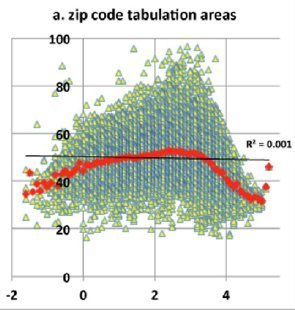
    Well it turns out that the supporting research data was slightly misinterpreted. According to the Per Square Mile blog, the UC Berkeley study associated with the interactive map reveals a more nuanced relationship between population density and carbon emissions. It turns out that people who live in the middle of nowhere (rural residents) actually have fairly low carbon footprints. Even though they’re reliant on cars, they tend to drive and consume relatively little.

    And so initially, as population densities increase, so do carbon footprints. That is until it reaches about 3,000 people per square mile. At that point, carbon emissions start to drop off dramatically—roughly 35% on average from suburb to city.

    Below is a graph I found in the comment section of the original Atlantic Cities article that demonstrates this phenomenon. Population density is on the x-axis and carbon emissions are on the y-axis.

    image

    So here’s the big takeaway. If you’re looking to optimize around your carbon footprint, you need to pick a side: Either be urban or be rural. But don’t be somewhere in the middle. Don’t be suburban.

  • Competitiveness and currency

    The Globe and Mail published an article yesterday morning called, “Why a lower loonie is (mostly) good for Canada.” It talks about the recent decline of the Canadian dollar from parity last May to roughly USD $0.92 today. But that the drop is essentially because of a rising US dollar. 

    Irrespective of what’s causing the devaluation though, the article takes the tone that it’s generally good for the country:

    “On net, this could be seen as a good thing because it’s making Canadian goods and services more competitive,” said Michael Devereux, a professor at the University of British Columbia’s Vancouver School of Economics.

    But this viewpoint always gets me concerned. 

    Canadian goods and services shouldn’t be competitive because they’re cheaper; they should be competitive because they’re the best damn good and services in the world. And so my fear with statements, like the one above, is that it almost makes us believe that a weak dollar is a prerequisite for competitiveness. It’s not.

    In fact, research done by Professor Walid Hejazi at the Rotman School has shown that a weak Canadian dollar actually lowers productivity levels and creates a disincentive for innovation. Why bother to innovate when you can always get your goods and services to market at a lower cost than your competitors?

    Thankfully, the outgoing Senior Deputy Governor of the Bank of Canada (and upcoming Dean of the Rotman School), Tiff Macklem, has acknowledged this perspective. In a talk at Queen’s University last January, he said:

    “What should Canadian businesses do? First, don’t count on a weaker Canadian dollar. Hoping for a weaker Canadian dollar is not a business plan. A sustainable export strategy cannot rely on expectations of a more favourable exchange rate, since Canada is likely to remain an attractive investment destination.”

    That sounds like good advice to me.

  • Interactive map of carbon footprints across America

    Atlantic Cities recently published an article called, “Beefing Up Population Density Won’t Curb Greenhouse Gas Emissions.” And in it, they link to a really neat interactive map created at UC Berkeley that outlines the carbon emissions of nearly every zip code in America (2013 numbers). 

    Not surprisingly, it shows that urban folk generally have a much smaller carbon footprint as compared to suburbanites. Here’s what New York City looks like (green is lower carbon emissions and red is higher):

    image

    But the article also goes on to say that the solution is not to work towards increasing population densities in either urban centers or suburbs. And that, in fact, efforts to increase population densities in the suburbs would only make things worse—emission levels have been shown to only go up and then new suburbs end up getting formed around the intensified ones.

    I understand the last point about endless suburbs, but I don’t fully understand this recommendation. Do carbon emissions go up in the suburbs when population densities are increased because it still remains car dependent and so all you have is more people driving?

    Intuitively, it would seem that if more people stopped driving, shopped locally and lived in more compact spaces, carbon emissions would fall. But perhaps I’m missing something.

    If anyone has any insights on this topic, I would love to hear from you in the comment section below or on twitter.

  • What real estate developers do and why I became one

    I met up with a friend yesterday after work and the topic of my blog came up. He said he loved the content, but that he would like to learn more about the inner workings of what it means to be a real estate developer. His belief was that there are lots of city blogs out there, but rarely do you get the candid perspective of a developer.

    I immediately thought this was a good idea for one simple reason: When I’m at a party and I tell someone that I’m a real estate developer, oftentimes they have no idea what that means. They usually think I’m a real estate agent. Or they ask me to explain a typical day. Either way, I’ve found it generally smoother (and more impressive) to just lie and say I’m an architect.

    So I’m going to do just what my friend suggested. I’m going to make an effort to talk more about what it means to be a real estate developer. And to kick it off, I thought I’d start with some of the basics and then talk about how I got into the business.

    Real estate developers are effectively the entrepreneur that make a new building happen. They go out and buy the land, they put a team in place (architect, engineers and so on), they get the necessary approvals to build (with the help of the team of course), they finance the deal, and then they get a builder to actually construct the project.

    Developers are like an orchestra conductor. They don’t play any instruments, they just direct the performance.

    But at the same time, developers assume 100% of the risk of the project. If the building fails (because you can’t sell the condo units or lease out the space), that all falls on the developer (and his/her investors). All of the other team members are getting paid based on the services they provide. They’re consultants.

    This distinction is what (can) make real estate development so lucrative—with risk comes reward. And I’ll be completely candid in saying that this is part of the reason I decided to get into development. I was training to be an architect and I started realizing that I could make more money as a developer.

    But I also came to the realization that as a developer I would likely end up having more say over the built environment. That’s the unfortunate reality of my industry. Even though architects spend far more time than your average developer thinking about what makes buildings and cities great, I would argue that they don’t have nearly the same amount of say. Because if they did, we probably wouldn’t have so many crappy buildings in our cities. But it’s this way because architects aren’t assuming the risk.

    Part of me used to actually feel bad about switching over to the dark side, which is how some architects refer to the development game. But the best way to summarize how I feel today is through what an architect friend told me a few years ago: “Brandon, cities don’t need more architects that care about design. We have lots of those. Cities need more developers that care about design.”

    And so that’s what I became. A developer who loves design and cares deeply about one of our greatest assets—cities.

  • Transit vehicle capacities compared

    I was cruising the twitter sphere yesterday when I came across the following chart, outlining the various transit vehicle capacities here in Toronto. It was created by Cameron MacLeod of #CodeRedTO, which is a grassroots group advocating for “a rational, affordable, and achievable rapid transit strategy for Toronto.”

    image

    On the left you have the vehicle type and then you have the capacity in terms of number of seats and standing room. The planned capacity is essentially the sum of those two numbers and the “unsafe crush load” is the number of people you could fit if you really put your back into it.

    Articulated buses refer to the longer (1.5x) bendy ones and, similarly, ALRV streetcars are the longer, articulated version of our regular streetcars. The low-floor streetcar is similar to what Toronto will be getting. And SRT is the Scarborough Rapid Transit system.

    The chart also compares between vehicle types: How many cars would you need to move the same number of people? How many buses? And so on. As one example, you would need 15.9 buses or 982 cars to move the same number of people as the Yonge subway line!

    What’s missing from the above chart though is light rail transit (LRT), which is comparable to the linking of up to 3 low-floor streetcars. In the case of the under construction Eglinton Crosstown LRT line, the planned capacity is 750 people!

    This is an hugely important takeaway because many people, including our own Mayor, do not properly distinguish between streetcar and light rail. The two are not one and the same. LRT has the potential to move a lot more people.

    In fact, at 750 people, the Eglinton Crosstown could move more people than the Sheppard subway line, which is only operating on 4 cars (as compared to 6 on our other subway lines).

    So while it’s all fine and dandy to bang our fists on the table and advocate for subways, they don’t make economic sense in all parts of our city. With the Sheppard line, we’ve been leaving capacity on the table and wasting taxpayer money.

    Of course this chart is also useful for those outside of Toronto. What I like about it is that it clearly shows the tool chest available to cities when it comes to building transit. Every city and neighborhood is different. And I think it’s important to have intelligent conversations about what makes sense in each.

    Thank you to Cameron and #CodeRedTO for allowing me to post their work.

  • Road pricing chicken and egg

    Regular readers of this blog will know that I’m a big supporter of road pricing. I think it’s an incredibly efficient way of reducing congestion, improving regional productivity, making us more sustainable, and funding other infrastructure, like transit.

    But one of the arguments I often hear against road pricing is that it’s unfair to force a segment of the market out of their car if there’s no good alternative (ie. proper transit). And even if the revenue produced from road pricing goes towards transit, we all know that new infrastructure takes a very, long, time.

    So we end up with a chicken and egg problem: Road pricing is a great way to fund transit, but it’s difficult to implement without the proper transit in place. So what should we do? What comes next?

    I have two thoughts.

    First, road pricing doesn’t necessarily mean that you can no longer drive without paying. Effective road pricing matches price with demand. Therefore if there’s nobody else on the road, you wouldn’t be paying (or at least wouldn’t be paying much). This is what makes it efficient—it adjusts. So for somebody without the willingness to pay for peak congestion pricing, they could still have the option of driving at another time. Go in early or go in later.

    But what it does mean is that no matter what time you’re driving, the road could be priced so that it actually functions again. In Toronto today, many of our roads are completely failing. Demand greatly exceeds available supply (the amount of road we have) and so you can’t use them to get anywhere in an efficient way. So what we have is equal access to terrible non-functioning roads.

    Second, there’s no such thing as a free lunch and nobody said it was going to be easy to build phenomenal infrastructure. We all complain and say we want it, but when push comes to shove, are you willing to open up your wallet and pay for it?

    So I say forget pontificating about chickens and eggs and just do it. If we priced roads and setup other appropriate revenue tools, I’m sure there are some financial wizards in this city that could use tax increment financing or other mechanisms to ensure that we get shovels in the ground today for the new infrastructure that we so desperately need.

    These are important discussions to be having no matter what city you live in. I would love to hear your thoughts in the comment section below or on twitter.