Daily insights for city builders, delivered every morning at 6 AM ET. I’m Brandon Donnelly — a Toronto-based real estate developer and founder of Globizen. I’ve been writing here since 2013.

  • Pick one or the other

    Two days ago I posted a neat interactive map of carbon footprints across America. It was taken from an Atlantic Cities article. But in the same post, I questioned the (Atlantic Cities) article’s headline and main assertion that increasing population density won’t help to curb greenhouse gas emissions.

    This didn’t make sense to me.

    Well it turns out that the supporting research data was slightly misinterpreted. According to the Per Square Mile blog, the UC Berkeley study associated with the interactive map reveals a more nuanced relationship between population density and carbon emissions. It turns out that people who live in the middle of nowhere (rural residents) actually have fairly low carbon footprints. Even though they’re reliant on cars, they tend to drive and consume relatively little.

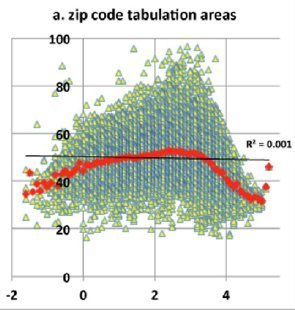
    And so initially, as population densities increase, so do carbon footprints. That is until it reaches about 3,000 people per square mile. At that point, carbon emissions start to drop off dramatically—roughly 35% on average from suburb to city.

    Below is a graph I found in the comment section of the original Atlantic Cities article that demonstrates this phenomenon. Population density is on the x-axis and carbon emissions are on the y-axis.

    image

    So here’s the big takeaway. If you’re looking to optimize around your carbon footprint, you need to pick a side: Either be urban or be rural. But don’t be somewhere in the middle. Don’t be suburban.

  • Competitiveness and currency

    The Globe and Mail published an article yesterday morning called, “Why a lower loonie is (mostly) good for Canada.” It talks about the recent decline of the Canadian dollar from parity last May to roughly USD $0.92 today. But that the drop is essentially because of a rising US dollar. 

    Irrespective of what’s causing the devaluation though, the article takes the tone that it’s generally good for the country:

    “On net, this could be seen as a good thing because it’s making Canadian goods and services more competitive,” said Michael Devereux, a professor at the University of British Columbia’s Vancouver School of Economics.

    But this viewpoint always gets me concerned. 

    Canadian goods and services shouldn’t be competitive because they’re cheaper; they should be competitive because they’re the best damn good and services in the world. And so my fear with statements, like the one above, is that it almost makes us believe that a weak dollar is a prerequisite for competitiveness. It’s not.

    In fact, research done by Professor Walid Hejazi at the Rotman School has shown that a weak Canadian dollar actually lowers productivity levels and creates a disincentive for innovation. Why bother to innovate when you can always get your goods and services to market at a lower cost than your competitors?

    Thankfully, the outgoing Senior Deputy Governor of the Bank of Canada (and upcoming Dean of the Rotman School), Tiff Macklem, has acknowledged this perspective. In a talk at Queen’s University last January, he said:

    “What should Canadian businesses do? First, don’t count on a weaker Canadian dollar. Hoping for a weaker Canadian dollar is not a business plan. A sustainable export strategy cannot rely on expectations of a more favourable exchange rate, since Canada is likely to remain an attractive investment destination.”

    That sounds like good advice to me.

  • Interactive map of carbon footprints across America

    Atlantic Cities recently published an article called, “Beefing Up Population Density Won’t Curb Greenhouse Gas Emissions.” And in it, they link to a really neat interactive map created at UC Berkeley that outlines the carbon emissions of nearly every zip code in America (2013 numbers). 

    Not surprisingly, it shows that urban folk generally have a much smaller carbon footprint as compared to suburbanites. Here’s what New York City looks like (green is lower carbon emissions and red is higher):

    image

    But the article also goes on to say that the solution is not to work towards increasing population densities in either urban centers or suburbs. And that, in fact, efforts to increase population densities in the suburbs would only make things worse—emission levels have been shown to only go up and then new suburbs end up getting formed around the intensified ones.

    I understand the last point about endless suburbs, but I don’t fully understand this recommendation. Do carbon emissions go up in the suburbs when population densities are increased because it still remains car dependent and so all you have is more people driving?

    Intuitively, it would seem that if more people stopped driving, shopped locally and lived in more compact spaces, carbon emissions would fall. But perhaps I’m missing something.

    If anyone has any insights on this topic, I would love to hear from you in the comment section below or on twitter.

  • What real estate developers do and why I became one

    I met up with a friend yesterday after work and the topic of my blog came up. He said he loved the content, but that he would like to learn more about the inner workings of what it means to be a real estate developer. His belief was that there are lots of city blogs out there, but rarely do you get the candid perspective of a developer.

    I immediately thought this was a good idea for one simple reason: When I’m at a party and I tell someone that I’m a real estate developer, oftentimes they have no idea what that means. They usually think I’m a real estate agent. Or they ask me to explain a typical day. Either way, I’ve found it generally smoother (and more impressive) to just lie and say I’m an architect.

    So I’m going to do just what my friend suggested. I’m going to make an effort to talk more about what it means to be a real estate developer. And to kick it off, I thought I’d start with some of the basics and then talk about how I got into the business.

    Real estate developers are effectively the entrepreneur that make a new building happen. They go out and buy the land, they put a team in place (architect, engineers and so on), they get the necessary approvals to build (with the help of the team of course), they finance the deal, and then they get a builder to actually construct the project.

    Developers are like an orchestra conductor. They don’t play any instruments, they just direct the performance.

    But at the same time, developers assume 100% of the risk of the project. If the building fails (because you can’t sell the condo units or lease out the space), that all falls on the developer (and his/her investors). All of the other team members are getting paid based on the services they provide. They’re consultants.

    This distinction is what (can) make real estate development so lucrative—with risk comes reward. And I’ll be completely candid in saying that this is part of the reason I decided to get into development. I was training to be an architect and I started realizing that I could make more money as a developer.

    But I also came to the realization that as a developer I would likely end up having more say over the built environment. That’s the unfortunate reality of my industry. Even though architects spend far more time than your average developer thinking about what makes buildings and cities great, I would argue that they don’t have nearly the same amount of say. Because if they did, we probably wouldn’t have so many crappy buildings in our cities. But it’s this way because architects aren’t assuming the risk.

    Part of me used to actually feel bad about switching over to the dark side, which is how some architects refer to the development game. But the best way to summarize how I feel today is through what an architect friend told me a few years ago: “Brandon, cities don’t need more architects that care about design. We have lots of those. Cities need more developers that care about design.”

    And so that’s what I became. A developer who loves design and cares deeply about one of our greatest assets—cities.

  • Transit vehicle capacities compared

    I was cruising the twitter sphere yesterday when I came across the following chart, outlining the various transit vehicle capacities here in Toronto. It was created by Cameron MacLeod of #CodeRedTO, which is a grassroots group advocating for “a rational, affordable, and achievable rapid transit strategy for Toronto.”

    image

    On the left you have the vehicle type and then you have the capacity in terms of number of seats and standing room. The planned capacity is essentially the sum of those two numbers and the “unsafe crush load” is the number of people you could fit if you really put your back into it.

    Articulated buses refer to the longer (1.5x) bendy ones and, similarly, ALRV streetcars are the longer, articulated version of our regular streetcars. The low-floor streetcar is similar to what Toronto will be getting. And SRT is the Scarborough Rapid Transit system.

    The chart also compares between vehicle types: How many cars would you need to move the same number of people? How many buses? And so on. As one example, you would need 15.9 buses or 982 cars to move the same number of people as the Yonge subway line!

    What’s missing from the above chart though is light rail transit (LRT), which is comparable to the linking of up to 3 low-floor streetcars. In the case of the under construction Eglinton Crosstown LRT line, the planned capacity is 750 people!

    This is an hugely important takeaway because many people, including our own Mayor, do not properly distinguish between streetcar and light rail. The two are not one and the same. LRT has the potential to move a lot more people.

    In fact, at 750 people, the Eglinton Crosstown could move more people than the Sheppard subway line, which is only operating on 4 cars (as compared to 6 on our other subway lines).

    So while it’s all fine and dandy to bang our fists on the table and advocate for subways, they don’t make economic sense in all parts of our city. With the Sheppard line, we’ve been leaving capacity on the table and wasting taxpayer money.

    Of course this chart is also useful for those outside of Toronto. What I like about it is that it clearly shows the tool chest available to cities when it comes to building transit. Every city and neighborhood is different. And I think it’s important to have intelligent conversations about what makes sense in each.

    Thank you to Cameron and #CodeRedTO for allowing me to post their work.

  • Road pricing chicken and egg

    Regular readers of this blog will know that I’m a big supporter of road pricing. I think it’s an incredibly efficient way of reducing congestion, improving regional productivity, making us more sustainable, and funding other infrastructure, like transit.

    But one of the arguments I often hear against road pricing is that it’s unfair to force a segment of the market out of their car if there’s no good alternative (ie. proper transit). And even if the revenue produced from road pricing goes towards transit, we all know that new infrastructure takes a very, long, time.

    So we end up with a chicken and egg problem: Road pricing is a great way to fund transit, but it’s difficult to implement without the proper transit in place. So what should we do? What comes next?

    I have two thoughts.

    First, road pricing doesn’t necessarily mean that you can no longer drive without paying. Effective road pricing matches price with demand. Therefore if there’s nobody else on the road, you wouldn’t be paying (or at least wouldn’t be paying much). This is what makes it efficient—it adjusts. So for somebody without the willingness to pay for peak congestion pricing, they could still have the option of driving at another time. Go in early or go in later.

    But what it does mean is that no matter what time you’re driving, the road could be priced so that it actually functions again. In Toronto today, many of our roads are completely failing. Demand greatly exceeds available supply (the amount of road we have) and so you can’t use them to get anywhere in an efficient way. So what we have is equal access to terrible non-functioning roads.

    Second, there’s no such thing as a free lunch and nobody said it was going to be easy to build phenomenal infrastructure. We all complain and say we want it, but when push comes to shove, are you willing to open up your wallet and pay for it?

    So I say forget pontificating about chickens and eggs and just do it. If we priced roads and setup other appropriate revenue tools, I’m sure there are some financial wizards in this city that could use tax increment financing or other mechanisms to ensure that we get shovels in the ground today for the new infrastructure that we so desperately need.

    These are important discussions to be having no matter what city you live in. I would love to hear your thoughts in the comment section below or on twitter.

  • Right answer to the wrong question

    Yesterday I wrote a post on why Norway loves Tesla Motors. The lesson was that if you want people to adopt sustainability, just make it cheaper. But here’s something to ponder: Are electric vehicles the right answer to the wrong question? (Jeff Speck in Walkable City)

    Now, don’t get me wrong, I think electric vehicles are great. They’re certainly better than gas vehicles from a sustainability standpoint. But is the ideal city of the future one where everyone is driving around in electric vehicles? Or is it one where the majority of people walk, bike and take transit? It’ll likely be a mixture of both scenarios, but I think it’s important for cities to know where they want to go.

    Switching from gas to electric solves some problems, but it doesn’t solve all of them. Traffic congestion and lost productivity, for example, don’t go away. So I would say that electric vehicles are part of the right answer—but there’s still lots of other work to be done.

  • Why Norway loves Tesla Motors

    Norway imposes big levies on the sale of fuel burning vehicles. They can amount to more than 100% of the sale price—effectively doubling the price of a vehicle. It’s a supertax.

    Exempt from these taxes, however, are electric vehicles. This has not surprisingly made Elon Musk’s Tesla Motors an incredibly popular choice. In fact, Norway has become Tesla’s best overseas market with the highest per capita sales.

    And it’s because it makes economic sense, at least for some. Here’s how a Norwegian would save by buying the Tesla Model S

    “EV drivers enjoy breaks on levies the government imposes on vehicle purchases to the tune of about $135,000 for the Model S, which has a local starting base price of about $112,000. In other words, if the Model S had a gas engine, like comparable luxury cars, it would cost nearly $250,000 to own one in Norway.”

    But this approach has been criticized as a subsidy for the wealthy. People are buying a Tesla S instead of a Porsche. However, you could argue that the intent of the supertax is being fulfilled: more people are buying electric vehicles. Which is why the per capita fleet of plug-in electric vehicles as a whole in Norway is the largest in the world.

    So the lesson here is that if you want people to adopt sustainability, just make it cheaper.

    Credit to Evgeny of 500px for giving me the idea for this post.

  • Condo maintenance fees explained

    One of the objections I often hear from people regarding condominiums is that they don’t like the idea of paying maintenance fees. So I’ve been meaning to do a post for some time now that breaks down and explains exactly where that money goes.

    Here is a simplified example. It ignores some of the miscellaneous income that buildings usually receive (from guest suites, the party room, public parking and so on). And of course, these numbers will vary based on the age of the building, specific amenities, and any deficiencies it may have. Nonetheless, it should give you an idea.

    image

    So assuming you pay $400 per month as a common element fee, a percentage of that will—or at least should—get immediately stripped away as a reserve fund contribution. Again this will depend on the age the building and the periodic reserve fund study that’s typically required to be done.

    After that you have the operating expenses. The biggest items you’ll notice are contracts and utilities. Contracts are things like janitorial services, snow removal, property management fees, security/concierge services and so on. They’re contracted items. Utilities are self explanatory. 

    Once all the operating expenses have been paid, any remaining money then goes to retained earnings and sits in the condo corporation to handle any other expenses that may arise.

    Looking at the total operating expenses ($263), you should notice that it’s only about 66% of the total common element fee ($400). A big chunk of your common element fee is actually going towards saving for the future. Assuming the building is being properly managed, I’m okay with this.

    If you have any feedback on my numbers, I’d love to hear from you in the comment section below or on twitter.

  • SKATE city videos

    Two weeks ago I wrote a post called “Skateboarding and the city.” If you liked that post, I recommend you take a look at this 5 minute video called SKATE Toronto. It’s part of a series where local skateboarders provide a guided tour of their city.

    [youtube=http://www.youtube.com/watch?v=SEb4QvJzFVU&w=560&h=315]

    You’ll find similar videos for New York, Los Angeles, Miami, Philadelphia, Hong Kong, etc. What I like about them (other than the skating, of course) is that they clearly demonstrate the unique way in which skateboarders examine and engage with cities.