
Daily insights for city builders, delivered every morning at 6 AM ET. I’m Brandon Donnelly — a Toronto-based real estate developer and founder of Globizen. I’ve been writing here since 2013.

  • Keeping our momentum

    This morning Kevin Marshall tweeted me a link to a blog post by Andy Weissman (partner at Union Square Ventures in New York). The post is about how small things matter—even small words.

    He starts by talking about a new sidewalk extension and curb cut at 86th Street and 3rd Avenue in Manhattan. This may seem like a pretty banal thing to talk about, but it’s in support of his argument that small things—like even a curb cut—can be used to solve bigger problems. In this case, the intersection was a dangerous one because of poor pedestrian visibility.

    But what I really like is how he describes the pulse of New York:

    “The rhythm of NYC is such that we need to keep moving and in motion; as a result, waiting to cross a street by standing at the curb is not enough, we must walk into the street to get going or keep our momentum.”

    This is great and it’s bang on. People in New York don’t stand at the curb waiting for the light to change. They impatiently push onto the street and wait for the first opportunity to cross. This may seem like a small tendency, but I think it speaks volumes about the character of New York.

    People in Toronto generally don’t do this.

    They (not me) wait patiently at the street corner even if there aren’t any cars coming. Why? Think about this the next time you’re standing on guard at the crosswalk. Don’t lose the momentum. The world rewards those who poke the box and keep moving.
  • Tomorrow’s capital of the world

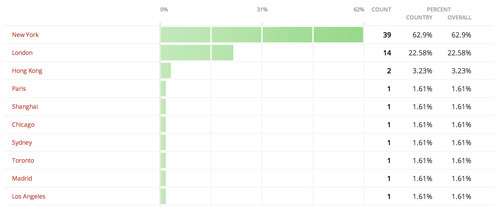
    Last week I polled the ATC community and asked which city they consider to be the “capital of the world.”

    image

    I received 62 votes and the overwhelming majority (63%) voted for New York. London came in a distant second with 23% of the vote. Though there’s probably a geography bias here (most of the readers of this blog are from North America), I did have a few people comment on Twitter that the answer to this question is blatantly obvious. The capital of the world is New York.

    But what I was really trying to do was establish a baseline for this week’s poll, which I think is a much more interesting question. Which city do you think will be the “capital of the world” in 2050? Again, there are no other instructions. Just select whatever first comes to mind. I’m using the same list of cities as before, but you can now add a city if you think the right answer is missing. If for whatever you can’t see the poll below, click here.

  • Housing policy in San Francisco

    The tech community has been receiving a lot of backslash in San Francisco as of late. And Peter Shih’s infamous 10 things I hate about San Francisco post certainly didn’t help. But I think there’s a bigger issue than just rich tech people driving up the price of real estate.

    I was reading Quartz this morning and I think they nailed it: 

    “But the blame shouldn’t go to the tech companies or their employees moving to San Francisco, however despicable some might be. Blame San Francisco for being pleasant, and its policymakers for being foolish: When a lot of people are moving to your city—San Francisco the city gained 50,000 new residents between 2000 and 2012, including some 25,000 between 2010-2012 and likely more since—home prices are going to increase unless you build a lot more housing.”

    I’ve talked about this idea before. But I wanted to break it down a bit more precisely.

    If San Francisco, the city, gained 25,000 people between 2010-2012, let’s say that the city gained roughly 8,300 people per year. I just divided by 3. However, if you look at the rate of new housing supply, you get a 10-year average of 2,350 housing units a year (from the Quartz article) and an even lower amount according to Atlantic Cities.

    Regardless, what you end up with is a pretty simple phenomenon: More people are moving to the city than new housing is being provided and that’s driving up the price of real estate. In fact, San Francisco allegedly only created 269 housing units in 2011! That’s the equivalent of only one fairly typical Toronto condo building going up (and we have hundreds under construction). No wonder there’s upward pressure on prices.

    So rather than just blame the tech community for the city’s housing problems, I think there needs to be a broader look at housing policy. If you really want to help affordability, here’s one simple solution: start building.

  • Housing tenure in Europe

    Yesterday I came across an incredibly fascinating chart from Eurostat, analyzing housing tenure (in 2011) across Europe. Here it is:

    image

    And here’s what I found interesting.

    Working from left to right, there seems to be a clear difference between Eastern and Western Europe in terms of the amount of leverage they use to buy homes. If you look at Romania, not only does over 90% of the population own a home, but they also don’t seem to have any outstanding mortgage or housing loan. That means they’re buying their homes in cash.

    By the time you get to the United Kingdom, you start to see numbers that are comparable to Canada and the United States. The percentage of owner occupied homes is sitting at or below 70% and the majority of them have a mortgage or loan.

    But as a whole, Western Europe seems much more likely to rent than Eastern Europe. And in the case of Switzerland, more people rent than own. Why is that? This seems odd given its economic strength. But the same could be said for Germany and Austria, which also show relatively low ownership rates. Here’s one possible explanation.

    Finally, I found it interesting that in Denmark, the Netherlands, and Sweden, there’s virtually no such thing as subsidized rental housing. If you rent, you’re paying market rate (at least according to this chart). I wonder if this has something to do with there being less income inequality.

    If anyone has any insights on some of these points, I’d love to hear from you in the comment section below.

  • Poke the box, dammit

    Last night before bed I decided to buy a book on my Kindle (iPad app) that I’ve been meaning to read for awhile. It’s called Poke the Box and it’s by Seth Godin. It’s a short read and it’s meant to be that way. You could easily read it in one sitting.

    The book is about taking initiative. Taking action. And drawing your own map. It’s about not being scared of failure and realizing that failures are how you learn. It’s about poking the box, which is a computer programming reference. Programmers learn by poking the box (computer) and seeing what works and what doesn’t work.

    As I read through the book I’m reminded of something that venture capitalist Ben Horowitz wrote a few months ago on his blog:

    “Every employee in a company depends on the CEO to make fast, high quality decisions. Often any decision, even the wrong decision, is better than no decision.”

    Both Godin and Horowitz are, in a way, talking about the same thing: You have to keep moving. Make decisions. Start stuff. And stop worrying so much about being wrong, because it’s virtually impossible to know how things will eventually play out in the future.

    A perfect example of this is Starbucks.

    The first Starbucks in Seattle didn’t sell brewed coffee. It sold beans. And had it continued along this path, it certainly wouldn’t have become the brand that it is today. In fact, it may have failed completely. It wasn’t until Howard Schultz saw what they had started and combined it with what he had learned in Italy, that the Starbucks experience of today was born.

    The important thing is that somebody (Jerry Baldwin, Zev Siegl and Gordon Bowker) took the initiative to start and build a Starbucks. It didn’t matter that they got the recipe wrong, they poked the box and it ultimately lead to something magical.

    The same reluctance to poke the box can also be found in city building.

    Here in Toronto we spend a significant amount of time debating and vacillating around transit decisions (as well as many other things). Should we build LRT? Or should we build subway? What should we replace the Scarborough Rapid Transit line with?

    But we’ve fallen into analysis paralysis.

    The original Transit City Plan was announced on March 16th, 2007. It’s now 2014. And transit still sucks. Imagine if we started and finished, say, 2 kilometers of rapid transit each and every year. Forget worrying if it’s LRT, subway or a horse drawn space ship. We just kept moving.

    Something tells me that we’d be better off, even if we did make a few mistakes along the way.

  • A culture of transparency

    One of the things I think the real estate industry is notoriously bad for is transparency. It’s getting better, but we’re nowhere near as transparent as some other industries, such as tech. In tech, you get companies like San Francisco-based Everpix who fail and then release all of their private documents to the public, including revenue, subscribers, cap table and so on.

    Could you imagine a real estate developer failing and then releasing all of its financials? This is what we paid for the land. This is how many units we sold. And this is why we failed. It doesn’t happen (or at least I’ve never seen it).

    Sure you might be able to get some of this information with a publicly traded real estate company, but that’s because they have to be more transparent. Everpix was 7 employees working out of a co-working space. They didn’t have to do this. But they did it because they wanted to help the larger startup community. They didn’t want to let a good failure go to waste.

    But at the same time, I actually don’t think that transparency is all about being altruistic. Transparency can also drive the bottom line. Every company wants to stand out from the competition and engage with its customers on a deeper level. But in order to do that, I think you need to give your customers something to engage with. You have to put yourself out there.

    One way to do that is to be more open and transparent. Be genuine and tell your customers who you are, what you believe in and, perhaps most importantly, why you’re doing the things that you’re doing. I like Simon Sinek’s philosophy that “customers don’t buy what you do, they buy why you do it.

  • Design your own beautiful maps

    If you love cities, then I’m willing to bet you probably also love maps.

    I just stumbled across a neat tool called Map Stack. It was created by San Francisco-based Stamen Design—probably one of the leaders in beautiful maps. The tool is one part Photoshop and one part Mapbox, and it allows you to quickly create an endless array of cool looking maps. Like these:

    image

    I spent 2 minutes and made a watercolor version of Toronto’s financial district:

    image

    This tool aside, I also really like Mapbox. When we were designing and building Dirt, we ended up using them for our map underlay because we wanted something beautiful and we didn’t love Google Maps for that reason. Though we missed Google Streetview, we were happy with the decision. Other apps using Mapbox include Foursquare and Pinterest.

  • A new model for the architecture profession

    Last week I provided a few suggestions for how architects might be able to transition over to real estate development. And I ended by saying that I loved architecture school, but that it could use a few more business and entrepreneurship classes. Today, I’d liked to expand on that idea.

    When I was doing my Master of Architecture at Penn, I spent a lot of time thinking about hybrid models for the architecture profession. I was trying to figure out a way to reconcile my love of design with my desire to be more of a building entrepreneur.

    I was interested in what Jonathan Segal was doing down in San Diego with his “architect as developer” approach. And I was really taken by a lecture that Joshua Prince-Ramus (formerly of OMA, now REX) gave where he talked about how architects have marginalized themselves (away from being the master builder) by shying away from liability.

    Out of all the models, conflating architecture and development seems to me like a real possibility. I believe that good developers understand good design and that good architects understand what’s good for the market. So why not merge the two?

    We know that the architecture profession is facing significant challenges; fewer and fewer architecture school grads are getting licensed and actually become a bona fide architect. Some think this calls for licensure reform, but I’m also interested in revisiting the model in its entirety.

    Imagine if every architecture school taught students how to design a building and then go out and actually get it leased up and built. Is this too much to ask of one discipline?

    I can see firms naturally splitting up roles between those who prefer the design side and those who prefer the selling and business side, but is there any reason why the same firm couldn’t be handling both?

  • Capital of the world

    If you had to pick one, which city would you consider to be the “capital of the world?” There are no other instructions. Just select whatever first comes to mind. If for whatever reason you can’t see the poll below, click here.

    If you’re curious about where the above list of cities came from, they’re simply all of the Alpha++, Alpha+ and Alpha cities according to the Globalization and World Cities Research Network (GaWC). The list may be a few years old though.

  • What signage says about your city

    I woke up this morning in the City of London, Ontario, to a parking ticket. Apparently, I had committed an infraction by parking between the hours of 3:00 am – 5:00 am.

    Here’s what the sign looked like, directly in front of my car. There were no other signs nearby other than one at the end of the street telling me where the parking area stopped.

    image

    Perhaps I’m missing something, but based on the signage provided, there’s absolutely no way for me to know that parking is not permitted between the precise hours of 3:00 am and 5:00 am. And truthfully, this seems like an odd set of hours to want to enforce. 

    If there were some feasible way for me to fight this ticket, I would. But since cities make this purposely difficult, I’m just going to pay it. Even though I feel like fighting it out of principle.

    But this post isn’t for me to complain about a parking ticket.

    When I got the ticket this morning, it reminded me of a “theory” that someone once told me at an Urban Land Institute conference a few years back in Washington D.C. I actually can’t remember who it was, but the idea was that you can tell how global a city is by the quality of its signage and wayfinding signage.

    I’m intrigued by this proposition because, if you think about it, a city unaccustomed to receiving outsiders has less of a need for quality signage. As a local, you begin to create your own mental map of the city and you intuitively start to understand what’s allowed, such as where you can park. The importance of good signage somewhat diminishes.

    But outsiders are coming with no understanding. They’re looking for directions and instructions. So you should make sure that your city is giving it to them. However, at the same time, there are lots of big global cities, such as New York, which are or were notorious for bad signage. So signage quality is probably not perfectly correlated with globalization.

    Regardless, signage matters. It’s one of the ways in which a city talks at you and others. How clearly does your city communicate?