Daily insights for city builders, delivered every morning at 6 AM ET. I’m Brandon Donnelly — a Toronto-based real estate developer and founder of Globizen. I’ve been writing here since 2013.

  • To drive or not to drive

    I’m writing this post from some lounge called Apropos at Toronto’s Pearson Airport. I’m waiting to board my flight to Denver and kick-off the 5th Penn Annual. Technically, the Annual is being held in Jackson Hole this year, but 2 of us are jamming in a few extra days in Vail beforehand. I like to make the most of these trips.

    As I was arriving at the airport, I made sure to check up on the status of the new Union Pearson (UP) Express station that’s currently under construction and slated to open in spring 2015. Once the line is complete, Union Station and Pearson Airport (Canada’s two busiest transportation hubs) will be connected by a 25 minute express train operating every 15 minutes. I’m pretty excited about this.

    One of reasons I’m excited is because I think that really great cities should be easily navigable without a car. I’m not saying that cars shouldn’t be allowed or that we should make life purposely difficult for drivers; I’m saying that the decision of whether or not to use a car should be entirely personal. Some parts of Toronto meet this criteria, but other parts most certainly do not.

    One of the parts that doesn’t is the trip to Pearson. Today, getting from downtown to Pearson on public transit is a terrible experience. I don’t recommend it. And so you’re basically forced to drive, get a ride or take a taxi. That’s fine, but it’s not ideal—particularly for non-residents.

    I like to think of visitors to a city as customers of that city. From the moment they land in the airport, they’re now using your product or service. And for most people, the first thing they’re thinking about is how they’re going to get to where they need to go. How are you going to help them?

    If you can put them onto an express train, and quickly and comfortably bring them into the city, then you’re already impressing them. Unfortunately though, we often don’t think of visitors in this way—unless you’re hosting some major event like, say, the Pan American Games. Then you really start to think about customer experience.

    Either way, the Toronto experience is about to get a whole lot better next year. And I’m excited about that.

  • Development Profile: The Well

    The Globe and Mail lands in Toronto, located between Front Street and Wellington Street, west of Spadina Avenue, have been in play for quite some time. But since the Globe and Mail confirmed last year that it would be moving its headquarters to a new First Gulf office building on King Street East, the lands opened up as a prime redevelopment opportunity.

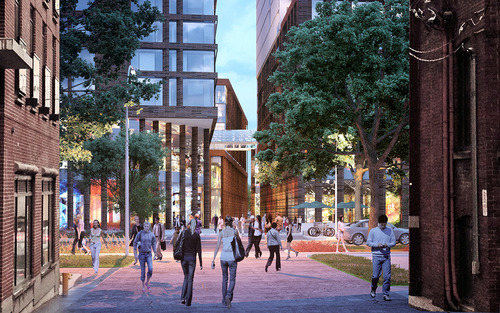
    Earlier this week I discovered the plans. It’s a new mixed-use neighborhood called The Well. And it’s a partnership between Allied Properties REIT, RioCan and Diamond Corp, with the master plan design being prepared by Hariri Pontarini Architects.

    Here are a few photos.

    Wellington Street looking east:

    image

    Wellington Street looking west:

    image

    Laneway looking south into the development site:

    image

    And here are some high level stats:

    • 7.7 acre site (Globe and Mail lands)
    • Encompasses Draper Street, which is a heritage designated street
    • Approximately 500,000 square feet of retail space
    • More than 1,000,000 square feet of commercial office space
    • More than 1,000,000 square feet of residential space

    From the early renderings, the project looks incredibly promising. Wellington Street East is a great street, but the south side of it is currently a mess. With a new lining of well designed midrise buildings on it, the street could be spectacular.

    I like that there seems to be a focus on creating a fine grain network of streets and laneways. And it’s making me think that this stretch of Wellington could work really well as pedestrian only. Both ends of the street terminate in a park (Victoria Park on the west and Clarence Square on the east), which would make it a really beautiful (dumbbell shaped) urban space.

    This is something Toronto doesn’t have today. This could be our opportunity.

  • Why Toronto should stop complaining about all its condos

    Below is my latest post from the TAS blog. You can find it cross-posted here.

    Last week I wrote a post on my personal blog about housing policy in San Francisco. My argument was that the backlash against the tech community (for allegedly driving up real estate prices) is actually misdirected and that housing policy should be the target. 

    The reasoning behind this is simple: More people are moving to San Francisco than new housing is being provided. And so regardless of whether you have tech workers or not, you have an environment where the rich are always going to outbid the poor for housing.

    If you look at the numbers from the past 2 decades, San Francisco on average builds 1,500 new housing units a year. And yet the city gained approximately 25,000 new people between 2010-2012 (that’s roughly 8,300 people per year). So what you have is a perpetual housing supply shortage.

    To correct this problem, San Francisco needs to start building. And I’m stealing this idea from Harvard economist Edward Glaeser, who wrote an article on this very same topic back in December of last year for Bloomberg (and a book called Triumph of the City). His argument was that “the surest way to a more equitable housing market is to reduce the barriers to building.”

    Now, if you compare San Francisco’s situation to Toronto’s, we’re almost on the opposite end of the spectrum. Toronto doesn’t have a problem building. We’re building lots. So much so that it’s become fashionable to joke around and complain about all the condos going up in this city.

    But it’s important to remember that all of these condos are making us a relatively affordable city by global standards. We have more people moving to this city every year than San Francisco and yet home prices are less. We’re also less expensive than Vancouver, where there are strong natural barriers to building, namely water and mountains.

    So rather than complain, I’m going to be the contrarian. I like seeing new housing built. I like knowing that the neighborhoods I love in this city are becoming home to more and more people.

    At one point, my home (which is in the St. Lawrence Market) was a “new development” and somebody could have fought and opposed it. But it was allowed to be built and I was allowed to move in. I’m thankful for that. And so my plan is to be just as gracious to the next person who wants to join the neighborhood.

  • Invest in whatever China blocks

    Last weekend I posted a poll asking readers what they think the “capital of the world” will be in 2050. It was really the 2nd half of a two part poll. The first one asked what people think the capital of the world is today. And the majority of people said New York.

    While New York still came out on top in the 2nd poll, the most notable difference is the rise of Chinese cities. Behind New York is Shanghai, Hong Kong and Beijing. And in a way, this order makes sense to me. China would like to see Shanghai on top of Hong Kong, because it’s perceived as being more Chinese (Hong Kong is still too British). But both are still more economically important than Beijing.

    Still, my own belief is that China is going to need to go through some structural changes before its cities really have a chance of dethroning New York (or London, depending on your vote in the first poll). And I think it has to do with openness, transparency and freedom. Fred Wilson probably put it best when he said to basically invest in whatever China blocks:

    As our [Bitcoin] panel was winding down, Superintendant Lawsky asked what countries were doing it right. I didn’t answer that question but instead decided to talk about one that isn’t doing it right and brought up China and noted that a fantastic investment strategy would be to have invested in every Internet service that China has blocked. My point being that the services China likes to block are the really important ones that have been built on the Internet.

    He then goes on to say that he believes there’s a strong correlation between innovation and freedom. And I would agree. So until China stops blocking the innovation that is likely going to drive the world forward, I think it’s going to struggle to assume a true leadership position.

    What are your thoughts?

  • Mapping public transit travel times

    image

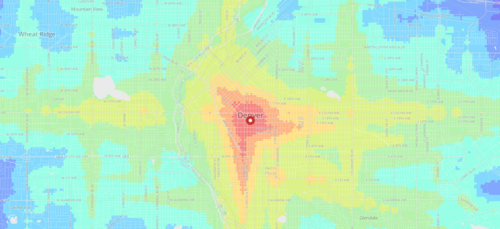
    I just came across an interesting web app created by geographer and programmer Andrew Hardin that maps public transit travel times for San Francisco, Seattle, Boulder and Denver.

    The app allows you to click on a location within one of these cities (or enter an address) and then receive a visual representation of travel times from that location.

    Both public transit and walking are factored in, and the fastest of the two is then modeled. The public transit data is taken from each respective authority and is similar to the data used by Google Maps.

    With these sorts of applications, I always wonder what it might look like overlaid with additional data points, such as home prices. Intuitively I would expect the best connected neighborhoods to also have some of the highest real estate values.

  • Those evil bikes

    image

    I just stumbled upon an interesting piece in the Boston Globe (from last December) talking about how the bicycle is “emerging as a new conservative front in the culture wars.

    It starts by talking about Toronto mayor Rob Ford and asks: Who elected this guy? Their response comes down to mode of transport.

    The answer, in large part, comes down to transit. Ford is famously pro-car, and his strongest support came from suburbs outside downtown Toronto, where voters drive into the city during the day and return by car in the evening. One political scientist found that the strongest predictor of whether someone voted for Ford in the 2010 mayoral election was the person’s method of commuting: Car commuters were Ford voters; everyone else wasn’t. Ford repaid their loyalty by declaring on his first day as mayor that the “war on cars” was over; he abolished the vehicle registration tax and announced a plan to kill light rail in the city simply because, he said, streetcars “are just a pain in the rear end.”

    The article then goes on to argue that Ford is at the forefront of a growing conservative movement using bikes as a new political lightning rod. Conservative politicians view cyclists as urbanites (statistically this is true) and therefore not part of their core voter base (statistically this is also true). And so hating on bikes has become a convenient way for them to galvanize their support base.

    But beyond bikes, we’re really talking about a bigger city building issue: How do you unify a city with such divergent priorities? How do we stop this downtown versus the suburbs mentality? These are important questions and I don’t think the answer is to de-amalgamate Toronto. That’s the easy way out.

    Whether we like it or not, the Toronto region functions as one contiguous economic unit and, if we want to be able to effectively compete on the global stage, we’re going to need cohesion. We need to get our house in order. It’s still early days for Toronto’s 2014 mayoral election, but I really hope the next 4 years turn out to be better than the last. I think they will.

  • Keeping our momentum

    This morning Kevin Marshall tweeted me a link to a blog post by Andy Weissman (partner at Union Square Ventures in New York). The post is about how small things matter—even small words.

    He starts by talking about a new sidewalk extension and curb cut at 86th Street and 3rd Avenue in Manhattan. This may seem like a pretty banal thing to talk about, but it’s in support of his argument that small things—like even a curb cut—can be used to solve bigger problems. In this case, the intersection was a dangerous one because of poor pedestrian visibility.

    But what I really like is how he describes the pulse of New York:

    “The rhythm of NYC is such that we need to keep moving and in motion; as a result, waiting to cross a street by standing at the curb is not enough, we must walk into the street to get going or keep our momentum.”

    This is great and it’s bang on. People in New York don’t stand at the curb waiting for the light to change. They impatiently push onto the street and wait for the first opportunity to cross. This may seem like a small tendency, but I think it speaks volumes about the character of New York.

    People in Toronto generally don’t do this.

    They (not me) wait patiently at the street corner even if there aren’t any cars coming. Why? Think about this the next time you’re standing on guard at the crosswalk. Don’t lose the momentum. The world rewards those who poke the box and keep moving.

  • Tomorrow’s capital of the world

    Last week I polled the ATC community and asked which city they consider to be the “capital of the world.”

    image

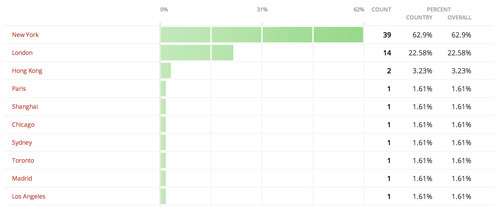
    I received 62 votes and the overwhelming majority (63%) voted for New York. London came in a distant second with 23% of the vote. Though there’s probably a geography bias here (most of the readers of this blog are from North America), I did have a few people comment on Twitter that the answer to this question is blatantly obvious. The capital of the world is New York.

    But what I was really trying to do was establish a baseline for this week’s poll, which I think is a much more interesting question. Which city do you think will be the “capital of the world” in 2050? Again, there are no other instructions. Just select whatever first comes to mind. I’m using the same list of cities as before, but you can now add a city if you think the right answer is missing. If for whatever you can’t see the poll below, click here.

  • Housing policy in San Francisco

    The tech community has been receiving a lot of backslash in San Francisco as of late. And Peter Shih’s infamous 10 things I hate about San Francisco post certainly didn’t help. But I think there’s a bigger issue than just rich tech people driving up the price of real estate.

    I was reading Quartz this morning and I think they nailed it: 

    “But the blame shouldn’t go to the tech companies or their employees moving to San Francisco, however despicable some might be. Blame San Francisco for being pleasant, and its policymakers for being foolish: When a lot of people are moving to your city—San Francisco the city gained 50,000 new residents between 2000 and 2012, including some 25,000 between 2010-2012 and likely more since—home prices are going to increase unless you build a lot more housing.”

    I’ve talked about this idea before. But I wanted to break it down a bit more precisely.

    If San Francisco, the city, gained 25,000 people between 2010-2012, let’s say that the city gained roughly 8,300 people per year. I just divided by 3. However, if you look at the rate of new housing supply, you get a 10-year average of 2,350 housing units a year (from the Quartz article) and an even lower amount according to Atlantic Cities.

    Regardless, what you end up with is a pretty simple phenomenon: More people are moving to the city than new housing is being provided and that’s driving up the price of real estate. In fact, San Francisco allegedly only created 269 housing units in 2011! That’s the equivalent of only one fairly typical Toronto condo building going up (and we have hundreds under construction). No wonder there’s upward pressure on prices.

    So rather than just blame the tech community for the city’s housing problems, I think there needs to be a broader look at housing policy. If you really want to help affordability, here’s one simple solution: start building.

  • Housing tenure in Europe

    Yesterday I came across an incredibly fascinating chart from Eurostat, analyzing housing tenure (in 2011) across Europe. Here it is:

    image

    And here’s what I found interesting.

    Working from left to right, there seems to be a clear difference between Eastern and Western Europe in terms of the amount of leverage they use to buy homes. If you look at Romania, not only does over 90% of the population own a home, but they also don’t seem to have any outstanding mortgage or housing loan. That means they’re buying their homes in cash.

    By the time you get to the United Kingdom, you start to see numbers that are comparable to Canada and the United States. The percentage of owner occupied homes is sitting at or below 70% and the majority of them have a mortgage or loan.

    But as a whole, Western Europe seems much more likely to rent than Eastern Europe. And in the case of Switzerland, more people rent than own. Why is that? This seems odd given its economic strength. But the same could be said for Germany and Austria, which also show relatively low ownership rates. Here’s one possible explanation.

    Finally, I found it interesting that in Denmark, the Netherlands, and Sweden, there’s virtually no such thing as subsidized rental housing. If you rent, you’re paying market rate (at least according to this chart). I wonder if this has something to do with there being less income inequality.

    If anyone has any insights on some of these points, I’d love to hear from you in the comment section below.