Daily insights for city builders, delivered every morning at 6 AM ET. I’m Brandon Donnelly — a Toronto-based real estate developer and founder of Globizen. I’ve been writing here since 2013.

  • John Tory is running for mayor of Toronto

    Yesterday I was at brunch for a good friend’s birthday and a few of us started talking about politics and the future of Toronto. We immediately became depressed by the fact that Rob Ford, could actually, get in again. For those of you outside of Toronto, I know this sounds like pure lunacy.

    We then speculated as to whether John Tory would ultimately run again. Though it would split the conservative vote (between Ford and Karen Stinz), I was hoping he would. Then, just like magic, Tory announced his candidacy. Here’s the video:


    While some would call it an oxymoron, John Tory is often painted as a “Red Tory”. He’s fiscally conservative, but then holds socially liberal views on issues such as same-sex marriages.

    But perhaps more importantly for the Architect This City audience, Tory is also a city builder. He’s Chair of the Greater Toronto CivicAction Alliance, which is non-profit group focused on transportation and economic development in the region. And this comes through in his clear support of the Yonge relief subway line (see above video).

    So even though this risks splitting the conservative vote, I will be supporting John Tory’s candidacy during this year’s mayoral election in Toronto.

  • Gentrification, animated

    A friend of mine sent me a link this afternoon to an art project called “Vacated”. The artist (Justin Blinder) reverse engineered Google Street View images to create a series of animated GIFs intended to demonstrate New York’s “changing urban landscape during the Bloomberg administration.”

    In his description of the project, Blinder ends by saying that “it’s up to the viewer to decide whether this change represents widespread gentrification.” Given the recent discussion we’ve had (here on Architect This City) about gentrification, I thought this post might be a good addendum.

    One of the big takeaways from our discussion, I think, was idea that there’s good gentrification and bad gentrification. Gentrification, after all, is really just another word for investment. And so generally I would consider this to be a good thing for communities.

    But there are instances when investment comes in and ruins what made the community worth investing in, in the first place. Perhaps the investment brought about the destruction of heritage buildings or the loss of the fine grain urban character that initially made it a great place to be.

    In these cases, I would say that this is bad gentrification. Sure there has been investment, but now the community has lost what made it cool. And as Jane Jacobs rightly pointed out: “When a place gets boring, even the rich people leave.”

  • It’s all about people

    Yesterday evening I met up with a talented Toronto-based technology entrepreneur who also happens to be passionate about cities. The conversation meandered between both worlds, but we ended up coming back to one central theme: It’s all about people.

    Facebook didn’t just buy WhatsApp for the technology. It spent $19 billion on almost half a billion active users. That’s what matters. Do people want to occupy your (real or virtual) space? Have you created a community? Whether it’s an app, a building or a neighborhood, you’re useless without engaged participants.

    And to be perfectly honest with you, that’s my ultimate goal for this blog. Ideally I’d like each and every post to inspire conversation and debate (just like this one did on gentrification). A one-sided conversation can only take you so far. The real value happens within communities.

  • Developer Dirt: Site selection and acquisition

    I’ve already spoken about why I became a developer and offered some insights into how you might be able to transition from architecture into development. So now I’d like to start focusing more on the day-to-day of what it means to be a real estate developer.

    And since I seem to be getting a lot of questions from readers on career and development related topics, I’ve decided that I’m going to turn these posts into a regular blog series. Right now the working name is “Developer Dirt”, but if you have a better name I’m all ears (let me know in the comments below).

    So let’s start with step 1.

    You’re ready to develop a new project and you’re now in the market for some land (also known as a site). It could be a greenfield site (meaning it’s virgin land that hasn’t yet been tainted by humans) or, on the other end of the spectrum, it could a brownfield site (meaning it probably once housed industry, it’s contaminated as all hell, and you’re going to need to clean that puppy up before you build).

    Without going into further detail about all the different kinds of sites you could potentially buy (which is a post in itself), here are 3 high level things to keep in mind as you move forward.

    Land is the residual claimant

    What this means is that you want to start with your top line. You want to start with revenue. What can I build on this site (use and square feet) and how much can I ultimately sell or lease that space for?

    Let’s say, for example, that you think you can build 100,000 square feet. If it were office space, you’d want to know that rents in your area are $30 per square feet and that that’s going to render you $3M a year in rental income. If it were residential condos, you’d want to know that the market is absorbing $500 per square foot and that if you sold 100,000 square feet worth of condo, that your revenue would be $50M. But remember this is top line.

    Once you know your top line, you then need to figure out what it’s going to cost to bring you that revenue stream. In other words, what are the hard costs (construction costs), the soft costs (consultant fees and other non-construction costs), the return my investors are going to demand, the money I need to keep the lights on in my business, and so on.

    Hopefully, once you’ve calculated all of these numbers, you’ll have some money left over from that original top line number. That residual money is what you can reasonably afford to pay for the land, which is why it’s often referred to as the residual claimant. But even though it comes last in this example, it comes first in development. If you overpay at the onset, it’ll be an uphill battle the rest of the way.

    You often don’t know what you can build

    But here’s the rub: You often don’t know exactly what you can build. When developers buy land they often consider what they can build “as-of-right” and what they think they can build as a result of variances, rezoning and other discretionary actions.

    As-of-right basically refers to what the current zoning permits. It’s what you could go out tomorrow and build (after you get the requisite permits of course). Unfortunately though, as-of-right uses and densities are not often inline with what’s actually happening in a neighborhood. So you need to go into the city for things like a zoning by-law amendment.

    Similarly, vendors want the most for their land and so they’re going to be aggressive on this front. As a developer, this is the point where you surround yourself with a team of smart people who can help you figure out what’s reasonably attainable for the site in question. And sometimes you have to worry about the politics as much as the planning.

    Approvals are uncertain

    During the due diligence phase, the goal is obviously to mitigate as much of your risk as possible. Nobody wants to get stuck with a piece of land that they overpaid for that they now can’t (profitably) develop. But sometimes shit happens.

    It may seem like a no brainer. You could have a site that’s surrounded by transit with lots of great precedences (this matters) for the height and density that you’re hoping to obtain and that you feel will be appropriate for the neighborhood. But sometimes the stars don’t align.

    And that’s why development is a risky game.

  • Revisiting the Gardiner East debate

    Last week I argued that the eastern portion of the Gardiner Expressway (Jarvis Street over to the Don Valley Expressway) should be torn down and replaced by an enlarged Lake Shore Boulevard.

    To quickly summarize, here’s why I support removing the Gardiner East:

    • Now is the time to do it (before we develop the surrounding area and it becomes both more expensive and more difficult to do it).
    • It would go a long way to stitching our disconnected downtown back to the lake and realizing our ambitions for the revitalization of the waterfront.
    • Unlocking the full potential of our waterfront is hugely important.
    • In my opinion, the only way to build a big, well functioning city, is on the backbone of public transportation. And this—the tearing down of the Gardiner East—could represent that paradigm shift.
    • It is a portion of the Expressway that has relatively low traffic volumes.
    • It’s the cheapest option on the table.

    Somewhat surprisingly though, a lot of people disagreed with me. They told me that adding anything to our already long commutes would be simply unconscionable and that they would not support it, no matter how much it improved our waterfront.

    So in the spirit of avoiding confirmation bias (that is, only seeking out things that reinforce an already established belief), I thought I would share the following article: “Like It or Not, Most Urban Freeways Are Here to Stay.” It’s from Atlantic Cities and there are 3 key take-aways that I’d like to point out.

    First, I thought it was interesting that the interstate system in the United States was, from the onset, always conceived of as a solution to urban congestion. I always thought it was about connecting the country, but that, apparently, was a secondary goal.

    Second, cities all across North America are engaging in the same debate about what to do with their aging highways. Detroit is debating. New Orleans is debating. And so is Syracuse. Toronto is not alone. But we could be alone in taking the lead on this issue.

    Third, the author basically acknowledges that, while not ideal, we’re stuck for the time being with all these freeways and that the better solution is going to be a really tough slog:

    “This is not an easy assignment, seeing as how cars are purchases we make with our hearts, more than our heads. Logic won’t convince Americans to change their ways. What will? Maybe, over time, prohibitive fuel prices and withering tolls, and, most importantly, investment in useful and convenient public transit. Only when the carrot is irresistible, and the stick stings too sharply to bear, will the shift begin, and it will take years to play out.”

    And while I would agree that it’s not going to be easy, that’s par for the course with anything truly worthwhile. If it were easy, everyone would be doing it. But they’re not. And that’s why there are leaders and there are followers.

    People in Toronto like to talk about how our City sometimes lacks vision. Well, here’s our chance. I’m not worrying about what the commute is going to be like tomorrow, because I know there’s an even better solution for that problem. I’m worried about something even bigger. I’m worried about the kind of city we’re all going to leave behind to our children.

  • Is gentrification really the problem?

    James Frank Dy Zarsadiaz (a Ph.D. candidate at Northwestern) published an article in Atlantic Cities a few days ago called, “Why gentrification is so hard to stop.

    In it, he essentially talks about how neo-liberalism has allowed private interest to trump public good and how it has dramatically changed cities and the expectations of its residents:

    “…those who can afford to live in a city now expect a personalized, “just for you” urban lifestyle. For-profit companies chase these urbanites with upscale housing and creative marketing campaigns, transforming blighted and blue-collar neighborhoods into “livable” urban nooks.”

    Now, as a developer I know I’m biased here, but is gentrification really as evil as he makes it out to be?

    One of the most insightful comments on the article had the following to say:

    “I’ve always maintained that gentrification is what occurs when demand exceeds supply and blight is what occurs when supply exceeds demand.”

    I like it because it’s a simple way of saying that what we are seeing is a natural market outcome. What’s wrong with somebody wanting to buy a house in a marginal area and fix it up? Can we reasonably expect to stop people from doing this so that wealth never increases within a neighborhood?

    The bigger issue, in my view, is rising income inequality. We know that this is becoming more and more of an issue. The benefits to being smart and educated today are huge. So how do we ensure that we’re not creating a society of haves and have-nots?

    Let’s figure this out and let people buy whatever homes they want.

  • The tale of 2 Chicagos

    Over the long weekend I wrote a post called “On medium density development.” My argument was that Toronto has gotten exceptional at building infill towers, but not so great at midrise and other medium density infill solutions. Though to be fair, we are starting to see more and more of that today.

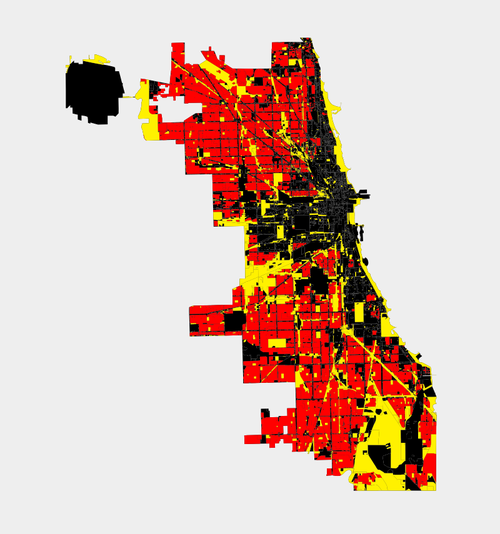
    Well it turns out that Chicago is in a similar, if not worse, position. According to Aaron Renn of the Urbanophile blog, most of the city (outside of the city center) only allows for single family homes. Though in some cases you may be allowed a duplex or triplex.

    Here’s a map:

    image

    The red is where you’re only allowed to build single family homes. The yellow represents non-residential uses (parks, industry and so on). And the remaining black is where you’d see high density development. Note how it runs all along Lake Michigan. Both Toronto and Chicago are developing in a similar “T” formation.

    Now, some of you may be saying to yourself: So what? But it’s important to remember that this type of zoning effectively creates a supply constraint in the market, which, as I’ve argued before, will drive up prices. Chicago may as well be surrounded by mountains, because that red area seems almost untouchable from a development standpoint.

    With so many people rushing back to cities today, a lot of them are struggling to create the same market environment that our parents enjoyed. You know the one where you finish school, get a job, and then you’re able to buy a house. But I think it’s because many of our cities are at a turning point, and yet are clinging to outdated principles of city building, such as single-use zoning.

    But I’m certainly no expert on Chicago, so if you are, please speak up in the comment section below.

  • Say hello to Kingston&Co

    image

    As of today, Family Day Monday, you’re going to start seeing information released regarding TAS’s (in partnership with Main & Main) newest community called Kingston&Co. It’s located on Kingston Road, just east of Victoria Park Avenue, in a neat area called Kingston Road Village. You can already register at kingstonandco.ca. And as part of the registration process, we’re also soliciting feedback as to the types of retail the community would like to see added to the area. Note: There’s already a Starbucks 🙂

    At the same time, we’ve also launched a redesign of our corporate site (tasdesignbuild.com). The biggest change is that we’ve taken the blog—which was hidden under a “Neighbourhoods” tab—and made it front and center on the homepage. We see this as a pretty significant change. One that shows that we would like you to join us in a conversation around city building. We now allow comments on all of our blog posts and you can see right on the homepage who the author of the post is.

    If you have any feedback on either Kingston&Co or the new homepage, we’d love to hear from you in the comment section below.

  • On medium density development

    Over the past decade, Toronto has seen a proliferation of condos across the city. And while I do think this intensification is a great thing, we’ve been much better at building towers than anything else. We’ve neglected medium density development and it has bifurcated our housing market: you’re either in the market for a condo or for a house.

    And since we’re not really building anymore of the latter, Toronto has become accustomed to bidding wars and multiple offers. Every young couple I know is in the market for an “hip fixer-upper in the city.” Problem is, that’ll cost you $700,000 or more and you may still need to gut it.

    At this point, it’s not realistic to expect that we’ll be building anymore single family homes in the city—at least not at any sort of significant scale. We’re tapped out. But what we can reasonably expect is more medium density development. I’m talking about midrise developments along our avenues, laneway houses in people’s backyards and other creative infill solutions that sit somewhere between a house and a highrise.

    If we’re concerned about creating equitable housing opportunities, then we’re going to need relieve some of the pressures on low rise housing. We’re going to need more diversity in our product offerings.

  • Is laneway housing a good idea or a bad idea?

    As a follow up to my recent post called “Disrupting everything”, I thought I would share this talk by venture capitalist Chris Dixon at Y Combinator’s Startup School. In it, he talks about why good ideas often seem like bad ideas at first.

    Chris frames the discussion by saying that when you have a good idea—that everyone else thinks is a bad idea—you effectively know a secret. But by a secret, it’s really that you believe something that nobody else believes to be true. So much so that when you try and tell everyone else about your secret, they all think you’re crazy, which is frustrating because it seems so obvious to you.

    He then provides a number of characteristics that can help you identity good ideas that seem like bad ideas:

    • Powerful people dismiss them as toys.
    • They unbundle the functions done by others.
    • Did it originate as a hobby?
    • Do they challenge social norms?

    Now, he’s obviously talking about startups, but I think the framework can apply outside of the technology world. I think it can apply to cities. 

    To give you one example, let’s consider laneway housing. If you’re a regular reader of this blog, you’ll know that I’m a big supporter of laneway housing in Toronto. But that it’s something the city generally does not support.

    However, there are laneway houses being built and they’re being built by architects and progressive urbanists. Some might even call it a hobby, because it remains a pretty tough business model at the moment.

    Personally, I think one of the main reasons the city is unwilling to formally allow laneway housing is because it challenges social norms. I’ve read the staff reports and the meeting minutes: people think it’s weird to live off a laneway. In fact, in one case somebody asserted that since laneways are generally undesirable urban spaces, anybody who would want to live off one is almost surely a social degenerate.

    But there’s absolutely nothing inherent to human beings that says we can’t live off a 5m wide street or that we can’t have a “house located behind another house.” Those are simply constructs we’ve created for ourselves.

    So the next time you hear about an idea that you think seems like a bad idea, ask yourself: Is it really a bad idea or does it just make me feel uncomfortable because it contravenes the norm? Taking yourself out of your comfort zone is a good thing. It’s how we grow.