Daily insights for city builders, delivered every morning at 6 AM ET. I’m Brandon Donnelly — a Toronto-based real estate developer and founder of Globizen. I’ve been writing here since 2013.
Earlier today, a good friend of mine shared this New York Times article on my Facebook wall. It talks about how some suburbs are taking action to try and curb the exodus of young people to cities. They’re doing things like making themselves more walkable and building bike lanes. I thought it was an interesting article.
Of course, it’s not just young people moving from the suburbs to the city. It’s also a case of young people living in the city and never leaving for the suburbs–which they have traditionally done.
I’ve talked about this topic a lot here on ATC, but I wanted to share this article because I think it’s one thing to talk about how city centers are on the rise and it’s another thing to talk about how suburbs are starting to take notice and take action to curb their (potential) decline.
I say potential because some would argue that the suburbs aren’t necessarily on the decline–we just have a scenario where young people are delaying that period of their life, either for economic reasons or for personal/lifestyle reasons.
I, however, would disagree. I think the growing preference for cities is a real societal shift. That doesn’t mean I think the suburbs are going to die though. There will likely always be a segment of the market that prefers that housing type (or some variation of). I just think the suburbs aren’t going to be what they once were to previous generations.
Earlier this week a friend of mine was live tweeting a public consultation meeting for the revitalization of Berczy Park in the St. Lawrence Market neighborhood of Toronto. And since I live in the neighborhood, it’s a project that I’ve been following particularly closely–although anything related to the built environmental generally fascinates me.
As soon as I saw the pictures he was tweeting out, I was immediately excited. And after reviewing the full design package (which you can download here), I must say that I think it’s going to be a brilliant change for the neighborhood.
On an entirely superficial level, I like the paving motif they’ve chosen; even if it does appear to be be a copy from somewhere else (see above photo). I don’t think one should underestimate how small details, like paving, can have a huge impact on how one feels in a space, whether inside or out. It all counts.
But beyond just cosmetic changes, there are a couple of significant design changes being proposed.
First, a larger kid-friendly green space is being proposed on the west side of the park. And what was interesting to see was how the community overwhelmingly expressed a need for this play area. I’d like to believe that this speaks to the growing acceptance of raising kids downtown. There are certainly lots of families in the St. Lawrence.
Second, the south portion of the park is being “opened up” with a much larger hardscape area. The result will be a bigger promenade along Front Street, as well as, what I hope, will become an “urban stage” for people to hang out, breakdance, busk or try and sell me things I don’t need.
But equally exciting is the fact that along with the revitalization of Berczy Park will come a public art competition. It’s already in the works, but there aren’t any pretty images to share, just yet. Regardless, I think the topic of public art is an interesting discussion.
In a lot of cities around the world, there are mechanisms in place to encourage or mandate public art. Commonly, it comes in the form of a “Percent for Art” program, which means that, in the case of a new construction project, 1% of the construction costs would or should go to public art.
But the fact that we, at least in some cities, have programs to mandate it, should immediately signal to you that public art is not something universally believed in. And certainly it’s one of those things where it’s hard to measure the return-on-investment.
But that doesn’t mean it doesn’t or can’t exist.
In fact, I would argue that in today’s information and digital age it’s only going to become more important. We are living in a world of too much information and too little time. We’re living in a noisy world and, whether you’re a corporation or a city, the only way to stand out is to be remarkable. You need to bring delight to people.
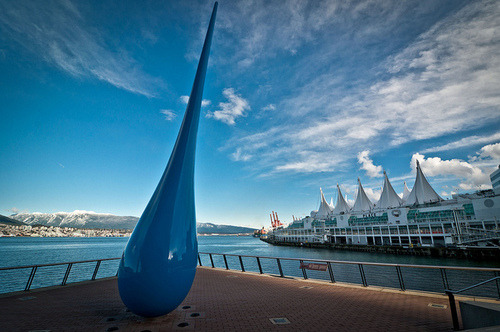
Because when you do, you get noticed (and probably shared on Facebook, Twitter, Instagram, Tumblr, Snapchat, Vine, 500px, Flickr and maybe even Google+). As one example, how many of you recognize the public art piece below? It’s in Vancouver and I’ve seen it pop up a number of times in my social news feeds. It’s something that brings delight to people.
But at the same time, it’s something that speaks to and creates a sense of place. What could be more Vancouver than a giant blue raindrop along the waterfront? And that’s really one of the ironies of today’s digital world. Despite the fact that, no matter where we are, we’re all hyper connected through technology, more and more of us are gravitating back towards cities. We want to live close to other people and we want to feel a sense of place.
When done properly, public art can help cities achieve that. Whether it’s the famous LOVE sculpture or Richard Serra’s controversial Tilted Arc, public art can make you stop and take notice of your environment. It can give you that sense of familiarity or it can take you by surprise. Either way, it gives you a sense of place.
You can find all the specific numbers here, but what is obvious is that the province is paying for most of this city’s transit expansion. Unfortunately though, it’s being done on an ad hoc basis. Toronto first asks for money and then the province decides whether or not it wants to give it.
This is problematic for a few reasons.
First, it’s an inconsistent funding stream. We all recognize the need for better transit and infrastructure in the city, but the big question is always: Who’s going to pay for it? So far, as we can see, it’s been the province. But that’s not always a sure thing. And it can often become political. If we’re going to get serious about building transit, Toronto needs a consistent funding source that would allow us to start building and not stop.
Second, how come, as one of the major economic engines in this country, we aren’t in a position to pay for our own infrastructure? It’s because our governance structure does not properly reflect the economic realities of today’s world:
Most local governments are formed by a charter or act granted by the province or territory. Local governments are not mentioned in the Canadian Constitution other than to say they are responsibility of the provinces. Consequently, municipalities can be created, amalgamated, or disbanded at the whim of the provincial government which controls them. They are also limited in the amount of interaction they have with the federal government because this would infringe upon an area of provincial jurisdiction. Since each province is responsible for creating local governments in its own territory, the names, functions, and powers of local bodies vary widely across the country. Local governments generally have limited powers, namely creating local by-laws and taxation (property tax).
And yet cities, not provinces, are our biggest economic drivers. We have it backwards. And so I think it’s critical that we look long and hard at ways in which we can better equip our cities with the tools and resources to compete globally. Transit funding is just one example.
I subscribe to a blog called Cities for People. It’s the blog of Gehl Architects out of Copenhagen and their focus–both the blog and the firm—is on how the built environment affects people’s quality of life. They call themselves Urban Quality Consultants.
The key insight was that, for a variety of reasons, men and boys seemed to be engaging with public spaces more than women and girls. For example, they found that boys were generally more assertive than girls and so, if there was a toss up between who was going to use a space, the boys would usually win out. As a result, there’s been a lot of debate around creating more inclusive public spaces, both from a design standpoint and a policy standpoint.
Interestingly enough, this is a debate that doesn’t seem to be happening here in Toronto. And I wonder if it’s because we don’t have the same problems (or I’m just oblivious) or if it’s because we don’t care enough about public spaces to do gender mapping exercises.
Toronto is a city of neighborhoods and small main streets–at least in the areas where our streetcars live. Streets such as King and Queen are only 4 lanes. And the problem we’re facing is that we’re trying to accommodate every single use case on them: cars, on-street parking, cyclists and streetcars. But in doing so, we’ve made the experience terrible for everybody. Streetcars move at a snail’s pace, drivers are frustrated by the lumbering streetcars, cyclists fear for their life driving by parked cars (doors can swing open at any time), and so on.
And with the rise of downtown shoulder neighborhoods such as Liberty Village, King West, the Distillery District and the soon to be complete West Don Lands, the strain on our east-west corridors is only going to get worse–much worse, in fact. Already the King streetcar is the busiest streetcar route in the city, moving almost 60,000 people per day. That’s more than the (under utilized) Sheppard subway line.
What I hope is clear to the ATC community though, is that the answer isn’t uniformly the car. We can’t have every single resident from Parkdale to Leslieville hopping into their car and driving downtown to their office at Yonge & King. It ain’t going to work. And so we’re going to need to make some difficult decisions about how we’re going to get our city moving on the backbone of transit.
Sure the downtown relief subway line (screw the politics I’m attaching it to downtown) would be the ideal solution to connecting our emerging shoulder neighborhoods, but that’s not going to happen overnight. And so how do we improve the efficiency of what we already have? First, we need to accept the fact that every street isn’t going to be everything to everyone at all times. We need to choose who we want to optimize for.
So here’s an idea that’s been floated many times before but never acted upon: let’s get rid of cars on King St and Queen St in the core during rush hour.
This would give our streetcars the room to efficiently move people across downtown, minimizing the dreaded “bunching up” that occurs as a result of traffic congestion. It would make transit a reliable choice and there are ways to pilot it. But let’s be clear: this is not about being anti-car. It’s about optimizing uses and getting people moving. Cars would continue to get priority on Richmond St and Adelaide St, and transit riders (as well cyclists) would get priority on King and Queen.
Of course, the Rob Ford viewpoint would say that we should be optimizing all streets for cars and getting the streetcars completely out of the way. But if that’s the approach we want to take, then we’re building the wrong kind of city. We shouldn’t be focused on intensifying and creating new inner city neighborhoods, because that only tips the scale in favor of transit. Instead, we should be focused on decentralization.
But that’s what not we’re doing. We’re intensifying our city to the point that we’re now faced with a number of difficult–yet enviable–decisions about how we’re going to live and how we’re going to move around in the future. We’re a city in transition.
Our mission here should be to figure out how to move people around the city as efficiently possible. Let’s put politics aside and recognize that time is one of our most precious resources. And when we put people in lumbering streetcars and debilitating traffic jams, we’re completely squandering that resource. It hurts productivity and it hurts our overall prosperity as a global city.
There’s a place for subways, streetcars, buses, bikes and cars in our city. So let’s just get on with making them all work.
With Toronto preparing to deploy the first batch of its new streetcars this summer, there’s been a lot of talk about streetcars in general. Rob Ford has said he wants to get rid of them all together and I hear a lot of other people expressing similar frustrations: Streetcars are rolling stop signs. Streetcars block 2 lanes of traffic. Why don’t we just use more buses? Streetcars cause traffic. And so on.
So what should we do?
First, let me start by saying that buses suck. I’m a huge proponent of public transportation in cities, but there’s nothing quite like a rush hour bus ride to have you question your economic status in life. Bus routes have also been shown to have little economic development value, where as fixed rail lines (such as streetcar, LRT and subway) generally increase surrounding property values and spur investment.
Second, my view is that streetcars themselves as a transportation technology aren’t the problem. It’s our execution. I’ve touched on this topic before on ATC, but I’d like to reiterate a few points here.
The value of light rail is that it’s a relatively inexpensive way (compared to subway) of efficiently moving a lot of people. But in order to do that, you need deploy it in a sensible way. In my mind, that primarily involves 3 things: giving streetcars their own dedicated lanes (grade separation), having a reasonable number of required stops, and streamlining the onboarding and off boarding process. Today, we don’t do a great job at most of these things (although our new streetcars will use a proof of payment model).
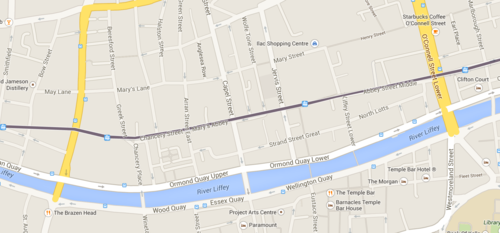
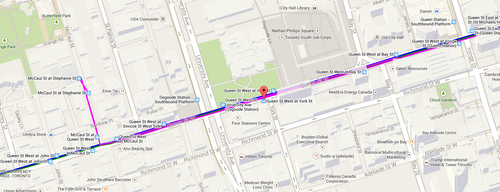
Take a look at this comparison between Dublin’s Luas light rail system and Toronto’s streetcar system. Both images are at the same scale. Notice the dramatically different stop spacing. Much of the Luas system also runs on its own dedicated lanes.
Dublin:
Toronto:
Every time a Toronto streetcar stops it generates waste. Cars are forced to stop behind it. Everyone on the streetcar has to sit and wait while somebody fumbles through their change looking for a token. But there are other ways to do this. There are ways to make light rail more subway-like, despite the fact that it may be above ground. And so I don’t think we should be so quick to write off all streetcars.
I’ve spoken about the term YIMBY before and this site is exactly that: a site dedicated to “saying yes in my back yard” to new development in New York. It was founded by 23 year old Nikolai Fedak and currently receives 75,000 monthly visitors. He has plans to expand to other cities and I’ve already emailed him to see if he has any plans for a Toronto YIMBY.
At a time when it’s common to hate on developers and new developments, it’s refreshing to see a site dedicated to the exact opposite. That’s not to say that all developments are good (New York YIMBY has no problem blasting the ones that suck, as it should), but it’s certainly framing development as a positive thing for cities.
In growing cities like New York and Toronto, development is going to happen. And so I would rather we focus on how to make it happen in the best way possible instead of just saying no.
Two things happened yesterday. And since there’s a nice tie in, I’d like to talk about both of them.
First, here at TAS, we launched a new condominium project called Kingston&Co. We had already gone public with some information, but we now have an updated rendering and we’ve gone live with a public Q&A section on our website (kingstonandco.ca). The questions are all geared towards topics that we think are on a lot of people’s minds and anybody can respond. Instead of trying to cover up the elephant in the room, we wanted to do the opposite and get it out and into the open. It’s all about promoting greater transparency.
Second, I watched this 45-minute interview with author and entrepreneur Gary Vaynerchuk last night before going to bed. It’s a great video and I would encourage you to watch it if you have any interest in entrepreneurship, social media, marketing, capitalism and overall hustle. But if you don’t have the time, here are some of my key takeaways. Gary makes, on average, between $3-5 million a year selling the social media dream (but it could be more depending on things like his angel investments). Everybody is a media company first. He has clients putting 100% of their marketing dollars into social media and they’re seeing a ROI. It took him 1 ½ years to get anybody to care about his video blog Wine Library TV. And don’t just ask. Give as well.
That last point is a tie in to his latest book called Jab, Jab, Jab, Right Hook. And what he’s effectively saying is that, as a brand, you need to be mostly giving to your customers (that’s the jab). It could be valuable content you produce via social media or whatever. It’s you, delivering value to your customers in some way. Then, once you’ve done that, you can go in for the right hook, which is the ask: Buy my stuff. The idea is that you build up trust with your customers and develop a relationship so that you get the privilege of asking them to give you money.
The alternative, of course, is what we’re all already familiar with: brands constantly bombarding people with right hooks. It’s the let’s throw a bunch of shit up against the wall and see what sticks approach. And it’s related to the whole permission marketing vs. interruption marketing debate popularized by marketer Seth Godin.
But Gary’s argument–and I found this really interesting–is that constant right hooks is the approach we had to take before the internet and things like social media. Those right hooks were so expensive to deliver through billboards, print ads, TV commercials and so on, that companies simply couldn’t afford to be delivering any jabs. But all that has changed with social media and technology. Now, the best brands succeed by building trust and establishing relationships with their customers–often one-by-one.
And this is exactly what we’re trying to do with Kingston&Co. We know that there’s a lot of discussion happening in the marketplace around condos and we didn’t want to ignore it. We wanted to address it. And if you look at our messaging, you’ll notice that in most cases we’ve put “Join the conversation” ahead of the typical “Register now.” That’s because we truly do want to have a conversation.
Over the past few months on this blog, I’ve started to introduce business terms into the way I describe and talk about cities. I’ve referred to residents and visitors as customers of a city, experiences within a city as products and services, and cities themselves as businesses. Until now though, I hadn’t explicitly talked about this parallel or fleshed it out in any sort of detail. But I think it’s an interesting one so I’d like to do a bit of that today.
The reason I started referencing cities with business terms is because I think it speaks to 3 important characteristics of cities. First, cities, just like businesses, are in direct competition with each other. We rank cities. We compare GDP per capita. And they fight, or at least should, to attract the best people and to achieve economic dominance.
Second, city prosperity can be ephemeral. We tend to think of cities as being quite permanent–centuries old–but history is littered with failed cities or cities that simply lost their economic importance (see Detroit). Consider this: The center of trade at one point was the Mediterranean Sea. Then, as the New World emerged, it shifted to the Atlantic. And now, one might argue that it’s moving over to the Pacific (and Asia). Either way, these macro shifts push certain cities to thrive and others to decline. The time horizon is longer than, say the rise and fall of Blackberry, but it’s similar nonetheless. Nothing is guaranteed.
Third, cities have become centers of lifestyle and consumption. That’s why I previously argued that any economic development strategy should consider lifestyle, and whether or not people actually want to live in the place. In business terms, you need to offer products and services that people actually want. You need to respond to customer needs.
And if you think of cities in this way, I think you’ll come to the conclusion that, just like businesses, strong cities require strong leadership and management. They need to ensure that they’re delivering the right products and services to their customers and that they’re staying ahead of the innovation curve.
The switching costs may be higher for cities compared to, again, something like a mobile phone, but that doesn’t mean people won’t eventually vote with their feet and leave for somewhere better.
One of the things I think is important for cities to have are things that are quintessential. I’m talking about a quintessential behaviour, a quintessential experience, a quintessential accent, a quintessential architectural style, or whatever. I’m talking about the things that make people say: “Oh, that’s so New York.”
What I’m essentially talking about is brand equity for cities. For better or for worse, when somebody associates something with a particular city, you could argue that that city effectively owns a trademark. (Definition of trademark: “…a recognizable sign, design or expression which identifies products or services of a particular source from those of others.”) In this case, the source is a simply a city.
Sometimes these trademarks are an informal understanding amongst people in the know, but in other cases they can become quite legitimate. Take for example Chicago’s distinct architectural style known simply–at least within architectural circles–as the “Chicago School.” This is a style that Chicago clearly owns. And if another city were to adopt it, people might say: “Hey, that building reminds me of Chicago.”
All of this is important because, just like companies, cities are increasingly in the position of having to compete for “customers” in a mobile and interconnected world. And if you ask some marketers, they’ll tell you (perhaps self-servingly) that brand is the most valuable asset a company has. But if you believe this to be at least somewhat true, then statements like, “Oh, that’s so (insert city name here)”, are actually pretty powerful.
Is there anything about your city that you could say is unequivocally yours?