Daily insights for city builders, delivered every morning at 6 AM ET. I’m Brandon Donnelly — a Toronto-based real estate developer and founder of Globizen. I’ve been writing here since 2013.
I was planning to write about something else today, but then I saw Fred Wilson’s post on revitalizing urban cores and I had to switch topics, because I think he makes a great point about turning around declining cities:
I’ve been asked by civic leaders from places like Newark, Cleveland, Buffalo, and a number of other upstate NYC cities that have suffered a similar fate how they can do the same thing. They all talk about tax incentives, connecting with local research universities, and providing startup capital. And I tell them that they are focusing on the wrong thing.
You have to lead with lifestyle. If you can’t make your city a place where the young mobile talent leaving college or grad school wants to go to start their career, meet someone, and build a life, all that other stuff doesn’t matter.
It’s exactly the same point I made in my post entrepreneurship as economic development strategy. You can throw as much money as you’d like at startups, but if young people don’t want to live in your city then you have a serious problem.
When Tony moved Zappos from the suburbs to the former City Hall in downtown Vegas a few years ago, he decided to invest $350mm in a massive urban revitalization project. He set aside $200mm to purchase land at bargain prices and the other $150mm to invest in three areas, arts and culture, small businesses (restaurants, cafes, bars, markets, boutiques, etc), and tech startups. $50mm is going into each area.
It’s an example of leading with lifestyle, urbanism and city building, rather than purely economics. And I think it’s the way to go. But to be clear, I’m not suggesting that the focus should be on large capital projects, such as stadiums and infrastructure. I’m not convinced those are the most effective catalysts. There’s no silver bullet here.
Instead, I think the answer is in building, from the ground up, a real sense of community and place. People need to love your city. That’s easier said than done though.
The big shift is going from a site-by-site approach to a neighborhood approach. Today, each and every development site is reviewed, approved and fought over. With the DPS, the idea is to establish a neighborhood scaled by-law and then streamline the review process for each individual site (the city will get 45 days to respond to applications as opposed to the 180 days it gets today).
What this should do is shift the big fights–among developers, communities and the city–to the front end (when the neighborhood by-law is being established) and minimize the fights over each site. It takes away an element of incremental urbanism–because you’re in some ways building out a master vision (large batch versus small batch)–but it would do a lot for transparency, efficiency and for creating cohesive urban form. And, it sounds like the DPS by-laws will have some flexibility, so that could address my batch size concern.
Right now the city is hosting open houses and is expected to issue a report on their public consultations sometime next month. It’ll then go to City Council in July. I think a lot will come down to how the DPS neighborhood by-laws are formed, but I think that anything that improves transparency and efficiency is likely a good thing for our cities.
When I was in grad school at Penn, real estate mogul Sam Zell used to come in and talk to students about once or twice every year. He permanently endowed the Samuel Zell and Robert Lurie Real Estate Center at the school and so there was a strong connection.
Because of Zell, a few of us developed a theory that the entertainment value of a talk was more or less correlated with net worth. In other words, the richer the speaker, the funnier the talk. Zell, for example, would often come in jeans, a baseball hat and a hawaiian-like shirt, and drop f-bombs all throughout his talks. You can do that sort of thing when you’re worth a few billion and you’re signing the checks.
But beyond just being entertaining, Zell shared a lot of insights about the businesses he was in, getting into (Chicago Tribune) and getting out of (Equity Office Properties). Some of those businesses turned out to be a disaster (Chicago Tribune), but others (Equity Office Properties), made him look like an absolute genius.
One business that he always liked to mention though, was the manufactured home business–also known as the trailer park business. And that’s because, as chairman of Equity LifeStyle Properties, Zell is the largest mobile-home landlord in the US. They control 140,000 sites across 32 states and in British Columbia, Canada.
The reason Zell likes this business is, quite simply, because it makes a lot of money and it’s growing. There are an estimated 12 million Americans living in trailer parks. That’s probably why Warren Buffet also bought Clayton Homes–another manufactured home builder–for $1.7 billion in 2003.
But it’s not just the big guys who like this business, it’s entrepreneurs at all levels. In fact, I was just reading this article from New York Times Magazine about a couple of entrepreneurs who actually setup a school called Mobile Home University. The objective is to train aspiring entrepreneurs on how to profit from poor people in America:
“The bottom line is Americans as a group are getting poorer,” he told his students — and while that’s bad news for those living on the economic fringes, it also means opportunities for those willing to take advantage of the trend.
Just how poor? Here are typical rents:
The typical tenant who rents from Rolfe and Reynolds pays $250 or $300 a month in lot rent and another $200 or $300 if also renting a trailer. “The trailer park is people’s last choice,” Rolfe says, “and we recognize that.”
Now, trailer parks are not the sort of thing that architects and planners typically like to talk about it. They’re not sexy. They’re not urban. But as the article says, these guys are providing the “dollar store” of housing and making a lot of money doing it (annual returns of approximately 25%).
But is targeting people with rock bottom credit ratings and no other housing options an ethical business model? (The article also talks about 10% a year rent increases.) I’ve personally always found these ethical questions to be difficult to take a stance on and so, for this one, I’m going to put it out to the ATC community. What do you think?
Fred Wilson (New York VC) wrote a post on his blog this morning called The Bubble Question. In it, he talks about how everyone asks him whether or not there’s a tech bubble, which he has been asked for the past 4 years now. It reminded me of the debates that are also happening in the real estate community (particularly in Canada).
The thesis of his post is this:
I learned in business school that the multiple of earnings one should pay for a business is roughly the inverse of interest rates.
In other words, as interest rates drop, people are willing to pay more for the business or asset in question. And it’s because they can’t find the yields anywhere else.
The same phenomenon, you could argue, is also happening in the real estate space. Typically, income producing real estate assets are assessed using capitalization rates (or cap rates), which is defined by the Net Operating Income (NOI) of the property (revenue – expenses, but excluding financing costs), divided by the price of the property.
The real estate equivalent of what Fred is talking about is cap rate compression. When cap rates drop it means you’re paying more for the same amount of yield (or NOI). One of the reasons that might happen is because people are anticipating that the asset will appreciate. But it could also be because interest rates are so low that investors will take whatever returns they can get.
So you could argue that the market is just responding to the macro economy. And since the feds are probably waiting for global growth to pickup (before raising rates), one could argue that the status quo is just going to continue. Ideally, it’ll continue until robust economic growth is able to take the place of cheap money.
I’ve been a big fan of MIT’s Senseable City Lab since I was a grad student at Penn. Their work sits at the intersection of cities and technology, and so I’ve always found it incredibly fascinating.
Recently, the lab examined data from all of New York’s 13,586 registered cabs and looked for ways that technology and mobile tech could potentially optimize the way the system works today. In particular, they were interested in examining instances where people were heading to the same place at the same time, and were within no more than a 3 minute walk of each at the start of the trip.
That is, 80% of the time, there was an overlap in both time and route. That’s an hugely interesting stat because it starts to show just how much waste and inefficiency there currently is in the system. Think about all the trips and carbon emissions that could be potentially eliminated through optimization.
Here’s a video they produced on the project. Click here if you can’t see it below.
It’s a great example of how technology is and will continue to creep into every segment of the economy. It’s exactly what I was talking about in my post, “Disrupting everything.”
Here’s my latest post from the TAS blog. You can find it cross-posted here. I hope you enjoy it.
Over the past 5 years, I’ve become borderline obsessed with laneway housing in Toronto. In fact, sometimes I ride my bike around the city just trying to find interesting laneways and alleys, and undiscovered homes. For most people, this is a portion, or scale, of the city that’s almost completely hidden. It doesn’t even really exist. But that’s precisely what makes laneways so interesting to me.
Today, Toronto’s laneways basically function as service roads. All 2,400 of them. They provide access to people’s rear garages in the typically older parts of the city. And so by design, they’re supposed to be nondescript and utilitarian streets. They were never intended to really have a sense of place or any redeeming urban qualities. Most don’t even have a name. They’re what architects and real estate people refer to as the “back-of-house.”
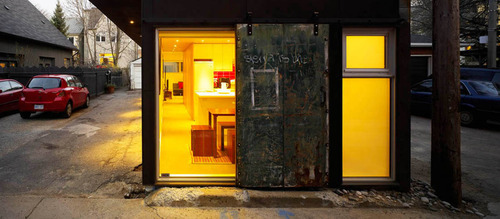
But similar to how lofts were once never considered desirable places to live, I think the same is going to to happen to laneway housing. That’s my bold assertion: compact and well designed laneway homes are going to be the new loft. From a regulatory standpoint, they’re almost impossible to build today in Toronto, but there are pioneers out there who have managed to do it. They’ve replaced rear garages with a new housing typology.
Other cities, such as Vancouver, have developed policy that allows laneway homes in certain instances. But that’s not the case in Toronto. They’re one-off exceptions. It usually helps to have an existing laneway structure (which was the case with Superkul’s project), but sometimes the city will allow them to be part of a larger redevelopment, which is what’s happening with our DUKE project in the Junction. At DUKE, we have 5 south facing live/work laneway homes at the south end of the building.
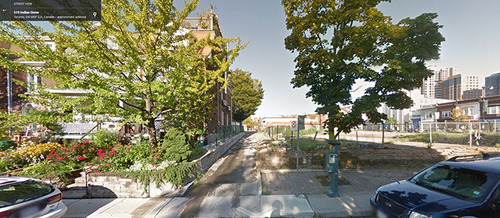
Here’s what the site looks like today from Indian Grove to the east:
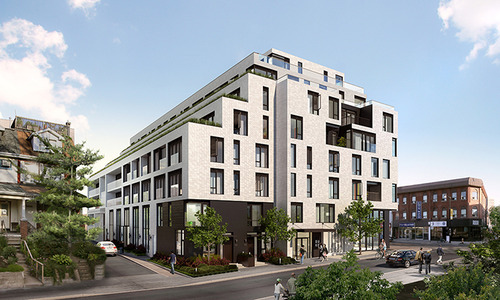
And here’s an artist’s rendering of what it’s going to look like when the project is complete. There are 5 live/work laneway homes (all 2 storeys) facing south and 2 townhomes facing east (Indian Grove):
I think these homes are going to be really great.
So why do I like laneway homes so much and why do I think they’re going to be the new loft? Here are 3 reasons.
1. The hip factor
For the same reason people love lofts, laneway homes are unique and a bit eccentric. Let’s face it, nobody wants cookie cutter these days. People want something with character. And having a beautiful home off an intimate urban laneway is cool.
If you’ve ever watched Swingers (it’s one of my favorite movies), you might remember the scene where Mikey is taking his friend from New York to a hot new speakeasy in Los Angeles. To get there, they’re forced to go down an alley and Mikey’s friend asks: “Where is this place?” Mikey then responds by saying:
For some reason the cool bars in Hollywood have to be hard to find and have no sign.
It’s kind of like a speakeasy kind of thing. It’s kinda cool.
It’s like you’re in on some kind of secret, you know?
The people who live in laneway houses today are usually architects, designers and other creative professionals. Typically, these are the kinds of people that pioneer new neighborhoods and new housing types (again, think about how lofts started becoming cool). So I have complete faith that these groups are on to something here too.
2. An intimate scale
The second one is about scale.
The way I see it, Toronto really functions at 3 main scales. You have the main streets like Yonge, Bloor, and Dufferin; you have your typical residential streets; and then you have laneways (which today have been mostly forgotten). Most people don’t want to own a single family home on a main street because it’s noisy. It’s perfectly fine to live higher up, but they often don’t want to open up their front door and walk out onto a street like Bathurst. That should be for retail.
So homeowners typically look to quieter residential streets. These are perceived as having more value. But if you want something even quieter and with less vehicular traffic, why not check out the laneway hidden behind that residential street? I can imagine these laneways being a perfect place for kids to play on in the future.
To use an example from outside of Toronto, I used to have a good friend who lived in Paris. She lived on a quiet laneway that was directly connected to an incredibly busy arterial road that led into the Place de la Bastille. But separating her laneway from that main road were a set of giant barn doors that you had to walk through. And once you walked through those doors from the main street, it was as if you entered a different world. Other than the sound of kids playing soccer on that laneway, it was absolutely silent.
That laneway is obviously different than the ones we typically find in Toronto, but the principle is exactly the same.
3. A diversity of housing options
Finally, I think laneway housing could serve as a really great way to relieve some of the pressure we’re seeing today on low-rise housing using the existing fabric of our city. If you follow Toronto’s real estate market at all, you’ll know that from the Junction to Leslieville, bidding wars are pretty commonplace. And there’s a simple reason for that: demand is exceeding available supply.
There’s no silver bullet, but I think we could improve the situation by building more, and different, housing types. In the case of laneway houses, they could be a great alternative for families wanting to stay in the city. And in the case of DUKE, our live/work units are intended as a way for business owners to both live and hang their shingle in the Junction. We’re living at a time where 3 people with a laptop and an internet connection can build something that changes the world. That’s affecting the way people live, work and play, and we’re trying to a respond to that with the homes that we build.
But that’s just my view on laneway homes. What do you think? We’d love to hear your thoughts in the comment section below.
I gave a talk about condos this evening at the Ted Rogers School of Management. For regular readers of this blog, the material wouldn’t have been all that new. I talked about supply and demand in housing markets and 2 of the projects that TAS is working on. The best part though was the Q&A, which, I think, was longer than the actual talk.
One question that I particularly liked (maybe because I’ve blogged about it before) was the question of what all these Generation Y condo dwellers are going to do when they decide they want a family. We know that people are getting married later and that more people are living alone. So there are some demographic changes at work here. But people are still going to have kids and people are still going to need more space.
At that point, I think 2 other, interrelated, factors come into play: first, a lot of people still feel you need a house in order to raise kids; and, second, there’s a problem of affordability. Multi-family dwellings (built out of reinforced concrete) are inherently more expensive to build than wood-framed single family homes.
To deal with these factors, a lot of young couples in Toronto (at least from my own empirical research) seem to be looking to inner city neighborhoods like Leslieville, Roncesvalles, Trinity Bellwoods, High Park, the Junction and so on. They still want to be in the city, but they want a house, for their kids. Problem is, everybody is trying to do the same and it’s creating tremendous pressure on our low-rise housing stock.
So what’s going to happen in the longer term?
Well if low-rise housing keeps appreciating at the rate it has been, we could reach a point, I think, where all of a sudden condos become the more cost effective solution.
For example, let’s say a young family is looking for a 3 bedroom home. It’s not inconceivable that the 1,500 square foot, 3 bedroom condo could become the cheaper option. At $650 per square foot (I’m assuming a slightly higher number because I’m assuming this is at some point in the future), you’re looking at roughly a million dollars. No question this is a lot of money, but what if the alternative (a single family home) is $1.5 million?
I’m sure there will always be a segment of the market that rushes towards the suburbs and/or a house when they decide they want to have kids. But I think we’ll see more and more families decide–either because of cost or because of a lifestyle preference–that having children in a condo isn’t all that bad.
What do you think? Would you ever raise children in a condo?
I’ve just created a new web property at brandondonnelly.me. It’s a true tumblelog or microblogging site (using Tumblr) that I plan to make more casual and free flowing than this, long-form, text blog. I’ll likely post things related to design, technology, real estate, snowboarding and wine.
Initially, that’s what this blog (brandondonnelly.com) was. It existed that way from 2012 to 2013. But then I decided to dedicate myself last fall to blogging about cities in long-form (mostly text). As the blogging saying goes, “narrow your focus to broaden your audience.” And for bloggers who aren’t celebrities, that seems to make sense.
But I found myself wanting to post other things and more quickly. I also look at domains as virtual real estate. So I decided to buy and setup brandondonnelly.me. Now I have brandondonnelly.com (or architectthiscity.com) as my cities blog and brandondonnelly.me as my place for personal expression.
Check it out and, if you’re on Tumblr, follow me up. Have a great day.
I’m on the Board for my condo in the St. Lawrence Market. I am one of three Directors. Although, the building is split up into 2 phases and so, in reality, there are other Directors involved. Sometimes developers phase their buildings (even if it’s physically one structure) in order to mitigate risk. That’s what was done here.
As a result of sitting on the Board, I get to see every single resident complaint. They all go to the management office, but then they get circulated to all of the Directors so that we can address them at our next monthly meeting. We try our hardest to address all complaints but some, quite honestly, can be really hard to resolve.
The most difficult to address are the ones that stem from people being inconsiderate. They’re related to noise, garbage being thrown off balconies and so on. These are tough because they have nothing to do with the building or the management. They have to do with the people. And it’s bound to happen in any environment where you have a lots of people living in close proximity to one another. In a low-rise neighborhood, it’s dogs pooping on your front lawn.
We’re constantly trying to come up with different solutions that go beyond just sending out letters–including knocking on doors. But none of them are ideal. It’s often hard to pinpoint who’s doing what and letters are slow.
But here’s another idea.
I think, the answer could be in some sort of private social network for apartment and condo buildings. Think Nextdoor.com for multi-family dwellings. This would personalize the complaints (as opposed to just using management letters) and it could create some societal pressure to better behave. If you threw garbage off your balcony you would then run the risk of getting called out, on the network, in front of the entire building.
Nextdoor.com says it needs at least 50 households to make a neighborhood viable. That would be easily achievable in a lot of the condo buildings in Toronto. Neighborhoods probably scale better in general, but maybe it would also work for buildings. There’s certainly a need.
When I rebranded this blog a few months and renamed it Architect This City, it wasn’t just to come up with a more interesting name (initially this blog was just called “Cities”). That was partially the reason, but it was also so that I could begin to create a brand that was independent of myself.
I wanted to do this because I’ve been thinking for a while that I would like to open this blog up to guest bloggers and eventually turn it into a much larger conversation around cities—one that me alone would never be able to provide.
I also keep hearing from a lot of readers that—time permitting—they would “love to start their own blog” and create something similar to ATC. Well, here is your opportunity. If you’re passionate about cities and would like to write a post or two, shoot me an email. Let’s work together to architect awesome cities.