Daily insights for city builders, delivered every morning at 6 AM ET. I’m Brandon Donnelly — a Toronto-based real estate developer and founder of Globizen. I’ve been writing here since 2013.
On the left is a picture of some crowded and dense city at, I presume, the turn of the 20th century. And on the right is a picture, today, of your generic suburban city with lots of cars, a broad street and auto-oriented signage everywhere.
As the captions say, the city on the left is what modernist architects like Le Corbusier and powerful city builders like Robert Moses were trying to fix. What we ended up with, as a result of these efforts, is the city on the right. Now, today, we–architects, planners and urbanists–are all trying to correct what we see as a huge misstep in the way we designed and built cities.
But is it really an anomalous misstep or is it simply a preferential pendulum that swings back and forth from generation to generation? One generation thinks cities are dirty and evil and that they need to be evacuated. And then the next generation loves them and wants to move back into them, which is what’s happening today.
Dogma–particularly when it comes to cities–takes a long time to percolate through the system. Le Corbusier was espousing his city building ideals of “towers in parks” in the 1920s. That’s when he proposed to demolish 2 square miles of Paris (Plan Voisin) and turn it into what most people today would think looks like a New York public housing project.
But for these new ideas to take hold, young architects, planners and builders first need to become indoctrinated in school or wherever they’re learning the ropes. Then, they need to get out and start practicing and mature to a point where they’re starting to influence and control substantial city building decisions. That’s why, I think, Le Corbusier’s ideas of the 20s really only became widely accepted as planning principles in the post-war years.
Because of this though, I sometimes wonder if I too am just following the natural cycle of changing tastes. When I went to architecture school, we were taught that public transit is more efficient than private cars, density is good for the environment and for economic development, and that Le Corbusier was generally a crappy city builder. And if you’re a regular reader of this blog, you’ll know that that is generally the view I take here.
But when I ask myself this question, I think of a few things. First, if you look at the urbanization of ancient cities, they were always organized around strong public spaces. The desire for human beings to be able to walk around, conduct business and socialize with each other is not a new phenomenon. And our post-war planning ideals put a strain on that.
Second, take a look at the world and what’s happening. The majority of people now live in cities and we’re continuing to urbanize at a frenetic pace. Shenzhen in China went from a population of just over 300,000 people in 1979 to over 10.5 million people today. That is the pace of urbanization that city builders need to deal with. It’s unprecedented.
And to even begin to make that manageable, I don’t think we can continue to build cities like the ones on the right side of the picture, above. It’s unsustainable both environmentally and from a mere space planning standpoint. There simply isn’t enough room.
So call me a product of the times, but I just don’t see our current planning goals as one side of a swinging pendulum. I see them as a return to what cities have always been about: a place for people to interact, socialize and generate wealth.
I’ve talked a lot about laneway housing here on Architect This City. I’m a big supporter and I wish that Toronto would get on board and formally allow them. It’s been done and it is being done in cities around the world. Just this morning, a friend of mine sent me this NY Times article talking about how Portland has embraced the “granny flat”, which is one of the many names used for this type of housing.
Eli Spevak, a local alternative-housing developer who is among those who lobbied for A.D.U.-friendly policies, said, “The city changed two rules, and all of a sudden it went from 30 a year being built to 200 last year” — an impressive figure, considering the total number of applications approved for single-family houses in 2013 was 800.
This is a hugely impressive figure that shows that these homes are not really a niche product. Laneway homes have become a meaningful chunk of the new home market in Portland. Given that they’re a relatively affordable and sustainable option, I’m not surprised. But I am surprised that more cities aren’t following suit.
For anyone who has recently tried to buy a house in Toronto, you’ll know that multiple offer scenarios, also known as “bidding wars”, are a fairly common occurrence. Demand for housing in the city is great and interest rates are low. And so homes are frequently being priced below market to generate a feeding frenzy.
When I read articles like this, I’m reminded of how much frustration I have for the way the real estate market operates today. There’s poor liquidity, there’s a lack of transparency, and there are high transaction costs. I’m a free market kind of a guy and so I’m bothered by how “imperfect” the real estate market remains.
A lot of people in the business like things just the way they are, but I believe that markets function better, for everyone, when they are open and transparent, and all participants have access to information. Thankfully, I do believe that we’re headed towards a world with more transparency, not less. Information wants to be free.
Last year I wrote a post called Province of Toronto, where I briefly talked about the outdated nature of how cities are organized and governed in Canada. I was effectively arguing that, in today’s global economy, our dominate economic unit needs to be the city–not the province.
This isn’t something that gets talked about a lot, but I feel strongly that we should be looking at it. We’re unnecessarily crippling the economic, social, and cultural potential of our cities because we, to put it bluntly, haven’t gotten around to reorganizing our governance structure.
Well, this evening, I happened to stumble upon a great post by The Urbanophile called, Are States an Anachronism? In it, he cites a book by Richard Longworth called Caught in the Middle (that is now on my Clear reading list), which argues that states, as an economic unit in the US, are not only outdated, but hugely detrimental to the economy.
More specifically, he outlines the following concerns (taken directly from The Urbanophile blog):
States do not represent communities of interest.
Arbitrary state lines encourage senseless border wars.
Many state capitals are small, isolated, and cut off from knowledge about the global 21st century economy.
Metro areas are the engines of the modern economy, but the rules for municipal and regional governance are set by states, and often in a manner that is directly contrary to urban interests.
States can’t to much to help, but they can do a lot to hurt.
For a complete explanation of each of the above points, I would encourage you to check out the full blog post, here. As I said before, this isn’t a topic that’s top of mind for most people. But it’s an important one. Our global competitiveness is at stake.
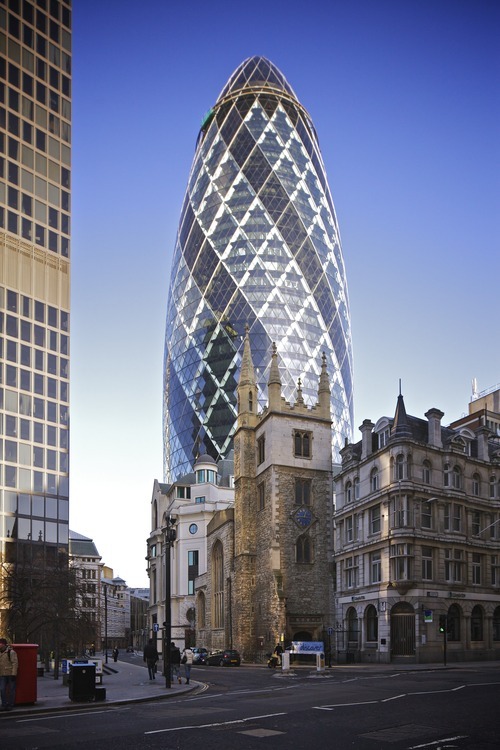
Late last month it was announced that the 30 St. Mary Axe tower in London–also affectionately known as the Gherkin–had gone into receivership. The reason was a mismatch of assets and liabilities, specifically currency losses:
A fund managed by IVG Immobilien AG, once Germany’s biggest real estate company, and London-based Evans Randall Ltd. bought the Foster + Partners-designed tower from reinsurer Swiss Re Ltd. for 600 million pounds ($1 billion) in 2007. Part of the IVG fund’s loan was in Swiss francs, which have gained about 63 percent against the pound over the last seven years, increasing the amount owed to the point that it breached rules on how much debt could be held against the property.
But what I found interesting while reading Bloomberg and Monocle, and learning about the loan default, is that there seems to be a lot of people in London that really don’t like this tower. Shaped like a giant pickle, it’s been the brunt of many lewd jokes, I’m sure.
However, within the architectural community, the Gherkin tower is generally revered as a pretty awesome piece of architecture. It’s a highly sustainable building that employs a number of natural ventilation and passive heating and cool techniques. It’s estimated to consume half the energy of a “typical” office building.
And certainly, I hear lots of people criticize the building here in the city. Often, they mention how much wasted space the angular walls generate, which makes me wonder why we have so many people living in the suburbs when there are so many space conservationists among us.
Personally, I love the Crystal. And I also love the Gherkin. They’re big and bold and they piss a lot of people off. Good, I say.
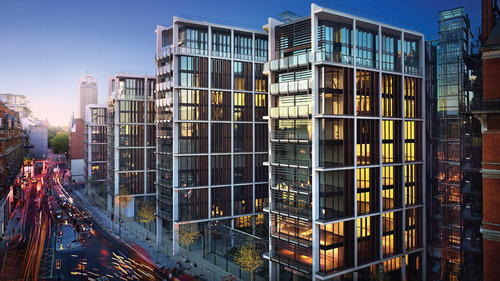
Yesterday evening I was reading the Spring Summer Candy GPS Report put out by London-based property developer Candy & Candy. If you’ve never heard of Candy & Candy, then I guess you haven’t been in the market for a £60m apartment. Candy & Candy are the developers behind One Hyde Park in London, which is said to be the world’s most expensive residential development.
But what is interesting about a project like One Hyde Park is that it’s really only possible in a global city, like London, that attracts a massive amount of foreign investment. A project like One Hyde Park is a possibility of globalization, not a result of local employment numbers.
Which is why if you take a look at the Candy GPS report, you’ll see that their interest is in tracking the habits of ultra-high-net-worth-individuals (UHNWIs)–those with wealth exceeding US$30 million. Last year, the world was estimated to contain almost 200,000 of them, with a combined wealth of almost $28 trillion. This number is expected to rise to $40 trillion by 2020.
Now, you may not be in the market for the most expensive apartment in the world, but I thought it would be interesting to talk about where this money is coming from and which cities it’s going into–at least when it comes to real estate.
The top 3 countries for UHNWIs investing in real estate are Germany, Japan and the United States, respectively. The US has the most ultra rich people, but they have a lower propensity to invest in real estate compared to Germany. Nonetheless, these are the countries that dominate.
But who are the recipients of this money?
Well, first of all, it’s going into cities. But it’s flowing into a small number of them. Cities representing 5% of the world’s population are said to attract over 50% of the real estate investments made by the richest people on the plant.
According to Candy GPS, the top cities are Hong Kong, London, Moscow, Singapore and New York, respectively. Hong Kong sits at the top, largely because of money flowing in from mainland China, but London is said to have the broadest investment reach.
So there you have it, a quick overview of where the ultra rich buy real estate.
I’ve spoken about global cities, such as New York and London, many times before on Architect This City. I’ve also talked about the rise of consumer cities. That is, cities with a high “urban amenity premium”, which could be great outdoor amenities or great restaurants, theatre and so on. These are places of consumption.
Sometimes global cities and consumer cities are one and the same. But there are also cities–such as Vancouver–where I view the urban amenity premium as outweighing their status as a global city. Vancouver, quite simply, is an awesome place to live and enjoy life. I almost went to UBC for grad school because of Whistler Blackcomb and the city itself.
Today, I’d like to introduce another type of city into the discussion mix: the necessary city. I heard about it here and, although it seems somewhat intuitive, I think it’s an important reminder that, even though a city may not be an alpha global city, it may be fulfilling a specific function for a particular industry or aspect of the global economy. It may still be a necessary city for your corporate headquarters.
For example, Houston is the city for energy companies. If that’s your business, you likely need a presence there. For fashion and luxury, it’s Paris. And if you’re in the auto industry:
The major global equipment manufacturers are widely dispersed, but when you look at leading global parts suppliers, they virtually all have their North American headquarters in Detroit – including the German, Japanese and Korean ones. Among them are companies like Robert Bosch, Denso, Yazaki and Hyundai Mobis. If you’re in the auto industry in America, you have to deal with Detroit. Unsurprisingly, Detroit boasts several nonstop flights to key Asian destinations.
In essence, we’re talking about cities making themselves necessary by becoming niche experts. And what I think is interesting about this concept is that it’s likely much more attainable for a lot of cities. Most cities will never become New York. And most cities will never be able to transform themselves into the next Silicon Valley.
But maybe those are the wrong economic development goals. It’s not about becoming the next, whatever; it’s about finding and owning a particular niche and making yourself absolutely necessary to the global economy.
Earlier this week I received a message from an undergraduate architecture student interested in moving into real estate development after school. That was his 10 year plan. And he had clearly read my blog post, “Transitioning from architecture to development.”
In his message, he asked me if there were any books I would recommend he read to improve his real estate and finance knowledge, and, if I could have a “redo”, if I would still do a M.Arch (Master of Architecture) or just go straight to the MBA?
After responding to his message, I thought: “This would make a good blog post, as well as an opportunity to talk about the current state of real estate education in Canada.” So here goes.
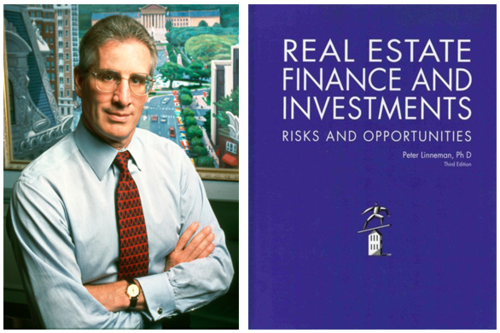
If you’re looking for a good real estate book to get you started, I recommend checking out “Real Estate Finance and Investments: Risks and Opportunities" by Peter Linneman. It’s a much easier read and way more casual compared to most textbooks. When I was in grad school, people referred to this book as the "blue bible.” The cover on the previous edition was less purple and more blue. Unfortunately, he has also changed his glasses since the photo below.
To his second question, if I were to do it all over again, I wouldn’t change a thing about my education. I loved architecture school and combining it with business school classes and a real estate concentration was the best thing for me. I never wanted to be just a “numbers guy”, but I also never wanted to be a fanciful artist type who didn’t know how to build and manage a pro forma.
Now, let’s talk about real estate education in Canada.
I think we’re way behind. In the US, you can do a Master of Science in Real Estate Development, a Master of Real Estate Development, and all sorts of other real estate degrees. In Canada, you’re probably doing a MBA with a few elective real estate classes. Real estate is the largest asset class in the world. Does that not justify a dedicated degree?
Part of the reason for this, I think, is because real estate development is still very much an entrepreneur’s business–though it has become more institutionalized in recent years. Because of this, people get into development from a variety of different professions. They just need that entrepreneurial hutzpah. And that’s all fine, but I still think that the profession, the economy and our cities would benefit from University trained developers.
I’ve been a Foursquare user for a number of years now. I like seeing which friends are nearby and where I’ve been. I love the data aspect of it. It’s a kind of urban “spidey sense.”
Sometimes when you “check-in”, the app will tell you the last time you were there (if it’s been awhile), how many consecutive weeks you’ve been there (which I like seeing when I check-in at the gym), and also give you any tips that others may have left about the place you’re at–such as, try the sea urchin ceviche.
But Foursquare has been struggling. Check-ins proved to be a bit of a fad and Yelp solved the what-do-you-want-to-do-tonight problem better. However I’ve always felt that, on a fundamental level, Foursquare had the potential to be so much more powerful than Yelp.
Well, today the big news in the tech world is that Foursquare is unbundling its app. There will be Foursquare and there will be Swarm. Foursquare will be a recommendation engine that helps people find places to eat, drink, shop and so on (just like Yelp), and Swarm will be all about social–seeing where your friends are and which ones are nearby. And along with this unbundling, there will be no more check-ins:
But how can Foursquare personalize its users’ results if they are no longer collecting check-ins, the foundation of Foursquare’s recommendation engine? Crowley smiles and says something a bit shocking. He no longer needs check-ins, the meat and potatoes of Foursquare’s entire business and data collection engine for the last five years.
Not only has Foursquare collected 6 billion check-ins, he says, but it has collected five billion signals to help it map out over 60 million places around the world. Each place is a shape that looks like a hot zone of check-ins — of times when people have said “I’m here.” Foursquare’s “Pilgrim” location-guessing engine factors in everything from your GPS signal, to cell tower triangulation, to the number of bars you have, to the Wi-Fi networks, in order to create these virtual shapes.
Now that it has this data, Foursquare can make a very accurate guess at where you are when you stop moving, even without a check-in, it’s a technology it hopes will allow it to keep its database of places fresh and accurate. Foursquare calls these implicit check-ins “p-check-ins,” or Neighborhood Sharing. Take your phone into four or five different Japanese restaurants over the course of six months and without a single check-in Foursquare will learn that you like Japanese food and start making recommendations for you based on that data.
There will obviously be a number of people who have anxiety about an app that’s passively tracking everywhere they go and then trying to feed them recommendations (come eat here!), but I do think they’re on to something.
The opportunity with Foursquare (and its data) is that the recommendations can be tailored. If I’m looking for a place to eat, Foursquare will already know that I love Mexican and that I just worked out (meaning I’m probably extra hungry). Personally, I’m okay with that.
But then I start to wonder how this might impact cities. If the process of discovery becomes this automated and this tailored, how might it change the way we organize and design our cities?
If you are under 30, you love Toronto and you care about public spaces in this city, I would encourage you to check out the NXT City Prize. It’s a public space competition being organized by a number of local organizations including Distl. (and my friend Mackenzie Keast), Loop, Gen Y, and the City of Toronto.
Toronto needs great ideas for its public spaces. Ideas that are big, bold and unconventional. Ideas from champions, outsiders and geniuses. Ideas that recognize Toronto’s greatness–and its potential for the future.
The competition opens today and anybody (under 30) can enter. The winner will receive $5,000 in cash, and then $10,000 to work on actually implementing the idea(s). What’s cool and unique about this competition is that it’s not just an ideas competition. It’s a competition based on doing and executing.