Daily insights for city builders, delivered every morning at 6 AM ET. I’m Brandon Donnelly — a Toronto-based real estate developer and founder of Globizen. I’ve been writing here since 2013.

  • Biggest US real estate website to acquire 2nd biggest US real estate website

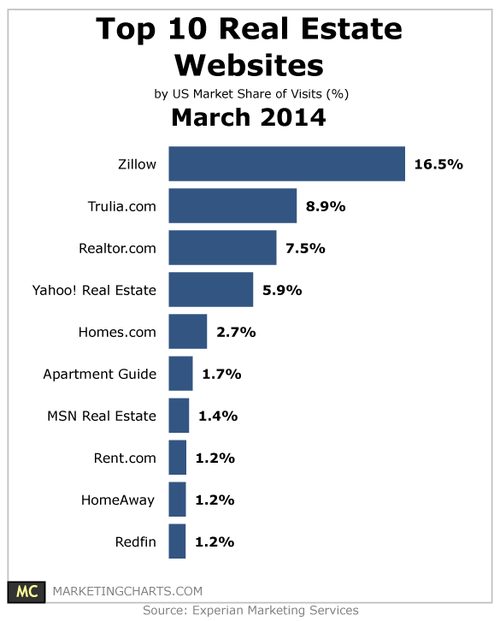
    Today it was announced that Zillow.com will be buying Trulia.com for $3.5 billion in a stock-for-stock transaction. Based on share of web visits, the biggest real estate website in the US has just acquired the 2nd biggest.
    image

    Both companies make the bulk of their money through advertising sales to real estate professionals (i.e. agents and brokers). But what was interesting to read in their press release is that, even with this merger, the combined revenue of both Zillow and Trulia still only represents about 4% of the estimated $12 billion that US real estate professionals spend on marketing each year. 

    Zillow says it’s because the real estate industry hasn’t fully made the switch to online and mobile – and thus it represents a huge market opportunity for them. And from my experience I would say that this is likely the case. But it could also be because the real estate community is putting their marketing dollars elsewhere online. 

    Whatever the case may be, Zillow.com (and its portfolio of companies) is now firmly positioned as the largest real estate website in the US. But even still, Zillow.com has never felt fully “net native” to me. It has never felt as if it were specifically built for the internet and that it’s only possible because of the internet. Instead, it feels like an offline model ported over to online. And the two are quite different.

    The reason I feel this way is because there’s an inherent tension to the way the online residential real estate market works today. Virtually every lead generation tool (that agents use) is intended to funnel buyers and sellers to them. That’s why so many real estate websites have sucked for so long. Because the goal wasn’t to keep you locked into a website, it was to get you to connect, in person, with an agent.

    Zillow and Trulia started to break with that tradition by offering a lot more information online. Before they came along, it was a lot harder for real estate consumers to do their own research. But at the end of the day, Zillow makes money when it’s an effective sales funnel for agents. And since that’s always been the way the market has worked, it doesn’t feel net native to me.

    If my gut is right, then it means there’s still lots of opportunities in this space.
  • Bad neighbors build wind turbines

    image

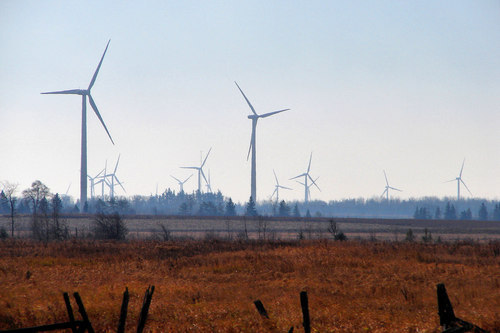
    On Friday when I was driving up to Thornbury, I ended up taking a route that goes through Shelburne, Ontario. I’ve taken this route at some point before, but I don’t remember seeing so many wind turbines. I guess it must have been before this particular wind farm had been built out.

    It turns out that these wind turbines belong to the Melancthon wind facility, which is the largest installation in Canada. The facility contains 133 wind turbines and has the capacity to generate 545,000 megawatt hours each year – enough renewable energy to power roughly 70,000 households. The facility is owned and operated by TransAlta and they’ve entered into a 20-year contract to supply renewable energy to the Ontario Power Authority.

    But what I also happened to notice were the many signs posted around with wording like the title of this post: “Bad neighbors build wind turbines.” And after speaking about it with people over the course of this weekend, I very quickly learned that there was fierce community opposition to this project.

    The concern with wind turbines is typically twofold. People don’t like the way they look and they worry about the noise that they will generate. There’s even an alleged condition called “Wind Turbine Syndrome.”

    I personally think they look quite beautiful. They seem so symbolic of the future and progress. But I am intrigued by the noise concern and so I decided to do a bit of research. I found this video from the UK. The big takeaways are that living beside a main road is generally much louder than living beside a wind turbine, and that a wind turbine isn’t usually that much louder than a quiet suburb, until you get fairly close to it. So I wonder if it’s really as bad as people are making it out to be.

    Either way, the issue at hand is incredibly important. We’re talking about renewable energy. And while you may not like the look of wind turbines scattered across the horizon as much as I do, I strongly believe that we need to figure out ways to wean ourselves off of fossil fuels. It’s for this reason that I’m a big supporter of both wind and solar power.

    So perhaps the counter to those signs scattered around Shelburne is the following: Responsible communities build wind turbines.

    Image: Wikipedia

  • Pools and gardens of New York

    Right now, I’m sitting on the sun deck at my friend’s cottage and looking out at the Georgian Bay. So this is going to be a short post. The New York Times just published a stunning photo series of hidden rooftop pools and gardens in New York. All of the photos were taken from a helicopter. If you’re as fascinated by cities as I am, I think you’ll really like them.

  • Pre-delivering new homes

    image

    Today was my mother’s PDI for her new condo. For those of you who aren’t in the industry, a PDI is a “pre-delivery inspection” that happens about a week or two before you take occupancy of a new home. It’s basically a time for you to identify all the mistakes that the construction team has made and have them (hopefully) correct them before you actually move in.

    But for someone like my mother who is making the move from a house that she’s lived in for decades, a PDI is actually something much more significant: It’s the first time she saw her new “home.” And a home is something much different than just a house or a condo – it has emotional significance.

    It’s going to be an adjustment for her. One of the first things she did was open up the oven to see if she could fit her Christmas turkey in it. But in the end, I have no doubt that she’s going to love her new home. As I’ve mentioned before, people often overestimate the potential risks of change. But never be afraid to give up the good to go for the great.

  • How much does it matter what message a city sends you?

    In keeping with the recent theme about cities, their brands, and the messages they send, I thought I would revisit an old essay (2008) written by Paul Graham (of Y-Combinator) called “Cities and Ambition.” In it, he talks about the various messages that cities send us, such as:

    • You should make more money (New York)
    • You should be better looking (Miami?)
    • You should be smarter (Cambridge)
    • You should be more powerful (Silicon Valley)

    But the most interesting part of his argument is the belief that we are largely products of our environment. No matter how strong or formidable our personalities might be, the message a city sends us is hugely important. In fact, it might be impossible to escape it. Here’s how Paul puts it:

    How much does it matter what message a city sends? Empirically, the answer seems to be: a lot. You might think that if you had enough strength of mind to do great things, you’d be able to transcend your environment. Where you live should make at most a couple percent difference.

    But if you look at the historical evidence, it seems to matter more than that. Most people who did great things were clumped together in a few places where that sort of thing was done at the time.

    You can see how powerful cities are from something I wrote about earlier: the case of the Milanese Leonardo. Practically every fifteenth century Italian painter you’ve heard of was from Florence, even though Milan was just as big. People in Florence weren’t genetically different, so you have to assume there was someone born in Milan with as much natural ability as Leonardo. What happened to him?

    If even someone with the same natural ability as Leonardo couldn’t beat the force of environment, do you suppose you can?

    I don’t. I’m fairly stubborn, but I wouldn’t try to fight this force. I’d rather use it. So I’ve thought a lot about where to live.

    To some, this thought may depress you. I mean, if you happen to live in a city or place with the “wrong” message, you might feel as if you’re missing out. I know that thought certainly crossed my mind when I read his essay. But different messages resonate with different people, and so maybe the message your city is telling you is exactly the one you need to accomplish great things.

    In Toronto, I’d say that the message is similar to that of New York: You should make more money. Oh, and also that you should buy more condos 😉

    What message does your city tell you?

  • Kingston&Co at the Beaches Jazz Festival

    image

    One of the best things about Toronto in the summer is that it feels like there’s a special event happening almost every day of the week. It would be impossible to go to everything, but one of my favorites is StreetFest at the Beaches Jazz Festival, which is running this week from Thursday (July 24) to Saturday (July 26).

    If you’re from Toronto, then you’ve probably been. But if you haven’t been, StreetFest is basically a 2.5 km stretch of Queen Street East in the Beaches that gets closed to traffic so that hundreds of thousands of pedestrians can walk around and listen to jazz music on the street. It’s a lot of fun and I’m told there will be 40 bands this week.

    This year TAS has sponsored a tent and so the Kingston&Co Condominiums team will be there to talk to people about our project (and also listen to some jazz music!). I’ll be there on Thursday night (tomorrow) and so if you’re around, come by and say hello. If you can’t find us, send me a tweet.

    If you haven’t been to StreetFest before, here are two tips. It gets super busy and traffic is often bad heading in and out of the area. If you have the option of biking there (or riding on someone else’s handlebars), I would highly recommend that.

    Also, given how busy it is, I remember it being difficult to find a beer the last time I went – all the restaurants and patios were full. So you may want to consider investing in a CamelBak Pack. We wouldn’t want you getting dehydrated 🙂

    I hope to see some of you there.

    Image: JR Photography

  • Rules are made to be broken. So which one is next?

    Jevon MacDonald of StartupNorth published an interesting article today called, You are supposed to break the rules. It talks about entrepreneurship and how great companies are built by disregarding the way things are done today.

    And I think it’s for that reason that many stupid sounding ideas (think Airbnb and its initial idea of offering air mattresses) actually turn out to be great ideas. In reality, they weren’t stupid ideas. They just contravened the norm, and that made them sound stupid. It made people feel uncomfortable. And as humans, we tend to have a bias towards things that reinforce our existing view of the world.

    In any case, Jevon talks about some of the “big rules” that are being broken today. His list includes:

    But really he’s talking about Uber, Tesla, and Airbnb. They are the startups breaking those rules. However, that’s old news for most of us. What’s more interesting are the following two takeaways.

    The first is his prediction that startups are going to start running into more and more regulatory hurdles. In other words, we’re going to see more, not less, litigation. And I think he’s right. As technology starts to creep into other industries (like it has with the taxi industry, the car industry, and the hospitality industry), we’ll probably see a lot of incumbents fighting to hold on.

    The second interesting takeaway for me was that out of his list of “big rules”, the real estate industry (i.e. the MLS) is the only one that doesn’t have a formidable disruptor attached to it. Which makes me wonder: Is something like Opendoor.com inevitable?

  • What are the most compelling reasons for someone to become an architect now?

    Since I’ve talked a lot before about the profession of architecture and the future of it, I thought I would share this recent interview with Mark Wigley from Surface Magazine (May 2014). Since 2004, Wigley was the Dean of Columbia University’s Graduate School of Architecture, Planning and Preservation. But he’s now stepping down and this was his exit interview.

    The first question he was asked was: 

    What are the most compelling reasons for someone to become an architect now?

    I actually think that there’s never a compelling reason to be an architect. The decision is irrational, and that irrationality is an enormous and precious asset. Architecture is full of romantics who think that even relatively small changes to the built environment create the aspiration for a better society. It sounds hokey, but there is in every architect the thought that things could be better. This is a kind of professional optimism. And that leads to an expertise in entering situations in which the dynamics are unclear. Architects are only ever called into a situation when it’s impossible. If it’s possible, you invite somebody with a toolbox who can give answers. You call the architect in when it’s not clear what the question even is. 

    The line I really like is the one I highlighted in bold above: “…there is in every architect the thought that things could be better.”

    Wigley is talking about it in a kind of romantic and idealistic way, but I don’t think it necessarily needs to be that way. The optimistic belief that things could be better, that things could be improved, is a powerful notion. In my view, it’s what drives entrepreneurship and that happens to be our most powerful economic engine.

    I actually think there are a number of parallels between architecture and entrepreneurship. In school, architects are indeed taught to enter into situations where “the dynamics are unclear.” It’s about taking an idea, developing it, and trying to figure out what it could become.

    Then, once you’ve poured your heart and soul into that idea, you get up in front of everyone and you pitch it. It’s your job to convince everyone that, yes, the way you’ve developed your idea is in fact the right way. Sometimes you get shot down. And other times you don’t. But you just have to take the risk.

    Click here to download the full PDF of Mark Wigley’s interview.

  • The branding of places

    image

    Most people would agree that branding is a powerful and important exercise in the world of business. We recognize that brand equity is something that pays dividends in the future.

    When you walk around a city with a Starbucks, Tim Hortons, or some other coffee cup in hand, you are sending signals about who you are as a person and consumer. So, you could argue that you’re consuming the cup, as much as you are consuming the coffee.

    But one area that still feels like it’s in its infancy is place branding. That is, the branding of nations, regions, cities, and places. I’ve talked a lot about the business of cities and how impressions are created around cities, but I’ve never explicitly talked about place branding.

    However, it is an area on the rise. Monocle has written extensively about the importance of nation branding and there are firms, such as Vancouver-based Resonance, that now specialize in the strategy and branding of places.

    Here’s a short 5 minute video that they prepared talking about place branding and their approach to it. If you can’t see the video below, click here.

    //player.vimeo.com/video/66920801

    But at the same time, there are more grassroot ways in which a place brand can emerge. Think about the number of times Jay-Z has referred to himself as the Brooklyn boy or Drake has promoted Toronto in one of his videos. It’s hard to measure the impact of these sorts of things, but I am sure there is one.

    Here’s another example – a 4 minute video of Drake talking about why he loves Toronto. Click here if you can’t see it below.

    [youtube https://www.youtube.com/watch?v=M3TrbGEJbio?rel=0]

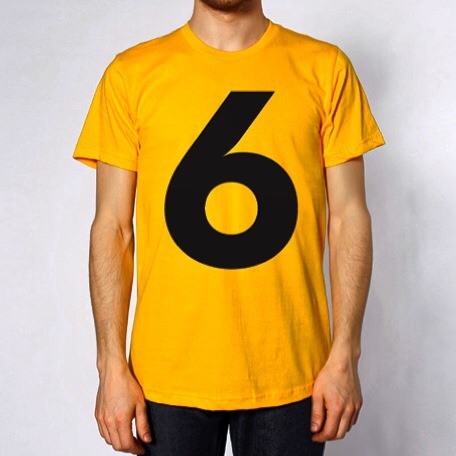
    Recently, you may have heard that Drake is about to give Toronto a new moniker: The 6. Some think it is in honor of our two main area codes 416 and 647, and I think that’s probably a good guess.

    But whatever the reason, I thought it was an interesting exercise in place branding. So I decided to partner with Toronto-based design firm Badd Press and make a “The 6” t-shirt (shown at the top of this post). You can get yours for $30 by visiting shopATC.

  • 2 parents, 2 kids, and 1 cat in 1,000 square feet

    Yesterday a colleague at the office sent around this Globe and Mail article talking about a Vancouver family of 4 (plus one cat) who live in a 1,000 square foot loft near downtown that they purchased in 2003 for $269,900. There weren’t really any photos of the place, but the article makes it sound like they have 3 beds crammed into one room. (I wonder how the parents ever manage to have sex. There are better ways to lay out 1,000 sf.)

    In any event, the point of the article is that there’s a growing number of families who are clinging to the downtown lifestyle that they’ve grown accustomed to and are refusing to follow the path of a conventional suburban house – regardless of how tight their current quarters might be. It’s happening in Toronto (here’s an article from the Toronto Star and here’s a post I wrote) and it’s happening in New York:

    A recent New York Times article on a similar trend noted that the number of white professionals with one or more children living in one-bedroom condo units in that city had jumped by almost a third between 2000 to 2006. Prof. Andrew Beveridge, from Queens College of the City University of New York, said the pattern was showing up in other expensive American cities. In Toronto, the 2011 National Household Survey showed there are about 72,000 families living in 71,500 units in buildings with five or more storeys – undoubtedly many of them the new, tiny condos proliferating there.

    To some this might sound crazy. I mean, why would a dual income family–such as the one in Vancouver–subject themselves to a smaller space when they could easily afford a bigger place somewhere else? Isn’t that the dream – to have a big house?

    The answer is that these families are considering–in addition to the direct costs of a bigger place–both the indirect costs of living further away from the core (such as longer commute times) and the inevitable lifestyle changes that would happen should they move out from their downtown neighborhoods. The urban lifestyle is different.

    But what I find interesting about this phenomenon is that if this trend continues (and I think it will), we’re going to have a new generation of people in North America who grew up in apartments, condos, and lofts, and don’t have the same biases around single family houses and suburban living. To them, an apartment will be a perfectly normal place to raise a family.