Daily insights for city builders, delivered every morning at 6 AM ET. I’m Brandon Donnelly — a Toronto-based real estate developer and founder of Globizen. I’ve been writing here since 2013.
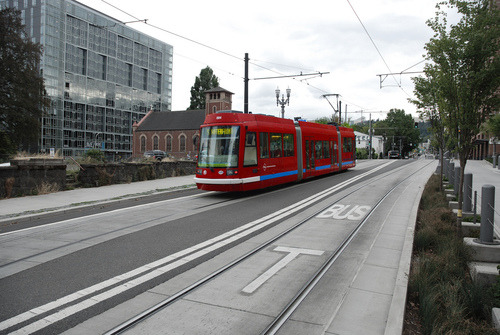
Earlier this month the Toronto Star published an article talking about the resurgence of streetcars in American cities. According to the Star, 89 cities in the US are currently implementing or at least considering building some form of surface-rail system.
But the article also goes on to argue that it could be a snobbish fad. Streetcars are new. They’re shiny. And they make yuppies – who don’t like taking buses – feel better about themselves. But is the ROI really there? Is the economic impact of streetcars as big as people are making it out to be?
To support this argument, the Star quoted transportation planner Jarrett Walker, who I’ve mentioned here before on Architect This City. But according to a follow-up post that Walker did on his blog, it would appear that he was misrepresented in the article. Here’s a snippet of his response:
Here’s the bottom line. Streetcars are just a tool. They can be used in smart ways and in stupid ways. Asking a transit planner for an opinion about a transit technology is like asking a carpenter what his favorite tool is. A good carpenter sees his tools as tools and choses the right one for the task at hand. He doesn’t use his screwdriver to pound nails just because he is a “screwdriver advocate” or “hammer opponent”. Yet the Toronto Star assumes that nobody involved in transit debates is as smart as your average competent carpenter.
I wanted to share this because I think it’s a great way to approach transportation planning and because I think it gets at a larger issue that we continue to face here in Toronto: We keep politicizing mobility tools. Cyclists have become pinkos. Streetcars are a war on the car. And the list goes on. How about we just look at the problem, and figure out what solution would work best?
I don’t have any tattoos and I have no plans of ever getting one, but if I were in the market for something to tattoo on my body, this Latin phrase would be a solid contender: Audentes fortuna iuvat. It translates into something along the lines of: Fortune favors the bold. And it’s one of my favorite proverbs.
The supposed meaning behind the phrase is that Fortuna, the Goddess of fortune and luck, was believed to be more likely to help those that took risks, took action, and were generally bold. And what I like about this is that it doesn’t make luck some abstract thing that people either have or don’t. It firmly transforms luck into something that you yourself can create. That is, if you want it.
Earlier this month, venture capitalist Fred Wilson wrote a post on his blog called Get Lucky, where he talks about the research that psychologist Richard Wiseman did on so-called lucky and unlucky people. Wiseman concluded the following:
My research revealed that lucky people generate good fortune via four basic principles. They are skilled at creating and noticing chance opportunities, make lucky decisions by listening to their intuition, create self-fulfilling prophesies via positive expectations, and adopt a resilient attitude that transforms bad luck into good.
Obviously, the common thread between these two ideas is that luck is something that you yourself can control. Lucky is a state of mind. Whether you believe in greater powers or not, people at least as far back as the Roman times identified the benefits of taking action, risk, and of boldness. It creates opportunity. And it creates luck.
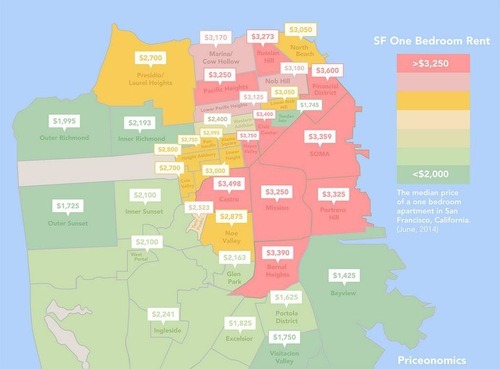
Recently Priceonomics posted a piece on San Francisco’s “rent explosion.” In it, was the infographic above showing the median rental rate for a 1 bedroom apartment in the city. The most obvious takeaway is that San Francisco is real expensive. In the core of the city, you’re easily looking at $3,000 per month.
That is with one exception: the Tenderloin (the green area just northwest of SOMA in downtown). The first time I ever visited San Francisco, I actually stayed on the outskirts of this area, which is a neighborhood well known for seediness, homelessness, crime, drug trade, strip clubs, and so on. And it was actually named after a similar neighborhood in New York that was also a center of vice in the late 19th and early 20th centuries.
But when I saw this diagram, I immediately asked myself: How could it be that the Tenderloin was holding out so well against the forces of gentrification? How is this island of seediness being preserved in the center of downtown? Particularly in a city like San Francisco where there’s a perpetual housing supply shortage and lots of wealth. The Tenderloin has some of the lowest rents in the city.
So I tweeted the good folks at Priceonomics and they responded with this article. It’s a few pages long, but the reasoning seems to come down to the following: active community groups that fought to keep developers out of the area (and that also own many of the buildings), downzoning, and a high percentage of rooming houses. According to that same article, the Tenderloin contains approximately 100 single room occupancy residential hotels (or SRO’s as they’re called). These were initially built to house the city’s transient and seasonal population after the great fire of 1906.
So it would appear that there are some significant barriers to entry.
But at the same time, it generally seems like a bad idea to concentrate poverty, homelessness, drug users, and so on. Interestingly enough, the article talks about how when the Bay Area’s transit system went on strike for a period of time, the supply of drugs actually dried up in the Tenderloin. This underscores how regional the drug business is, but also makes me think that dealers are almost surely benefiting from the clustering of their client base.
In any event, this is a much larger problem than just a real estate development one. I don’t know what the solution should be, but I’m pretty sure that things are being made worse by concentrating everything in one neighborhood and by rising income inequality in the city. Inequality seems to lead to all kinds of negative externalities and, from my experience, mixed-income neighborhoods perform better than 100% poor ones.
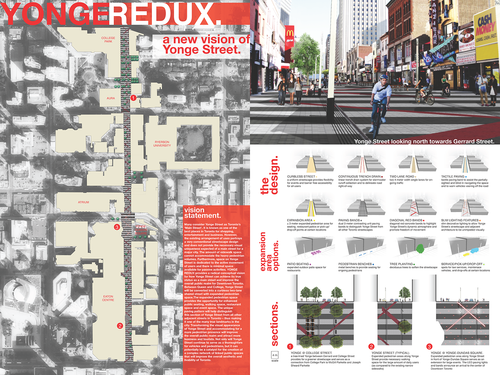
Back in April I wrote about a competition for young people to reimagine public space in Toronto. It was called NXT City. Well that prize has been awarded and the winner was Richard Valenzona for his vision–called Yonge-Redux–of a new and reimagined Yonge Street. To download the PDF of his entry (the image shown above), click here.
The proposal encompasses a stretch of Yonge Street that runs from Queen Street in the south, to College Street in the north. It would capture the Toronto Eaton Centre (mall), Yonge-Dundas Square, Ryerson University’s expanded Yonge Street footprint, and the massive mixed-use developments happening in the College Park area (see Aura Tower). To quickly simplify, the proposal is essentially about enhancing the urban experience, prioritizing pedestrians, and reducing the flow of cars to two lanes.
Overall, I think it’s a wonderful proposal and I’m not surprised it won NXT City. This type of intervention is on so many of our minds. In fact, it’s somewhat surprising that we’ve been as slow as we have to improve our main street. There are so many anchor institutions, such as the Eaton Centre and Ryerson University, that plug into this section of Yonge Street. It makes a lot of sense.
But as I said in my original post, one of the most exciting things about the NXT City Prize is that it has always been about execution. This is not just an academic exercise–or at least that’s the hope. This exercise is about spurring real change in the city and I genuinely hope that they’re successful in doing so. Because then I can turn around and say: Take that Melbourne 🙂
Kudos to Richard Valenzona, Mackenzie Keast, as well as everyone else involved in NXT City, for making this initiative a reality and for doing your part to make Toronto even more awesome.
One of the things that makes cities so exciting is the fact that they’re always changing. New restaurants open up. New buildings are built. Old buildings (with no heritage value, of course) are demolished. Bike lanes are added. New infill homes pop up in quiet residential neighborhoods. And the list goes on.
For years I’ve wanted an app or some sort of product that would allow city builders to keep track of everything that’s going on in their city. In the same way that Foursquare helps you find cool restaurants around you, I would like to know about everything that’s going on, from rezoning applications to construction updates.
One of the challenges, of course, is that I’m sure more people care about cool new restaurants than about esoteric planning applications. It’s definitely a niche market. But that doesn’t mean there isn’t a thriving group of people who do care. So I’ve decided to introduce an Architect This City hashtag on Twitter: #ATHISCITY.
I’ll be using it for city building updates and, if some of you join in as well, I think it could become a great way to keep track all of the neat things that are happening in our city, as well as in others around the world.
The cost of a parking spot in downtown Toronto has reached as high as $60,000 (per stall) in some new construction projects. If you convert that to a per square foot price (which is typically how people measure condo prices), you’re looking at over $350 per square foot for that parking stall. Is it worth it?
Most cities around the world have what is called a parking minimum. This means that to build, say a new residential condo, developers need to provide a certain number of parking stalls. In Toronto, those minimums will depend on your unit mix. Bigger units have more stringent parking requirements.
In some cities, though it’s much rarer, they actually have parking maximums. Portland, for instance, has a maximum number of parking stalls that you’re allowed to build, which fluctuates based on the development’s proximity to transit.
And finally, there are some cities, such as Berlin, with no parking minimums or maximums at all. In those cases, the market dictates the number of parking stalls that should be built. If people want a parking spot with their apartment and won’t buy or rent it without one, then the developer builds it.
Though parking variances do happen in Toronto (for reasons such as proximity to transit), the city is generally skeptical of a market led approach to parking requirements. And there are a couple of reasons for that. They worry that investors might be buying the units (with no parking) and so the sales data may not be indicative of the end-user market.
The city also worries that developers might actively discourage purchasers from buying parking spots, as it’s usually more profitable not to build them. Underground parking is costly and often subsidized by the sale of the condo units themselves. In fact, I’ve heard of instances where underground parking has cost upwards of $100,000 per stall because of buoyancy forces and other technical details.
But I’m generally a free market guy. So I question if the market really isn’t capable of figuring out how much parking there truly needs to be. Undoubtedly, there will be families who demand 2 parking spots. I also bought a parking spot with my condo. But there may also be a number of people who would rather pay less for their home than subsidize a parking garage that they’ll rarely use.
And as I wrote in a recent post called, Is traffic the right question?, we could be losing sight of the greater goal. If we truly want to build a sustainable and livable city, then we should be considering how our development activity encourages transit usage over driving, and how we can promote a more balanced modal split across the city.
What are your thoughts? Would you buy a home without parking? Should we get rid of parking minimums, just as cities like Berlin have?
“Make no little plans. They have no magic to stir men’s blood and probably themselves will not be realized. Make big plans; aim high in hope and work, remembering that a noble, logical diagram once recorded will never die, but long after we are gone will be a living thing, asserting itself with ever-growing insistency. Remember that our sons and grandsons are going to do things that would stagger us. Let your watchword be order and your beacon beauty. Think big.”
-Daniel Burnham, Chicago architect. (1846-1912)
I’m a big fan of Chicago. Having now visited the city, I can say that everyone was right when they told me that I was going to love it. It has great art and architecture, great food (with some of the largest portions I’ve ever seen), great nightlife, and great people.
But I don’t want to talk about any of these things today. Instead, I want to talk about something much more specific that stood out to me last weekend: Chicago’s relationship to both the water and the street.
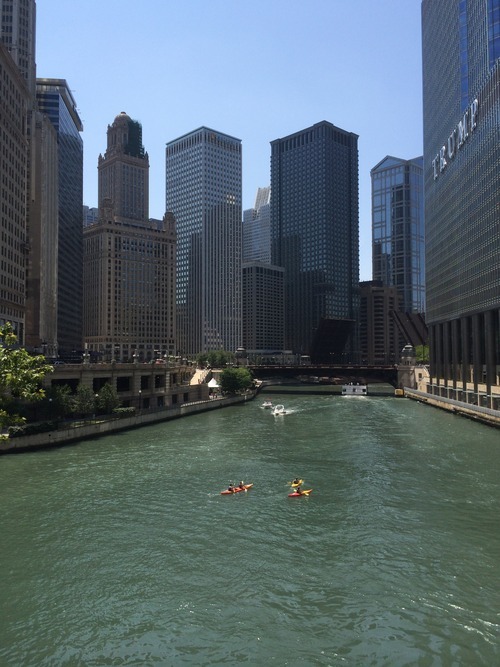
While Chicago and my hometown of Toronto share many similarities– including being situated on a Great Lake and having rivers flow through the middle of them–the relationship to these bodies of water is remarkably different. Here is a photo of people kayaking in the Chicago River on a Friday afternoon:
What impressed me about Chicago is how intimate and urban the relationship is with the lake and its rivers. If you look at the photo above, you’ll see that many of the buildings are built right up against the river, but that there’s space allocated for riverwalks, patios, and so on. It’s all about engaging and connecting with the water.
Toronto on the other hand, is only recently starting to reacquaint itself with its bodies of water. We spent much of the second half of the 20th century with our back turned to the lake and without a strong urban connection to the Don River. And if I had to guess why it’s because we built highways along them.
We built the Gardiner Expressway adjacent to Lake Ontario and we built the Don Valley Parkway adjacent to the Don River. This fundamentally changed our orientation and largely precluded us, I think, from creating the same kind of waterside urbanity offered in Chicago.
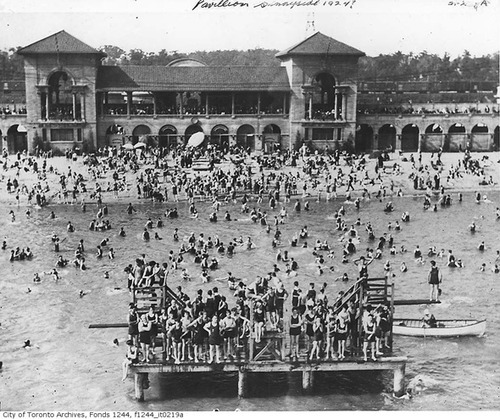
As an example, consider that in the first half of the 20th century, Toronto’s Parkdale neighborhood – which today still has a questionable reputation – was actually an affluent and desirable waterfront community filled with beautiful Victorian mansions. It was well connected to the waterfront, and so the area flourished. Here’s what Sunnyside Pavilion used to look like:
But then in the 1950s we built the Gardiner Expressway, disconnecting Parkdale from the lakefront and destroying many of its amenities, such as the Sunnyside Amusement Park. In turn, the rich people left and their large Victorian mansions got chopped up into rooming houses and other rental housing stock. And in my view, Parkdale still hasn’t fully recovered from this.
Highways are divisive. There’s no question.
So unless you can afford to bury them, it comes down to trade offs: Do you want to make it easier for people to drive in from the suburbs or do you want a truly spectacular water or riverfront? In the 1950s we chose the former. But even still today, the thought of tearing down–even a portion of the Gardiner Expressway–is fraught with opposition. I guess not much has changed.
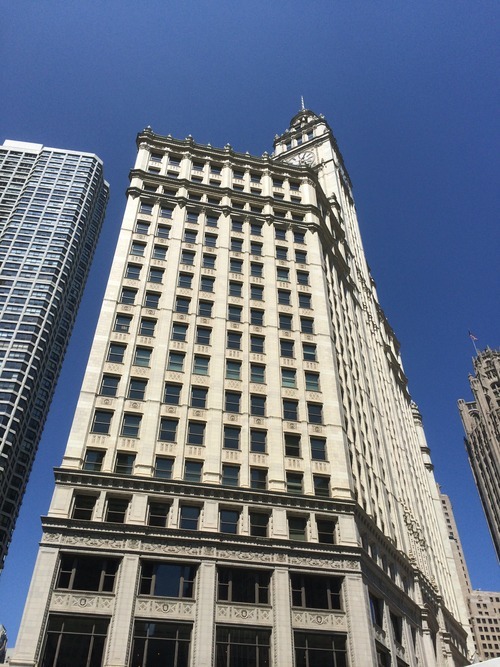
The second way that Chicago impressed me is through the relationship that many of its buildings hold to the street. They come down to ground level with authority and with great retail presence, and often make no amends about their mass and impressiveness. This frames the street and creates a level of urbanity that isn’t always found in Toronto – particularly outside of the downtown core.
In Toronto, the trend today is towards street level podiums, significant setbacks, and delicate point towers that minimize the impact of their height and allow for natural light to reach street level. It’s well-intentioned and perfectly appropriate in many urban settings. But sometimes you need a little urban assertiveness. Sometimes you want to impress and impose. And Chicago does that.
What I’m getting at is that Chicago architect Daniel Burnham was on to something. He famously advocated for man (that was the era) to think big. Make no little plans, he said. And it’s admirable advice. Toronto is going through a tremendous transformation right now. We’re North America’s boomtown, which is a title that Chicago would have held at one point.
But as we build for the future, let’s remember that, long after we’re gone, we’re going to be judged based on the plans we are making today. So why not make them big ones.
Public consultation is broken. And by that, I mean that the way in which municipalities, developers, and other city builders solicit feedback from communities is fundamentally flawed.
For new developments, the process works more or less like this: The developer makes an application to the city. The city reviews it and then agrees to move towards a public/community meeting (the goal of which is to solicit feedback on the proposal). Once a date is set, notices go out, and the developer secretly hopes that no one will show up.
Because what often ends up happening is that it’s only the people with the time or a bone to pick who actually go to these things. Rarely do people go simply to voice their support for a project. That’s why the benchmark for success is usually no community opposition – it’s rarely about support.
But from writing Architect This City, I know that many of you care deeply about your community and about cities in general. The problem, is that I don’t think most of you get a chance to voice your opinions. How many of you have actually gone to a community meeting in order to show your support for a development project or city initiative? I’d be curious to know, but I suspect most of you haven’t.
The result is a system whereby the voice of a few (often naysayers) have a disproportionate amount of weight. They set the tone. But that’s not how community input works best. It needs to be representative of a broad and diverse cross section of the population. It needs to be inclusive. Everyone in the community should have a say.
So today I was thinking that there’s an opportunity for somebody out there to create an online platform for community feedback. Developers would post up their project and then everyone in the community, as well as in the larger city, would have an opportunity to vote on it and provide their feedback.
To make it fair, you could assign higher weights to people the closer they live to the project. But the idea would be to make it as easy as possible for everyone to provide feedback – whether they’re on their smartphone or at the regular community meeting.
Obviously this would require greater openness, but I don’t think that pulling back is the answer to this problem. The solution isn’t to hide from the potential naysayers; it’s to galvanize the supporters.
If your community already has a platform like this, please share it in the comment section below. I’d love to see it.
Many of you, I’m sure, have seen this public sculpture before, either in person or somewhere online. It’s called Cloud Gate and it’s by Anish Kapoor – though its nickname has become, quite simply, the bean.
Given that it’s been a hugely successful piece of public art, I asked what people thought the ROI of it might be. Obviously I wasn’t expecting any sort of number, but I wanted to draw attention to the fact that the right kind of investment in public art can pay huge dividends. Oftentimes we, developers and others, don’t think of it in this context though.
And it’s probably because it’s so hard to figure out what those dividends might be. What’s the value of a big recognizable bean that everyone around the world associates with your city? But if you think about it, it’s not that different than a corporate logo that everyone knows is yours, which is why I’m interested in the branding of places.
However, as Gil Meslin rightly pointed out in his tweet storm response to my tweet, it’s hard to consider the bean investment in isolation. I mean, the whole point of the bean is to reflect the surrounding urban landscape. So if it wasn’t for the larger Millennium Park investment and the beautiful historic buildings along Michigan Avenue, maybe that bean wouldn’t be the bean that it is today.
Ultimately, that just makes coming up with any sort of defensible ROI even more difficult. But that shouldn’t deter us. Because as I’ve said before, just because you can’t measure or prove it (right now), doesn’t mean it isn’t a good idea. In this case, I think it’s pretty clear that this bean has been a hugely successful investment.
Before visiting Chicago for the first time, everybody told me that I was going to love the city. They would tell me that it’s similar to Toronto, except that it has better architecture and a better waterfront. Having now visited the city, I not surprisingly have a lot to say on this matter. But I need another day or so to formulate my thoughts.
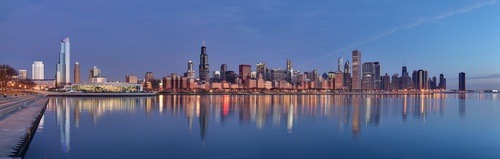
In the interim, I thought it would be fun to host a little competition. Given that both Chicago and Toronto are Great Lake cities of comparable size (and formally sister cities), I’d like to know: Which city, do you think, has the better skyline? Please respond in the comment section below and make sure to include your location (so we all know if you might have a hometown bias).
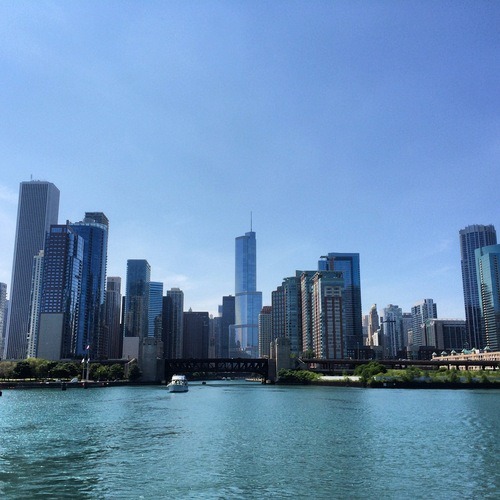
To help you make your assessment, here are a few photos. Below is one that I took of the Chicago skyline from the architecture boat cruise we went on yesterday afternoon. The building directly in the center is the Trump Chicago.
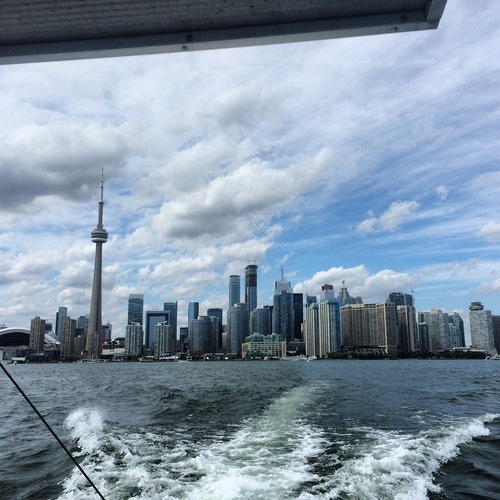
And here’s a photo of the Toronto skyline that I took from a water taxi earlier this summer.
But since these photos only represent one particular vantage point (me on a boat), here’s a set panoramic photos that I found online (Chicago & Toronto). I want to be as fair as possible.
I think this one could go either way. But I personally like the variety that the lit up CN Tower and Sky Dome (Rogers Centre) bring to Toronto’s skyline. Overall, it feels a lot more modern and exciting to me. So I pick Toronto. What about you?