
Daily insights for city builders, delivered every morning at 6 AM ET. I’m Brandon Donnelly — a Toronto-based real estate developer and founder of Globizen. I’ve been writing here since 2013.

  • Families do, in fact, want 3-bedroom homes

    June 26, 2025 · View original


    Here’s an interesting figure from the Missing Middle Initiative showing the change in population of 0-4 year olds in Southern Ontario between 2016 and 2021:
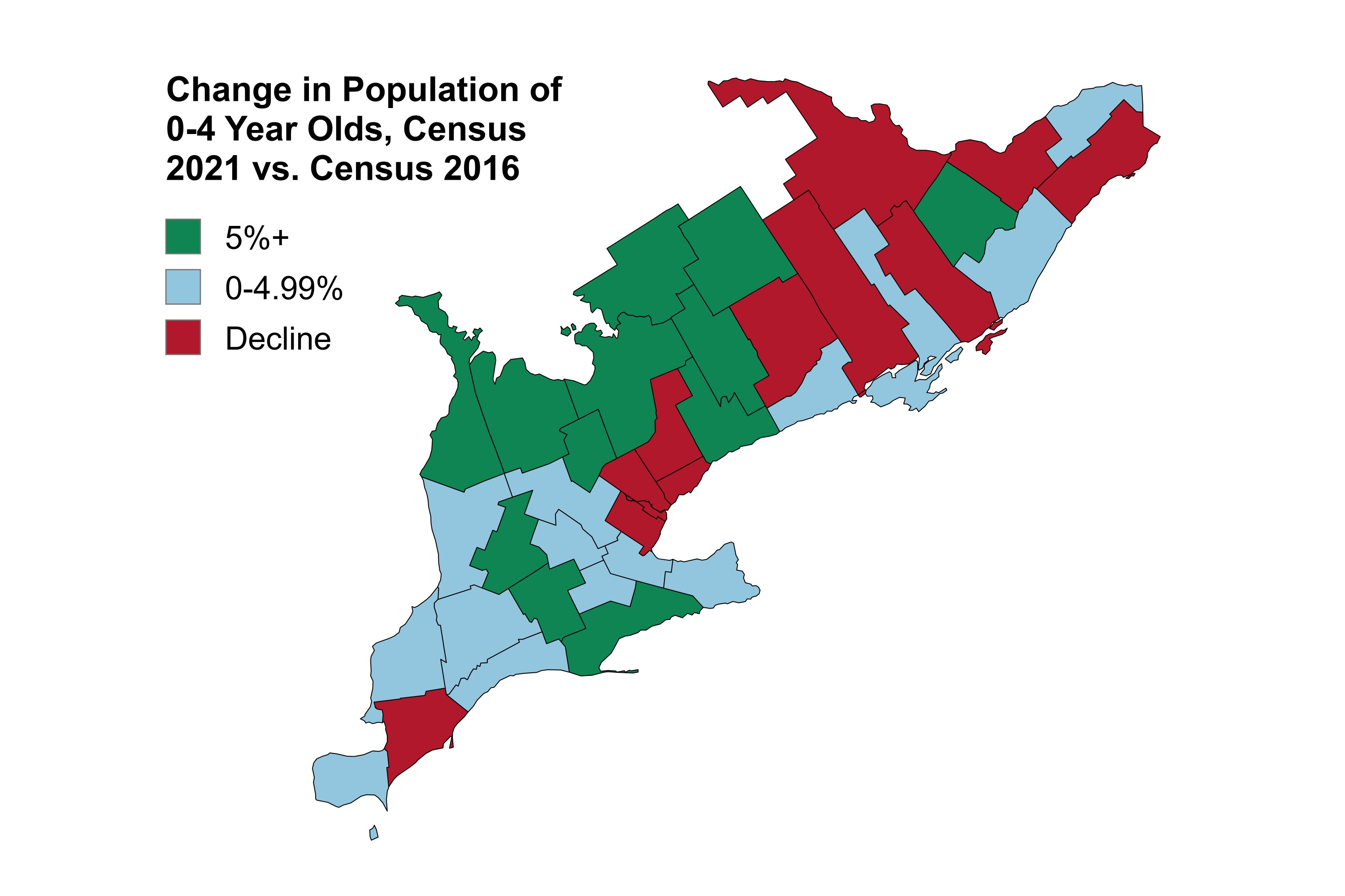
    What this shows is that the population of young children declined in the Greater Toronto Area and in Ottawa, but increased dramatically in areas further out, such as in Lanark County (outside of Ottawa) and Oxford County (between London and Hamilton). If you know what home prices are like in Southern Ontario, then this probably makes intuitive sense to you. Families are, as the old saying goes, “driving until they qualify.”

    But let’s look at the data more closely. What the Missing Middle uncovered was that the metric most highly correlated with the population growth of children under the age of 5 was the increase in the supply of housing with three or more bedrooms. More specifically, though, it was highly correlated with an increase in the number of larger owner-occupied homes. Rental housing did not have the same correlation.

    They go on to remind us that correlation is not causation, which is true. But regardless, there’s a clear recipe here: If cities want to become more family-friendly, house more young children, and not lose them to exurban areas, then they need to figure out a way to unlock more 3-bedroom homes at price points that more families can afford.

    Note: As is typical on this blog, I am using the term home to include all housing types, not just single-family housing. A home is not a housing type. It is simply a place where people, families, and households live permanently. Associating the term home with only single-family housing creates a cultural bias that I believe is suboptimal for cities.
  • Cities are forcing short-term rentals to evolve

    June 25, 2025 · View original


    Most global cities now have restrictions, and in some cases an effective ban, on short-term rentals. Here are some examples, along with their annual nightly rental cap as I understand them (and by this, I mean what ChatGPT is telling me):

    – Berlin: Secondary residence rentals are limited to 90 days per year – London: Annual cap of 90 nights – Mexico City: Annual cap of 180 nights – New York City: Only host-present stays allowed – Paris: Annual cap of 120 nights – Rio de Janeiro: Annual cap of 90 nights – San Francisco: Annual cap of 90 nights – Singapore: Minimum stay of 3 months for private properties and 6 months for HDB properties (Singapore’s public housing authority) – Sydney: Annual cap of 180 nights – Toronto: Annual cap of 180 nights

    These rules and caps will have nuances to them. Like if you want to rent your place on the third Tuesday of a month and your property faces west and has a view of an outdoor terrace with no more than 6 brass bistro tables, you probably require a special license. Okay, this isn’t true. But broadly speaking, most cities now have strict caps in the range of 90-180 nights and differentiate between whole-home rentals and host-present stays.

    What this, of course, means is that most big cities don’t want people operating short-term rentals as a business. They’d like hosts to be people who maybe rent out their place while they’re away on vacation and/or offer up an extra room when some conference or event is taking place in town. In other words, cities do not want short-term rentals to negatively impact their supply of long-term rentals.

    It’s no wonder that Airbnb is investing heavily in both its “experiences” and “services.” It has to do this because its core “homes” business is facing significant regulatory headwinds. But what this also means is that the hospitality industry is now shifting toward other solutions — things like aparthotels/serviced apartments. These are purpose-built solutions that typically require commercial zoning.

    Globally, the aparthotel segment is expected to be the fastest-growing subset in commercial lodging for the remainder of this decade. And that makes sense. With STR regulations only becoming more stringent and with the continued rise of digital nomadism, the demand for this kind of apartment-like product is going to need to be satisfied in other ways.

    There’s clearly a market for kitchens, washing machines, and a bit more space.

    Cover photo by Aquilion Property on Unsplash

  • Do you even develop, bro?

    June 24, 2025 · View original


    In yesterday’s post I spoke about the practice of buying land, rezoning it for a higher-and-better use, and then selling it for a margin. It may not make economic sense to do this in the current market, but it remains an important step in the delivery of new homes and other forms of real assets. Before you can build, you need entitled land.

    But as I have mentioned before, there are people who look down upon this practice. They view it as a form of land speculation; one that just drives up land prices and doesn’t ultimately create anything of tangible value. They might even go so far as to say that, if this is what you do, then you aren’t actually a real estate developer!

    Of course, this would be false and it shows a lack of understanding of how development works. It’s also insulting to developers who work hard in this part of the business.

    Let’s consider Wikipedia’s definition of development:

    > Real estate development, or property development, is a business process, encompassing activities that range from the renovation and re-lease of existing buildings to the purchase of raw land and the sale of developed land or parcels to others. Real estate developers are the people and companies who coordinate all of these activities, converting ideas from paper to real property. Real estate development is different from construction or housebuilding, although many developers also manage the construction process or engage in housebuilding.

    The two most important points for this discussion are bolded. One, development includes a range of activities that might include the sale of land or parcels to others. And two, real estate development is distinct from construction or housebuilding. So the more accurate way to describe a developer who sells land and doesn’t build is to call them a developer who isn’t also a builder. It’s that simple.

    But more important than nomenclature is the fact that there’s nothing inherently wrong with securing development approvals and then passing off the land to a builder to complete the rest. Somebody has to do it.

    Entitling a site often takes years — sometimes even decades. It’s a process that creates value and serves as a prerequisite to building new homes. Whether it’s done by one company or two shouldn’t matter.

    Cover photo by Alexander Tsang on Unsplash

  • Land prices have been flat

    June 23, 2025 · View original


    At the end of last year, I wrote this post arguing that development value has shifted from land to the build. And in it, I argued that it’s no longer viable to be a high-density land developer in Toronto. The practice of buying land, rezoning it for a higher-and-better use, and then selling it for a margin, is over — at least for the time being.

    It’s also not easy to find value in the execution of new builds, but it’s a better place to be looking. Because today, as we underwrite new development sites, we are seeing land prices (on a per buildable square foot) that are similar to what they were back in 2017 when we were assembling the land for Junction House. Meaning that, in some cases, land prices have been nearly flat over this 8 year period. This is despite a total inflation rate of approximately 25% and an average annual decline in the value of money of 2.86%.

    This is not all that surprising, though. Land should, in theory, be the residual claimant in a development pro forma; so it should be one of the first things to reset during a market downturn. However, in the past, I have referred to land prices as being sticky in the face of changing cost structures, such as development charge increases and/or new inclusionary zoning policies. So which is it, Brandon?

    Well, one way I think about this is that land prices tend to be sticky in the short term. Nobody wants to immediately take a loss. And as long as prices/rents continue to exhibit strong growth, there’s a chance that these new costs will get absorbed into somebody’s pro forma and that land prices won’t need to adjust downward. But turn off demand and reverse price/rent growth, and now there’s no other option but for land prices to come down.

    This is what we’ve been seeing in Toronto since 2022.

    Cover photo by Adam Vradenburg on Unsplash

  • How Tokyo manages to be so clean without any public garbage bins

    June 22, 2025 · View original


    One city that we didn’t talk about from Monocle’s recent Quality of Life Survey, but that regularly appears on the list, is Tokyo. In this year’s ranking, it was bestowed with “best for cleanliness.”

    > All of this isn’t to say that there’s no rubbish in Tokyo but, overall, it’s much tidier than other cities of a comparable size. Tokyo spends a fortune on keeping things presentable. The Clean Authority of Tokyo’s waste management budget for the central wards is ¥105bn (€640m) this year, of which ¥83bn (€507m) is dedicated to cleaning. But the secret to the city’s sparkle is that it’s not simply the work of city employees: it’s a collective job.

    If any of you can remember my “Takeaways from Japan” post from this earlier this year, you might recall that cleanliness shows up in my first point. It is absolutely astounding that the largest city in the world — it almost has the entire population of Canada — manages to be so clean. On top of this, it manages to achieve this with almost no public garbage bins.

    If you’ve been to Tokyo, you’ll know this. There are very few places to throw out your garbage in a public space. This is perhaps the irony of Tokyo’s cleanliness. But it works because of the expectation that people will take their garbage home and then sort it according to the city’s strict separation rules. And of course, this is what people do.

    That said, there are some other reasons for the lack of public bins, namely the 1995 subway sarin attack. There remains a deep fear that garbage bins might be used to conceal a terrorist device, which is why if you do see a garbage bin, it’ll often be transparent in nature so that nothing nefarious can be concealed. But by and large, the Tokyo approach seems to work because everyone wants it to.

    This reminds me of an incident when our ski and snowboard group was there in February. We were walking around Harajuku and a few of us decided to indulge in a set of elaborate desserts involving crepes, various fruit-like mixtures, and an absolutely excessive amount of whipped cream. You know, the sort of thing you’d never order if you were at home.

    One of us ended up wearing their dessert. He had it on his face, his chest, his hands, and somehow all over this jacket sleeves. There was whipped cream everywhere. He needed to abandon ship immediately and rid himself of what remained of his dessert. Except, there were no garbage bins anywhere! This is despite being on one of the busiest tourist streets in the city (see cover photo).

    It became a mission to get himself cleaned up. But what he absolutely did not do is litter. That’s just not how one conducts oneself in Japan — with or without public garbage bins.

    Cover photo by Elton Sa on Unsplash

  • France just banned smoking in all public spaces

    June 21, 2025 · View original


    One of my least favorite things about Europe is the experience of sitting on a cafe terrace and having someone smoking beside you while you’re trying to enjoy a gelatinous pig foot from Au Pied de Cochon. (I kid; gelatinous pig foot isn’t my favorite.)

    So here’s some news: France has just announced that, starting July 1, smoking will be banned from nearly all public spaces, including parks, beaches, public gardens, and bus stops. That said, the ban does not yet include cafe terraces. So I can still expect my gelatinous pig foot experiences to be horribly ruined.

    Still, this is a giant step in the right direction, especially for a country with one of the highest smoking rates among OECD countries. As of 2023, the national average for daily smokers was estimated at 23% for adults aged 18 to 75. The region with the highest percentage of smokers was the southeast (~29.5%) and the region with the lowest percentage of smokers was Greater Paris (~21.9%).

    In addition to varying by region, smoking is also strongly correlated with socioeconomic status. INSEE, France’s national statistics agency, estimated the following daily smoking rates as of 2022:

    – 42.3% of unemployed adults – 33.6% of people in the lowest income tier – 30.8% of people without a degree (baccalauréat level) – 16.8% of people with higher education (above baccalauréat level)

    But even among high-income groups, the rates are significantly higher than what you’d find throughout the rest of Western Europe, and in places like Canada and the US. We’re in the 10-11% range. All of this is why the French health ministry is now aiming to create a generation “free of tobacco” by 2032.

    The majority of French people also seem to support this new public space ban; which maybe isn’t surprising, given that the majority don’t smoke.

    Cover photo by Marie-Sophie Tékian on Unsplash

  • Monocle’s city of the year

    June 20, 2025 · View original


    It’s that time of year again.

    Monocle has just released their annual Quality of Life Survey. This is their 18th annual ranking of the world’s top cities according to what they do best: whether it be housing or nightlife. What I like about this survey is that it does things a little differently. Most liveability surveys tend to be a list of the world’s most boring cities. It’s as if uneventfulness is the measure of quality of life.

    This is not that.

    For example, number 3 on the list is Athens. And it’s there specifically because of its nightlife. Monocle refers to it as “one of Europe’s few truly 24-hour cities.” Also on the list, at number 7, is Mexico City. This is a city that is required to have women-only subway cars because the men apparently can’t behave in public.

    Of course, it’s an incredible city in so many other ways. It has leafy neighborhoods filled with the kind of mid-rise buildings that Toronto is now desperately trying to add to its major streets. And according to the survey, the city’s population grew by about 600,000 people between 2019 and 2023 — many of whom came from the US and Canada.

    Jumping to the top of the list, Monocle’s city of the year and best all-rounder is a city that we talk a lot about on this blog: Paris. This is perhaps not surprising given the city’s bold moves to pedestrianize streets, plant trees everywhere, build more than 1,000 km of bike lanes, and generally enhance the overall urban experience.

    But it’s not just that:

    > All of this, combined with the policies of the country’s most pro-business president in a long time, has helped Paris to draw and foster enough talent to snatch London’s double crown as Europe’s top venture-capital city and its leading technology hub. “Paris lends itself far more to an office-based culture than cities such as San Francisco or London,” says Jordane Giuly, the founder of fintech company Defacto. He points out that the French capital’s gentle density is conducive to cross-pollination between start-ups and preferable to the vast distances that one needs to traverse in its rivals.

    For their full list of the 10 most livable cities in the world, click here.

    Cover photo by Vlad B on Unsplash

  • Cities need to be able to change

    June 19, 2025 · View original


    Yesterday afternoon and evening was a series of interesting discussions about city building in Toronto. First, I met with Jeff Ranson of Northcrest Developments for a tour of YZD. This is the 370-acre former Downsview Airport lands that is now the biggest urban redevelopment project in North America.

    The tour also involved the two of us e-scootering around the property, which was timely given yesterday’s post about not hating on them so much. Jeff is up next on Globizen’s Global City Builder series, so stay tuned for that.

    After that I was on Ben Myers’ Toronto Under Construction podcast. After 80+ episodes, he finally invited me to join (wink wink). It was a great discussion with Rob Spanier of the Spanier Group and Ilana Altman of The Bentway. When the link comes out, I’ll be sure to share it on the blog.

    But one of the common threads across both discussions, that I’m now thinking about, is about how city builders can better provision for flexibility in new urban projects. Flexibility is an important feature because cities need to be able to grow and adapt over time.

    Consider some of the older main streets in Toronto where it’s very clear that the shop or restaurant you’re in used to be someone’s home that has now been converted. This is a very good outcome. It’s the city iterating.

    But this isn’t always possible with newer developments. Condominium corporations, land use restrictions, and a variety of other factors can make this largely impossible. It’s for this reason that I’m always drawn to things like live/work suites. They already contemplate a greater degree of flexibility.

    Two specific examples that come to mind are the live/work suites fronting onto Fort York Boulevard (in CityPlace), which have over time become more retail oriented, and loft buildings like 90 Sumach Street, which is known for housing a lot of creative professionals.

    Cities are at their best when they are able to change and adapt. So I think it behooves us to spend more time thinking about how we can encourage greater flexibility through different design approaches, flexible land use permissions, legal carveouts, and whatever else might be necessary to fully unlock the potential of our cities.

    Cover photo by Minh on Unsplash

  • Stop hating on shared e-scooters

    June 18, 2025 · View original


    Toronto never adopted a shared e-scooter program. And as far as I know, e-scooters in general are technically illegal to use on our public roads, though this illegality seems to be minimally enforced. But today, more cities around the world seem to be following suit.

    Paris — which had become the leading scooter market in Europe — voted to ban them in 2023 (albeit with an extremely low voter turnout). Shared e-scooters are now also banned in Madrid, Malta, and in all of the Netherlands.

    But I continue to think that this is a shame. I first tried a shared e-scooter in Lisbon in 2019. And at the time, I wrote “I now know what all the fuss is about!” It was a lot of fun. I used it to ride out to the Museum of Art, Architecture, and Technology. I also said that they would be arriving in Toronto imminently. Nope.

    The main concerns seem to be around urban clutter and riders using them irresponsibly. But I think you could say the exact same thing about cars, and we’re not going to ban those anytime soon.

    So I agree with what Karen Vancluysen says in this recent CityLab interview: Keep e-scooters on the menu and give people as many transportation alternatives as possible. They’re not going to work for everyone, but that’s okay. They’re one option in a broader mobility network.

    Cover photo by Kseniia PENKOVA on Unsplash

  • Waymo is more expensive than Uber and Lyft — huh?

    June 17, 2025 · View original


    The autonomous vehicle narrative has historically gone something like this: remove the labor component of rides (i.e. drivers) and rides will become significantly cheaper. Then, people won’t need or want to own a car anymore. They’ll just Uber or Waymo or whatever around.

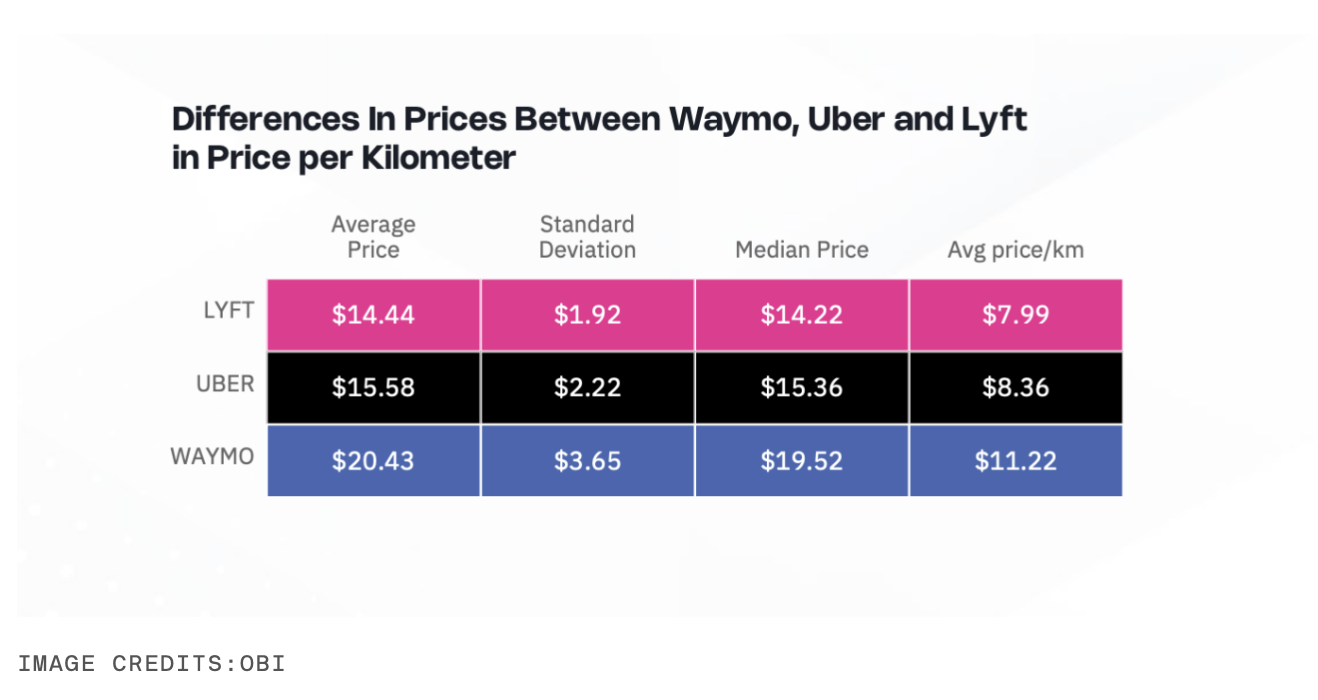
    But as Waymo provides in and around 250,000 paid trips per week in the 4 cities in which it operates, the opposite has proven to be true — at least so far. A recent report by Obi (an app that aggregates real-time ride pricing) has just revealed the following for San Francisco during the period of March 25 to April 25, 2025:

    In other words, Waymo is more expensive than Uber and Lyft, especially for shorter distances. Is this right? Well, Waymo may not have to pay drivers, but they do own and operate their own cars. Uber and Lyft do not. This represents a very different cost structure.

    They also have a more inelastic supply base, meaning they have cars whether demand is high or not. Whereas in the case of Uber and Lyft, supply can be variable. That’s the idea behind “surge pricing” — to induce more drivers onto the road when it’s needed the most.

    Fewer Waymos also means that wait times are going to be longer and that their cars are probably spending more time driving around without paying passengers. That’s a cost.

    Whatever the reasons, lots of people seem to be willing to pay the premium. Part of this almost certainly has to do with the novelty of riding in an autonomous vehicle. I’d pay more if they were in Toronto today. But another reason seems to be that people really appreciate being in the car alone. I guess it’s akin to driving your own car.

    It, of course, remains to be seen how Waymo’s cost structure and pricing model will evolve over time, but I have no doubt that privacy will remain a feature people are willing to pay something for. In the modern world, we are all going to have at least two places of solitude: bathrooms and Waymos.

    Cover photo by gibblesmash asdf on Unsplash