Daily insights for city builders, delivered every morning at 6 AM ET. I’m Brandon Donnelly — a Toronto-based real estate developer and founder of Globizen. I’ve been writing here since 2013.
A close friend of mine (from Urban Capital) sent me the above video this morning. It’s of the “Sliding House” in Suffolk, UK. If you can’t see it above, click here. You have to watch the video to fully appreciate the house.
Built as a place to retire, the Sliding House consists of a building envelope with fairly typical punched windows that physically slides overtop of a minimal glass structure. This allows the building to adapt to the changing seasons (or to the moods of its occupants).
This concept of adaptable architecture is incredibly interesting to me. Because for a lot of climates — where the temperatures can swing dramatically from hot to cold and vice versa — it can actually be incredibly difficult to design an efficient building.
When it’s cold, you’re trying to trap heat inside the house. And when it’s hot, you’re trying to exhaust heat to the outside. So by default, the building has to be adaptable.
In its simplest form, this could mean an operable window. But in a more elaborate form — like in the case of the Sliding House — the entire skin of the building might adapt.
And if it means having to rely less on active mechanical systems then I think it’s a step in the right direction.
Having just spent the weekend in Calgary and Banff, I’ve been thinking a lot about importance of picking the right city in which to live. I’m not saying that I don’t love Toronto. Because I do. But I am incredibly envious of cities – like Calgary, Vancouver, and Denver – that have such easy access to incredible mountains.
Now, this might not matter to a lot of people, but it does to me. It’s a personal thing. There’s something really nice about landing in a city and seeing people leaving the airport with skis and snowboards in hand. And there’s something really nice about a city where so many people are active, outdoorsy, and fit.
The developers behind the much talked about Mirvish+Gehry project in Toronto (Projectcore) recently released a video showcasing the architectural model. It’s a great way to see the project from every angle. Click here if you can’t see it below.
I’ve written about this project a number of times before and my view has always been that I’m excited by the project, but that I don’t think we should be demolishing all of the heritage buildings on-site. This latest scheme – with two towers ranging from 82 and 92 storeys – is the result of that compromise.
What are your thoughts on Mirvish+Gehry? And what do you think the condos will ultimately go to market at? My guess would be somewhere around $1,000 per square foot.
I’m off this evening to Banff (and then Revelstoke) for a 10 day snowboarding trip. If you’ve been reading Architect This City since this time last year, you’ll know that this is an annual tradition that I started with a group of close friends from grad school. It’s our annual retreat to the mountains and it’s our 6th year doing. I hope we never stop.
So what happens to ATC?
Regular scheduled programming will continue as usual. But don’t be surprised if I change things up and make the content a bit more personal on some of the days. I’ve also decided to try out something new and video blog throughout the trip using Snapchat Stories. If you’d like to follow along, my username is donnelly_b. There will also be a more traditional video to follow.
Finally, if you happen to know Banff and/or Revelstoke well, or happen to be from out west, I’d love to hear from you. It’s always great to get local insights.
A friend of mine recently introduced me to a young real estate company out of New York called ASH NYC (the founders are around 30).
But in reality, calling them just a real estate company is an oversimplification. They’re actually a vertically integrated firm that brings interior design, real estate development, property management, hospitality, and a few other disciplines all under one roof. The way they talk about it is in terms of “joining historically compatible disciplines” and “creating both aesthetic and economic value” – which is a pretty neat approach.
I’ve written a few times before about the future of the architecture profession and so I think it’s really interesting to see yet another example of design being completely integrated with real estate. And I’m certain we’re going to see more of these kinds of hybrid and integrated business models across many other industries.
In my own career, I’ve been (somewhat similarly) fascinated by the intersection of design, real estate, and technology. And I suspect that many of you also feel like you’re operating in some kind of overlap. Is that true?
In it he talks about a “weirdness index” that he developed for CEOs for Cities that measured and ranked 50 American cities across 60 different behavioural indicators. San Francisco and Salt Lake City come out as the weirdest, and Portland ranked 11th out of 50. The most “normal” part of the US was the Midwest. Normal meaning behaviours that are most similar to the national average.
He then goes on to talk about weird as a competitive advantage. Here are a few snippets:
When it comes to economic success in today’s economy, the key is to differentiate yourself from your competitors. Harvard Business School’s Michael Porter counsels businesses that “competitive strategy is about being different.” And the late, great urbanist Jane Jacobs told us, “The greatest asset that a city can have is something that’s different from every other place.”
True entrepreneurship is about deviant behavior: starting a business that makes a product that no one else has thought of or thinks there’s a market for. Entrepreneurs and open-minded, experimental customers go hand-in-hand.
We shouldn’t do things just to be different, but we should never be dissuaded from trying something simply because it is different or would make us different from other places.
What this all comes down to is the simple fact that what is weird today, might very well become the norm tomorrow. But you need to be open enough to allow that to happen if you want to be the place that generates those news ideas.
Could you have imagined that selfies would become as ubiquitous as they have? That would have been pretty hard to predict. It used to be the case that people were afraid to use their real name on the internet. Now we share our entire life online, including our faces.
A few days ago, Bill Gurley – who is an investor in Uber – wrote a really fascinating blog post called, Uber’s New BHAG (Big Hairy Audacious Goal): UberPool. Bill doesn’t update his blog very often, but when he does it’s incredible stuff.
I’ve touched on UberPool briefly before. But basically it’s a true “ride sharing” service where people with overlapping routes can easily share the same car – much like people do today informally. The obvious advantage of this is cost. It’s cheaper to share.
What’s most fascinating about this service though is how it fits into Uber’s larger mission to drive transportation costs down. And there’s a specific reason for that (via Bill Gurley):
When Uber launched its low-cost UberX offering in the summer of 2012, the company quickly realized that the demand for its transportation services is HIGHLY elastic. As the company achieved lower and lower per-ride price points, the demand for rides increased dramatically. A lower price point delivered a much better value proposition to the consumer, yet still remained a great business decision due to the remarkable increase in demand.
So what Uber quickly figured out was that if they could increase the utilization rate for drivers (the time actually spent with passengers), they could charge consumers lower prices while at the same time maintaining driver salaries. Prices went down, but volume went up.
One way to do that is to obviously decrease driver downtime by improving liquidity on the marketplace. But another way is to simply increase the number of passengers being transported at one time. Hence the creation of UberPool.
But it doesn’t stop there.
Because of all the transportation data that Uber now has (the company has a data group called the “math department”), they can fairly accurately predict what a price cut will do to their ridership levels. This allows them to “forward invest” their capital in new services – such as UberPool – before they even have the revenue from the anticipated increase in ridership.
So what does this all mean?
It means that Uber is going to get cheaper and cheaper and cheaper. Uber is trying to get to what they call “The Perpetual Ride”, which basically means that drivers will always have customers (100% utilization). That’s quite a goal, but it would mean the absolute lowest prices for consumers (barring any other changes to their cost structure).
Dirt cheap transportation is a pretty compelling value proposition, which is why I continue to believe that cities should be hard at work trying to figure out how to harness this transportation shift.
If you’re interested in this topic, I would encourage you to give Bill Gurley’s blog post a read.
It should start from the premise that the fundamental underpinning of the Canadian economy to have prosperity is dependent on the success of the cities, because 80 per cent of Canadians live in cities. -Toronto mayor John Tory
This week the leaders of Canada’s 22 largest municipalities are gathering in Toronto to figure out how to put urban issues on our national agenda. This is a topic I’ve touched upon many times before on Architect This City, but I continue to believe that it’s one of our most pressing issues.
We know that the vast majority of Canadians live in cities (see above quote) and we know that the vast majority of our economic output is concentrated in cities. In fact, roughly half of Canada’s GDP is produced in our 6 biggest cities alone – Toronto, Montreal, Vancouver, Calgary, Edmonton, and Ottawa-Gatineau.
But despite this concentration of wealth and economic activity, our governance structures do not reflect this reality. They’re outdated. They were built for a Canada that has passed. And so in my view, there’s a significant amount of untapped potential lying dormant in our cities if only we could get around to properly empowering them. There’s a “stimulus package” waiting to be unleashed.
In anticipation of this week’s leadership meeting, the Globe and Mail published an article called, Canada’s big city mayors ready to push urban agenda. And in it they included a number of interviews with Canadian mayors. It’s fairly long, but definitely worth a read. Here are a few relevant sound bites…
Vancouver mayor Gregor Robertson
We have an archaic system. Cities aren’t recognized in our constitution. It’s unbelievable. But Big City Mayors have set aside those important gaps because the needs are now so urgent on housing and transit, we can’t afford to spend a couple years debating structural change. For the time being, the focus is just on ensuring there’s more federal capital provided for transit and other urban infrastructure.
Calgary mayor Naheed Nenshi (on municipal funding sources)
I would prefer to levy myself, so that I’m ultimately accountable to my citizens and, if they don’t like it, they can get rid of me. Allowing others to levy the tools takes away predictability and stability, as well. That said, we’re starving here, and any improvement to the system that leads to those predictable, stable cash flows is a good thing.
Winnipeg mayor Brian Bowman (on the most pressing issue facing Canadian cities)
I’d say without question infrastructure and new funding models to modernize the ways that cities fund themselves. That’s something I’ve started discussions on already with some of my counterparts, Mayor [Naheed] Nenshi in Calgary, Mayor [Don] Iveson in Edmonton as well as Gregor Robertson in Vancouver. We’ve talked about a number of topics including the missing and murdered indigenous women and girls issue, public transit and rapid transit development. But the one consistent theme is that the way cities are funded is outdated.
Toronto mayor John Tory
I start from this premise: Are people paying enough taxes? In many cases, you could argue, not only are they paying enough taxes, they can’t afford to pay any more. We should be looking at the total amounts paid to all three levels of government and how that is being allocated. Do we believe that, in the case of Toronto, the federal and provincial governments are making adequate investments in transit, given the amount of money they take out of this area in taxation? I would say the answer is: not yet. [But] they have been doing better.
Montreal mayor Denis Coderre
We are negotiating a new pact between the province and Montreal, and it’s all about municipal autonomy. We need tools so we’re not always waiting in the hallway at the end of legislative sessions looking for amendments to make the city work better. Since 85 per cent of immigration in Quebec is going to Montreal, we need more control over tools of integration, like job creation and housing. Montreal needs financial leverage…
One of the central themes in his post is the American (and Canadian) fixation on single-family homes:
…the United States is the only developed country of those surveyed, apart from Canada, to widely employ single-family detached residential zones that bar all commercial and multifamily uses.
And the reason for this is largely because of two longstanding beliefs in American (and again Canadian) culture: Your goal should be to become a homeowner, and that home should ideally be a single-family detached home.
But there’s lots of evidence to suggest that these legal protections (and many of the other things being done to encourage/subsidize homeownership) aren’t actually that effective at driving up homeownership.
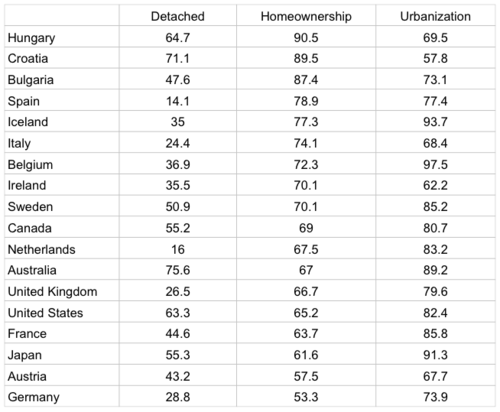
In his post, Charlie includes a chart showing the percentage of detached homes and the homeownership rates for various countries (data is from 2013/2014). I sorted it based on homeownership and added urbanization rates to see if there was any correlation (doesn’t appear to be).
The US and Canada are quite good at putting lots of people in detached housing (though not as good as Australia!), but the homeownership rates are nowhere near the top. In fact, the US falls in the lower half.
Did you think the homeownership rate would be higher in the US?
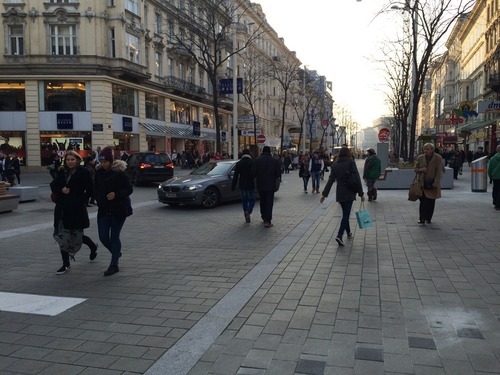
Yesterday my friend Darren Davis out of Auckland introduced me to a 3-part blog series that he recently did with Andreas Lindinger out of Vienna, which looked at pedestrian zones and shared spaces across these two cities.
Compared to both Auckland and Vienna, Toronto is behind when it comes to pedestrian zones and shared spaces. So it’s interesting to see how other cities have managed to pull it off. It’s also further proof that you don’t have to be a warm climate city to have amazing public spaces.
Image: Vienna via Vienncouver (notice the cars and pedestrians mixed in)