Daily insights for city builders, delivered every morning at 6 AM ET. I’m Brandon Donnelly — a Toronto-based real estate developer and founder of Globizen. I’ve been writing here since 2013.

  • New York’s 8-figure apartments

    Whenever you’re starting to feel like real estate prices in your city are getting out of hand, just turn your attention to New York. It’ll make you feel better.

    The New York Times published an interactive overview of the Manhattan real estate market today. It was spurred on by the fact that the average residential sale price in Manhattan just hit $1.7 million (a new record) and that there’s a growing number of 8-figure apartments being bought up.

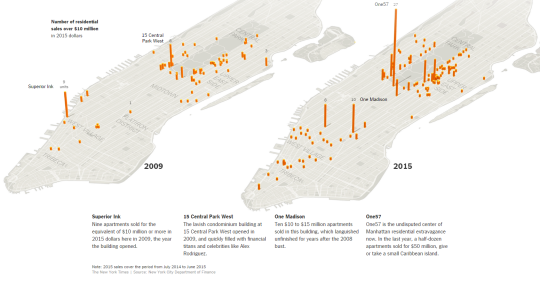
    Last year half a dozen apartments sold for more than $50 million in the One57 tower at 157 West 57th Street. (The New York Times calls this building the “undisputed center of Manhattan residential extravagance.”)

    Here’s one of their diagrams showing the number of residential sales over $10 million in 2009 and then in 2015:

    image

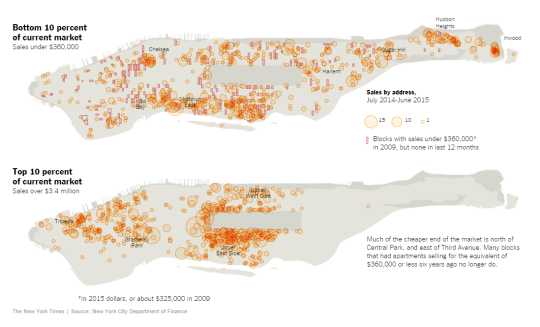
    And here’s another one of their diagrams showing the bottom and top 10% of the current market:

    image

    It’s interesting to see the clustering in certain areas and also the lack of clustering at the high end around the top of Central Park.

  • Those troublemakers

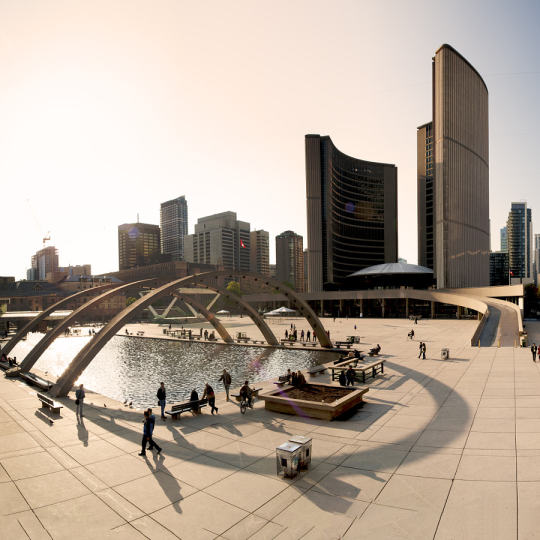
    Toronto City Hall by Sébastien Pacaud on 500px.com

    https://500px.com/embed.js

    Jennifer Keesmaat is the Chief Planner of Toronto. She was hired for this job in 2012.

    She has a Masters in Environmental Studies (Politics and Planning). She is a Registered Professional Planner with the Canadian Institute of Planners. And she was also the founder of 2 (city) planning firms prior to taking the position of Chief Planner for Toronto.

    So presumably, she was hired for this job because she possesses some sort of expertise in the realm of planning. I also presume that she is expected to make her opinions known to other people so that informed planning discussions can occur and decisions can be made.

    So I find it curious that in some circles, and in the media, Jennifer Keesmaat is being branded as a “troublemaker.”

    A lot of the recent chatter stems from the fact that Keesmaat was at odds with Mayor Tory during the Gardiner Expressway East debate (quote via Toronto Life):

    Eventually Tory had enough and pulled Keesmaat into a meeting where he basically told her to zip it. “The mayor has said it is perfectly appropriate for staff to make their opinions public, as Ms. Keesmaat has done,” wrote his communications chief, Amanda Galbraith, in a statement. “It is not appropriate for city staff to campaign against councillors or the mayor on social media or through other public platforms.” Keesmaat counters that she never campaigned. “I stated an opinion,” she says simply.

    But the “troublemaking” didn’t just start with the Gardiner East. Pretty much since the moment she took the position of Chief Planner and launched her own blog (ownyourcity.ca), she was dubbed a shit disturber. (Those bloggers!)

    But if you ask me, these criticisms stem from an old and outdated way of thinking.

    The last thing we need from government is less transparency and more politicking. We should be working towards more, not less, information. Even if that information doesn’t butter our metaphorical bread.

    What do you think?

    I think this will make for a great discussion in the comment section below.

  • Advancing green building technologies, one condo suite at a time

    This evening I had a fascinating conversation with Subhi Alsayed of Tower Labs. If you haven’t yet heard of Tower Labs, I would encourage you to check them out. Here’s their mission statement:

    Our mission is to facilitate the adoption of green building products, technologies and practices through pilot and demonstration projects in highrise buildings; and accelerate the evolution to a low-impact, sustainable urban environment.

    What they do is test out new green building technologies in one-off condominium suites. And since they were founded by both MaRS and Tridel (which is one of, if not the largest condo developer in Toronto), they have plenty of opportunities to do just that.

    This is important because the real estate industry is notoriously slow at innovating. I’ve written about this many times before. Whenever you try and introduce something new, there’s always a lot of change management that goes along with it. The construction trades, to use one example, need to get their heads around it. And until they do, they’re going to charge a premium for it.

    So by creating a one-off test case, everybody gets to see how it works, how it is built, and, most importantly, how it actually performs in the real world.

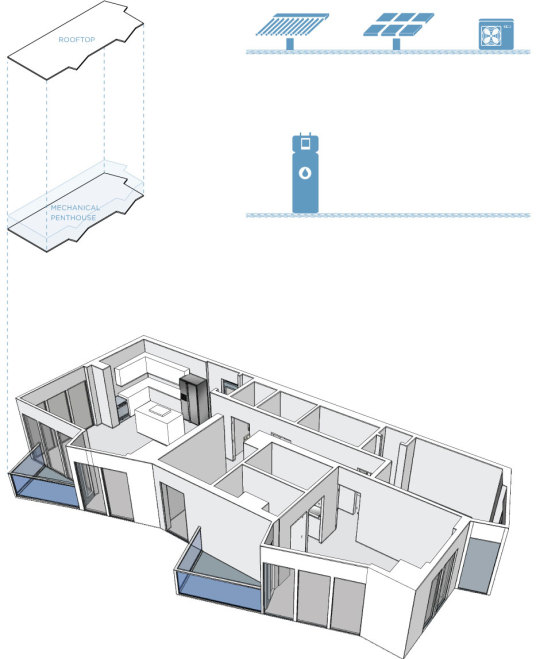
    One of the projects that they’re working on is something called NetZED, which stands for Net Zero Energy Dwelling. As the name suggests, it’s a condominium suite that produces as much energy as it consumes. 

    The way it works is by trading energy. At night when the sun isn’t out and the panels on the roof aren’t able to produce energy, the suite “borrows” electricity from the building. But during the day when the sun is out, the suite powers itself and then returns any borrowed electricity to the building. Click here to learn more about the suite. It’s being built in the Aqualina Condos on Toronto’s waterfront.

    image

    I find all of this incredibly exciting. Not only because they’re working towards a more sustainable future, but also because they’re applying their efforts towards the multi-family building typology (towers). Given that most of the world now lives in cities, this is an important building typology to make even more sustainable.

    Image: Tower Labs

  • Munich is planning an ambitious…Radschnellverbindungen

    On Monday of this past long weekend, I went for a quick bike ride over to the Beaches, up to Little India, and then back down to the St. Lawrence Market. 

    The ride along Lake Shore and through the Beaches is one of my favorites. Minus a few awkward twists and turns as you leave the East Bayfront, it’s generally smooth sailing. It feels a bit like a bike highway.

    It took me about 24 minutes to get to the beach, which means I was traveling on average just over 20 km/h. If you lived in the Beaches and worked downtown, that would be a perfectly reasonable commute in my mind.

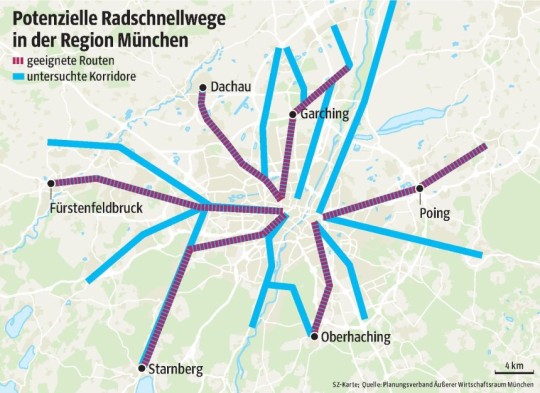
    And it’s for reasons like this that Munich is looking to invest in a huge network of bike highways. They’re calling it a Radschnellverbindungen – which I might start ambitiously calling some of the bike paths in Toronto – and the idea is to connect the city with all of the suburbs.

    Below is a map of the routes they’re looking at. The purple lines are “suitable routes” and the blue lines are corridors they’ve looked at it. If I’m wrong in my translation, blame Google.

    They are still in the feasibility stage, but the idea is for each bike path to be 4 meters wide and have no cross streets or traffic lights – essential a highway for bikes.

    And if you think this all sounds like a pipe dream, check out this video of the recently opened Cykelslangen (Cycle Snake) in Copenhagen.

    [youtube https://www.youtube.com/watch?v=iypvbe6J6Qs?rel=0]

    Would you commute to work on your bike if you had a highway, just like cars do?

  • Build the Future – A CityAge Summit this October

    The View from CN Tower II by Roland Shainidze on 500px.com

    https://500px.com/embed.js

    This October 8th and 9th (2015) in Toronto, CityAge will be hosting a summit at the MaRS Discovery District called, Build the Future. The goal is to explore the future of Canada’s economic powerhouse.

    Here’s a little bit about CityAge:

    CityAge is a platform for ideas and business development, designed to enable new partnerships among the business, government and societal leaders who are shaping the 21st Century.

    Founded in 2012 in Vancouver, Canada, our events have taken place, or are scheduled, in New York City, Hong Kong, Toronto, London, Los Angeles, Seattle, Edmonton, Philadelphia, Kansas City, Ottawa, Vancouver and The Waterloo Region in Canada.

    To date more than 4,000 leaders in business, government and society have attended a CityAge event.

    I’ve seen the draft agenda and list of speakers for the event, and if you enjoy the content on this blog, I think you’ll also really enjoy this CityAge summit.

    But even better is the fact that if you’re a young professional (under 35) and a reader of Architect This City, you can use the code YOUNGPRO to attend for just C$195.

    You’re welcome. I hope to see you there 🙂

  • A site-specific light installation on Wabash Avenue

    A Kickstarter project called The Wabash Lights has just reached its funding goal of $55,000 to implement what it is calling the beta version of its project. 

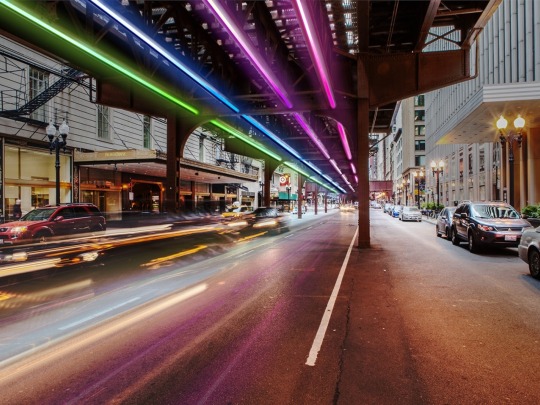
    The project is a site-specific and interactive LED light installation on the underside of the elevated train tracks that run along Wabash Avenue in Chicago.

    The lights are completely customizable (color, patterns, pulses, and so on) and they will be controllable via web and mobile. So anyone walking down the street will be able to have some fun with the lights.

    Here’s a video from the creators explaining more about the project:

    [vimeo 131322692 w=500 h=281]

    It’s a clever idea and I can see the lights becoming just as recognizable as Chicago’s bean.

    But the true success measure will be whether or not it draws people to the area and it changes the composition of the street. Elevated structures aren’t great for street life. That’s why I fought (unsuccessfully) to have the elevated Gardiner Expressway East removed here in Toronto.

    It’s interesting to hear the one woman in the above video talking about how Wabash isn’t really a street you go to. It’s just the street between Michigan and State that you have to pass through. That’s how I feel about most parts of Lake Shore Blvd in Toronto.

    Here’s how CityLab described it in their writeup about the project:

    “While the L tracks are as iconic to Chicago as some of its skyscrapers, their presence overhead doesn’t necessarily bring in the foot traffic compared to other nearby streets.”

    But something like The Wabash Lights could really make a difference.

  • A Spanish social media town

    I am a big fan of Twitter.

    I use it more than any other social network and any other app on my phone (according to my battery usage). In fact, I’m such a fan that I recently started buying shares. I don’t own a lot and the Canadian-US exchange is awful right now, but I do plan to continue buying (I like dollar cost averaging).

    Twitter isn’t the darling of Wall Street like Facebook is. And I think the biggest weakness of Twitter is that it’s difficult for new users to really “get it.” Facebook solved this problem early on by recognizing that new users had to connect with X number of friends right away so that they received value immediately and the next time they visited.

    But I digress. That’s not the focus of this post.

    This morning a friend shared a Medium article with me that was written by the Laboratory for Social Machines at MIT. The article is about a small town in Spain called Jun (pronounced “hoon”) that has transitioned to using Twitter as the dominant platform for communication between government and citizens.

    The initiative first launched in 2011 and since then the mayor, José Antonio Rodríguez Salas, has been trying to get every resident onto Twitter. All 3,500 residents are even encouraged to go into the town hall to have their Twitter accounts verified. This way government employees know for sure that they’re dealing with an actual resident of the town.

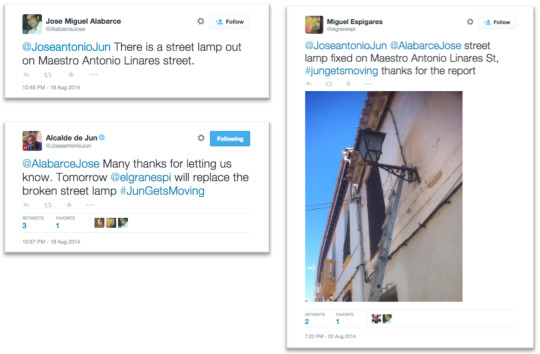
    Here’s a simple example of what this means for government-citizen relations (the folks at MIT translated everything to English):
    image

    In the above example, a citizen tweeted the mayor informing him that a street lamp was out. The mayor then responded, tagged an electrician, and said it would be fixed the following day. Sure enough the electrician went and fixed it the following day, and then tweeted out a photo of the lamp.

    This is great. And Twitter was made for these kinds of interactions. Facebook was not.

    Here in Toronto we have @311Toronto, which I have tweeted many times before with problems and they do respond quickly (far quicker than if you try and call them). But I still think there’s room for us to improve transparency and engagement across the board.

    All of this is a perfect example of how technology and cities are colliding in a big way. In today’s world I really think you need to be able to think across disciplines.

  • Peer-to-peer solar startup

    Airbnb is a platform that connects people who have extra space with people who need space. It’s a peer-to-peer hospitality company.

    Yeloha, which is a startup I just discovered today, is a peer-to-peer solar company based out of Boston. 

    In the same vein as Airbnb, it connect people who have extra roof space (that’s suitable for solar collection) with people who want to buy solar energy (but may not have a solar friendly roof).

    Here’s an image from their website that explains how it works:

    image

    Basically, if you have a solar friendly roof, Yeloha will come and install solar panels on top of your place for free. You get to keep some of the energy that’s generated (about 1/3 apparently) which becomes a credit to your electricity bill. You are then known as a “Sun Host.”

    The remaining energy gets fed back into the grid and, if you don’t have a solar friendly roof, you can purchase this excess energy, which also results in a credit to your electricity bill. The solar electricity is less expensive than the regular grid electricity. In this case, you are known as a “Sun Partner.”

    I think this is a pretty neat idea. Neither party has to pay anything upfront. Both parties save money. And the result is more solar through a distributed and virtual net metering setup.

  • CAPREIT announces first joint venture development

    Yesterday CAPREIT announced that we have entered into our first joint venture development agreement for a mixed-use project at 1100 King Street West in Toronto’s Liberty Village neighborhood. 

    The agreement is to acquire a 1/3 undivided interest in the residential component of the project for $60.3M. The residential component will consist of 3 towers and 506 apartment suites (sitting on top of a roughly 160,000 square foot commercial/retail podium that will not be owned by CAPREIT).

    Here’s what Thomas Schwartz, President and CEO of CAPREIT had to say:

    “We expect our interest in the property, combined with the property management fees we will receive, will be accretive to our cash flow and set the stage for similar partnerships, along with our own new rental developments in the future.”

    As a member of the development team at CAPREIT, it feels great to get this one out there.

    Click here for the full public press release.

  • The Olympics are dead. Or are they?

    Olympic Pool – Barcelona, Spain by Tom Weightman on 500px.com

    https://500px.com/embed.js

    Early this morning Professor Robert Wright – who is a regular reader and commenter on this blog – sent me an article from The Guardian called, ‘The Olympics are dead’: Does anyone want to be a host city any more? And that got me thinking.

    With Toronto having just hosted the Pan Am Games (the Parapan Am Games are still going on), there’s a lot of talk and debate happening in this city right now about whether or not we should make a go at hosting the 2024 Summer Games. The deadline for cities to express their interest is September 15th, 2015.

    The supporters (of which I would include myself) say it’s a great opportunity for civic (re)branding and urban renewal. It creates real deadlines to get things done. But the naysayers argue it’s a fiscal disaster waiting to happen. See 1976 Summer Olympics in Montreal.

    But in my view there are ways to host the Olympics and there are ways not to host the Olympics. Montreal (1976) is an example of what not to do. And Los Angeles (1984) and Barcelona (1992) are some of the best examples of what to do.

    The key is to think of the Olympics not as the end, but more as the beginning. In Olympic talk, they refer to this as legacy. Here’s what Los Angeles managed to accomplish as a result of the 1984 Summer Games (via Gizmodo):

    In 1979, the L.A. organizing committee had made a deal. If the games saw any profits, LA84 would give 60 percent back to the U.S. Olympic Committee and keep 40 percent for Southern California. At the end of the games, the total expenditures came in at a respectable $546 million, but even more impressive was the profit: A surplus of $232.5 million, meaning $93 million would stay in the region. This was huge. The only other games at the time which could claim to be financially successful at all were the other L.A. Olympics: The ones held in the city in 1932.

    The profits were used to create an endowment called the LA84 Foundation, which funds youth sporting events, resources, and facilities throughout the area. With smart management, the endowment has grown over the years, and over $214 million has helped an estimated three million children and 1,100 organizations in Southern California. Recently, the LA84 Foundation helped raise money to pay coaches and buy equipment at LAUSD high schools after budget cuts decimated their programs.

    The rest of the above article is definitely worth a read. It’s a great example of fiscal prudence.

    So what I am suggesting is not that we run blindly into hosting the Summer Games. But that we instead open our minds to the opportunities. Let’s great creative. If we could catalyze further city building, turn a profit, and leave meaningful legacies for this region (like what LA did), then why wouldn’t we want to have a go at it?