
Daily insights for city builders, delivered every morning at 6 AM ET. I’m Brandon Donnelly — a Toronto-based real estate developer and founder of Globizen. I’ve been writing here since 2013.

  • Affordable housing and the economics behind developing new rental apartments

    light trail in concrete jungle by Tassapon Vongkittipong on 500px.com

    https://500px.com/embed.js

    In most big cities around the world, there is a pressing need for more affordable housing. We know that inclusive cities make for better cities. But from San Francisco to Hong Kong, you always hear people talking about how expensive housing is.

    So why is this such a difficult problem to solve?

    Part of the problem, I think, is that many people don’t understand the economics behind building a new building. Oftentimes I hear people say that because developers make so much money, they should just build more affordable housing. Done. Simple.

    But things are not that simple.

    To illustrate my point, let’s walk through the thought process for developing a new rental apartment building.

    In its simplest form, developers are concerned with: revenue – costs = profit. And since many of the costs associated with building a new building just are what they are, it all starts with revenue, which in our case would be rents.

    To build a new rental tower in Toronto, your rents typically need to be at least in the high $2′s per square foot per month. Otherwise the economics don’t work. But to make the math simple, let’s say you need $3 per square foot in rent. That means a 1,000 sf apartment would rent for $3,000 per month.

    That’s not cheap. There are only so many people who can afford these kinds of rents and only so many areas where you can command these kinds of rents, which means there are only so many areas in Toronto where new rental apartments will be built by the private sector.

    If the rents instead happen to be $2 psf – meaning that same 1,000 sf apartment now rents for $2,000 per month – then for-profit developers will not build (barring any unique deal circumstances). Even at $2.50 psf / $2,500 per month, it would be difficult to make the numbers work here.

    And by the numbers, I am talking about tight returns that really only start to make sense in our environment of record low interest rates. Which means that when interest rates start to rise (pushing cap rates up), it may not even make sense to build rental apartments when the rents are in the high $2′s per square foot. This is particularly true if you’re competing against condo developers to buy the land. They can afford to pay more. 

    In this scenario (of rising interest rates), many real estate firms might simply opt to buy existing assets instead of taking on the risk of building anything new. Now all of a sudden your supply of new market rate apartments (not to mention affordable apartments) has dried up. Remember, it’s been decades since Toronto built rental apartments at any sort of meaningful scale.

    It’s for reasons like this that Vancouver launched a program called Rental 100. In a nutshell, it helps to reduce the “costs” variable in the equation mentioned above so that developers are able to meet minimum project returns and build more rental buildings. They do that through things such as reduced parking requirements, additional density, development charge waivers, and so on.

    In some ways, these items are subsidies. The city is giving up revenue that it could have otherwise collected from a developer building, say, a condo. But in other ways, they are freebies. The city could be unlocking development sites that may have otherwise not been developed. In which case it’s not really forgone revenue.

    Vancouver’s Rental 100 program is a market rental housing policy. But there’s no reason that similar thinking couldn’t be applied to create an affordable rental housing policy. It has been done and is being done in many cities.

  • Where will we live?

    image

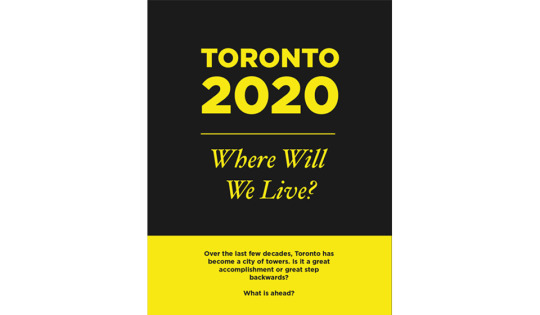
    This evening I participated in a roundtable discussion at WORKshop here in Toronto. It was part of an exhibition that they currently have on called, Toronto 2020: Where Will We Live? They are located in the concourse level of 80 Bloor Street West, so go check them out.

    The discussion this evening was all about the dramatic change in Toronto’s urban form over the last decade. In other words, the condo boom. We covered everything from the life cycle of buildings and urban design to demographics and policy. It was a lot of fun and I am certain the group could have continued talking all night.

    But one thing that I was reminded of this evening is how important it is for great city building to be cross-disciplinary.

    Take, for example, architects and (real estate) developers. 

    The stereotypical developer is greedy and only concerned with money. They don’t care about the impact that their buildings have on the built environment. On the other hand, the stereotypical architect is only concerned with design and not with the economic feasibility of projects. (I’m exaggerating here for effect.)

    The point is that neither of these participants in isolation could build a great city. A beautiful design doesn’t have much value if it can’t be financed and built. And a highly financeable project could end up contributing nothing to the city. In some cases it could actually detract from the built environment.

    So if we really want to build truly great cities, I believe it needs to be a collaborative effort. We need to bridge the divides in thinking and leverage each other’s strengths. 

    I have felt very strongly about this since I first started studying architecture as an undergraduate student, which is how I ended up taking business and real estate classes. I felt and continue to feel that the greatest opportunities exist at the intersection of different ways of thinking.

  • Life after fishing on Fogo Island

    Fogo Island is a small remote island off the coast of Newfoundland in Canada. As of 2011, the population was roughly 2,400 people.

    For centuries the island was a thriving fishing community, particularly for cod. At its peak, Canadian fisherman alone were bringing in 266,000 tons of cod every year.

    But in 1992 the Canadian government put in place a moratorium on fishing North Atlantic cod. And it decimated the local economy. (Should we still be calling it a moratorium after all this time?)

    However, thanks to people like Zita Cobb and her Shorefast Foundation, Fogo Island is in the midst of an entrepreneurial and cultural renaissance. Take a look at the Fogo Island Inn. It’s on my list of places to visit.

    Back in 2013, Monocle Magazine published a two-part video series outlining what is happening on the island. You can watch part 1 of that series by clicking here and part 2 by clicking here. Each video is under 10 minutes long.

  • The evolution of unions

    Today is Labo(u)r Day in Canada and the United States.

    It is the official end of summer for a lot of people, which is always a bit sad. (Unlike a lot of people I know, I’m not a huge fan of fall.) But primarily, today is a day to celebrate the labor union movement.

    Fred Wilson wrote an excellent post on his blog this morning about this topic. I agree with him and he put it far better than I could this morning. So here are a few snippets:

    When one looks back over the history of the development of the modern economy from the agricultural age, to the industrial age, to the information age, the development of a strong labor movement has to be one of the signature events. Capitalism, taken to its excesses, does not allocate economic value fairly to all participants in the economic system.

    I am a fan of the idea that labor needs a mechanism to obtain market power as a counterbalance to the excesses of markets and capitalism. I think we can look back and see all the good that has come from a strong labor movement in the US over the past 150 years.

    However, like all bureaucratic institutions, the “Union” mechanism appears anachronistic sitting here in the second decade of the 21st century. We are witnessing the sustained unwinding of 19th and 20th century institutions that were built at a time when transaction and communications costs were high and the overhead of bureaucracy and institutional inertia were costs that were unavoidable.

    Click here for the full post.

    On that note, I am in the market for new – ideally daily – blogs to read. Blogs such as this one, which generally focus on a particular topic but are written by one person and are a bit personal in nature. I find those are where the best online communities develop.

    If you know of any, please leave the link in the comment section below. A lot of readers have also asked me for similar recommendations, so I am sure they would appreciate the suggestions.

    Happy long weekend 🙂

  • The life expectancy of buildings

    Geisel Library by Angie McMonigal on 500px.com

    https://500px.com/embed.js

    We tend to think of buildings as being very permanent structures. After all, our cities are filled with buildings that are hundreds of years old. And in some cases, much older.

    But the reality is that buildings, just like everything else, depreciate over time. They have life cycles and they need to be regularly maintained and periodically renovated in order for them to survive.

    This morning I was reading the blog of Witold Rybczynski, who is an author and architecture professor at the University of Pennsylvania. A few months ago he wrote a post talking about the short life cycle of modernist buildings.

    According to a recent colloquium at the Getty Center, the average life span of a conventionally built building (masonry and wood) is about 120 years. But for modernist buildings (reinforced concrete and glass curtain wall) it’s half that: 60 years.

    And if you are to consider the typical big box retail store, the life expectancy is probably a third of that – if even that. Usually it is cheaper to just tear down the old box and build a new one when needs change. That’s part of the reason why the leases usually have clauses that try and prevent the retailer from just “going dark” and stopping operation.

    So we are literally not building them like we used to. And there’s a lot of debate in architecture and building circles about whether or not this poses a serious problem for cities. It is clear that Witold is unhappy about this shift.

    I am a strong believer in heritage preservation. I believe wholeheartedly that cities are far richer with layers upon layers of history. But I also acknowledge that in our world of 6 second Vine videos, we seem to be less worried about whether something will last 60 or 120 years.

    Perhaps that’s a problem. Or perhaps the times are just changing.

  • How high are your ceilings?

    I’ve been having a lot of discussions lately about ceiling heights. The clear height from the top of the floor to the underside of the ceiling.

    In Toronto there has been a bit of an evolution in ceiling heights. Older apartment and condo buildings often have 8’ ceilings. Newer buildings today often have 9’ ceilings. And we’re now seeing 10’ ceilings creep into the market, though I wouldn’t say it’s close to becoming the standard. It’s more at the top end. Of course there are also loft buildings with even higher ceilings.

    I am personally big on ceiling height. But I would be very curious to hear from the Architect This City community on this one.

    How high are your ceilings? What do you consider ideal? Do you even care? And is there a ceiling height where it would become a deal breaker for you when it comes to buying/renting a new place? I also think your actual height might have an impact on preference, so it would be great to also hear how tall you are.

    I have 10’ ceilings in my place. Not because my place is all that special, but because my suite is on the same floor as the building amenities. So the higher ceiling height is carried through (the rest of the building is 9’). I think it makes a big difference, particularly since my place isn’t all that big. I’m 6’3".

    Let me know your thoughts in the comment section below. This is great market feedback that will certainly be taken to heart.

  • The relationship between architecture and film

    There has always been a strong relationship between architecture and film. Next to actually being there, video is one of the best ways to experience architecture.

    And that’s because space is not static. A big part of how we experience space has to do with what it feels like as you move through it.

    For example, American architect Frank Lloyd Wright was notorious for his sprawling horizontal houses and low ceiling heights. In his Fallingwater House (which is stunning), I swear that my head was rubbing on the ceiling in certain rooms (I’m 6’3").

    But he did this to purposefully create a feeling of compression. Because then as you exited the room (in this case to go outside onto a terrace) the feeling of openness and expansion is all that more powerful. The contrast creates awareness.

    In honor of the cinematic nature of architecture, below is a magnificent video of the Casa del Acantilado (House on the Cliff) by Fran Silvestre Arquitectos. Pay attention to the sliding planes and framed views throughout.

    The image shown at the top of this post is from Architizer.

    [vimeo 52162380 w=500 h=281]

    Casa del Acantilado | House on the Cliff by Fran Silvestre Arquitectos from Fran Silvestre Arquitectos on Vimeo.

  • Towards a post privacy world — what the Ashley Madison hack could mean for cities

    Blinded View by Markus Jentes on 500px.com

    https://500px.com/embed.js

    Ashley Madison is a website that helps married people have affairs. 

    Recently the website was hacked and over 33 million accounts were exposed. This included full names, email addresses, mailing addresses, and so on. Not surprisingly, this has gotten a lot of press. The site was/is marketed as being private and secure. And clearly that is not what it is right now.

    But there are people in the tech community, such as venture capitalist Albert Wenger, who believe that is merely a glimpse into the future – a “post privacy future.” He even argues on his blog that we as a society should be more accepting of the leak and that the release of this data could lead to a “more measured view of affairs.” (There are many who argue that humans are not intended to be monogamous.)

    For many, or probably most of you, I’m sure this position seems pretty radical. After all, this leak will likely destroy many marriages.

    But Wenger’s position on privacy is a fascinating one and he’s written a lot on the topic. The tension he sees is one between individual privacy vs. collective intelligence. In this part of the world, our society values the former over the latter. But he believes that we are headed towards a world where almost everything, yes everything, will eventually become public. Again, radical position. But consider how much we publicly share about our personal lives today versus 10 or even 5 years ago.

    What’s perhaps more relevant to the Architect This City audience though is what this could mean for many other industries beyond tech.

    I often think about what a “post privacy future” could mean for city building. Imagine if every architect, real estate developer, engineer, and other participant made public all of their work. This would mean that all designs, financial models, sales data, and so on were made widely available to anyone who wanted to see them.

    The thought probably scares many of you in the industry, but consider what it would mean for our collective intelligence. There’s a strong argument to be made that we would all be better off and that the process of building would become far more efficient. In fact, if truly everything were public, it could in theory eliminate most of the market’s concerns about overbuilding, a condo bubble, and all the other stuff that gets talked about.

    The reason people speculate on these market factors is because we don’t have all the data. We don’t actually know what’s going to happen. We have no idea. I know I certainly can’t predict the real estate market.

    So why aren’t we quickly becoming more public?

    Wenger raises the game theory principle known as the prisoner’s dilemma:

    “So one way to think about secrecy is that it leads to lots of prisoner’s dilemma style situations. Individuals (or companies) would be worse off if they were the only ones disclosing, but if everyone disclosed (or at least the majority), then everyone would be much better off. In the language of game theory, we are in a bad equilibrium.”

    In other words, if only one real estate developer disclosed her project’s financial information to the public, then she would probably be worse off against her competitors. But if every developer in the city did it, then the market as a whole would be better off because everyone would then benefit from collective intelligence.

    Using the example of infidelity, if one person is caught having an affair, then that person is more than likely worse off. But if over 33 million people are caught having an affair and it reinforces the statistic that between 30-60% of married people in the United States will have an affair at one point in their lives, then maybe it forces us as a society to rethink what marriage means today. And maybe that makes us all better off.

    This is a pretty far out there argument, though the city building example is probably more palatable than the Ashley Madison one. Regardless, I would love to hear your thoughts in the comment section below. 

    Are we heading towards a post privacy world?

  • The importance of having your own beliefs

    On Monday I watched the movie Moneyball for the first time. I really enjoy movies, but I unfortunately don’t watch a lot of them, which is why I am only now watching Moneyball. It was released in 2011.

    The movie is based on a 2003 book of the same name that many people believe changed the game of baseball. It emphasizes rigorous statistical analysis (known as sabermetrics) over gut feeling, instinct, and traditional metrics when it comes to assembling winning baseball teams.

    I don’t know a lot about sabermetrics, but I am now excited to read the book. Still, the dichotomy between the New York Yankees and the Oakland Athletics is incredibly interesting to me. And it reminded me of a post I wrote a few months ago ago called: When everyone thinks you’re wrong.

    In the movie, Billy Beane, the GM of the Athletics, realizes that he cannot compete with the Yankees dollar for dollar. The Athletics are a small market team and the Yankees, with their large payroll, will always be able to pay more for players. So he decides that he will need to think about the problem differently to win.

    What’s interesting about this is that it’s exactly the framework I talk about in my post when it comes to buying (real estate) development sites:

    “…you can really only win development sites in one of two ways. Either you’re willing to spend the most money or you see something and have a vision that nobody else sees.”

    Of course, lots of baseball teams today are now employing sabermetrics. But at the time, everyone thought Billy Beane was nuts. It’s hard to try something new and be different. Many of us just want to do what is least likely to fail.

    But there’s so much value in having conviction and being right about something that everyone else thinks is wrong. You won’t always get it right. And that’s okay. But when you do get it right, it’ll be magic.

  • From stuff to services

    This morning Fred Wilson linked to a Bloomberg article on his blog called, Maybe This Global Slowdown Is Different. There are a bunch of great charts throughout the piece and I’d like to share 3 of them here.

    The first chart shows how per capita energy consumption has dropped remarkably in the United States since the 1990s, but how, not surprisingly, China’s rate is increasing.

    The second chart shows car sales in the US. There was a big drop off during The Great Recession, and though sales have rebounded, they still haven’t reached their late 1990s peak. But that’s not to say that they won’t.

    And the third chart shows the tremendous shift in the US over the last 65 years from the consumption of stuff to services.

    This last one is fascinating. And it ties into the argument that the way value is created in our economy has shifted dramatically.

    But I wonder if this change is really as sharp as it seems. 

    If you look at what makes up “services”, you’ll see that housing (and utilities) and healthcare make up over 50% of what is considered to be personal spending on services. And if you look at housing and utilities spending since the 1960s in the US, it has increased dramatically. 

    So how much of this shift from stuff-to-services is actually being driven by housing?