Daily insights for city builders, delivered every morning at 6 AM ET. I’m Brandon Donnelly — a Toronto-based real estate developer and founder of Globizen. I’ve been writing here since 2013.

  • What tax policy could be doing to home sizes in Ontario

    Golden City (of Toronto) by Evgeny Tchebotarev on 500px.com

    https://500px.com/embed.js

    In yesterday’s post I made a remark that we have antiquated tax policies here in Ontario that encourage the building of smaller new construction condominiums. There seemed to be a lot of interest in that comment, and so I’d like to talk about that today.

    Some people thought I was referring to development charges, but I was actually thinking of the GST/HST New Housing Rebate in Ontario

    The way it typically works in Ontario is that when buy a new construction home, the price you pay is inclusive of HST (harmonized sales tax) and net of any applicable rebates, such as the rebate program mentioned above. 

    This means that the price you see on your agreement is usually the price you pay. I say usually only because there are ways that you could disqualify yourself from the New Housing Rebate program. But that’s a different post.

    So what does this mean in practice?

    Let’s say you went out and bought a new construction condo for $368,200 (there is a reason I’m picking what seems like an arbitrary number). If there was no such thing as the New Housing Rebate program, then the sales tax owing on this home would be the full 13%. And that would mean that the price paid before any taxes is actually $325,841 (x 13% = $368,200). This is an important number because it represents revenue to the developer.

    But since there is a New Housing Rebate program, the effective tax rate actually works out to be 5.20% for this particular sale price, which means that the price paid before any taxes is now $350,000 (a nice whole number). And so because of rebates and because they are now paying less HST, the developer’s revenue number has increased. It has gone from $325,841 to $350,000.

    The way this logistically works is that purchasers usually assign the New Housing Rebate benefits to the developer who then processes all the paperwork. This is what I mean when I say that the “sticker price” is inclusive of HST and net of any rebates – it already factors in the possible deductions.

    So far things are looking good. And I want to be clear that I don’t have concerns with the New Housing Rebate program in its entirety. In fact, it’s a hugely important part of the new home industry. Without it, many projects would simply not be feasible to build.

    However, as the price of the new home increases (which typically happens as the home gets bigger), the rebates start to fall off. The federal portion of the rebate maxes out at a base purchase price of $350,000 (which is why I chose that number) and the Ontario portion maxes out at a base purchase price of $400,000.

    What all this means is that as the unit sizes get bigger and more expensive, the effective tax rate is no longer at 5.20%, as was the case in the example I gave above. It increases. And if you hold prices constant for the purchaser, it means that the developer’s revenues now start to drop.

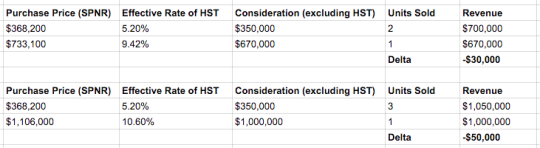
    To illustrate why this matters, consider the following chart:
    image

    In the first scenario, the developer builds and sells 2 units for a price of $368,2000. This translates into revenue of $700,000. However, if the developer instead decides to combine those 2 units and sell the larger single unit for $733,100 (roughly double the price) then the effective rate of HST goes up and revenue drops by $30,000.

    The second scenario is similar to the first one except that instead of 2 units, it’s 3 units which then get combined into one. Here revenue drops even further – by $50,000.

    Now, you could argue that there are some cost savings associated with building fewer suites, but I don’t think it would offset the differentials shown above, especially if you multiply those revenue numbers across an entire project. So what this all means is that it can be more profitable for developers to build smaller units priced below the thresholds mentioned above, as opposed to a smaller number of larger units. 

    Again, I’m not saying that HST rebates are bad. They’re critical to the industry. I love them. But I do believe we should be thinking about the possible implications that the current set up could be having on what we’re building and in particular on unit sizes.

    If you’d like to learn more about how the rebates work, check out this PDF from the Canada Revenue Agency. I tried to keep things simple in this post.

  • Pre-sales, shear walls, and condos, oh my

    Work In Progress 2 by bryan simpson on 500px.com

    Pre-sales are a big part of many condominium markets. The way it typically works is that developers sell suites in their building before construction has even started and then uses those purchaser deposits (which are held in trust) to obtain a construction loan to actually build the building. Part of the reason this is done is that it, in theory, reduces speculative overbuilding.

    Nobody really knows the exact number, but here in Toronto many suites within a new building often end up getting sold to investors. And in some locations and some buildings, it could be most suites.

    On the one hand this is a good thing. Because in a way they provide the short-term money that gets new projects off the ground. And if they end up holding onto their suites, they also become landlords for new rental housing. Here in Toronto condos have been almost the only new rental stock built in this city for decades. (Purpose-built rental is now starting to come back though.)

    But one of the potential negatives is that buildings could be getting designed more around investor needs as opposed to end user needs. And that is happening because many end users – particularly when it comes to larger suites – find it difficult to make such a big life decision 3-5 years out. Doing that means saying to yourself: Okay, I’m going to buy this 3 bedroom condo today because 4.5 years from now when it’s complete I expect to be married and have 1.5 kids. Life doesn’t always work that way.

    We also have antiquated tax policies in Ontario that encourage the building of smaller suites. And I believe they should be modernized. (This topic deserves a dedicated post.)

    So if we are to think of these condo suites as products, then you could say that there are two broad customer segments: the investor and the end user. There are obviously sub-segments within each, but let’s assume that those are the top of the funnel.

    The challenge now facing developers creating new product is that the system we have put in place arguably privileges one customer segment over the other. And it’s a problem that is somewhat unique to the real estate industry because it takes so damn long to bring new supply to the market. (If you sell jets or yachts, maybe you have a similar problem.)

    Now one way to solve this might be to create lots of flexibility in the product. That is, you could allow people to adjust and combine suites to fit their current needs. And that’s what great products do: they meet specific needs and solve problems. In this scenario, perhaps the single person could “add-on” to their suite as they enter a new life phase. And indeed, this is something people are experimenting with by way of things like “knockout panels.”

    But the problems with this are twofold. 

    Firstly, this requires an adjacent and suitable suite to come on the market so that you can buy it. And that may not happen 6 months before the baby comes. 

    Secondly, most Toronto condominiums are built using something called shear walls. These are structural reinforced concrete walls that cannot be removed without compromising the integrity of the entire building. And most purchasers like these walls between them and their neighbors because they’re worried about noise. So combing suites isn’t always as straightforward as we might think. There are many constraints.

    One way to mitigate these problems is through smaller projects. That reduces the lead time between purchase and occupancy. But I am sure there are probably other creative solutions that we could come up with to better align product and customer needs.

  • Urban population densities, compared

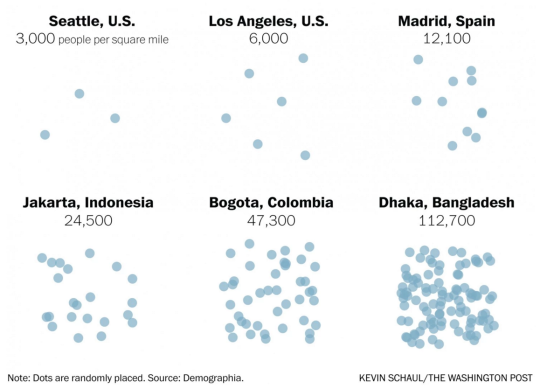
    Earlier this month The Washington Post published an article called, There’s no such thing as a city that has run out of room.

    And what it was really about was that when we say there’s no more room (I guess people are saying this), we are really saying that we just don’t want to allow anyone else to become our neighbor. Because the reality is that urban population densities vary widely around the world. So how can you really call a place full?

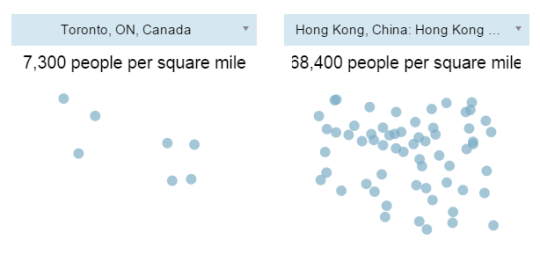
    I’m not sure I feel this pain point as much as the author, but I always find population densities to be a fascinating topic. And accompanying the article was a tool – using data from Demographia – that allowed you to compare the population densities of various cities.

    Here are are two scenarios I ran:

    It’s important to keep in mind that these numbers are averages for the entire economically contiguous region. So it tells you nothing about the potential spikiness of certain areas. That’s why the population density of New York (which includes portions of New Jersey and Connecticut) probably seems low to you.

    Still, it’s fascinating to see how extreme some cities – including some first world cities like Hong Kong – can be. Clearly many cities have a lot of room to become a lot more dense. And I think that would be a good thing.

  • How cities get branded

    Taxi on Times Square by frederic prochasson on 500px.com

    https://500px.com/embed.js

    I have been thinking a lot about city branding lately. It’s a topic I’m interested in to begin with, and all of the Blue Jays mania going on in Toronto right now has got thinking about our own brand.

    Because at the end of the day, yes, it’s baseball. But it’s also something much larger. It’s about civic and national pride, and it’s about who we are as a city. That’s why city branding has become a global industry and why it’s so closely connected to tourism, media, sports, and entertainment.

    Still, great city branding is incredibly difficult to do. Lots of cities have tried and lots of cities – from Adelaide to Toronto – have failed. Anyone remember the “Toronto Unlimited” brand of the mid-2000′s? It had absolutely zero stickiness.

    But in reality, cities are brand building all the time whether they realize it or not. Here in Toronto, our biggest brand builder right now is probably Drake. That might sound silly to some, but I believe it to be true. And next to that, you have people like Jose Bautista with his bat flips and his support of local brands like Peace Collective. In addition to their day jobs, these people are helping to shape the identity of the city.

    What, then, is professional city branding supposed to do?

    Well, in my opinion, it is their job to mine a city for the things that already exist. A city brand, no matter how great it may be, cannot be expected to create something from nothing. There has to be something there to begin with.

    But once you identify that something, a great city brand can tie it all together; create a cohesive and collective identity; and serve as a guide for future decision making. And when that’s done effectively, you actually begin to enhance the things that you initially started out with. The associations become even more powerful.

    So today I thought we could have a discussion in the comments about city brands. How would you describe the brand of your city in one sentence?

    For me, I would describe Toronto along the lines of being the most livable and multicultural 24/7 global city. And when you think of it this way, you can probably see why I think a 2AM last call at the bar is laughable.

  • Thoughts on land-value taxation

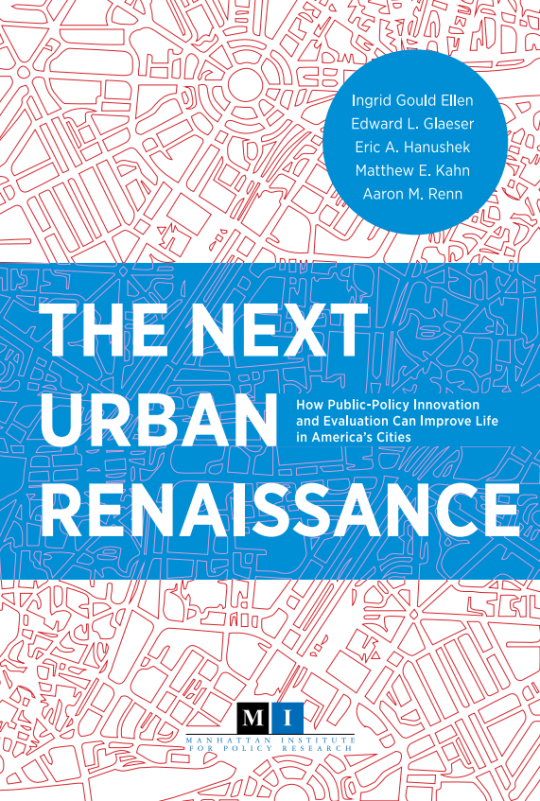
    Yesterday I wrote about a new book that was just released called The Next Urban Renaissance

    The first essay in the book, written by Ingrid Gould Ellen of New York University, is centered around three ideas to help cities deal with the affordable housing problem. This is something that successful cities all around the world are grappling with.

    The first idea is land-value taxation, which is also known as a “split-rate” tax. I’ve touched on land-value taxation before on ATC, but I never really dug into it. So this was a good reminder to do that.

    The idea behind land-value taxation is to split property taxes into a land tax and an improvements tax (i.e. the building), and then shift more of the burden over to the land side. Economists tend to really like this model because taxing buildings/improvements can discourage property investment and development, whereas taxing land doesn’t impact supply. The supply of land is fixed.

    So in the context of affordable housing, land-value taxation is thought to be a way to encourage more development and to increase the supply of new housing – which is usually a good way to keep home prices in check.

    Here’s how Ingrid Gould Ellen described it:

    …a land tax would discourage speculators from hoarding
    undeveloped land and incentivize them to develop their parcels to the
    full extent allowable. Regardless of whether a parcel sits vacant, houses a
    partially occupied, one-story retail strip, or holds a 30-story apartment
    tower, the annual tax bill would be the same. By switching to a land tax,
    a city could therefore increase the supply of housing and, by doing so,
    reduce prices across the board.

    But I can’t help but wonder if this isn’t more applicable to cities or areas that are currently struggling to encourage development. For instance, would boom town Toronto really benefit (in terms of affordable housing) from a tax change that ends up encouraging more high-rise development?

    It also strikes me as being exceptionally difficult to implement, particularly in city like Toronto that is growing and changing so quickly. Is it reasonable to ask the owner of a small downtown parking lot to being paying property taxes as if a 90 storey supertall had been built on top of it? Because that is the reality in some parts of this city.

    And if we opted to phase in this new land tax, would it then become a game of arbitrage where developers look for properties with the lowest land taxes but the highest achievable densities?

    Finally, I wonder if it wouldn’t exacerbate some of the problems that already exist in rapidly growing cities, one of which is the preservation of smaller heritage buildings in centrally located neighborhoods:

    In the case of a split-rate tax,
    the losers will be owners of parcels with high land-to-building value
    ratios, or owners of small buildings on valuable, centrally located parcels,
    who will likely see an increase in their tax bills after the switch to
    a split-rate tax.

    Land-value taxation is something that I’ve been thinking about for a number of months now. But I am struggling to come up with a decisive position. If you have any thoughts on this, it would be great to hear from you in the comments.

  • The Next Urban Renaissance

    The Manhattan Institute for Policy Research has just published a free book called, The Next Urban Renaissance: How Public-Policy Innovation and Evaluation Can Improve Life in America’s Cities.

    Here’s an excerpt from the foreword:

    This collection of essays brings together the best ideas from scholars with expertise across a broad spectrum of urban issues. The common theme of the papers is to innovate, evaluate, and leverage the remarkable private talent that is so abundant in America’s great cities. Public capacity is sharply limited; the ingenuity of urban entrepreneurs seems practically boundless. Local governments should be more entrepreneurial and do more to use the talents of the entrepreneurs around them.

    As a further preview, two of the ideas suggested in the book include: 1) reducing or eliminating parking requirements for new developments (which is something I’ve written about before on ATC) and 2) implementing a split-rate property tax for land and its improvements.

    If you’d like to download the free PDF, click here.

  • The economic benefits of a winning sports team

    Jays Game 2 by Charles Bodi on 500px.com

    https://500px.com/embed.js

    I was having round 1 of (Canadian) Thanksgiving dinner with my father on Saturday night and we inevitably started talking about the Blue Jays.

    As I write this post, the Blue Jays are down 2-0 in the ALDS, but by the time you read this email in your inbox (assuming you subscribe), game 3 will have already happened. Either the Jays will be on their way to a great comeback or the season will be over. I am remaining fiercely optimistic.

    But in addition to the regular sports chatter, we also started talking about the possible economic benefits of the Blue Jays winning and being in the playoffs for the first time in decades. 

    We assumed that 50,000 people buying tickets, heading downtown, and spending money on food, alcohol, parking, transit, taxis, and hotels, would be a great benefit to the local economy. And immediately I thought to myself: this would make a great blog post.

    But it turns out that the local benefits of professional sports aren’t so clear cut.

    There’s been a lot of research on public funding for sports stadiums and a lot of the research suggests that it may not be in the best interest of taxpayers. A considerable amount of the spending does not get retained by the local economy and instead gets siphoned off to the respective league and to concentrated private interests.

    But Toronto already has the SkyDome, I mean, Rogers Centre. It’s a sunk cost. So looking forward, there must be some incremental benefits.

    Well, a recent article in the Chicago Tribune asked this same question in light of the Cubs heading to the playoffs. And it turns out that it’s also not so clear cut.

    Part of the problem is something called the “substitution effect.” When a sports team starts winning (and people jump on the bandwagon), money is simply redirected away from other forms of entertainment towards sports entertainment. In other words, instead of going to see a movie or going to the museum, people go to the game.

    In fact, a 2001 study by Dennis Coates and Brad R. Humphreys called, “The Economic Consequences of Professional Sports Strikes and Lockouts”, found that during sports stoppages, 37 metro areas with professional sports franchises actually experienced no negative financial impact. And in many cases they performed better.

    Interesting.

    Having said all this, there’s a powerful sense of solidarity that takes over a city when everyone is rooting for the same team to win. And that’s hard to attach a value to.

  • Fred Wilson on where the New York tech ecosystem is heading

    Venture capitalist Fred Wilson is the poster boy for the New York tech industry. And this morning he posted an interesting video on his blog of a recent talk he did at Google NYC.

    At the 4:50 mark he begins talking about the evolution of the tech sector in New York and how it became what is probably the second most active startup hub in the United States.

    Given yesterday’s post on talent and the recent CityAge conference I participated in, I thought this video would make a great follow-up. There’s talk of lifestyle, diversity, gender equality, and talent within cities.

    Fred is heavily involved in growing and improving computer science education in New York, which is a perfect example of how cities can better leverage the people and talent they already have – as opposed to just focusing on bringing in new talent. Coding is a valuable skill to possess.

    I also found it interesting that Fred ended up in New York precisely because his wife wanted to live in New York. And that had a lot to do with all of the things you can do in the city, outside of work.

    If you can’t see the video below, click here.

    [youtube https://www.youtube.com/watch?v=_fZCrasNIfQ?rel=0&w=560&h=315]

  • Last call at the bar

    Earlier this week I attended the CityAge conference here in Toronto and participated in a panel discussion about talent. 

    The questions were all about how cities can attract and retain talent, and how they can best leverage the talent they already have. These are questions that a lot of cities around the world are thinking about.

    In my responses I talked about things like transit connectivity, which is a problem that all of us in Toronto recognize we have. But I also focused a lot on quality of life, on sense of place, and on being a cool place to live. These are important factors.

    The example I then gave is Berlin. Some say Berlin is now over. But for many years Berlin has been dubbed one of coolest cities in the world. And I personally think a lot of that has to do with the arts, culture, and nightlife scene that emerged in the 90s. 

    But this wasn’t a government initiative to make Berlin a hub for talent. It was largely a grassroots movement that took hold for a myriad of reasons, one of which was simply empty buildings that people could colonize for parties. And it transformed the place into a city that later became known as “poor but sexy.”

    That brought me to another point, which is that Toronto’s 2AM last call at the bar is laughable by global city standards. And we know that. That’s why whenever we host an event of any sort of notoriety – such as the Toronto International Film Festival – we extend it to 4AM. The people coming here from all around the world expect that.

    This may seem like a small thing. And I am sure many of you here in the city would like things to stay just the way they are. But I think we need to loosen up.