Daily insights for city builders, delivered every morning at 6 AM ET. I’m Brandon Donnelly — a Toronto-based real estate developer and founder of Globizen. I’ve been writing here since 2013.

  • The change order (ruminations on innovation)

    If any of you are in the
    business of creating – whether that’s a mobile app or a building – I’m sure
    you understand that the product or thing you’re working on will naturally
    evolve and change over time – probably in unexpected ways.

    In fact, I usually take this as a positive sign. When I have my
    head in a project and I’m focused on solving problems, ideas will naturally
    start to flow. I start thinking of things that I never would have thought
    about at the outset. That’s why I generally think of creativity as a process,
    rather than as some divine gift.

    But the challenge with all of this is that many of our existing business
    processes are not set up to deal with this kind of ambiguity. If anything we
    try and punish these sorts of deviations. If it wasn’t pre-meditated at the
    beginning of the project, we call it “scope creep” and charge extra for them as
    “change orders.” These two words equal death in construction.

    Now, don’t get me wrong, I completely understand the realities
    of running a business and the importance of managing scope and resources. It’s
    a balancing act. Without some structure, nothing would get done. 

    But the more that iterative
    lean methodologies and “design thinking” can be embedded into our processes,
    the more value creation I believe we will see.

    My thinking is as follows: At
    least part of the reason that innovation comes from startups and new market
    entrants is that the founders aren’t usually sitting around talking about defined
    scope and laying out elaborate business plans. They’re focused on creatively
    solving problems and doing whatever it takes to get there.

    It’s also one of the reasons
    that conventional wisdom dictates that tech startups shouldn’t outsource development.
    It’s too core a competency and you can’t “move
    fast and break things
    ” if you don’t have that in-house and you’re constantly worried
    about eye-popping invoices hitting your desk.

    I have always seen lots of
    parallels between startups and architecture. In both of these worlds, the idea
    you start with is rarely what you end up with (at least that’s the case in
    architecture school). You research, learn, and iterate along the way and that
    leads you in new and unexpected ways.

    And in my view, that’s often what
    the path to innovation looks like. Because if you define the entire path at the
    outset, how can you expect to go anywhere new? And if you’re not going anywhere
    new, how can you expect to outperform the market?

  • A money back guarantee on your next home

    image

    I’ve written about Opendoor.com a few times. As far as I can tell, they are the furthest ahead in terms of disrupting the residential real estate market. So I like to follow them quite closely.

    They’ve recently launched some new features, so I figured it would be a good time to check-in on what they’re up to. But first – for those of you might not be familiar with Opendoor – here’s what they do.

    Opendoor offers instant liquidity to homeowners by buying homes site unseen. The fee they charge seems to amount to less than 10% of the value of the home. 

    They also say that they typically offer prices that are about 1-3% less than the market value of the home 3 months into the future. (Apparently 3 months is the average time-on-market for the cities in which they operate.)

    Once they’ve bought the home, they then make improvements and put it back on the market. As of today, they are buying about 10 homes a day in the two markets in which they operate (Phoenix and Dallas). They are spending about $75 million a month buying homes.

    To mitigate their risk, they won’t buy a home built before 1960, a home that was pre-fabricated, a home with a solar lease, and so on. They also stick to values that are between $100,000 to $600,000. But apparently this covers off about 90% of homes in the United States. (You can read their full FAQ here.)

    To accomplish all of this, they have raised about $110 million in venture capital.

    What’s fascinating about all of this is that they are starting to create a seamless marketplace. As they continue to buy more homes (and aggregate supply), more buyers are starting to come to their marketplace. They also allow people to easily find local contractors.

    Over time as they gain scale and as their algorithms improve, one could imagine their pricing becoming more competitive, them taking more of the market, and them bearing much less market risk as homes quickly trade. 

    They liken their model to car trade-ins. Apparently 60% of people who buy a new car are trading in an old one. That’s an interesting comparison that I hadn’t thought about before.

    So what’s new?

    Two things

    First, they are offering a 30 day full refund on new home purchases. In other words, if you buy a home through their platform and, for whatever reason, you end up not liking it, they’ll buy it back (minus some transaction costs and so on).

    Second, they are providing a 180-point inspection report to buyers and if anything breaks in the first two years of ownership (presumably it is something that contravenes the inspection), they’ll come and fix it.

    These additions are helpful because it starts to target buyers, which will help them fill out the other side of their marketplace. It also promotes greater transparency because now they’re partially on the hook for the home’s performance.

    I like what they are doing and, again, I can’t think of any other company making such big bets in this space.

  • Design, technology, and culture

    Every now and then I’ll come across a website, a product, or something that immediately resonates with me. Usually that means I’ll immediately subscribe to it, buy it, follow it, or do whatever the action is supposed to be. It doesn’t happen all that often – though I think it should be a goal of companies and organizations to delight – but that’s exactly what happened to me this morning when I stumbled upon Subtraction.com.

    Subtraction is a blog about design, technology and culture (all things I love) and it’s written by Khoi Vinh. Khoi is Principal Designer at Adobe. Prior to this, he was Design Director of The New York Times and co-founder of the design studio Behavior, LLC. Fast Company also named him one of the 50 most influential designers in America. But enough of all that. His blog is great.

    Whenever I write about blogging, I tend to get questions about other blogs I might recommend. So today I’m recommending Subtraction.com. I’ve also added it to my working reading list, which I don’t think many of you are aware of because you probably just read this blog in your inbox. But it exists and I’m happy to add to it if you have interesting suggestions. (Please leave a comment below.)

    P.S. Because of Subtraction, I now have the movie High-Rise on my watch list. Have any of you seen it? Because I don’t have cable or Netflix, I tend to be painfully out of the loop on these sorts of things. It’s based on a book by J.G. Ballard and it’s the story of a 1970s suburban London apartment building that starts to socially degrade. How could I not want to watch that?

  • Rental apartment expansion in Detroit

    The Detroit Free Press recently published a summary of some of the new rental apartments coming online in and around downtown Detroit. Here’s the map that they published along with their piece:

    image

    Based on this article, demand is outstripping new supply and rents are starting to push above $2 per square foot. This strikes me as a solid number given that there are also for sale lots/houses in the city going for $10,000.

    Going back to some of the posts I have written about rental apartment development in Toronto, you might remember that $3 psf is roughly our magic number given current cost structures.

    In some special circumstances you might be able to get a project off the ground with rents closer to $2 psf, but that’s an exception to the rule. There are many areas in the Toronto region with $2 psf rents and few, if any, new rental apartments.

    But Detroit is obviously a different city, as is every real estate market.

    Land would be cheaper. Many of these new rental apartments are conversions of existing buildings (which were probably bought for cents on the dollar). And I wouldn’t be surprised if there are tax abatements and other incentives to encourage more development. 

    I also wonder if people in the city aren’t being at least partially drawn to multi-family buildings because of the safety and security benefits. That’s something that certainly came up when I was in Detroit last weekend.

    Regardless, this is a good news story for Detroit, which is not always the story you hear people telling of the city.

  • 133 Wai Yip Street, Hong Kong

    Dutch architecture firm MVRDV recently converted an old industrial building in Hong Kong into new office space. The overall project size is roughly 200,000 sf. What’s unique about the project is the obsessive focus on transparency and glass.

    Here’s what the interior looks like:

    And here’s how the architect has described the project:

    “We are moving into a transparent society, businesses are becoming more open with the public, and people care more about what goes on behind closed doors. In that way, a clear workspace leaves nothing questionable, nothing hidden; it generates trust.” Tells MVRDV co-founder Winy Maas, “But also it is an opportunity for the building to become a reminder of the industrial history of the neighbourhood, monumentalised in a casing of glass.”

    I have written quite a bit about how I believe we are shifting towards a more transparent world – perhaps even a radically transparent world. And so it’s interesting to see an architect pick up on this broader theme and translate it into physical space.

    The floor is transparent. The partitions are transparent. The furniture is transparent. And you can clearly discern the interfaces between old and new.

    Good architecture, at least in my opinion, should reflect what is happening in our broader society. That’s why I believe that studying the history of art and architecture is really like studying the history of the world.

    For more photos of the project, click here.

    Image by Ossip van Duivenbode via MVRDV

  • Why blog?

    Someone recently asked me: “Why do you blog?”

    I have lots to say whenever someone asks me this and I’ve written a few of those things down, here. Obviously I believe that there’s tremendous value in writing your own blog and reading the blogs of others.

    It’s for these reasons that I really enjoyed one of Seth Godin’s posts this week called: Read more blogs. The post is about using an RSS reader (Feedly) to keep track of blogs (which I do), but it was the lead-in that caught my attention:

    Other than writing a daily blog (a practice that’s free, and priceless), reading more blogs is one of the best ways to become smarter, more effective and more engaged in what’s going on. The last great online bargain.

    Good blogs aren’t focused on the vapid race for clicks that other forms of social media encourage. Instead, they patiently inform and challenge, using your time with respect.

    He then ends by arguing that we shouldn’t sit idle while powerful gatekeepers like Google and Facebook “push us toward ad-filled noisy media.”

    The reality of many personal blogs is that they don’t live and die on clicks like other online media. It’s a labor of love and that makes it a unique place on the internet. I clearly like this place and, if you’re a reader of this blog, I suspect you might too.

    Thank you for reading my personal journal.

  • Event: Community Consultation for Mirvish Village

    image

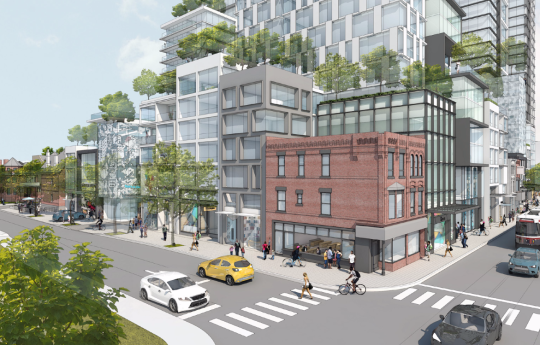
    One June 13, 2016 from 6:30 to 9:00 pm, the City of Toronto will be hosting a community consultation meeting for the proposed redevelopment of Honest Ed’s / Mirvish Village

    The meeting will be held at the Bickford Centre Auditorium at 777 Bloor Street West (across from Christie Pits Park).

    The purpose of the meeting is to present Westbank’s revised development proposal, which was submitted to the city last month. Their first proposal was submitted last summer (July 2015). 

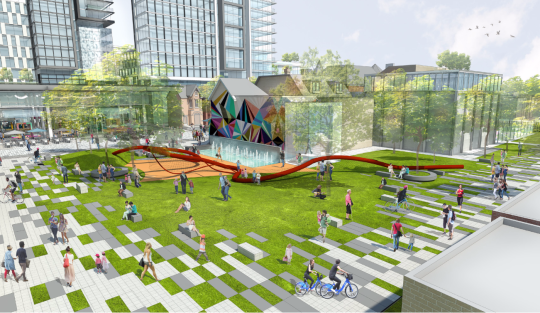
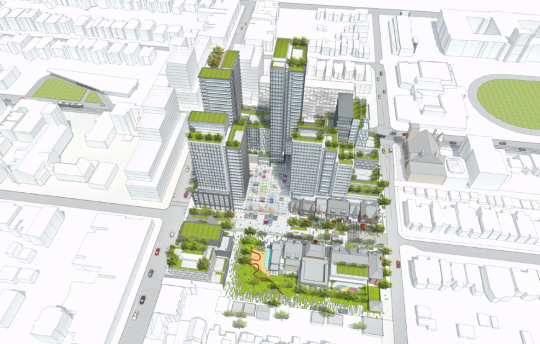
    Some of the key changes include a new on-site public park, the retention of additional heritage buildings (now 21 in total), more pedestrian porosity, and the retention of Honest Ed’s alley in its current location.

    I consider Westbank to be one of the most thoughtful developers in the city and so I’m pretty excited to see this one evolve. I’m planning to attend the community meeting and maybe I’ll see you there.

    Below are a couple of other renderings to give you a taste.

    imageimageimage

  • More thoughts on inclusionary zoning

    Alan Ehrenhalt recently published a balanced piece in Governing that largely reflects my own views on inclusionary zoning. It’s called: Why Affordable Housing Is So Hard To Build.

    His argument is that there are lots of cities trying to build more affordable housing, but that most strategies have not yet proven to be all that successful.

    I’ve written a few posts on inclusionary zoning. The most recent is this one. And though I believe that a mix of incomes is a critical component of good city building, I am having a hard time believing that inclusionary zoning is the silver bullet that will get us there. Admittedly, it sounds like a great idea. But how does that translate into reality?

    Here’s a snippet from Alan’s article (shout out to Daniel Hertz of City Observatory who seems to get cited in almost every article I read these days):

    Just about every city that has tried an inclusionary zoning law in recent years has had a similar experience. In some cases, the results have been much worse. According to BAE, Chicago’s inclusion law produced $19 million in 11 years, but only 760 affordable units. Thirteen years of inclusionary zoning in Seattle brought the city $31.6 million in fees and a grand total of 56 units. As the urbanist Daniel Hertz wrote recently, inclusionary zoning has been “more powerful as a symbol than as a way of helping people.”

    Of course, the devil is in the details. Many inclusionary zoning policies allow cash in lieu of actual housing:

    San Francisco actually has had an inclusionary zoning law since 2002, and it has been a flop. It mandates a 12 percent affordable set-aside, but allows developers to escape the mandate by paying a fee to the city. As in Arlington, this is what they have done. A study by the research firm BAE Urban Economics found in 2014 that after 12 years the San Francisco law had brought in $58.8 million in developers’ fees and had generated 1,560 units. That’s better than nothing, but it’s a drop in the bucket for a city facing an affordability problem in virtually every neighborhood.

    All this said, I’m still not so sure that it’s as simple as eradicating the cash in lieu option and forcing mandatary inclusionary zoning. As Alan rightly points out in his article, if we set the bar too high, then all of a sudden it starts making some market rate housing infeasible to build. 

    And if this ends up lowering the overall supply of new housing, then we could be hurting affordability while at the same time trying to mandate more of it. Does that make sense? Clearly this is not as simple as it may seem.

    I get the appeal for cash poor cities. It sounds like free affordable housing. But I’m always suspect of “free” lunches. In any event, I think we can all agree that this is an important discussion to be having.

  • Towards car-free living

    Right now, there’s an apartment building in San Francisco that is trying to encourage car-free living by offering residents a $100 per month credit that can be used for Uber and/or for public transit. Prospective residents can even get a $20 credit to go check out the community. (The program is a partnership with Uber.)

    The reason this leasing strategy caught my attention is because we’re at a point where city builders are now trying to recalibrate themselves to this new emerging world. 

    When I was at the Land & Development conference earlier this month, one developer brought up this exact point. He more or less asked: If you’re starting development on a new building today and you’re expecting approvals in 2 or so years and completion in another 3 or 4 years, what do you think the state of cars/driving will be at that point? Should you really be building all that underground parking?

    These are great question. And they highlight one of the challenges of development. It takes a long time to bring new supply to the market and a lot can change during that time period. My sense is that we are pretty clearly seeing downward pressure on driving and car ownership.

    That said, this isn’t the case in every city or in all parts of a particular city. I just got back from a trip to a Detroit where it’s pretty hard to imagine the city being oriented around anything but the car. But in cities like San Francisco and Toronto, car-free living is already a reality for many people and so we need to respond to that.

    How do you see yourself driving, or not driving, in the next 5 to 10 years?

  • The answer to San Francisco’s housing affordability problem

    Blogger and programmer Eric Fischer has an excellent post up on his site where he looks at: “Employment, construction, and the cost of San Francisco apartments.” It’s worth a good solid read.

    What he did was dig deep into whatever data he could find – the data goes back to the beginning of the 20th century in some cases – to try and figure out a solution to San Francisco’s housing affordability problem.

    Many (including myself) have argued that, at least part of the solution, is to build more, not less, housing. However, others, such as Tim Redmond of 48 Hills, have argued that building more market-rate housing would simply exacerbate the current situation.

    In Eric’s analysis, he looked at everything from median rents and new housing units constructed (above graph) to annual wage growth and income inequality. I particularly liked his summary of the city’s various building booms. 

    In the end, here’s the conclusion that he came to:

    “In the long run, San Francisco’s CPI-adjusted average income is growing by 1.72% per year, and the number of employed people is growing by 0.326% per year, which together (if you believe the first model) will raise CPI-adjusted housing costs by 3.8% per year. Therefore, if price stability is the goal, the city and its citizens should try to increase the housing supply by an average of 1.5% per year (which is about 3.75 times the general rate since 1975, and with the current inventory would mean 5700 units per year). If visual stability is the goal instead, prices will probably continue to rise uncontrollably.”

    By visual stability, he is referring to maintaining the current urban fabric of San Francisco just the way it is. In other words, he is making the link between preservation and affordability in a prosperous and growing city.

    Intuitively, this makes sense to me. It’s unrealistic to think that you can maintaining some level of housing affordability without allowing supply to increase alongside demand.

    At the same time, I do not believe that preservation needs to equate to no changes whatsoever. Urban preservation, to me, should be about dutifully respecting the past while still looking firmly towards the future. And that’s how I believe successful should be approaching this problem.