Daily insights for city builders, delivered every morning at 6 AM ET. I’m Brandon Donnelly — a Toronto-based real estate developer and founder of Globizen. I’ve been writing here since 2013.

  • The top 20 US neighborhoods for venture capital investment

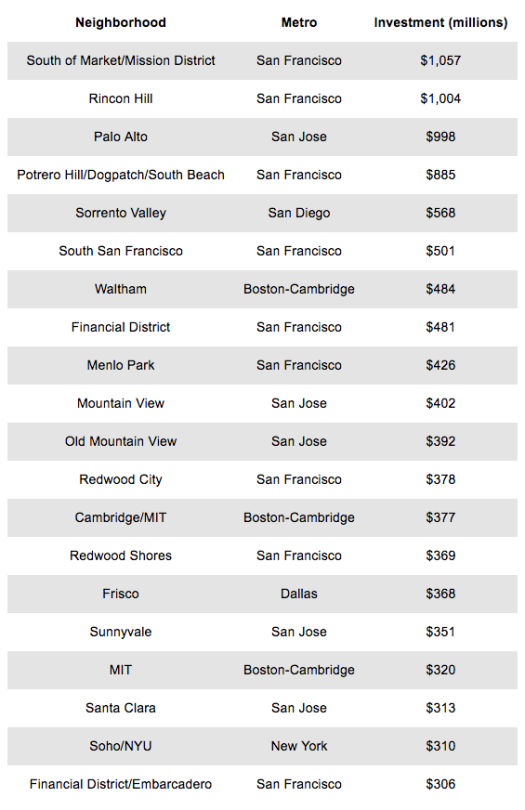
    There’s a lot of talk about how venture capital investment has shifted from the suburbs to cities and how it is also concentrated in certain metro areas. But a new report from the Martin Prosperity Institute has dug even deeper to look at the top 20 neighborhoods (zip codes) in the US for venture capital investment.

    Here’s a summary of what they found:

    “The top 20 neighborhoods or zip codes for venture investment include nine in San Francisco, five in San Jose, three in Boston-Cambridge (one in suburban Waltham and two in Cambridge close to MIT) and one each in San Diego (close to the University of California, San Diego), Dallas, and New York (close to New York University).”

    And here’s the full top 20 list:

    image

    Initially I looked at this list and thought that neighborhoods such as Menlo Park and Redwood City shouldn’t be labeled as San Francisco, since they are outside of the county. But technically they still fall within the San Francisco Metropolitan Area

    It’s amazing how San Francisco dominates this list.

  • Come original

    I am thinking about nonconformity and originality this morning because I just ordered a book by Wharton professor Adam Grant called, Originals: How Non-Conformists Move the World. I ordered it along with another book that was recommended by a regular reader of this blog. (Thanks Daniel.)

    I find this topic fascinating because there’s clearly a deep appreciation for originality and creativity in our society and yet I think we do a lot to encourage the opposite: conformity. Of course, part of this is that it’s inherently easier to conform. Think about how much pressure we have in our lives to please others and generally just “fit in.”

    This is something that I think about and try to fight in my own life, particularly as I get older. As a teenager, I was a skateboarder with bleach blonde hair who rode around in a t-shirt that said “skateboarding is not a crime.” That’s clearly not me anymore (I prefer my natural hair color), but I continue to believe that a bit of rebelliousness can be valuable.

    For instance, I don’t think it’s a coincidence that San Francisco – the epicenter of counterculture in the 1960s – ended up becoming such a hotbed of entrepreneurship.

    To drive that point home even further, here’s a quote from a recent interview with Adam Grant:

    “It often starts with a slight recalibration in perspective followed by a small, but defiant act. It’s the originals who keep pulling on that thread — they instinctively know that that’s the difference between inspiration and innovation.”

    So there’s also a lesson here for cities. Most cities around the world believe in the value of a thriving startup ecosystem. They want entrepreneurs to start companies and create jobs. But we shouldn’t forget that starting a company is also “an expression of nonconformity.” It is someone deciding to carve out their own path in life.

    If that’s what we’re trying to encourage – and most places are – I believe we should also think about what we’re doing and not doing to encourage the right kind of nonconformity in our cities.

  • Crowdsourcing unsafe cycling conditions with a small yellow handlebar button

    Hövding – a Swedish company best known for its radical airbag cycling helmets (definitely check these out) – is currently crowdsourcing unsafe conditions and cyclist frustration in London.

    Working with the London Cyclist Campaign, they distributed 500 yellow handlebar buttons. Cyclists were then instructed to tap these buttons whenever they felt unsafe or frustrated with current cycling conditions. 

    Here’s what the button looks like:

    Every time the button is hit, the data point gets logged to a public map and an email gets sent to the Mayor of London reminding him of his promises around cycling. Both of these things happen via the rider’s smartphone.

    Here’s what the public map looks like at the time of writing this post:

    Not only does it tell you pain point locations, but it also seems to suggest the primary cycling routes. I think this is a brilliant initiative because, it’s entirely user-centric. It’s telling you how people feel on the ground.

    Supposedly, Hövding is actively looking for other cyclist groups around the world to help them distribute their buttons. So if you’re a group in Toronto or in another city, I would encourage you to reach out to them. The more data the better.

  • Architecture as a tool of capital

    I just stumbled upon an interesting Architectural Review article from last year called: Architecture is now a tool of capital, complicit in a purpose antithetical to its social mission. The author is Reinier de Graaf, who is an architect and partner at the firm OMA.

    The focus of the article is on inequality; capitalism vs. socialism; Thomas Piketty’s book, Capital in the Twenty-First Century (which is now on my reading list); and on how Modernism lost its social mission and got repurposed as a tool that just serves capitalist interests. It went from an ideology to simply an architectural style.

    Here is an excerpt:

    “Once discovered as a form of capital, there is no choice for buildings but to operate according to the logic of capital. In that sense there may ultimately be no such thing as Modern or Postmodern architecture, but simply architecture before and after its annexation by capital.”

    Given that I am initially trained as an architect, but that I work as a real estate developer, this article hits home for me. But unlike the author, I am not as fussed by this intertwining of capital and architecture. In fact, I have always believed that the more architecture can understand its economic milieu, the more likely it can affect positive change.

    Of course, there’s the question of whether that economic milieu is even the right one in the first place. I’ll echo this blog post (on the limits of capitalism), by saying that I consider myself a capitalist, but not an absolute capitalist. Capitalism isn’t perfect.

    I like Reinier’s description of income vs. wealth (borrowed from Piketty):

    He identifies two basic economic categories: income and wealth. He then proceeds to define social (in)equality as a function of the relation between the two over time, concluding that as soon as the return on wealth exceeds the return on labour, social inequality inevitably increases. Those who acquire wealth through work fall ever further behind those who accumulate wealth simply by owning it.

    What are your thoughts?

  • The cost of parking minimums

    Access Magazine has a good piece on parking minimums and the cost they create for our cities. The article is by Donald Shoup, who is Professor of Urban Planning at UCLA. He is also the author of The High Cost of Free Parking.

    Here is his argument:

    “Minimum parking requirements create especially severe problems. In The High Cost of Free Parking, I argued that parking requirements subsidize cars, increase traffic congestion and carbon emissions, pollute the air and water, encourage sprawl, raise housing costs, degrade urban design, reduce walkability, damage the economy, and exclude poor people. To my knowledge, no city planner has argued that parking requirements do not have these harmful effects. Instead, a flood of recent research has shown they do have these effects. We are poisoning our cities with too much parking.”

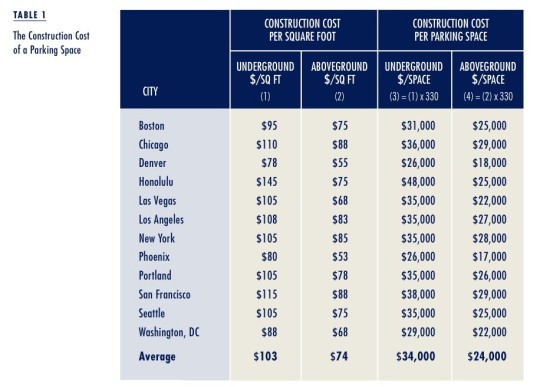
    And here’s his summary of what it costs to build a parking stall in various US cities (both underground and aboveground):

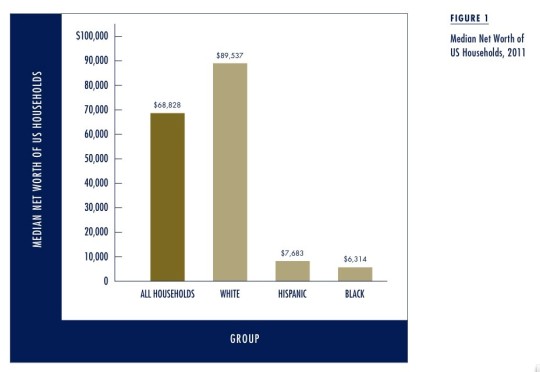
    To put these numbers into perspective, he also looks at the median net worth of US households (2011) to show just how expensive this parking is for some groups. 

    Because remember, these parking costs get embedded into the cost of housing, retail stores, and so on.

  • Conversational investing

    I’ve been spending my mornings this weekend, listening, watching, and reading things. I’m always reading to find content for this blog, but I’ve allocating more time to consumption this weekend. So you might be noticing a slightly different varietal of posts over the past few days.

    This morning it’s a podcast called Dorm Room Tycoon. It’s an interview with Andy Weissman, who is a partner with the New York venture capital firm, Union Square Ventures. The topic is “how we invest” and I’m enjoying the discussion.

    Andy describes their firm as being boutique and thesis-driven. Meaning they have theses and they look for companies that dovetail with them. But in addition, he also labels their approach as “conversational investing.”

    What does that mean?

    It means they listen, watch, and read. They blog (all the partners write their own personal blog). They engage and discuss. They put themselves and the firm “out there”. And they don’t pretend to have all the answers or to be able to predict the future. Instead they let their conversations – both internal and with the broader market – help them make their investing decisions.

    So why do I bring this up?

    Because in my own small way, I am trying to do the same with real estate development, architecture, and city building. I write every day to learn and because I am infinitely curious. If you want to know what I’m thinking about, read this blog.

    It’s for this reason that my favorite blog posts are the ones in which there’s lots of discussion in the comment section. It’s the market talking back, telling me whether I’m out to lunch or not. Ultimately, this idea of “conversational investing” is really about iterative decision making.

    Here’s the podcast embed in case you would also like to listen:

    [soundcloud url=”https://api.soundcloud.com/tracks/266734055″ params=”auto_play=false&hide_related=false&show_comments=true&show_user=true&show_reposts=false&visual=true” width=”100%” height=”450″ iframe=”true” /]

    Regardless, the Dorm Room Tycoon is worth checking out. They have other interviews with people like Malcolm Gladwell and Simon Sinek.

  • Should I stay or should I go?

    I’m listening to The Foreign Desk this morning while I have my coffee. Steve Bloomfield is interviewing two different politicians: one who believes Britain should remain in the EU and one who believes Britain should leave the EU. 

    (Each interview is about 15 minutes short.)

    The back and forth is largely centered around two things: the economy and immigration. Will the British economy be better off in or out of the EU? And on the immigration front, will “in” translate into millions of Turks flooding into Britain should Turkey join the EU?

    For those of you who haven’t been following, Britain will be holding a referendum on June 23rd (2016) to decide whether they stay or go.

    My general view is that a strong economy should trump concerns over foreigners. But I don’t feel as if I know enough about this precise topic to take a firm position.

    Regardless, I very much enjoyed The Foreign Desk episode this morning and I would be open to discussing this issue in the comments below if any of you are also interested.

  • Young, educated, and urban

    The Wall Street Journal recently published this article talking about how the young and educated are flocking to high-density urban areas all across the United States. Here’s a set of charts from the article:

    There are many people who will point out – probably rightly – that despite the “return to cities” that we are currently seeing, the world is still suburbanizing. But, it doesn’t appear to be suburbanizing in quite the same way as it did for prior generations. There’s also a socioeconomic shift taking place.

    As an example, and to drive home the point that it’s not just the expensive coastal cities that are seeing rising home prices, the WSJ article focuses quite a bit on Ohio City – a neighborhood in Cleveland. Here’s what has been happening:

    In the Ohio City neighborhood, the median income skyrocketed to $93,000 from $23,000 since 2006, according to Ohio City Inc., a local nonprofit development group. Median home values shot up 800% since 2000 to $270,000, according to Ohio City Inc. Median rental prices in downtown Cleveland as a whole jumped 47% from late 2010 to late 2015, according to the Center for Population Dynamics at Cleveland State University.

    These are pretty dramatic increases – though $270,000 feels cheap to someone from Toronto. Still, it speaks to a trend. You and I both know that Ohio City isn’t the only neighborhood seeing those sorts of numbers.

  • Fluted glass curtain wall

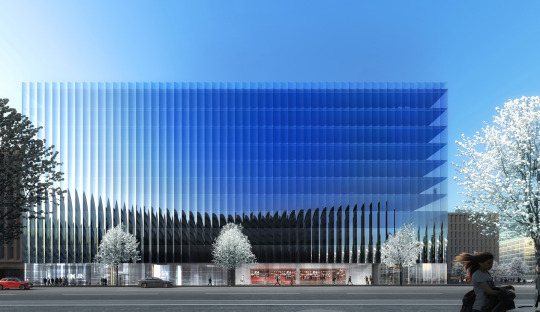
    New York architecture firm REX is working on a new office building in Washington DC that will incorporate a beautiful fluted glass facade. Here’s a rendering of what it is intended to look like:

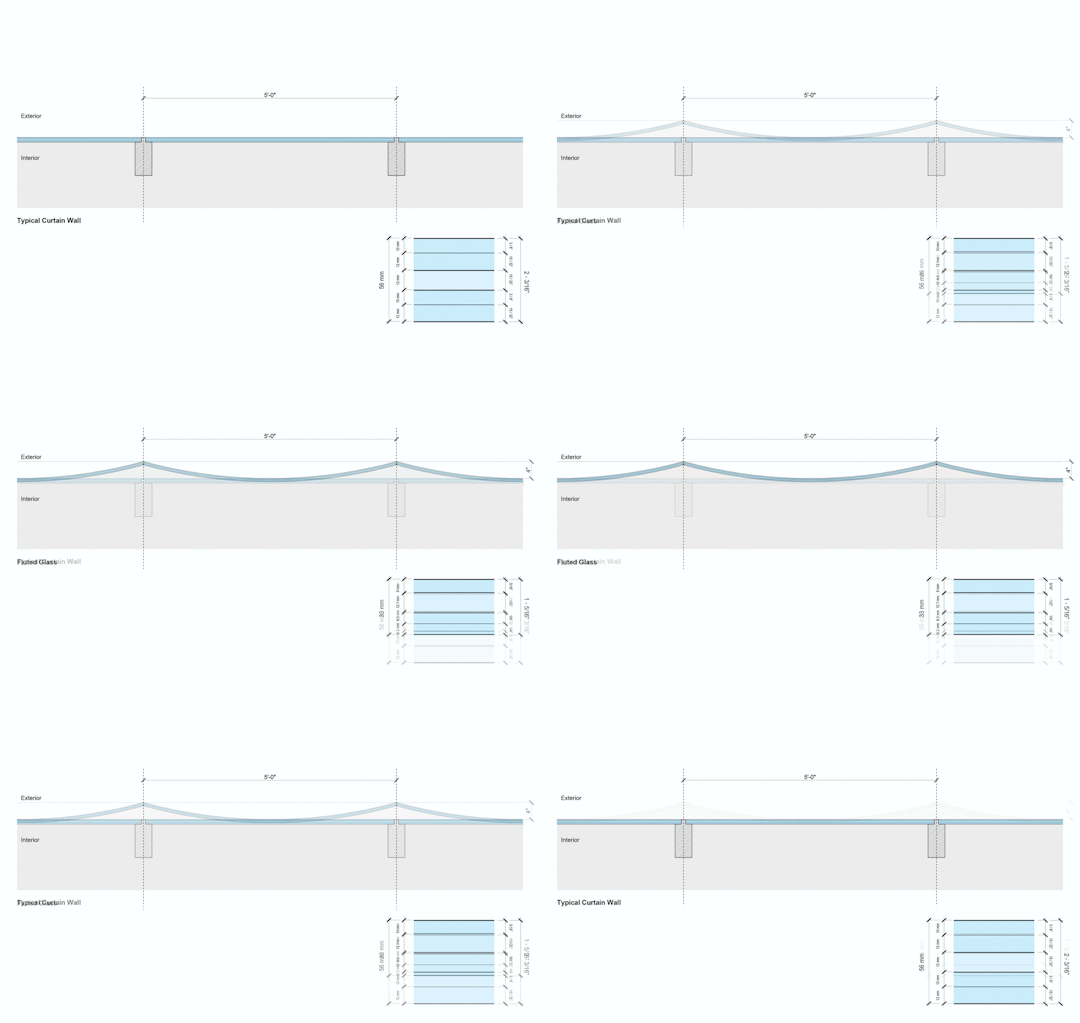
    Here’s what that looks like in plan (it’s a GIF that should show typical curtain wall vs. proposed fluted glass):

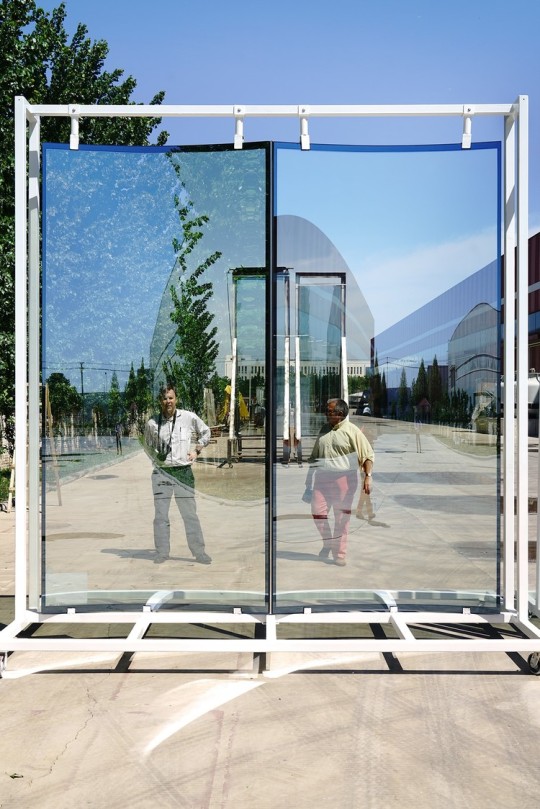
    Here’s a photo of the 1:1 mockup:

    And here’s a description from the architect:

    The façade’s approximately nine hundred identical, insulated-glass panels—3.2 m tall by 1.5 m wide (11’-6” tall by 5’-0” wide)—are subtly curved to a 2.9 m (9’-6”) radius through a heat roller tempering process. The curve yields structural efficiency, which meets wind load requirements and enables a thinner monolithic outer lite than normal, providing greater transparency. 

    Because of the curve’s inherent rigidity in compression, only the top and bottom edges of the panels are supported from the floor slabs, while the mullionless vertical edges are flush-glazed for a minimalist aesthetic that improves sight lines, while gaining usable floor area.

    They are working in collaboration with Front Inc., which if you haven’t heard of, you should check out. They are a design/engineering consultancy that specializes in facades and building envelopes. They work with many of the big name starchitects. The developer of the project is Tishman Speyer.

    It’s worth noting that part of the impetus for the fluted glass facade was to try and innovate within the confines of DC’s draconian zoning – which mandates that no building can be taller than 130 feet. Because of this, developers and architects are usually forced to build out to the allowable area, leaving little room for architectural variation. 

    But in this case, the fluted glass removed the need for thick mullions and also allowed them to extend out beyond the lot area by 4 inches every 5 feet (the curves are considered “architectural features”). So this move has created both architectural variation and more rentable area.

    It doesn’t appear that the building will have any operable windows, but other than that, I think it promises to be quite beautiful. What do you think?

    All images from REX.

  • The change order (ruminations on innovation)

    If any of you are in the
    business of creating – whether that’s a mobile app or a building – I’m sure
    you understand that the product or thing you’re working on will naturally
    evolve and change over time – probably in unexpected ways.

    In fact, I usually take this as a positive sign. When I have my
    head in a project and I’m focused on solving problems, ideas will naturally
    start to flow. I start thinking of things that I never would have thought
    about at the outset. That’s why I generally think of creativity as a process,
    rather than as some divine gift.

    But the challenge with all of this is that many of our existing business
    processes are not set up to deal with this kind of ambiguity. If anything we
    try and punish these sorts of deviations. If it wasn’t pre-meditated at the
    beginning of the project, we call it “scope creep” and charge extra for them as
    “change orders.” These two words equal death in construction.

    Now, don’t get me wrong, I completely understand the realities
    of running a business and the importance of managing scope and resources. It’s
    a balancing act. Without some structure, nothing would get done. 

    But the more that iterative
    lean methodologies and “design thinking” can be embedded into our processes,
    the more value creation I believe we will see.

    My thinking is as follows: At
    least part of the reason that innovation comes from startups and new market
    entrants is that the founders aren’t usually sitting around talking about defined
    scope and laying out elaborate business plans. They’re focused on creatively
    solving problems and doing whatever it takes to get there.

    It’s also one of the reasons
    that conventional wisdom dictates that tech startups shouldn’t outsource development.
    It’s too core a competency and you can’t “move
    fast and break things
    ” if you don’t have that in-house and you’re constantly worried
    about eye-popping invoices hitting your desk.

    I have always seen lots of
    parallels between startups and architecture. In both of these worlds, the idea
    you start with is rarely what you end up with (at least that’s the case in
    architecture school). You research, learn, and iterate along the way and that
    leads you in new and unexpected ways.

    And in my view, that’s often what
    the path to innovation looks like. Because if you define the entire path at the
    outset, how can you expect to go anywhere new? And if you’re not going anywhere
    new, how can you expect to outperform the market?