Daily insights for city builders, delivered every morning at 6 AM ET. I’m Brandon Donnelly — a Toronto-based real estate developer and founder of Globizen. I’ve been writing here since 2013.

  • Detroit on the move

    image

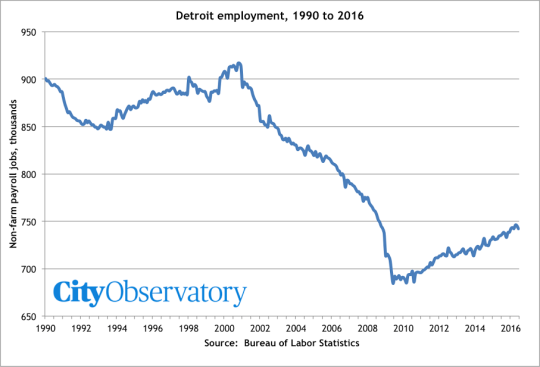
    Between 2001 and 2010, Detroit lost more than 200,000 jobs. It went from over 900,000 jobs to a low of about 690,000 jobs. All of this was happening while the United States was experiencing – up until 2008 at least – an economic growth cycle.

    But we all know that Detroit is now a city on the move. According to City Observatory, Detroit has exhibited 5 consecutive years of job growth. And 2016 looks to be no different. Since bottoming out, Detroit has added more than 50,000 jobs.

    The above chart is based on federal data for Wayne County, Michigan. It includes Detroit, Dearborn, and Livonia, but does not include any other counties within the Detroit metro area. (The above chart and stats are all via City Observatory.)

    Of course, the big question is: Has Detroit made the requisite structural changes to its economy to keep this trend line continuing or is this simply a case of a rising tide lifting all boats?

    I have visited Detroit basically every two years since 2009 and you can certainly feel the change, even in that short period of time.

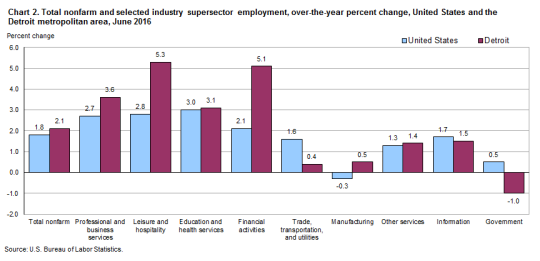
    And if you look at total non-farm employment growth over the last year (June 2015 to June 2016) for the entire Detroit metro area, you see that some of the fastest growing industries include: professional and business services (+14,200 jobs); leisure and hospitality (+10,500 jobs); education and health services (+9,300 jobs); and financial activities (+5,500 jobs). In fact, many of these industries are growing faster than national averages.

    In case you were wondering, manufacturing added 1,200 jobs and government lost 1,800 jobs.

    I’ve heard some people complain that the city, at least downtown, is now too controlled by one entity (Dan Gilbert). But that’s probably what had to happen to really kickstart the city’s renaissance. Somebody had to seed it before you could get the cool coffee shops, bars, restaurants, and coworking spaces.

    There’s still heavy lifting to do, but the data suggests that the city is now headed in the right direction.

    What are your thoughts? Also, if any of you are working on interesting projects in Detroit, I would love to hear from you.

  • LED neon lighting by Electric Confetti

    image

    Ever since I attended Art Basel Miami Beach last year, I’ve been determined to get a neon piece for my condo. I got inspired by all of the neon I saw at the show and so I told myself that I was going to get something made.

    I found a company in Vancouver called Endeavour Neon, but I never ended up pulling the trigger. It turns out that traditional neon lighting is pretty expensive. 

    However, I recently discovered a Melbourne-based company called Electric Confetti. Founded by designer Natalie Jarvis, the company makes LED neon lighting using flex tubes. Supposedly, this makes them more durable and more energy efficient. They’re also less expensive.

    I am trying to figure out shipping to Canada, but it looks like I might be finally getting my neon. I really like the banana (pictured above), but that might be an odd reference for a bedroom. I’ll sleep on it.

    I thought I would share with all of you in case you have a home, an office, or a project that could use some neon lighting.

  • BARED: David Wex, Urban Capital Property Group

    image

    David Wex started his career working for one of the big Seven Sister law firms in Toronto. But right from the outset, it was clear that he wasn’t in it for the long run.

    In fact, only a few days after he started, David had the clever idea of turning his desk around so that it faced the window, instead of the hall. That way, he could avoid eye contact with partners as they walked by his office, and reduce his chances of being assigned a file.

    Of course he couldn’t avoid being tracked down all the time. But whenever someone would try to assign him work, he would simply say: “I’m sorry, but I’m really busy working on something right now.” His nickname quickly became “One File Wex” and it was clear that he was headed towards the departure lounge and not a corner office.

    But already, David had his mind set on doing something related to cities. So while still working as a lawyer he decided to complete his Graduate Record Examination (GRE) in preparation for going to planning school. Ultimately, he decided not to go back to school, but instead leave the firm and just figure things out. He left in 1992.

    After leaving, he did in his words, “nothing” for a few years. He lived off his savings, spent some time working with a bunch of guys cleaning up the Don River, and tried to figure out a way to put together a development project.

    Eventually he met a friend of the Goodman family and this led to an introduction to the Dundee Corporation.

    It was the early 90’s and nothing was happening by way of development in Toronto. The real estate industry was in a deep recession. Ask anyone who was “active” during this time. It was a painful time to be in the business. But the Goodmans told David that he if could find a suitable site to develop, they would invest. Lesson: Developers are constantly leveraging other people’s money.

    So David went out and found a site on a sleepy street named Camden in Toronto’s Fashion District. This is not the Camden Street of today, which has an Ace Hotel currently in the works. It was a dead zone. By this point we are in 1995 and few people believed that anyone would want to live on a downtown street like Camden.

    Given the perceived undesirability of the site and the continued lull in the market, David tied up 29 Camden for C$700,000 with a 2 year option. What this means is that he had 2 years to figure out if he actually wanted to close on it. He could put very little money down and get the project going before having to worry about carrying the land. It wasn’t until midway through sales that he actually went firm.

    It’s hard to imagine being able to do this in today’s competitive real estate market, but that was the market at the time.

    Of course, the flip side to all of this is that it also took him 2 years to sell about 20 condominium units (out of a total of 55), at an average price per square foot of $195. Today you could sell those units in 2 hours at $800 psf.

    Brad Lamb – who was just starting out at the time – was the broker on the project. And activity at the sales office was so scant that everyone would get excited even when a car would drive down Camden Street. That’s how dead it was in the Fashion District.

    Eventually Dundee got impatient. Sales were slow. A lot of money had been spent on marketing. And the partners didn’t believe that “the bump and grind of Queen Street” (original marketing pitch) was the right way to position the product. David was also in the midst of rebranding his company from Red Rocket (named after our transit commission) to Scrappy Dog Real Estate Investments. By that point Dundee came in and said: “You’ve fucked up this project. You’re out.”

    David had felt like he had made it and become a developer with Camden Lofts. But just like that – before construction had even started – he was off the project.

    The deal that David struck with his partners was that he didn’t want any money out of the project (it didn’t end up making much money anyways). But he wanted to stay involved and be able to call Camden Lofts his project. And so to this day, Camden Lofts remains the first development project of his very successful real estate career.

    But Camden Lofts didn’t solidify David as a real estate developer. After the fumble, David took on the role of managing a loft conversion for what turned out to be some pretty dodgy landowners. The total management fee was a princely $5,000, but David wanted to complete his own project from beginning to end. And so he did just that with Century Lofts at 365 Dundas Street East. He also spent a great deal of time learning Illustrator, Photoshop, and other design tools so that he could do all of the marketing himself. This is an experience that would later manifest itself in his company’s business model.

    After tuning his craft for a couple of years, David met his current business partner, Mark Reeve. Mark was a corporate real estate developer and planner, and they talked about doing something together. So they did, and the result was Urban Capital Property Group. Mark was also able to planning consult on the side and that helped fund their fledgling business as they worked on breaking into the development game.

    The first project to come out of this relationship was The Sylvia, which was also on Camden Street (#50). However, you won’t find this project on their website because it was done in partnership with developer Intracorp. The relationship ended up not being a productive one and both David and Mark vowed never again to be involved in a project that they weren’t actively managing themselves. That vow continues to this day.

    The first project that Urban Capital did on their own was the 66-unit Charlotte Lofts. It’s the first project they completed from A to Z. They sourced the site, secured the financing, worked on the design, marketed it, and constructed it. It was a success.

    The partners did well but the learning curve remained so steep that neither felt that they had really “made it” with this project. Indeed, my interviews have uncovered that this is a common experience amongst new developers. It can take a few projects before they really hit their stride and, in some cases, even make any money.

    But who ever remembers the stumbles?

    Today, Urban Capital has completed over 4,000 urban condominiums and has another 2,500 in the works. They have developed over $2 billion worth of real estate to become one of Canada’s most influential urban infill developers.

    Unlike other Toronto-based condo developers, they have branched out beyond Toronto: east to Montreal, Ottawa and Halifax; and west to Winnipeg and Saskatoon, with other cities on the horizon. Their mission is to act as an urban regenerator by bringing high design urban living to new markets across the country.

    They have come a long way since the days of Scrappy Dog Real Estate Investments. Clearly David is the furthest thing from “One File Wex.”

    You can follow Urban Capital on Twitter and on Facebook.

    Image: River City 2, Toronto

    ———————————————————

    This is the first post in my new blog series called BARED (Becoming A Real Estate Developer). More posts to come in the following weeks. Subscribe to stay in the loop.

  • #FirstSevenJobs

    I’m late. I’ve been meaning to write this post all week. I think #FirstSevenJobs is a great trending meme. It shows that careers and life are often a non-linear journey. It’s also not all privilege. Many (most?) successful people started off from very humble beginnings.

    But as I was trying to list out my first seven jobs, I came to the realization that I have done a lot of different things for money and out of interest before I settled into my career. Many of them also overlapped each other and I couldn’t quite remember which came first. I also worked all throughout University.

    So I’m going to break the rules. Rather than only list my first seven jobs, I’m going to list all of the gigs I took on before getting into the business I’m in today. Like Seth Godin though, I’m in a way thinking of these more as projects, than as jobs.

    Here’s my list:

    1. Bagged and carried people’s groceries at Sobeys
    2. Shovelled dirt at a green house
    3. Sales Associate in computer department at Staples
    4. Traveling Sales Representative for Hewlett-Packard
    5. Sold burnt CDs at my high school (until everyone else had a CD burner and I lost my unique value proposition)
    6. Built custom computers (anyone remember when overclocking was a thing?)
    7. Mover (usually for offices)
    8. Sales Associate at Sony Store (these stores no longer exist)
    9. Started online community for students at StudentLifestyle.com (I clearly didn’t execute as well as Facebook)
    10. Model/actor with Ford Models (included one summer in Taipei and Hong Kong)
    11. Waiter at a Thai restaurant on Queen Street (I lasted 1 week; I hated serving people)
    12. Started daily photoblog at bdonn.com (shut down about 15 years ago)
    13. Nightclub promoter
    14. Paid DJ at exactly 1 wedding
    15. Sales Associate at trendy clothing store
    16. Sales Associate with Telus Mobility dealer (sold mobile phones)
    17. Security Guard (paid reasonably well and gave me time to study in undergrad)
    18. Intern at Canadian Architect (magazine)
    19. Intern Architect
    20. Teaching Assistant at the Wharton School
    21. Started global real estate listing platform (failed)
    22. Development Intern (real estate)

    Looking back, it’s probably no surprise that I studied computer science before studying architecture.

    What’s your list?

    Please share in the comment section below. Feel free to keep it to seven if that’s what you prefer. But I found that difficult.

  • Introducing: BARED blog series

    I was out with for a bike ride the other night with a good friend of mine and we were talking about all of the creative and social media-based projects that we would like to do. Everything from a daily vlog to a regular podcast. Sadly there are only so many things one can focus on.

    If you’ve been reading this blog since the beginning of this year, you’ll know that I’ve been trying to write a book on “becoming a real estate developer.” I believe there’s a lot of interest in this topic. It’s the number one question I receive from readers: “How do I become a developer?”

    But with everything that’s going on this year, I have decided to turn the research and writing I have done to date into a blog series that I’m calling BARED (Becoming A Real Estate Developer). I’ve interviewed a lot of fantastic people in the business and I want to get that information out there.

    The focus of the series – which was the intent of the book – is to uncover the early decisions and first projects that these now successful developers made and took on. In other words, it’s less about their current successes and more about what they did to get there.

    So no book. But expect to see the first BARED post very shortly. I think I’ll start with 3 posts and then gauge the response.

  • Manager vs. maker

    image

    I am a big believer in making things. 

    That could be writing a blog post, recording a podcast, coding an app, designing a building, making something tangible, or whatever. It is the act of creating something. And it’s one of the reasons I love what I do. At the end of the day, I have had a hand in (hopefully) creating something awesome that didn’t exist before.

    I don’t think everyone feels this way but, for me, when I don’t block time to “make things” I can sometimes feel antsy. I need time to do creative things. It makes me feel like I’m being productive. It makes me feel like I’m producing output, as opposed to just sitting in meetings and making sure everything is on track. Maybe that’s the architect in me.

    Paul Graham describes these two mindsets as that of a manager and that of a maker. And in a great essay published in 2009, he talks about how different these two people’s schedules can be. Below is a longish excerpt that I think you’ll find valuable for life and business.

    “There are two types of schedule, which I’ll call the manager’s schedule and the maker’s schedule. The manager’s schedule is for bosses. It’s embodied in the traditional appointment book, with each day cut into one hour intervals. You can block off several hours for a single task if you need to, but by default you change what you’re doing every hour.

    When you use time that way, it’s merely a practical problem to meet with someone. Find an open slot in your schedule, book them, and you’re done.

    Most powerful people are on the manager’s schedule. It’s the schedule of command. But there’s another way of using time that’s common among people who make things, like programmers and writers. They generally prefer to use time in units of half a day at least. You can’t write or program well in units of an hour. That’s barely enough time to get started.

    When you’re operating on the maker’s schedule, meetings are a disaster. A single meeting can blow a whole afternoon, by breaking it into two pieces each too small to do anything hard in. Plus you have to remember to go to the meeting. That’s no problem for someone on the manager’s schedule. There’s always something coming on the next hour; the only question is what. But when someone on the maker’s schedule has a meeting, they have to think about it.

    I find one meeting can sometimes affect a whole day. A meeting commonly blows at least half a day, by breaking up a morning or afternoon. But in addition there’s sometimes a cascading effect. If I know the afternoon is going to be broken up, I’m slightly less likely to start something ambitious in the morning. I know this may sound oversensitive, but if you’re a maker, think of your own case. Don’t your spirits rise at the thought of having an entire day free to work, with no appointments at all? Well, that means your spirits are correspondingly depressed when you don’t. And ambitious projects are by definition close to the limits of your capacity. A small decrease in morale is enough to kill them off.”

    This really resonates with me. It’s a great reminder, regardless of which schedule you’re currently on. Because even if you’re firmly ensconced in one of the two camps, chances are you work with people in the other one. And understanding where they’re coming from is important.

    Paul then goes on to talk about speculative business meetings in his essay. These are the “let’s grab coffee” meetings. They’re costly if you’re on the maker’s schedule, but they’re expected if you’re on the manager’s schedule. I have learned to cap these throughout the week. They can easily overwhelm a calendar.

    The big takeaway for me after reading Paul’s essay is that – if you make things – you have to be draconian about blocking time for that. I completely agree that even one meeting can derail an ambitious make session. So I am going to work harder at doing just that.

    Would you consider yourself to be a manager, maker, or both? I aspire to be both.

  • Dear City Council

    Kate Downing was formerly a planning commissioner in the City of Palo Alto. She recently resigned from her position and, about about a day ago, she posted her resignation letter on Medium. It has since gone viral.

    The reason it has spread so quickly, I think, is because it addresses the very same issues that so many cities around the world are facing: a lack of housing supply and eroding affordability.

    As a developer, I obviously have a vested interest in this matter. But to the extent that I can put that aside, I really do believe that our goal should be to build inclusive, rather than exclusive, cities.

    For instance, when I think of great cities such as New York and Toronto, I think of their history of taking in a large number of immigrants and then empowering them to climb the socioeconomic ladder. There’s something magical about that. One of my best friends likes to talk about this potential as “immigrant hustle.”

    But when we sterilize our cities by allowing only the incumbents to survive, I believe we place that socioeconomic potential in jeopardy. So for that reason, I am reposting Kate’s entire letter. I have bolded the points that stood out for me. Let me know what you think in the comments.

    ———————————————————

    Dear City Council Members and Palo Alto Residents,

    This letter serves as my official resignation from the Planning and Transportation Commission. My family has decided to move to Santa Cruz. After many years of trying to make it work in Palo Alto, my husband and I cannot see a way to stay in Palo Alto and raise a family here. We rent our current home with another couple for $6200 a month; if we wanted to buy the same home and share it with children and not roommates, it would cost $2.7M and our monthly payment would be $12,177 a month in mortgage, taxes, and insurance. That’s $146,127 per year — an entire professional’s income before taxes. This is unaffordable even for an attorney and a software engineer.

    It’s clear that if professionals like me cannot raise a family here, then all of our teachers, first responders, and service workers are in dire straits. We already see openings at our police department that we can’t fill and numerous teacher contracts that we can’t renew because the cost of housing is astronomical not just in Palo Alto but many miles in each direction. I have repeatedly made recommendations to the Council to expand the housing supply in Palo Alto so that together with our neighboring cities who are already adding housing, we can start to make a dent in the jobs-housing imbalance that causes housing prices throughout the Bay Area to spiral out of control. Small steps like allowing 2 floors of housing instead of 1 in mixed use developments, enforcing minimum density requirements so that developers build apartments instead of penthouses, legalizing duplexes, easing restrictions on granny units, leveraging the residential parking permit program to experiment with housing for people who don’t want or need two cars, and allowing single-use areas like the Stanford shopping center to add housing on top of shops (or offices), would go a long way in adding desperately needed housing units while maintaining the character of our neighborhoods and preserving historic structures throughout.

    Time and again, I’ve seen dozens of people come to both Commission meetings and Council meetings asking Council to make housing its top priority. The City Council received over 1000 signatures from Palo Alto residents asking for the same. In the annual Our Palo Alto survey, it is the top issue cited by residents. This Council has ignored the majority of residents and has chartered a course for the next 15 years of this city’s development which substantially continues the same job-housing imbalance this community has been suffering from for some time now: more offices, a nominal amount of housing which the Council is already laying the groundwork to tax out of existence, lip service to preserving retail that simply has no reason to keep serving the average Joe when the city is only affordable to Joe Millionaires.

    Over the last 5 years I’ve seen dozens of my friends leave Palo Alto and often leave the Bay Area entirely. I’ve seen friends from other states get job offers here and then turn them down when they started to look at the price of housing. I struggle to think what Palo Alto will become and what it will represent when young families have no hope of ever putting down roots here, and meanwhile the community is engulfed with middle-aged jet-setting executives and investors who are hardly the sort to be personally volunteering for neighborhood block parties, earthquake preparedness responsibilities, or neighborhood watch. If things keep going as they are, yes, Palo Alto’s streets will look just as they did decades ago, but its inhabitants, spirit, and sense of community will be unrecognizable. A once thriving city will turn into a hollowed out museum. We should take care to remember that Palo Alto is famous the world over for its residents’ accomplishments, but none of those people would be able to live in Palo Alto were they starting out today.

    Sincerely,

    Kate Downing

  • Should the Olympic Games be held in the same place every 4 years?

    I have argued before that hosting major events, such as the Olympics, can serve as a catalyst for completing meaningful public projects. But there is also an argument to be made that it’s not entirely worth it. The economic legacy is weak. The ROI simply isn’t there.

    Recently Harvard Business Review interviewed a gentleman named Chris Dempsey. Dempsey was a former Bain & Company consultant and the cofounder of the No Boston Olympics organization. He played a big part in Boston withdrawing their bid to host the 2024 Summer Games. Los Angeles ending up taking its place.

    His rationale is as follows.

    The International Olympic Committee was founded on June 23, 1894 by a Frenchman by the name of Pierre de Coubertin. At the time of its creation, the World’s Fair had already pioneered the rotational model of traveling to different cities.

    The most famous of these exhibitions was arguably “The Great Exhibition” held in London in 1851. Indeed, the plate-glass Crystal Palace structure which actually hosted the event was later seen as an important turning point in the history of architecture. It was designed by Joseph Paxton, who was an English gardener and architect.

    Of course, the world was a different place at the end of the 19th century.

    The events weren’t being broadcasted around the world in HD. We didn’t have social media. And transportation costs were high (economist Edward Glaeser reminds us of this in the talk I posted yesterday). So rather than ask people to spend weeks traveling the world by boat, it was decided that the show should travel to them. It should rotate places.

    This made sense then, but does it make sense now? I would love to hear your thoughts on this in the comment section below.

  • Knowledge is more important than space

    I don’t always agree with economist Edward Glaeser, but I really enjoyed the talk that he gave at the Vancouver Urban Forum back in 2012 (at least part 2 of it). I came across it on Twitter today and, since it only has about 300 views, I figured that some of you also haven’t seen it.

    The argument he makes is that knowledge and education are the bedrock of cities. And since we continue to cluster in cities, despite all of our technological advances, knowledge is clearly more important than space. One of the ways he defines cities is by their lack of space and the closeness of the people.

    Of course, this isn’t anything new. If you’ve read his book Triumph of the City, you’ve heard all of this before. But that didn’t stop me from enjoying his talk. It’s a great overview of declining transportation costs, locational advantages, agglomeration economies, the importance of urban density, the impact of small and large firms in a city, and so on.

    I also really liked this idea that knowledge is worth more than space. So if you have 20 minutes and you want to get geared up about cities, have a watch.

    Click here if you can’t see the video below.

    [youtube https://www.youtube.com/watch?v=zg7aITkTNe8?rel=0&w=560&h=315]

  • Where the world’s billionaires live

    The Martin Prosperity Institute here in Toronto recently published an interesting report called The Geography of the Global Super-Rich.

    What they did was use the Forbes 2015 Billionaire List to chart billionaires and billionaire wealth by location and by industry. They also looked at the wealth gap in each location and whether the wealth was self-made or inherited.

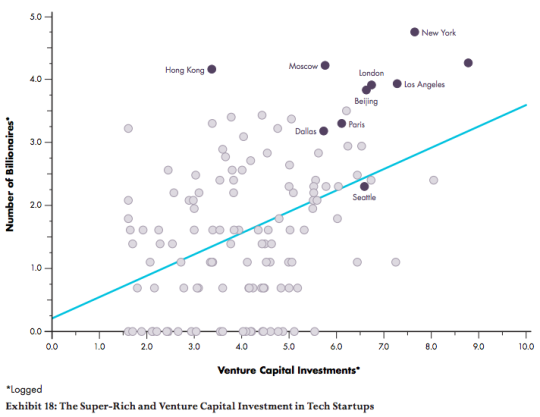
    A correlation analysis was also done to see what key variables – such as population, density, economic output, global city standing, VC investment, and so on – were positively correlated with a greater concentration of super rich people.

    There are 1,826 billionaires across the world according to Forbes. The researchers were able to match 99% of them to a specific metro area / primary residence.

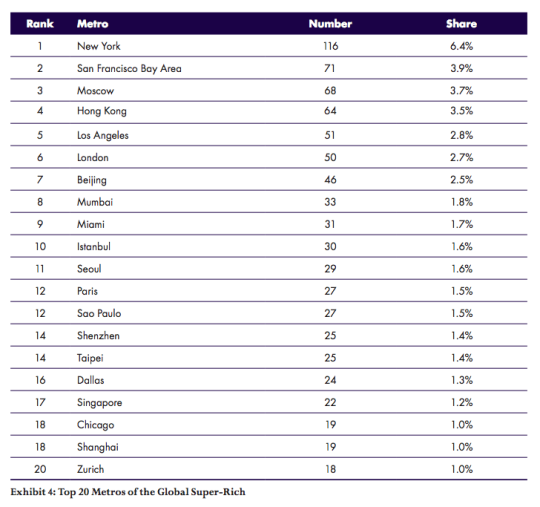
    Here are the top 20 metro areas in terms of the number of billionaires:

    image

    Look at Miami at #9. 

    I suspect that this may surprise some of you. But Miami has grown into a significant global city. As one of my friends from Miami likes to tell me: “The best thing about Miami is that it’s a Latin American city that’s so close to the United States.”

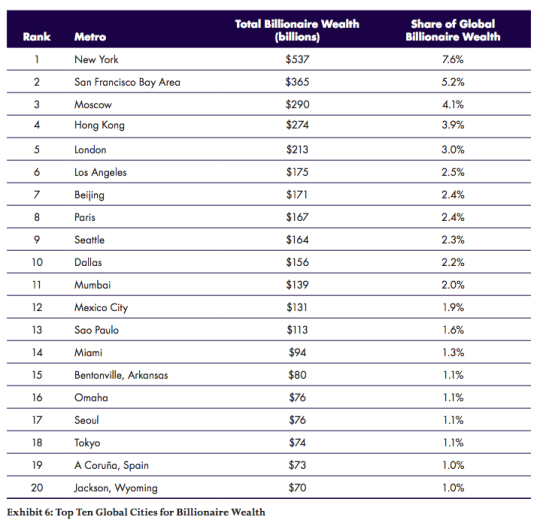
    Here are the top 20 metro areas in terms of total billionaire wealth: 

    image

    A bunch of changes on this list because of extremely wealthly people and families in places like Bentonville (Arkansas) and Omaha.

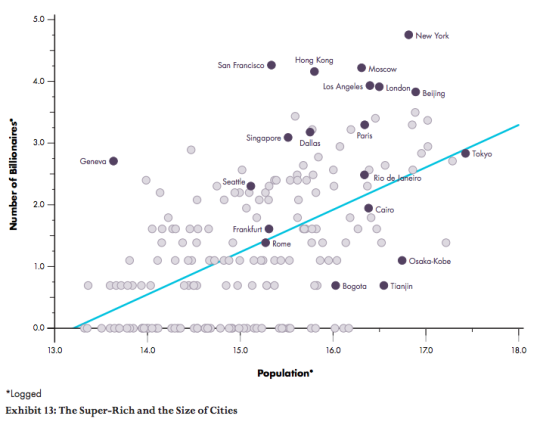
    One of the conclusions of the report is that the size of the city generally matters:

    “The geography of the super-rich is a function of larger cities. Both the number of billionaires and their net worth are positively associated with the population of global cities, with correlations of 0.56 for the number of billionaires and 0.44 to their net worth.”

    Here is a chart comparing population to the number of billionaires:

    image

    Cities such as New York, Moscow, and Hong kong, which sit far above the blue line, have more billionaires than their population size would predict.

    Here is a similar chart comparing venture capital investment to the number of billionaires:

    image

    Once again, there is a positive association.

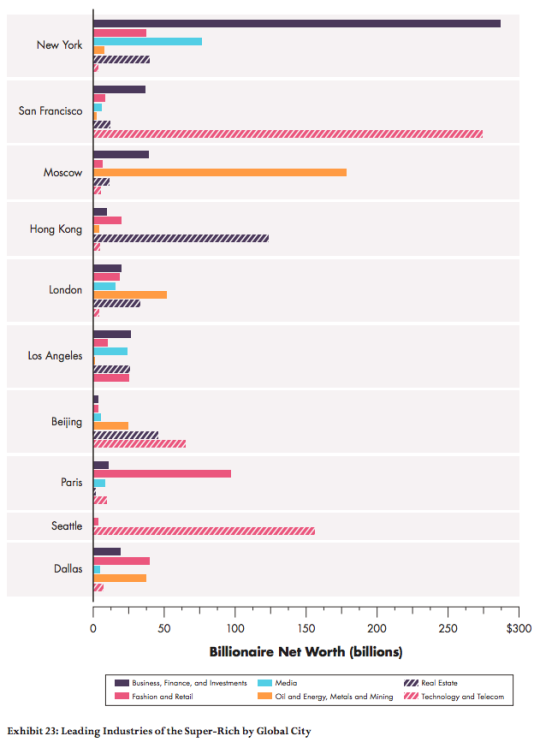
    Finally, here are a two charts that show which industries have produced the most billionaires:

    imageimage

    If you’re interested in this study, you can download the full report here. All of the charts were sourced from the report.