Daily insights for city builders, delivered every morning at 6 AM ET. I’m Brandon Donnelly — a Toronto-based real estate developer and founder of Globizen. I’ve been writing here since 2013.

  • Tools of the trade and productivity hacks

    Like a lot of people, I am always on the lookout for productivity tools and hacks. This is an old post, but I love the idea of getting rid of voicemail (I hate checking it) and of 3×5 cards where you focus yourself on 3-5 important tasks each day.

    So today I thought I would share some of the tools, apps, and hacks that I use on a regular basis. Then if you feel like it, you can share your tools and approaches in the comments so we come up with a good running list.

    I’ll start with software and then move to actions.

    Google Drive: I have my Google Drive mapped to my computer and I store everything on it. That way I can access any file I need from my phone while I’m away from my desk. There’s also Dropbox and Box for moving around large files.

    Evernote: I am trying to go paperless. Right now I photo scan almost all of my documents into Evernote (including business cards). I really should invest in an actual scanner. If you know of a good one for this purpose, let me know. Again, the advantage of this approach is that all of my documents are accessible on mobile.

    Asana: I have used Asana off and on over the years for managing team projects. (We used it for Dirt.) Everyone needs to be committed to it though. And we all know how sticky email is for communication/assigning tasks. But if you can get in the habit of listing and assigning action items during or right after meetings, I think it can be a great way to keep projects moving. 

    Slack: I have a tendency to always want to keep everyone on a team informed about what is going on. That way nobody is left out and people can speak up if they see something concerning. I got in the habit of this when I was at Morguard. That was the way we did things in development and I think it’s a sound approach. Today, we have Slack to help do that.

    Buffer: I use Buffer to schedule and share all of my social posts. Some people swear by Hootsuite, but I love the simplicity of Buffer. It couldn’t be easier to add posts to your queues across multiple platforms.

    Pocket: This is my save-it-and-read-it-later tool. I use Pocket to keep a running list of articles and links I find interesting so that when I sit down every morning to write this blog, I have material to refer to.

    Now let’s switch gears to actions…

    Notifications Off: I have all notifications off on my phone during the day (except for phone calls). The temptation to check my phone when it goes off is too great, so I keep it completely silent. It doesn’t even vibrate. Going even further, I also have notifications off for most non-essential apps.

    Directing Messages: I am trying to keep messages directed to Twitter, text, and email. That means I am generally terrible at responding to messages on Facebook, LinkedIn, and so on. But I’m okay with that. There are simply too many channels to stay on top of.

    Routines: When I first started writing this daily blog, people would ask me why I don’t take the weekends off. But I actually think it would be harder to stay disciplined if I did that. By doing it every day it has become a non-negotiable routine. I try to think of productivity in terms of regular actions.

    Today’s Tasks: I am starting to do this more and more. It’s easy to end up with an overwhelmingly long list of things to do. So it can be incredibly valuable to ask yourself: What are the most important things for me to complete today? Then go and do those things.

    Gym: For me, lifting weights is one of the best ways to stay productive. It’s a natural energy booster and I find that it gives me a mental clarity that I just don’t get from anything else. I am not the same person when I fall behind in my workouts.

    What do you use and do to get shit done?
  • Sharing walls with strangers

    Barry Ritholtz recently published an article in Bloomberg View called: Still a Lot of Negativity on Housing

    He basically says that “many people” should go out and buy a home given the current state of the US housing market and the historically low interest rates. That’s a perfectly fine argument. But it’s not all that interesting.

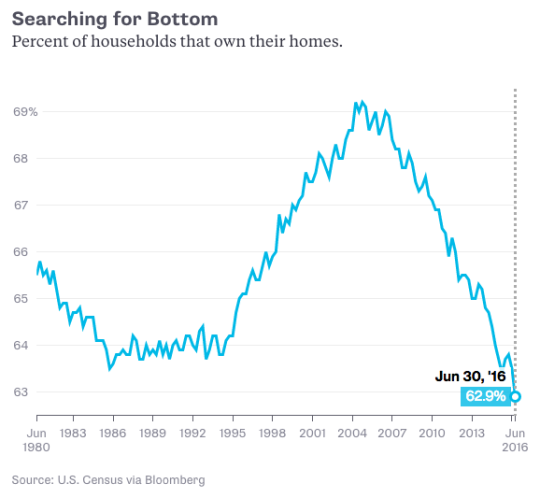
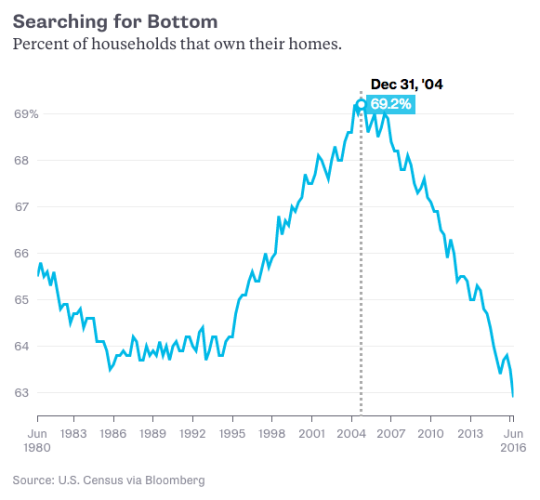
    The article does, however, have a moderately interactive chart showing the percentage of US households that own their homes.

    It shows the pre-2008 peak:

    image

    And it shows, somewhat surprisingly, the recent “search for bottom.” I knew there was a significant post-2008 decline, but I guess I thought it had stabilized. Instead, the US is hitting homeownership rates not seen since the mid-1960s.

    image

    Big cities tend to have a higher percentage of renters. Millennials are flooding into cities. The digital economy now encourages mobility, which contradicts traditional notions of homeownership. There are all kinds of potential hypotheses that could be extracted here.

    But the other interesting thing I noticed in the article, was this:

    However, at some point in life, you probably no longer want to have a landlord telling you what color your walls can be or become tired of having strangers share a wall with you. I am not a zealous believer that everyone should go out and buy a home. However, for many people, buying makes sense – especially with mortgage rates as low as they are (the current rate of about 3.45 percent for a 30-year fixed-rate mortgage is just 0.10 percent higher than the record low).

    I couldn’t help but notice the embedded cultural bias. The inference is that when you rent, you share walls. In other words, you live in some sort of multi-family apartment. 

    But when you finally go out and buy a home, you graduate from that. You no longer need to share walls with strangers. Because an owned home equals a single-family detached dwelling. That’s how you know you’ve made it.

    Well, I have shared walls in my owned home. I guess I’m not there yet. 🙂

  • Job Opportunity: London Night Czar

    The City of London is looking for a “Night Czar” to help shape and grow the city as a 24-hour destination. Here’s a snippet from the job posting:

    “The Night Czar will champion the value of London’s night time culture whilst developing and diversifying London’s night time economy.

    Working with the Mayor, the Night Time Commission, local authorities, businesses, the Metropolitan Police Service, Transport For London and other agencies, the Night Czar will create a vision for London as 24-hour city and a roadmap showing how the vision will be realised. The Night Czar will have proven leadership ability, public profile and convening power, plus a thorough understanding of the night time economy and the ability to work in a political environment.”

    I think 2016 will turn out to be the year of the “night mayor.” This trend is really picking up momentum in Europe, as more and more cities look to capitalize on their night time economies.

    The job will pay £35,000 per year for 2.5 days of work per week. The closing date for the application is Monday, September 12, 2016. If you’d like to apply, you can do that here.

    I’ve been writing about this trend all year. Hopefully a decision maker in Toronto is reading this.

  • The rise of tech outposts

    What happens when wages and real estate prices become too high in a city? Companies start growing in lower cost locations. We’ve all seen this before. 

    Fred Wilson recently blogged about this “spillover effect”, citing a New York Times article talking about the growth of tech offices in Phoenix. As someone who sits on the board of many technology companies, he was noticing a thematic trend:

    “A big theme of board meetings I’ve been in over the past year is the crazy high cost of talent in the big tech centers (SF, NYC, LA, Boston, Seattle) and the need to grow headcount in lower cost locations.”

    We talk a lot about housing prices on this blog, and so I think it’s useful to see how this, along with high wages, also impacts companies. The two are interrelated.

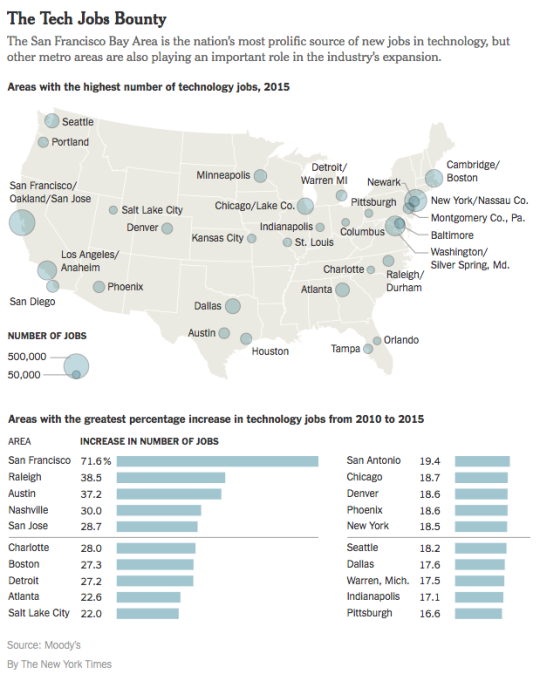
    Below is a chart from the NY Times article showing the US cities with the highest number of technology jobs and the most growth from 2010 to 2015. 

    San Francisco is in a league of its own. But overall, the growth is in tech and many cities are adding lots of technology jobs. Look at Detroit and Boston right beside each other (Detroit obviously has a smaller starting base). And look at how Miami is nowhere to be found.

    Of course, one interesting question is whether these new outposts – such as Phoenix – can truly come into their own and carve out a niche:

    “We don’t want to be San Francisco’s back office — we need more creators here,” said Scott Salkin, a founder and the chief executive of Allbound, which is based in Phoenix, makes sales software and has offices down the hall from Gainsight’s.

    Even with the high cost of living, it’s hard to supplant the coastal hegemony. That’s where people go to chase riches. As comedian Daniel Tosh likes to say, “the middle of the country is for people who gave up on their dreams.”

    Though for some, living in a place like Denver or Salt Lake City and snowboarding every weekend is a better outcome than living in a studio apartment and commuting an hour to work.

  • The institutionalization of development

    Jones Lang LaSalle recently asked: Is there still room for the buccaneer property developer?

    But in the contemporary world of real-estate – corporatized, institutionalized and massively capitalized – is there any longer room for the swashbuckling “merchant developers” or are they doomed to go the way of the wildly-gesticulating floor traders in colourful blazers that once symbolized financial markets?

    “There is always room for the entrepreneur,” says Richard Bloxam, JLL’s head of capital markets, Europe, the Middle East and Africa. “It is, however, fair to say that real estate has been on a journey away from total reliance on the entrepreneurial model.”

    I’ve written about the institutionalization of the business before. And it’s something I’ve been asking developers that I interview for my BARED blog series. Are the days of the eccentric and larger than life developer behind us?

    The consensus appears to be no. 

    All that has changed is the capital source / stack. The skills that make for a successful developer haven’t changed. You still need to be creative and look for opportunities that others don’t see. You still have to navigate through all of the various constraints – of which there is probably more of today. You still need to be entrepreneurial in spirit.

    What I wonder though is if this change hasn’t undemocratized the business to a certain extent. It seems to me that it’s harder, today, to fly by the seat of your pants with just an idea (and no capital). The barriers to entry feel more significant. But as Richard says, “there is always room for the entrepreneur.” And I believe that.

    I would be curious to hear your thoughts. 

    Also, the next BARED post will be up shortly. Stay tuned.

  • Ethnic self-identification

    How do you self-identify in terms of ethnicity?

    I was having a discussion last night with a few friends about ethnic self-identification. In a multicultural city like Toronto where more than half of the population was born elsewhere, it’s an interesting topic.

    For new immigrants, I can understand that there often remains a strong connection to the home country and culture. 

    However, for subsequent generations, the attachment seems to manifest itself and wane (which I think is a natural tendency) in a variety of different ways. I am sure it partially depends on how determined the parents are to preserve the lineage vs. fully assimilate. In any event, it’s a somewhat subjective phenomenon.

    The best data I could find on this is from the 2006 Canadian census (I couldn’t find anything similar from the 2011 census). However, the question on the census was not about ethnic self-identification, per se, but rather how each respondent would classify the ancestry of their parents.

    There were a total of 31,241,030 responses. Some people gave a single response and some people selected multiple ethnic origins, which was allowed.

    In total, 10,066,290 people selected “Canadian.” Roughly 1/3 of the country. However, only 5,748,725 selected it as a single response. So only about 18.4% of respondents identified their parents as being only Canadian. The remaining group of people who selected Canadian also selected some other ethnic origin.

    The reason I pick out this stat is because – to answer my own question at the beginning of this post – I would self-identify as being only Canadian. I feel no emotional attachment to any other country.

    I would never support any other country at the Olympics and I would never fight for any other country.

    In terms of my background, my father wasn’t born here and so I am 1st/2nd generation on that side, depending on how you define 1st generation. However, on my mother’s side, I would be 3rd/4th generation Canadian.

    How do you self-identify? There’s no right or wrong answer here.

  • The self-driving car arms race

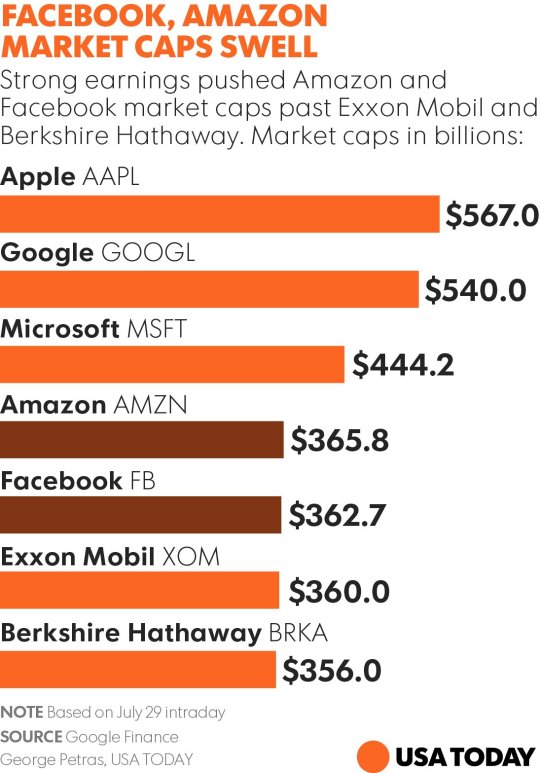
    Earlier this month, I came across the following chart from USA today. 

    image

    It was based on market caps as at July 29 and so the order wouldn’t look quite the same today. Still, here are the largest companies by market cap and the top 5 are US consumer-facing technology firms.

    Remember when it was a big deal that Apple had surpassed Exxon Mobil as the world’s most valuable company?

    We are living in a tech-driven world.

    Then yesterday, I was reading this New York Times article talking about Uber’s acquisition of Otto (a startup focused on self-driving truck technology) and its plans to allow riders in Pittsburgh to summon self-driving vehicles later this month.

    The vehicle will be a tricked out Volvo:

    image

    These two snippets from the NY Times stood out for me:

    Suddenly, it seems, both Silicon Valley and Detroit are doubling down on their bets for autonomous vehicles. And in what could emerge as a self-driving-car arms race, the players are investing in, or partnering with, or buying outright the specialty companies most focused on the requisite hardware, software and artificial intelligence capabilities.

    “There’s an urgency to our mission about being part of the future,” Travis Kalanick, Uber’s chief executive, said on Thursday in an interview. “This is not a side project. This is existential for us.

    The way it will work in Pittsburgh this summer is that the self-driving Volvos will still arrive with a driver, in addition to a sidekick in the passenger seat taking notes about how the vehicle is performing. But the goal is to start weaning us off of human drivers. These pilot rides will be free to start.

    This is quite possibly the start of a general change in terms of the way cities operate (quote from Bloomberg):

    In the long run, Kalanick says, prices will fall so low that the per-mile cost of travel, even for long trips in rural areas, will be cheaper in a driverless Uber than in a private car. “That could be seen as a threat,” says Volvo Cars CEO Hakan Samuelsson. “We see it as an opportunity.”

    Uber is currently logging about 100 million miles per day. Hopefully it is clear at this point that this is not as simple as ride sharing vs. traditional taxis. Cities who are thinking about it in this way are thinking short-term and missing the bigger picture.

    Companies such as Uber, Tesla, and Google are aiming for a fundamental rethink of urban mobility. There is an arms race going on that I believe will completely eradicate the need for human drivers.

  • The Lofts at SoDoSoPa

    Introducing The Lofts at SoDoSoPa and The Residences at The Lofts at SoDoSoPa (South of Downtown South Park).

    The following South Park video is a great parody of every real estate marketing video you’ve ever seen. Real estate marketing can be so terrible.

    [youtube https://www.youtube.com/watch?v=pAPmjcBnxIs?rel=0&w=560&h=315]

    This video is probably old news, but I never watch TV and so it’s the first time I’m seeing it.

    If you can’t see the embedded video, click here.

  • Urban migration, household type, and housing supply

    Here is an interesting discussion paper on the Toronto region’s economy, demographic outlook, and its land use. It was recently published by IBI Group and Hemson Consulting to support the 10-year review of our regional transportation plan.

    I wanted to share a couple of charts from the report that I thought were interesting. If you’re not in the Toronto region, I would be very curious to hear how your city might compare in terms of the way it is trending.

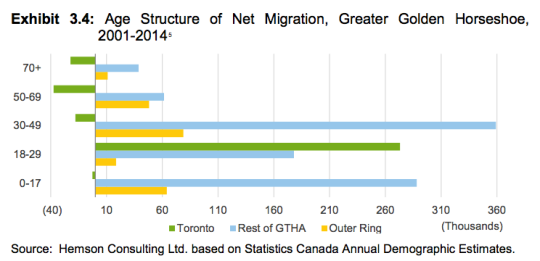
    The first chart is net migration by age group. Like Vancouver – similar chart posted here – people have been moving into the city/Toronto when they’re young and then moving out to the suburbs once they start having families. 

    Will that continue? The oldest Millennials are now hitting their mid-30′s and I am very interested to see if there will be any reversal in this.

    image

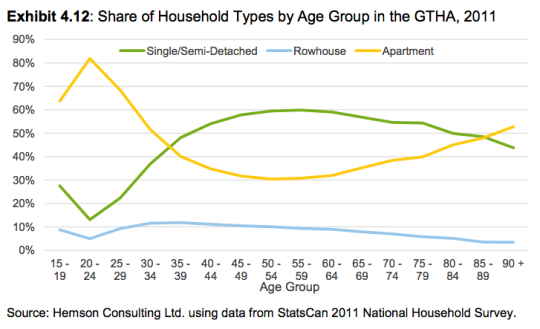
    Given the above trend, people in this region are not surprisingly also swapping apartments for ground-related housing as they get older. The crossover point seems to be (or at least has been) when people hit their mid-30′s. Again, I am curious how this may evolve as the city matures.

    image

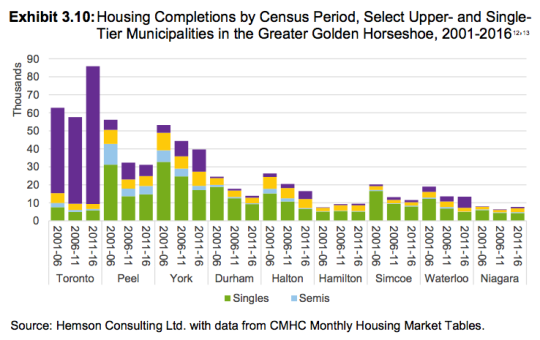
    Because if you look at housing completions from 2001 to 2016 (chart below), the only municipality that was able to meaningfully increase its housing supply was Toronto. 

    Every other municipality – except for Hamilton, which posted modest gains – experienced significant declines in the number of new homes delivered to the market over the last census periods. 

    Of course, the only reason Toronto was able to increase its housing supply was by building up – in other words by building condos and apartments. (Shown in the purple below. For some reason the legend is incomplete in the report.) 

    image

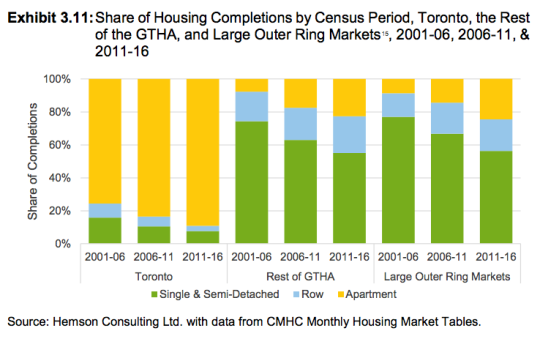
    If you look at the share of housing completions, over 80% of new homes in Toronto are now in apartment form. 

    image

    Intensification is a deliberate policy choice. And we can certainly debate whether it’s a good or bad thing (I believe it’s a good thing). 

    But putting that aside, the above charts are a great answer to the perennial question: “How is it that Toronto is building so many condos?” This is why.

  • Compact and constrained

    I was walking by a tight construction site last night and it got me thinking. Besides the obvious environmental benefits of building up, as opposed to out, compact urban sites can force something else: intent.

    One of the ways I think about good design is that it is intentional. It is about seeing problems and/or opportunities and then being deliberate in how you respond. Every creative decision needs a reason why. I like how John R. Moran talks about design in this blog post from 2014:

    “The opposite of design, then, is the failure to develop and employ intent in making creative decisions. This doesn’t sound hard, but, astonishingly, no other leading tech company makes intentional design choices like Apple. Instead, they all commit at least one of what I term the Three Design Evasions.”

    The three design evasions he goes on to talk about are (1) preserving, (2) copying, and (3) delegating.

    The thing about compact and constrained urban sites is that they can force you away from the three design evasions that Moran lists in his post. You can’t just repeat what was done in the past or copy what someone else has done, because that precedent probably didn’t have the same challenges you face.

    Of course, if this were enough to promote great design, our cities would look a hell of a lot different. Still, it’s one of the reasons why I’m attracted to compact forms of development such as laneway housing and other urban infill.