Daily insights for city builders, delivered every morning at 6 AM ET. I’m Brandon Donnelly — a Toronto-based real estate developer and founder of Globizen. I’ve been writing here since 2013.

  • The politics of flooding

    Do you believe that human action has caused and is causing negative outcomes with respect to the environment?

    The New York Times published a feature piece this week on the flooding of the US east coast. 

    Associated with the article is a fantastic infographic that shows all of the NOAA (National Oceanic and Atmospheric Administration) tide gauges up and down the eastern seaboard. It then zooms in to a few locations and shows mean sea level rise (in inches) since 1950 and the number of days of “nuisance flooding.”

    Here’s a sample screenshot:

    If you don’t feel like reading the full article, at least check out the infographic. The increase in nuisance flooding for some cities – such as Wilmington, N.C. (shown above) and Annapolis, MD – is astounding.

    What’s frustrating about the whole climate change debate is that it remains not only a debate, but an ideological debate. Here’s a quote from the article that stood out for me:

    “I’m a Republican, but I also realize, by any objective analysis, the sea level is rising,” said Jason Buelterman, the mayor of tiny Tybee Island, one of the first Georgia communities to adopt a detailed climate plan.

    In other words: I’m not supposed to think this way, but I do.

    Politics.

  • I can’t spend unrealized gains

    image

    Earlier this week the Wall Street Journal published an article claiming that the celebrated venture capital firm Andreessen Horowitz was lagging behind its elite peers in terms of returns.

    The firm then responded with a well-written blog post explaining why this accusation is off the mark. Their response was simply that you can’t measure returns on “unrealized gains.” Until there is a liquidity event – that is, the company gets sold or goes public – it’s just paper returns. And what matters is cash. 

    As the post clearly states: “I can’t spend unrealized gains.”

    But beyond just a rebuttal, the blog post is a great primer on how the venture capital industry works. We talk a lot about the tech space on this blog, so I thought some of you might find it interesting. 

    One of the reasons I like to follow the VC space is that there are many similarities to real estate development. Not only in the way that the funds are structured, but also in the way that the gestation periods are incredibly long.

    The post talks about this as a “J curve.” In the early years of a fund, the returns are negative. Money is going out the door to invest in immature and risky startups. And it’s not until the harvesting period (7+ years later) that the realized gains start getting paid out to investors (LPs).

    It’s also interesting to note that the exit timing for companies – at least according to Andreessen Horowitz – seems to be increasing (10+ years). This is yet another similarity to real estate development where it seems to be getting harder and harder to build and deliver new supply.

  • Which cities shop small businesses?

    Using anonymized credit and debit card data from over 54 million Chase customers across the US, City Observatory recently published a chart showing the percentage of retail sales that goes to “small businesses” in 15 US cities.

    This is based on proprietary data (2015) from JPMorgan Chase and is surely not perfect. But it’s still an interesting approximation.

    At the top of the list is New York with 36% of all retail sales going to small businesses. And at the bottom of the list – keep in mind that this list only has 15 cities – is Columbus with 23% of retail sales.

    One of the overarching findings was that urban centers tend to see 10-15% more retail sales going to small and medium sized businesses compared to the suburbs.

    Intuitively, this makes sense to me. Space is a precious commodity in urban centers and that may naturally privilege the small operator. There’s also the question of consumer preference among urbanites.

    If you’re interested, you can download the full report from JPMorgan Chase, here.

  • 11 months in Antarctica

    I came across this tweet last night before bed:

    //platform.twitter.com/widgets.js

    I am late to the party on this one, but Dr. Christine Corbett Moran has been living in the Amundsen-Scott South Pole Station since January 2016. She is “wintering” with the South Pole Telescope and studying Cosmic Microwave Background radiation with the University of Chicago.

    I don’t profess to be a student of CMB, but I am so intrigued by her settlement situation. She is living in a place where there is effectively one long day and one long night. There’s sun for 6 months and then no sun for 6 months. 

    I’m not sure how I would feel living in such a remote place with no sun for half of the year. I’m thinking about it now and it’s making me a bit anxious. I’m not sure if the remoteness would make me feel liberated or trapped.

    Thankfully, Christine has a newsletter where she shares her experience in the South Pole. I signed up for it last night and I’m looking forward to seeing what she publishes. If you’d also like to give it a go, you can sign up here.

  • Staying foolish

    I am still a young guy, but already I find people of my vintage starting to hate on some of the things that even younger people are into.

    I hear people say that they’re not into Snapchat because it’s for teenagers. What’s the point?

    I hear people say that they don’t get why anyone would want to rent an urban shoebox. It’s so small. Do you have to hang from the ceiling like a bat when you sleep?

    I hear people say that they don’t get how that new app will ever make money and turn into a business. It’s just a toy.

    It’s so easy to fall into this mentality, where you think that you’re right and everyone else is wrong. But it can be toxic.

    Because what is crazy and fringe today could very well become mainstream tomorrow. And the earlier you can recognize that shift, the easier it is to stay ahead of the curve in business and in life.

    I’m not suggesting that we all try and predict the future. Instead I am suggesting that we all try and remain as open as we can so we recognize the shifts earlier.

    I think there can be a natural tendency to close up over time – unless you deliberately fight it. We start to believe that there’s a certain way that things should be done. We get busy and don’t want to reinvent the wheel. I find myself falling into that trap sometimes and then I try and fight it. This must be why Steve Jobs told us to “stay foolish.”

    In an information and attention economy where the best new ideas win, it pays to keep an open mind.

    (This post was written on my phone which is why it’s void of links.)

  • 3 years of daily blogging

    image

    This past Sunday was the 3rd anniversary of this blog. That is 3 years of me writing something here every day (I think I’ve only missed 2 days in the past 3 years). So I have now written almost 1,100 blog posts.

    Admittedly, they weren’t all masterpieces. But that doesn’t really matter. To do good work, I think you have to be prolific and show up every day.

    The big change this year was that I “unbranded” this blog and started writing just under my personal name, as opposed to Architect This City. I got some initial pushback when I did that, but I continue to believe it was the right decision for what I am trying to achieve here.

    I recently had someone ask me if there was any change in traffic after the switch. And the answer is no. If anything, traffic increased. 

    Over the last year, this blog received about 225,000 page views. Of course, this doesn’t include the 14,000 or so people who read via email subscription and Tumblr, and never actually land on this site.

    But honestly, I don’t care about the numbers anymore. I used to. But not anymore. I blog because it:

    – Forces me to stay current on the topics that matter to me

    – Allows me to clarify my thoughts in a way that thinking alone can’t do

    – Holds me publicly accountable for the things I say and the stances I take

    – Connects me with people I would never otherwise meet

    – Exposes me to new business opportunities

    – Gives me a distribution channel for discussion and sharing

    – Allows me to learn from readers who know more than I do

    – Feeds my desire to create things (creating > consuming)

    – Allows me to exert my personal independence (I write what I want here)

    – Promotes greater transparency and, hopefully, better city building

    I could go on, but those are some of the most salient points.

    At the same time, the world of blogging and social media is all about giving first. So I do try to curate content and posts that I think would be valuable to the readership of this blog. If there’s something else you’d like to see on here, I am always open to suggestions.

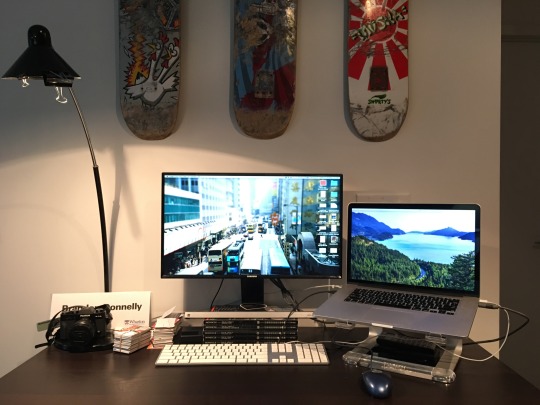
    Thanks for reading! Regular scheduled programming will resume tomorrow. And yes, those are my old skateboard decks hanging on the wall behind my desk.

  • New all-year, multi-valley, ski and snowboard destination approved in British Columbia

    I know it’s only August, but I am already thinking of snowboarding.

    And I just recently learned that the British Columbia government has given the go ahead for a new multi-peak and year-round ski destination near Valemount, BC. The summits will include Mount Pierre Elliot Trudeau, Twilight Glacier, Glacier Ridge, and Mount Arthur Meighen.

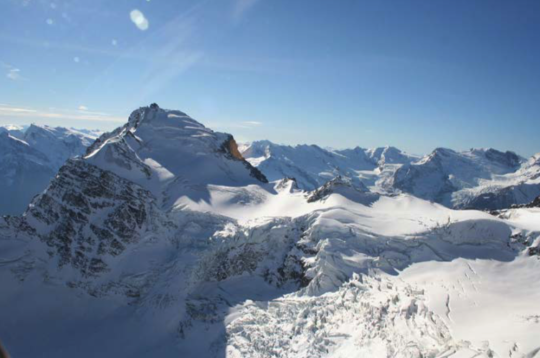
    Here is a photo of Mount Meighen (taken in September) from the project’s master plan.

    image

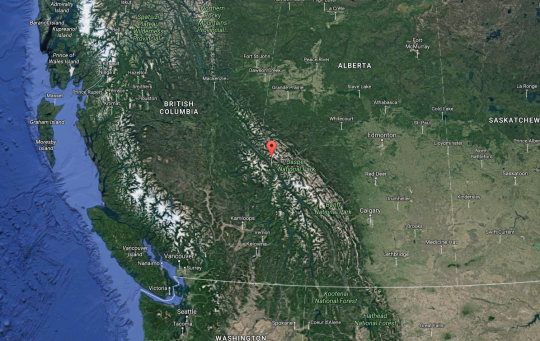
    Here is where Valemount is situated. It’s a 7 hour drive from Vancouver and a 5.5 hour drive from Edmonton.

    image

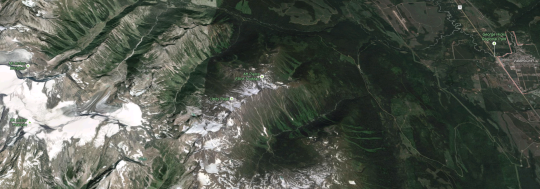
    Here is the mountain range in relation to Valemount. Right hand side of the image. Sorry, I know it’s small.

    image

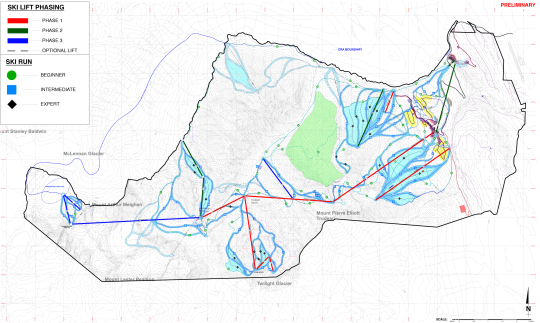
    Here is the master plan that just got approved. Valemount is once again on the right / east.

    image

    And here is why this is a big deal (at least in my world):

    – Valemount has the potential to be “the third largest lift-serviced non-contiguous vertical” in the world at 2,260m (7,415 feet). Zermatt, Switzerland and Chamonix, France are number 1 and 2. Of course, it would still get the title of the largest vertical drop in North America.

    – There are a number of glaciers that would allow for summer / year-long snowboarding.

    – They want to create a multi-valley snowboarding experience, similar to the European Alps.

    – The mountain range has one of the highest average snowfalls in Canada. Valemount gets 5.36m (211 inches) per year and at an elevation of 1,800m it’s 14m (551 inches) of snowfall per year. This is more than Whistler. Because of this, they are not planning any snowmaking.

    – There’s an airport nearby.

    – One of their guiding principles is to minimize the environmental impact.

    Construction is expected to begin in the spring of 2017 and the plan is to open to the public by December 2017. The first phase will include Twilight Glacier at an elevation of 2,530m (8,301 feet). So right from the outset, there will be summer skiing.

    If you’re curious what the master plan for a ski resort looks like, you can download the entire report here. It’s only 324 pages.

  • The Elephant Graph

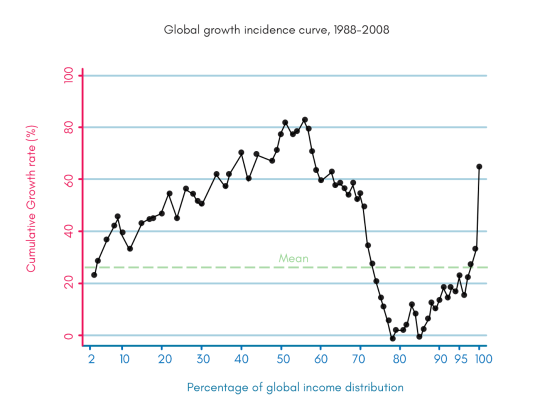
    The following chart was created by Branko Milanovic (Visiting Presidential Professor, Graduate Center, City University of New York and Senior Scholar, Luxumberg Income Centre) and by Christoph Lakner (Economist in the Development Research Group at the World Bank.

    image

    It is known as the “elephant graph” because, well, it kind of looks like an elephant. The trunk is on the right.

    What it shows is global cumulative real income growth from 1988 to 2008 for every percentile around the world.

    The trunk on the right is the world’s 1%. Their income is up.

    The 50-60th percentile range is also up. These are people in the developing world who started making a bit of money as a result of industrialization. In percentage terms things look good, but in absolute terms they’re not making a lot of money. Still, they are becoming better off.

    Where things fall apart is in the 75-90th percentile range. These are essentially the lowest income folks in the developed world. Their incomes haven’t been growing at the same rate and, in some cases, their incomes decreased in real terms. They are falling behind.

    Kaila Colbin wrote a Medium post about this graph and asks whether the exponential growth in technology that we are seeing today, will end up creating more jobs than it eliminates – as it did before in the past. 

    She also wonders whether the dip we are seeing in the 75-90th percentile range could spread left as automation eliminates jobs for those folks in the developing world.

    These are important questions.

  • Preserving place

    I was recently asked: How do you go into a neighborhood, build new, and not erase and/or sterilize what makes that neighborhood interesting in the first place? 

    Gentrification is a controversial topic in city building. Too often I think we ignore what happens when we don’t invest in communities, but that doesn’t mean we shouldn’t be deliberate when we do make investments.

    Development is filled with tensions. We are constantly trying to navigate through constraints and balance out the wants of each and every stakeholder. It becomes an art. It doesn’t always work out as planned.

    To state the obvious, I would say that it starts with caring. If you’re not interested in community and city building, then the default response will be to simply replicate what worked on the last project.

    But every place has a local culture. And if city builders are to have any hope of preserving and building upon what makes that place unique, we have to first understand it. What made it successful in the first place? What is its DNA?

    Because then you’re in a position to think about both built form and programming in a way that is culturally sensitive.

    One example that comes to mind is the proposed redevelopment of Honest Ed’s / Mirvish Village here in Toronto. 

    The “micro tower” design is intended to create the sense that the area was built up organically over time. And the fine grain retail (50-60 individual retail spaces) is intended to house local retailers, micro retail startups, and pop-up shops. To me, both of these elements speak to the history and fabric of the area.

    Adopting a unique approach can also sometimes mean rethinking how you measure ROI. If all you care about is who will pay you the highest rent – right now – then you’re going to make a decision based on that metric.

    Maximizing revenue is not a bad thing. That’s what businesses are supposed to do. But sometimes there is or should be a larger vision at play. And sometimes you need to take a longer view.

    In Toronto’s Distillery District, the developers made the decision to eschew large chains and franchises (in favor of more local retailers) so that they could create a very particular place. Ultimately that particular place became a great place to sell condos, but they suffered early on for it.

    I like how Gary Vaynerchuk put it when he asked: What is the ROI of your mother? Sometimes you may not be able to measure it, but that doesn’t mean the ROI isn’t there.

    Any other suggestions?

  • Returning to photography

    I used to be more into photography. In architecture school, I had an old Canon Rebel and a photoblog where I posted one photo every day. Clearly I have a thing for daily routines.

    But that was the pre-social media era and before mobile phones had cameras. With the rise of those two things I eventually moved over to just taking photos on my phone and posting them to my Instagram. Today we are all photographers.

    However this week I decided that I want to start taking that creative outlet a bit more seriously again. So I asked my talented photography buddy (founder of DSCBRD) if he could recommend a reasonably priced camera for my purposes. 

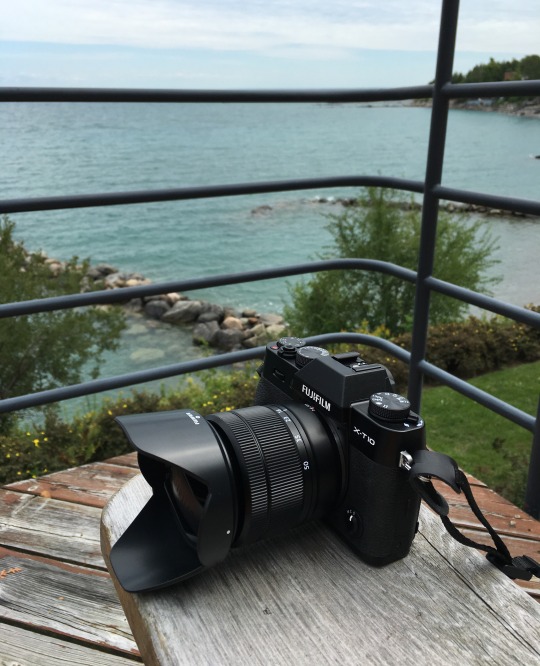
    I then sifted through all of the reviews – because that’s what I do – and decided on the mirrorless Fuji X-T10. I love the retro design. It’s also compact enough that it’s easy to carry around. The best camera is the one you have on you.

    image

    So I’m spending this afternoon at a cottage playing around with it. It’s a fun place to experiment. I hope you’re all having a great weekend. Talk to you tomorrow.