Daily insights for city builders, delivered every morning at 6 AM ET. I’m Brandon Donnelly — a Toronto-based real estate developer and founder of Globizen. I’ve been writing here since 2013.

  • Abu Dhabi signs cheapest electricity contract, ever

    The Abu Dhabi Water and Electricity Authority recently completed a 350 MW solar tender. They received a total of 6 bids and the low bidder was Japan’s Marubeni Corp and China’s JinkoSolar Holding Co Ltd. Their bid was USD $24.2 per MWh or 2.42 cents per KWh.

    This is really low.

    According to the U.S. Energy Information Administration, the average cost of a new natural gas-fired plant is 5.6 cents per KWh. More than double the above solar bid.

    In fact, author, blogger and futurist Ramez Naam calls the above bid, “the cheapest contract for electricity ever signed, anywhere on planet earth, using any technology.” (Blog post here.) 

    Huge.

    Now, Abu Dhabi is obviously a very sunny locale. No shortage of bluebird days there. But that doesn’t negate the fact that we are seeing a rapid decline in solar power prices.

    This, along with the growing adoption of electric vehicles is excellent news for us sustainability dorks. Just this morning I was thinking to myself that the car I currently own will likely be the last gasoline-powered car I ever own.

    Hopefully they start making an electric version of the G-Class.

  • Sign me up for Spectacles

    image

    Snapchat just changed their company name to Snap Inc. and announced a new product called Spectacles. They are sunglasses with an integrated video camera that captures a 115 degree field of view. Compared to the camera on your phone, this is more similar to what our eyes see.

    Here’s their announcement video:

    [youtube https://www.youtube.com/watch?v=XqkOFLBSJR8?rel=0&w=560&h=315]

    Some of you are probably thinking that Google already tried something like this and failed. But that doesn’t mean that Snap won’t be successful. I think Spectacles will be a huge success. 

    Evan Spiegel is calling them a fun toy right now, but lots of meaningful products start out that way (including Snapchat itself). Regardless, it strikes me as absolutely the right move for a company like Snap.

    What differentiates Snapchat is that, relative to other social platforms, the content that gets shared is far more natural and unfiltered. It empowers a different kind of conversation and a different kind of content creation.

    Still, there is something about pulling out your phone that takes you out of the moment. And Snapchat is all about sharing that moment. That’s where Spectacles come on. They are further minimizing the barriers to sharing.

    But here’s the other thing: Snap made them look cool. Google Glass looked positively dorky. I already want to take a pair of Spectacles snowboarding and on tours around different cities. I can think of so many interesting/entertaining use cases. If I were GoPro, I’d be anxious right now.

    Snap, if you’d like to send me a pair to test out, please shoot me an email. Thanks 🙂

  • The Toronto startup ecosystem in numbers

    When I met with all of the lovely folks from Amsterdam last week, one of the things that I mentioned about intensification is that it is almost certainly a contributing factor towards innovation, agglomeration economies, and the overall startup ecosystem here Toronto. 

    I don’t know to what extent, but I feel it happening. And there’s lots of research correlating urban density with innovation

    The continued densification of Toronto means it is constantly becoming easier to schedule that morning coffee before going into the office or to pop into that meetup after work. And those sorts of things are hugely valuable in today’s economy.

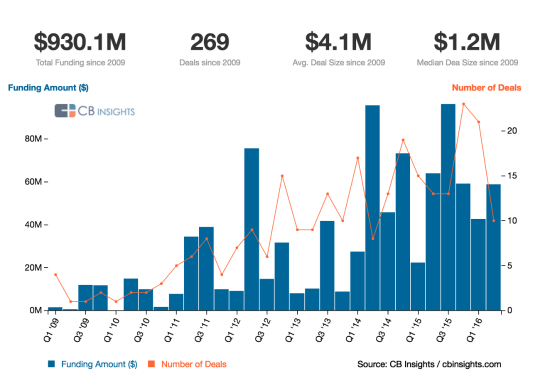
    I talked about a number of local startups in my presentation, including 500px, Wattpad and Wealthsimple. But I didn’t show any hard data. So I’d like to do that today. Below is a chart showing total venture funding (internet/software) and the number of deals (Seed to A/B/C/D) in Toronto since 2009:

    image

    It was taken from this Medium post. Supposedly this places us 12th in the world as far as startup cities go.

    Again, who knows how much of this venture growth has been helped along by intensification. After all: “Silicon Valley proper is soul-crushing suburban sprawl.” But I would bet money that it’s moving the needle in the right direction.

    Here is another relevant post by venture capitalist Albert Wenger where he talks about the great startup ecosystem that Toronto is growing. He posted it earlier today.

    All of this is important because some of these deals will spawn big companies. And those companies will the hire lots of people, as well as consume space. 

    Real estate developers like to talk about how they create jobs. And we do. But we can’t have a city of people just building buildings. People and businesses need to fill that space and that hinges on entrepreneurs who are willing to go out there and forge something new for themselves. Fortunately, Toronto seems to have a growing number of those kinds of people.

  • Last lake swim of the year

    I’m in Muskoka right now, with very little time to write. 

    I had about an hour before dinner, but I decided that a far more responsible thing to do would be to jump in the lake for what will likely be the last lake swim of the year. It might be the end of September, but it still feels like summer.

    Here’s what that looked like:

    If you’re searching for something more city related, check out these high resolution maps of Canada according to our trails, roads, streets, and highways. My good friend Peter just sent them over to me. Thanks Peter.

    Regular scheduled programming will resume tomorrow.

  • Mapping the creative soul of US cities

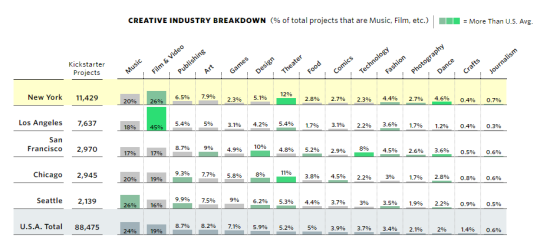
    Polygraph (visually-driven essays) has a great piece called, The Entire History of Kickstarter Projects, Broken Down by City. What they did was look at 88,475 Kickstarter projects to map the various creative communities across the US.

    Here’s a snapshot (you may need to zoom in):

    image

    In general, Kickstarter in the US sees a high concentration of music projects (24%) and film & video projects (19%). But where it gets interesting is to see which cities over-represent in certain categories.

    New York = film & video, theater, and dance

    Los Angeles = film & video (not surprisingly 45% of all projects)

    San Francisco = design and tech

    Chicago = theater

    Detroit = music

    Nashville = music (76% of all projects!)

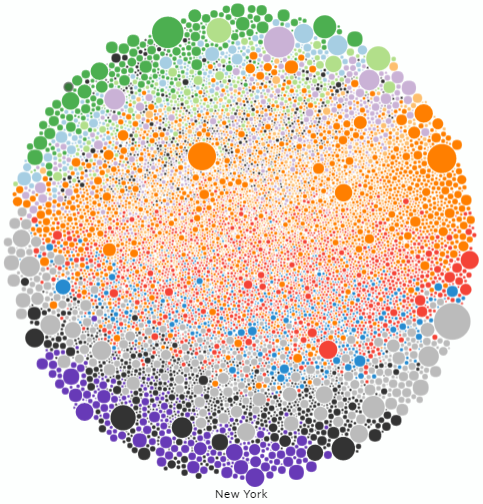
    They also measured the size of each project (number of backers) and created these neat bubble diagrams:

    image

    Above is New York. Red is music. Orange is film. And yellow is theater.

    I also like their explanation for why they did this project:

    Pretty much all existing attempts to map creative communities use census and jobs data. But creative efforts are often side-hustles. They’re garage/basement/cottage industries that will not appear in a census.

    It’s true. This data should be a much better capture of each city’s creative soul.

  • Building crap

    Last night I participated in an excellent dinner discussion with a group of planners, architects, city officials, and politicians from Amsterdam. They were visiting Toronto to see first hand what rapid intensification has done to this city. And I very much appreciated the invite. Thank you.

    My message was that intensification has created a far more vibrant and exciting city compared to 15 or so years ago. It’s hard to know what exactly could be correlated with intensification, but we have certainly seen an explosion of culture, innovation, and pride in this city – among many other things. (It could be all Drake’s doing.)

    However, the counter argument at the dinner table was that Toronto is letting unfettered development produce unremarkable architecture. We are simply building glass tower after glass tower. And I know that, for many of you, this will ring true. I hear it all the time, including in the comments of this blog.

    Now, I will be the first to admit that there has been a lot of shit built in this city. No argument there. Some people have no taste. But at the same time, I think it’s myopic to assume that it’s strictly because of profit-motivated developers. 

    Oftentimes the perception is that development projects are awash in cash. There’s tons of money in which to do the right thing. Developers just need to stop being so greedy and start being more creative.

    The reality is that developers operate within a market. There are real limits to what people will pay for new space. And when, for instance, land prices go through the roof (an input), municipal fees jump (cost of doing business), and approvals drag (time value of money), guess where everyone starts looking for savings? In the build.

    I say this not to justify building crap. If I had it my way, everything would be beautiful. I champion design whenever possible. I say it simply to shed light on the process. Because when we all understand the factors at a play, I believe we all become more effective at finding solutions.

  • Planning for the unplanned

    I was listening to The Urbanist (Monocle Radio) last night while I was making dinner and there was a segment on Moscow’s “illegal retail kiosks.” These are small scale retail structures that were built without formal planning permissions and so the city decided to demolish them. 

    There was lots of backlash. Photos here.

    Now, I’ve never been to Moscow. So I can’t really comment on the attractiveness and usefulness of these kiosks. But I suspect that these illegal retail kiosks, many of which seem to have been located around metro stations, contributed quite a bit to the city’s urban vibrancy. Retail is hard to get right. It doesn’t work everywhere.

    All of this got me thinking about our tendency to sterilize and overplan cities. I’m not saying that planning is bad. It’s not. But I do think we should acknowledge that we don’t know everything about the future and that human ingenuity will undoubtedly unlock new things we never thought would be beneficial.

    So how do we plan for the unplanned? Perhaps it starts with accepting the off-center. Here’s a quote from Anthony Bourdain (it’s all over the internet, but I can’t seem to find the original blog source):

    I think that troubled cities often tragically misinterpret what’s coolest about themselves. They scramble for cure-alls, something that will ‘attract business,’ always one convention center, one pedestrian mall or restaurant district away from revival. They miss their biggest, best, and probably most marketable asset: their unique and slightly off-center character. Few people go to New Orleans because it’s a ‘normal’ city — or a ‘perfect’ or ‘safe’ one. They go because it’s crazy, borderline dysfunctional, permissive, shabby, alcoholic, and bat shit crazy — and because it looks like nowhere else. Cleveland is one of my favorite cities. I don’t arrive there with a smile on my face every time because of the Cleveland Philharmonic.

    There’s value at the margins.

  • Building the future

    Toronto-based heritage architect Michael McClelland recently published a piece in Spacing called: Misuse of Heritage Conservation Districts can deaden both past and future

    Here are a couple of snippets:

    The City of Toronto believes it has found a silver bullet to control development pressure in the downtown core through the use of a tool known as a “heritage conservation district” (HCD).

    The problem is that HCDs are meant to conserve intact and bone fide heritage areas, such as Wychwood Park, Rosedale, or Cabbagetown. They were never intended to control development downtown.

    In preparing for a HCD designation, consultants trained in history examine an area’s context and determine what is of value historically. They do not generally study the growth potential of an area, its future, nor any economic considerations, nor the larger planning policy framework, or even an evaluation of the built form generated by other market forces. HCDs look at heritage.

    The rigidity of the proposed new urban design controls introduced by the HCDs effectively prohibits innovative and thoughtful architecture in the downtown core.

    My own view is that it should be a balance between preservation and progress. We should respect our past, but at the same time look towards the future. Don’t fear change. Michael argues that HCDs achieve neither of those things. It’s worth a read.

    Speaking of the future, the CityAge conference is returning to Toronto on October 6 and 7. Their mission statement is about “building the future.” I was on one of their panels last year and it was an overall great event.

    If you’d like to attend, use the code “CITYAGE” to save $100. And if you’re a young professional (under 35) and/or a startup, email Marc Andrew to get an even sweeter deal. Tell him you’re a reader of this blog.

    Image: Photo by me taken at People’s Eatery on Spadina Avenue

  • The universities that produce the most funded founders

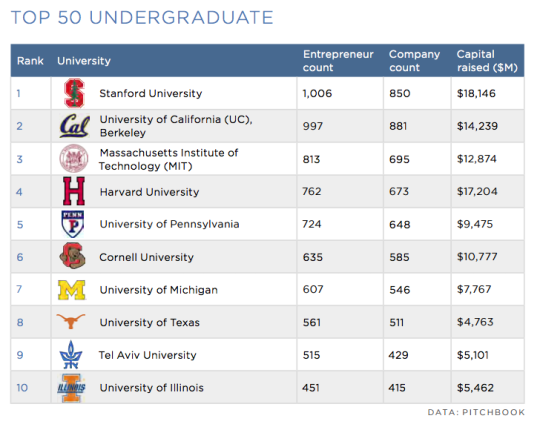
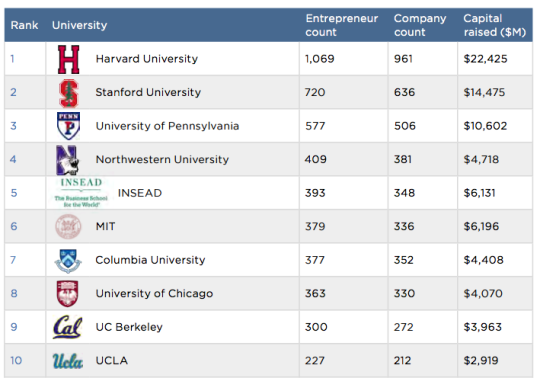
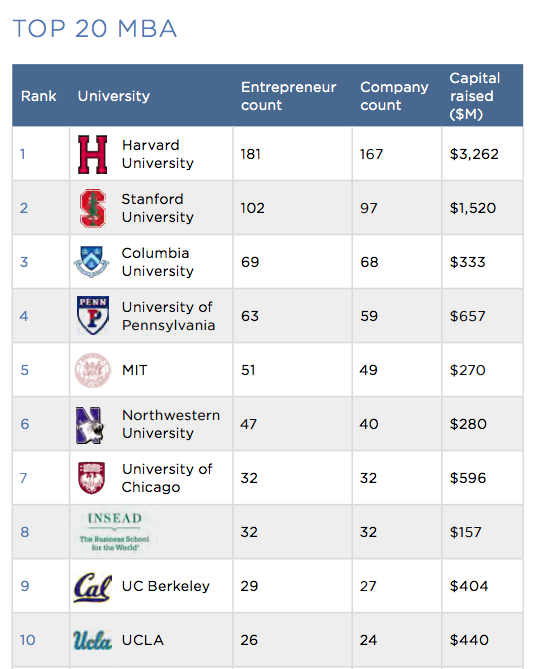
    PitchBook recently published a report looking at which universities produce the most funded founders.

    What they did was track founders of companies that received a first round of venture funding between January 1, 2006 and August 15, 2016. They then looked at which school they graduated from and sliced the data to find companies valued over $1B (”unicorns”), big exits, Ivy vs. non-Ivy league alumni, and so on.

    The full report can be downloaded here for free. However, you’ll need to enter your email. Below are some of the key highlights.

    Top 10 MBA:

    Top 10 MBA by female founders:

    For all of you Canadian readers, the top undergraduate schools include:

    • University of Waterloo (#20)
    • McGill University (#32)
    • University of Toronto (#33)
    • University of British Columbia (#49)

    McGill does quite well in the unicorn department, placing in the top 10. However, it is clear that Canadian universities need to step up their game.

    Of course, the question remains: what is it that is holding us back? How much of it is the school itself and how much of it is external and perhaps cultural?

  • Forest

    I just backed the following project on Kickstarter:

    https://www.kickstarter.com/projects/991195979/n-o-r-t-h-simple-timeless-and-refined-watches/widget/card.html?v=2

    It is a new watch line from two Montreal designers. The brand is called Forest Time Co. There’s so much creative talent in that city.

    I was immediately drawn to the focus on minimalism and on high quality materials. That’s a philosophy I can get behind. I plan to go for the black band with copper case.

    I know nothing about watch movements, but it’s a “Japanese Miyota.” I assume that’s pretty basic.

    I love finding interesting projects on Kickstarter. There’s something about backing a team and their new creation. We should all aspire to make and create more.

    At the time of writing this post, they’re about $1,000 shy of their funding goal of $24,000. I hope they reach it by this Sunday. I’m sure they will.