Daily insights for city builders, delivered every morning at 6 AM ET. I’m Brandon Donnelly — a Toronto-based real estate developer and founder of Globizen. I’ve been writing here since 2013.

  • New Squarespace HQ

    I am a big fan of the company Squarespace. They have a great and beautiful product. I use them for globizen.com.

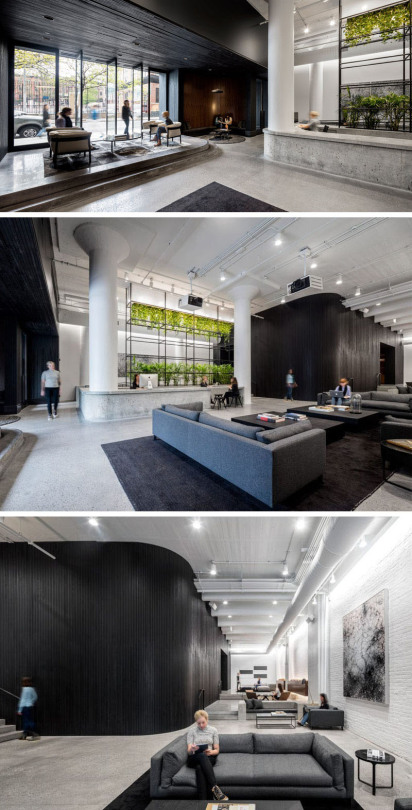
    Recently they moved into a new office in Lower Manhattan (98,000 sf), which was a consolidation of 4 distributed offices. The interiors were designed by New York-based A+I.

    Not surprisingly, it’s a beautiful space:
    image

    (Photography by Magda Biernat via Contemporist)

    But two other things stood out for me. 

    One: The amount of informal working/meeting spaces. I really had to look for the conventional office seating.

    Two: The ground floor presence and the lobby which doubles as a possible event space.

    For consumer-facing companies, I am really attracted to having a street presence and having spaces that can be programmed. It’s a way to engage and plug in to what’s happening beyond the office. Here’s a related example.

    I’m not sure if their narrative is the same as mine, but regardless: cool space.

  • Sonder — intimate neighborhoods, consistent quality

    Airbnb has been a game changer. I know many people who have made Airbnb their full-time career or who “stay for free” when they travel because they Airbnb their home. Airbnb likes to focus on the “community” rather than on the business possibilities, but regardless, it unlocked space in a new way.

    Here’s another take on decentralized vacation rentals: Montreal-based Sonder. Similar to Airbnb, you submit your property to their platform. But unlike Airbnb, they take care of everything from reservations and guest communication to operations and housekeeping. It’s a completely hands-off approach for owners.

    The value proposition to guests is that they get a more consistent experience, but with all the “local color” of a traditional vacation rental. And for owners, they get to maximize revenue without having to be as hands-on as with an Airbnb. (Presumably Sonder’s take is greater.) In many ways, it’s like a decentralized hotel chain. Same supply source as Airbnb, but they are now unifying the customer experience.

    It’s fascinating to watch this software/internet layer developing on top of real estate. It’s giving me all sorts of ideas.

  • Vancouver-Seattle

    The New York Times has an interesting article up talking about how Vancouver and Seattle are trying to more closely align themselves and create a unified tech corridor. 

    BC premier Christy Clark and Washington governor Jay Inslee recently signed an agreement to that effect, which included more research collaboration between the University of British Columbia and the University of Washington.

    Seattle wants this because its companies need talent (read: foreign workers) and Vancouver’s borders are more open. Vancouver wants this because its tech industry is relatively small (go Hootsuite!) and it could benefit greatly from being more proximal to Seattle.

    On a side note, Seattle is an interesting case study. In terms of venture capital dollars invested, it is below top tier cities such as San Francisco, New York, Boston, and so on. But in terms of the companies it has birthed (Microsoft, Amazon, Zillow, Expedia…) it is certainly a heavy hitter.

    One of the key factors will be physical connectivity. There’s talk of high speed rail and/or a dedicated lane for autonomous vehicles. However it’s done, I think bringing this trip to < 1 hour would be the ideal scenario. There’s a psychological barrier beyond that.

    If any of you live/work in either of these cities today, I would be curious to hear your thoughts.

  • Flynn in the city

    I very much enjoy the branding and marketing side of the development business. It’s probably an architect / designer thing. So I’m always looking out for interesting case studies.

    Recently I came across The Flynn in Chelsea, New York. The developer is IGI and the agency is Winkreative.

    What they did was create a namesake character named Flynn. Everything then became about a day in the life of. 

    The Instagram account is flynninthecity. They made colorful animations. And they even partnered with the Spring Street Social Society to host in-person performance art pieces. The Being Flynn series was a bunch of vignettes that combined “dance and physical comedy” and highlighted a cast of fictional characters who all, of course, reside at The Flynn.

    As you all know, selling condos is typically about selling a lifestyle. A dream. In this case, they created a character to show you exactly what that dream should be.

    Real estate marketing can sometimes often be cheesy. But I thought this was a clever and overall creative approach. Winkreative does great work.

    What do you think of the approach?

    Image: Winkreative

  • Tools for promoting healthy, responsive, affordable, high-opportunity housing markets

    This month the White House released a Housing Development Toolkit. The report starts by talking about the local barriers to building and makes this statement:

    “The growing severity of undersupplied housing markets is jeopardizing housing affordability for working families, increasing income inequality by reducing less-skilled workers’ access to high-wage labor markets, and stifling GDP growth by driving labor migration away from the most productive regions.”

    It then goes on to highlight a number of tools that American cities have adopted or should adopt “to promote healthy responsive, affordable, high-opportunity housing markets.” 

    They are:

    • Establishing by-right development
    • Taxing vacant land or donate it to non-profit developers
    • Streamlining or shortening permitting processes and timelines
    • Eliminate off-street parking requirements
    • Allowing accessory dwelling units
    • Establishing density bonuses
    • Enacting high-density and multifamily zoning
    • Employing inclusionary zoning
    • Establishing development tax or value capture incentives
    • Using property tax abatements

    None of this will be news to regulars of this blog. We have spoken about almost every single tool in the above list. 

    I’m not necessarily sold on all of them (good discussion to have), but I have gone on ad nauseam about eliminating parking minimums (off-street parking); the value of accessory dwelling units (commonly called laneway housing here in Toronto); and the negative impacts of barriers to building.

    The good news is that there’s growing alignment around a similar set of actions. Change takes time. There’s usually a heavy bias towards the status quo.

  • 365 project

    I love the idea behind a “365 project.” Two examples here and here. I learned about it from Bijan Sabet.

    The idea is simple. It’s a personal photography project where you post a single photo each day of the year with a short blog-style caption. In the above examples, it’s typically a description of what’s going on in their lives.

    Obviously there’s a major element of discipline to this project, but I also really like that the photos become a celebration of the mundane. The ordinary. The everyday.

    One photo I saw had the caption: “Today wasn’t a very good day.”

    Social media has evolved to become a high curated representation of our lives. We use it in an aspirational way to tell a story about who we hope to become or who we want people to believe we already are.

    I am not exempt. 

    But it’s refreshing to think about “an honest account of your life.” Unless you happen to have a life that consists entirely of Vegas trips and yacht parties, a daily photo means that it won’t always be epic and it will sometimes feel like a chore.

    I frankly don’t have the time for another daily commitment beyond this blog, but I would love to do a 365 photography project. Perhaps some of you have the time and the interest.

  • The 2×2 investment matrix

    Today I am thinking about product/market fit.

    Product/market fit is startup speak for being in a good market and having a product that satisfies the needs of that market. This may sound intuitive, but having the best product doesn’t matter if there’s no market for it. I like this line from Marc Andreesen: “Markets that don’t exist don’t care how smart you are.”

    So the first takeaway is to create products that people care about. Sounds simple enough. But another reason why this is a thing worth talking about is that markets evolve and there’s always a chance that you can unlock a new market that nobody else is servicing. That’s obviously riskier, but it’s an ideal scenario.

    Below is another way of thinking about that. It’s a quote from Andy Rachleff.

    “Investment can be explained with a 2×2 matrix. On one axis you can be right or wrong. And on the other axis you can be consensus or non-consensus. Now obviously if you’re wrong you don’t make money. What most people don’t realize is if you’re right and consensus you don’t make money. The returns get arbitraged away. The only way as an investor and as an entrepreneur to make outsized returns is by being right and non-consensus.”

    It’s a lot scarier to be charting new territory and sitting in the non-consensus camp. Consensus is comforting. But this is how the game works. I try and remind myself of this on a regular basis. I would like to say more, but I will leave it at that for today’s post.

  • The lure of super-places

    image

    If you’re a very talented person, you have two choices: you either move to New York or you move to Silicon Valley. This is the message that Peter Thiel delivered to a conference being held in Chicago earlier this month. Not surprisingly, it pissed a few people off.

    Peter responded by saying that he was simply illustrating the “extreme version” of a metaphor about the impacts of globalization and technology. And while it certainly doesn’t sound very nice if you’re sitting in Chicago, or the countless other fantastic cities between the coasts, I can appreciate what Peter is getting at.

    Saskia Sassen is known for coining the term global city. These are cities which play an important role in the functioning of the global economy. But what has happened, she acknowledges, is an even further concentration of activity within a select few “super-places.”

    Here is an excerpt from a Financial Times article by Simon Kuper (2014) talking about Amsterdam’s position in the world:

    “…a new, higher category of cities may now be emerging: global capitals. Amsterdam has risen but New York, London and Hong Kong have risen faster. The Dutch elite is moving to Amsterdam; but many ambitious Dutch people no longer want to join the Dutch elite. They want to join the global elite. That often requires moving to a global capital.”

    Anecdotally, I can say that almost everyone I know who has left Toronto for an opportunity has moved to New York, Silicon Valley, London, and so on. They have moved up the rank of global cities/capitals.

    So while Peter may not have chosen the right way to deliver this message, I do believe it is a message worth delivering.

  • Who needs work?

    Earlier this month, The Atlantic published an article called: The Free-Time Paradox in America. The gist of the article was that the wealthy are increasingly starved for time, whereas the exact opposite is happening to the poor.

    The article throws out this stat: “In 2015, 22 percent of lower-skilled men [those without a college degree] aged 21 to 30 had not worked at all during the prior twelve months.”

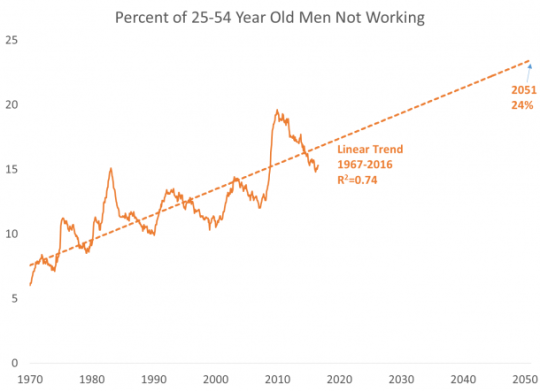
    More recently, Larry Summers published the following graph on his blog, along with the prediction that by the middle of the 21st century over a third of men between 25 and 54 will no longer be working in America.

    He cites technology and declining marriage rates as two possible explanations. Supposedly unmarried men are more likely to be out of work.

    If you’re interested in this topic, Nicholas Eberstadt has a new book called Men Without Work. The focus is on a new class of men who are neither (1) employed nor (2) unemployed and looking for work. Instead they voluntarily electing not to participate in the US labor force. Similar to Ed Glaeser, part of his argument is that the incentives not to work (welfare) are simply too great.

    This drop in labor force participation is largely concentrated among those without a college education. The problem seems to be that we are no longer creating enough good paying jobs for the less well educated. So the way I see it is that we have two options: we figure out how to do that (again) or we focus ourselves on education and training.

    Richard Florida has written a lot about elevating service and retail jobs to fill this gap. But I have never understand how that works. I think it comes down to figuring out how to better elevate people.

  • The Edge — The World’s Greenest Building

    When I was in grad school, I used to search around online and make lists of real estate developers that I felt were philosophically aligned with my own view of the world. I didn’t want to work for just any developer, I wanted one that cared about design, technology, sustainability, and so on.

    One of the developers on my list was OVG Real Estate in Amsterdam. They describe themselves as “the largest real estate technology company in The Netherlands” and they have recently completed The Edge, which is being called the greenest office building in the world. It received a 98.36% sustainability score from BREEAM-NL.

    The building uses 70% less electricity than the “typical office building” and uses solar panels on its rooftop, as well as on some neighboring university buildings, to produce more energy than it consumes. The building is also a great example of the Internet of Things. Anchor tenant Deloitte created its own mobile app so that employees can control lighting, climate, and so on.

    The building also has an on-site gym. I’m a big fan of mid-day workouts.

    There’s a lot going on with this building, so here’s a video from Bloomberg describing how it functions (click here if you can’t see it below):

    [youtube https://www.youtube.com/watch?v=JSzko-K7dzo?rel=0&w=560&h=315]

    Photos of the building here.