Daily insights for city builders, delivered every morning at 6 AM ET. I’m Brandon Donnelly — a Toronto-based real estate developer and founder of Globizen. I’ve been writing here since 2013.

  • Where do you shop?

    Matthew Townsend of Bloomberg recently published an interesting article talking about the dominance of Amazon.com (and online shopping in general); the shift towards experiences over stuff; and the languishing brick-and-mortar brands that keep saying it’s the macroeconomy, rather their product/approach, which is causing sales to slump.

    Here are a 3 excerpts that stood out for me:

    Lurking behind the cliché is a hard truth these executives are eager to avoid. “All this pleading that the consumer isn’t spending is an excuse, largely from management teams whose product is less relevant,” Kernan said. “The consumer is actually driving the U.S. economy, so it’s a little ridiculous when we hear the excuse of the macro environment is not good.”

    Another hurdle that isn’t going away is the shift to increased spending on experiences such as travel and classes, which make for much better posts on Instagram, Facebook, and Snapchat. “Social media has really fostered a have-done environment, which is not what retailers sell,” Perkins said.

    One characteristic of these struggling brick-and-mortar chains has been direct competition with Amazon. If they don’t go head-to-head with the online giant, they rely heavily on people visiting shopping centers anchored by retailers that do, such as ailing department-store chains Macy’s and Sears. One measure of store visits in the U.S. paints a dire picture, with only a dozen positive weeks over the past two years.

    According to Bloomberg, 55% of online product searches start at Amazon.com. And while online sales in 2016 have only accounted for 11% of all (U.S.) retail revenue, it has represented 54% of all growth! That’s a big number, especially when you think about what that will mean over time.

    Talking about the growth and threat of online shopping has become a boring truism. I know that. But are retail executives taking it seriously? The Bloomberg article gives you the sense that many are not – or at least they’re not publicly acknowledging it.

    When I look around my place right now and think about where I bought each item – everything from the shoes at my door to the protein powder in my cupboard – it’s pretty amazing to think about how much I now buy online. And I’m sure that many of you are the same.

    Groceries aside, I’m probably 85-90% online. What about you?
  • Airbnb’s 5 point plan

    New York State Governor Andrew Cuomo recently signed a bill that will levy heavy fines (up to $7,500) on Airbnb hosts who do not abide by local housing regulations.

    Hours after, Airbnb filed a federal lawsuit claiming “irreparable harm.”

    However, they also proposed a 5 point plan that they hope will make home-sharing work in New York City and then serve as a framework for new legislation.

    Here are Airbnb’s 5 points (summarized by me):

    1. One host, one home: Just like it sounds, this would limit people to renting a single home within the five boroughs.
    2. Require registration: State would require short-term rental hosts to register. Airbnb would be authorized to register people on behalf of the state.
    3. Make home-sharing work for all: Landlords would be able to set specific rules for short-term rentals in their buildings and then secure a portion of the revenue for maintenance and so on. (I would imagine that the same could be done by condo corporations.)
    4. Good neighbor rules: Platforms would be required to have dedicated 24/7 hotlines should any neighbor complaints arise as a result of home-sharing.
    5. Taxes to support affordable housing: Airbnb would collect and remit additional taxes on behalf of hosts, which could then be used for things such as affordable housing.

    It’s interesting to think about Airbnb’s evolution. It started out as air mattress rentals on the floor and nobody thought it would ever work as a business. Now it’s a huge business and governments everywhere are trying to figure out an appropriate response. Hopefully a suitable middle ground will be found.

    How do you feel about Airbnb’s proposed 5 point plan? With this framework, would you be comfortable with Airbnb in your building? I know that many of you are also hosts (some of you do it for a living), so I would be curious to hear your thoughts.

  • Has there been a “great inversion?”

    Urbanist Richard Florida has spoken a lot about a “great inversion.” This is about poverty moving to the suburbs and the core of cities becoming a kind of “gated suburb.” (i.e. wealthy)

    In response to this narrative, City Observatory recently published a post where they call this a new mythology. Joe Cortright argues that it is simply an exaggeration that sounds good in media headlines. And indeed, if you look at some accounts of poverty, the swings haven’t been that dramatic.

    However, if you dig into this study by Luke Juday at the University of Virginia (cited in the City Observatory article), there have been some interesting changes. 

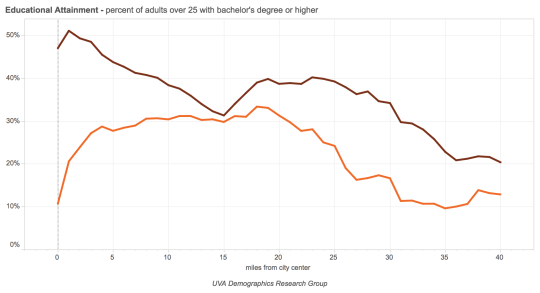
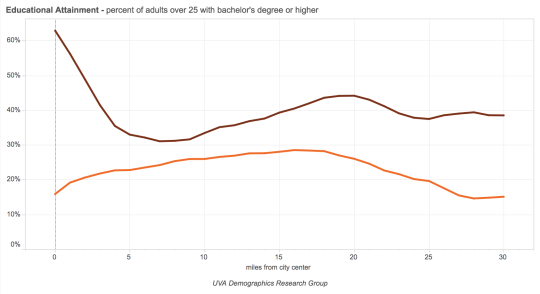
    Below is a chart that shows the percentage of adults (over 25) with a bachelor’s degree (or higher) sorted by distance from the city center. This particular chart is a composite of 7 northeastern (US) cities. The brown line is 2012 and the orange line is 1990.

    As you can see, there has been a huge spike in educated people living in city centers – at least in the northeast.

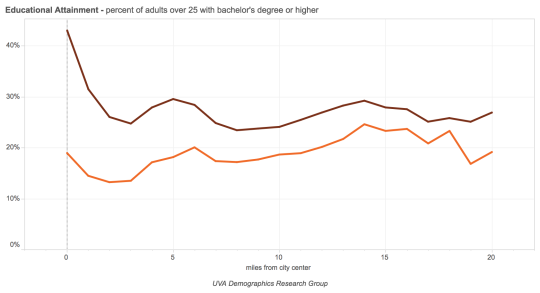
    Here is that same chart for Atlanta:

    New York:

    In the case of New York, it looks like the entire city just became more educated.

    Miami:

    Educational attainment is often the single biggest determinant of income. So there is something to be said about highly educated people concentrating themselves in city centers. We may not want to call it an inversion of great proportions, but it’s a meaningful shift.

  • The Shinola Hotel, Detroit

    Hotels play such an interesting role within cities. They are public-facing in a way that many other uses are not and they invite a mixing of different people – everyone from transients to locals. It is therefore no surprise that they can serve a variety of different roles. They can be cultural hubs. But they can also be places in which to misbehave.

    When the Drake Hotel opened up on the west side of downtown Toronto in 2004, I remember it feeling far out. It was on the edge of that which was interesting at the time. But it quickly anchored West Queen West with its cultural and nightlife offerings. And today, we could be about to see the exact same story repeat itself in the east end with the new Broadview Hotel.

    It’s for these reasons that I was both excited and curious to learn that Bedrock (real estate company) and Shinola are in the midst of launching a new boutique hotel concept in Detroit. It is called The Shinola Hotel. It will be located at 1400 Woodward Avenue. And it will be all about the city of Detroit. They expect it to open sometime in the fall of 2018.

    What I am about to say may be an availability bias talking, but there seems to be a push by many companies into the hotel space. In 2015, Equinox Fitness announced that it would be opening its first hotel in 2018 at Hudson Yards in New York. And just last month furniture retailer West Elm announced that it would be opening a first set of hotels in both Savannah and Detroit. (Go Detroit!)

    West Elm sells furniture. Equinox operates gyms. And Shinola makes and sells watches, bikes, and leather goods. But all of them are now in the hotel space. What other new hotel brands have I missed?

    Image: Shinola

  • Low-rise vs. high-rise

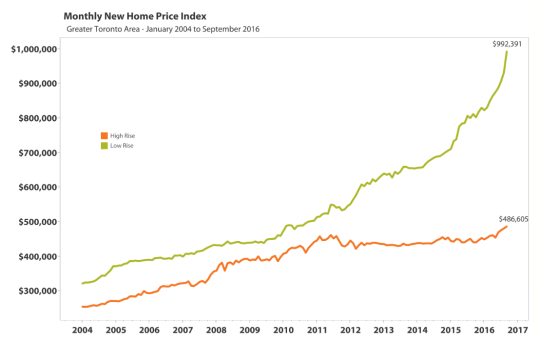
    Yesterday I sent out this tweet, which included this graph:

    The chart is from Altus Group and it is a monthly price index of new low-rise vs. high-rise housing in the Greater Toronto Area (GTA). I have posted similar charts in the past, but every time this chart gets updated the spread widens and the market looks even crazier.

    Some people responded on Twitter by saying that this is clearly an indication of a bubble. I don’t know if that is the case. 

    But, as I have said many times before, I do believe that it tells a vivid story around supply. Low-rise housing is severely supply constrained in the GTA and high-rise housing is less so. That has helped to stabilize pricing in the latter case.

    Now, you could look at this chart and say that the pace of low-rise price increases is simply unsustainable. The market must correct. 

    But you could also look at it and say that the market is going through a fundamental shift whereby more and more families will start living up, as opposed to out – which should then translate into high-rise pricing trending upwards as unit sizes increase. This is where I think we are headed. 

    What do you reckon is happening?

  • Full self-driving hardware

    Tesla has just announced “full self-driving hardware” on all of its cars, including the upcoming Model 3, in anticipation of a big software update to be released sometime around December 2016 (hopefully). 

    This will enable fully autonomous driving “in almost all circumstances” – they mention rain, fog, and dust, but no snow – at a level of safety that Tesla believes is already 2x better than the average human driver.

    This is being accomplished through a souped up onboard computer and by increasing the number of surround cameras from 4 to 8. Here’s a diagram (via Tesla) of how those cameras work and how they will capture a 360 degree view:

    image

    A couple of immediate thoughts / takeaways:

    The Smart Summon feature is obviously very cool. Summon on your smartphone and your car will come find you. Elon Musk has said that it will eventually find you even if you happen to be on the other side of the country. 

    But this assumes that there are solid metal snake chargers (or something else) to automatically charge your vehicle somewhere on route. It also suggests that the vehicles won’t be equipped to cross international borders by themselves.

    Elon Musk has said that (unfortunately) retrofitting older Tesla vehicles to full self-driving hardware will be very difficult and costly – the cost delta is greater than buying a new car. This reinforces my belief that leasing, rather than owning, is probably a wise strategy right now given how much change is happening in the auto space.

    Lastly, here’s some fine print from the Tesla Auto Pilot website:

    “Please note also that using a self-driving Tesla for car sharing and ride hailing for friends and family is fine, but doing so for revenue purposes will only be permissible on the Tesla Network, details of which will be released next year.”

    Uber vs. Tesla. Round 1. Fight.

    If you’d like to see a full self-driving Tesla in action, check out the video on their website.

  • Big, bold, and global

    I love the way that urban planner Joe Berridge thinks about Toronto and city building. He is constantly considering our position on the global stage and urging us to fight for a top position by executing on real and meaningful projects. 

    Here is a recent article from the Toronto Star which lists some of those projects. They include everything from a new convention center to creating a fourth university (in addition to the University of Toronto, York, and Ryerson).

    Here’s a snippet:

    We could get “lost in domesticity — very nice, but that’s not enough,” he says, drawing on his experience leading urban renewal projects around the world.

    Toronto’s social cohesion is enough to attract 125,000 new people each year to the region. But they won’t stay if we can’t employ them and provide opportunities. And that requires global thinking.

    Berridge says it is the city’s “moral obligation” to use its taxing power, its wealth, its status as Canada’s only global city and the historical advantages of public education, public health and public services to propel Toronto into super city status.

    Cities will often talk in nebulous terms about being “world class.” That isn’t all that helpful. Let’s be specific and also acknowledge that great things cost money. Are we a top tourist destination? Are we a top convention destination? Are we attracting the smartest people in the world with the best schools? Do we have the best transit and health care systems in the world?

    Toronto is a great city and so it’s perhaps easy to become complacent. But past performance is not an indicator of future outcomes. We need to think in global terms. We need to keep in mind that this is an international competition. And every day all of us step onto that field.

    Thank you Joe for constantly reminding us of that.

  • The tech ecosystem in Toronto (and New York)

    Tech Toronto recently published a new study called, How Technology Is Changing Toronto Employment

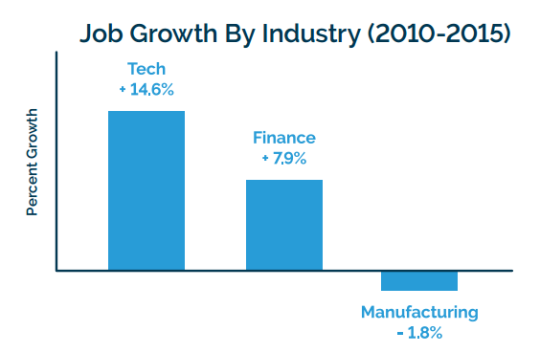
    They estimate that there are over 400,000 tech jobs in Toronto, out of a total of 2.7 million people employed. That number includes tech people working for non-tech companies, and tech and non-tech people working for tech companies. So tech jobs are thought to represent about 15% of the city’s employment.

    Within this 400,000 or so jobs, an estimated 93,000 people are self-employed (23% of tech jobs). And the belief is that there are around 2,500 to 4,100 active “startups.”

    Zooming out, it is also one of the fastest growing industries in the city:

    image

    To try and put this into perspective, a similar report for New York – published in 2014 – reported 291,000 tech jobs out of 4.27 million people employed. I was a bit surprised by these numbers, but the Toronto report seems to have been modeled after the New York one. So presumably they use similar methodologies.

    Of course, there’s the big question of quality over quantity. There’s a certainly a difference, in terms of impact to the economy, between a back office tech job and fast growing startup that will eventually reach the coveted $1 billion valuation number and create thousands of new jobs.

    Obviously every city is hoping for the latter.

  • 6 things about cities from Richard Florida

    Last week Richard Florida headlined an “Urban Lab” panel at the NYU Schack Institute of Real Estate. It was moderated by Sam Chandan, who is dean of the Shack Institute. 

    Here are 6 takeaways from the discussion, with a few of my own thoughts attached:

    1. Suburban brain drain. This is happening. Florida states that (real estate) development is the key to rebuilding the suburbs. It will challenging to reorient the suburbs away from the car (though suburbs vary greatly), but I do agree that many suburban areas need a refresh to keep them relevant against this brain drain.

    2. Decline in home ownership. Florida believes we will see owning vs. renting drop to about 50-50. This would be a pretty big change given that US homeownership is currently hovering in the low 60s and this is already at historic lows. However, the trend is towards urban and that often means more renting.

    3. New city characteristics. Access to urban amenities, cultural capital, and transportation is critical and should drive new development. Transit and rail infrastructure can “open up” new areas and combat issue #4, below.

    4. Housing affordability. Florida reiterates “the great inversion.” Poverty moving to the suburbs; cities now housing the rich. He also isn’t sure that capitalism alone will solve this problem. Gives example of Manhattan where market is focused on high-end luxury residential.

    5. Florida argues that planning and real estate knowledge need to come together to overcome some of the information-asymmetries inherent in the development industry. I’ve written about similar ideas before. I try and apply this sort of multi-disciplinary thinking to urban issues.

    6. Micro-living is not a silver bullet for “chronic poverty.” I think it serves a segment of the housing market.

  • PHLEGM video

    This past summer I wrote about the 8 storey mural (by street artist PHLEGM) that was about to go up on the side of a Slate building at the corner of Yonge + St. Clair in midtown Toronto.

    Well, that mural is now complete. It’s been in the news a bunch over the past couple of months, both locally and internationally. designboom (they’re allergic to capital letters) wrote about it last month.

    In case you missed all that press and/or you’d like to learn more about the process, here is a video that the STEPS Initiative published last week. It’s 5 minutes. If you can’t see the video below, click here.

    [vimeo 185861345 w=640 h=360]

    The STEPS philosophy of creating public art in unlikely urban spaces is a hugely interesting one. It’s really the antithesis of the white-walled art gallery.