Daily insights for city builders, delivered every morning at 6 AM ET. I’m Brandon Donnelly — a Toronto-based real estate developer and founder of Globizen. I’ve been writing here since 2013.

  • GLUE

    I am all booked for my annual retreat to the mountains, which means I now have snowboarding on the brain. This year we are headed back to Whistler (/Powder Mountain) so that we can all check heli boarding (and heli skiing) off the bucket list. That’s one goal – among a few others – that I plan to accomplish in 2017.

    If you don’t snowboard (or ski), this probably means nothing to you. It can be hard to explain the feeling. Thankfully, Christian Haller (Swiss snowboarder), Kris Lüdi, and Stephan Maurer have just released a short film that may very well be the closest approximation to the real thing. It’s called GLUE.

    The whole point of the movie is to portray, in an authentic and visual way, what it’s like to snowboard. To do that, a lot of the footage was shot using a “follow cam.” There are also a lot of close-up shots. I just love the perspectives when it kicks in at 1:50.

    If you can’t see the video below, click here. And if snow and snowboarding aren’t your thing, check back tomorrow for regular scheduled programming.

    [vimeo 190544188 w=640 h=360]

    GLUE from Christian Haller on Vimeo.

  • re:Public + NXT City Night

    On Friday, November 25th, NXT City will be hosting a one-day symposium here in Toronto (re:Public) that brings together some of the top people, projects, and ideas in the world of public spaces. Following that will be an after party (called NXT City Night) that runs from 8pm to very late. 🙂

    Here are some of the organizations that will be represented at the symposium: City of Toronto, Uber, CivicAction, Monocle, Arup, STEPS Initiative, Breather, The Laneway Project, Oxford Properties, as well as many others. It will be a great event.

    For the full speaker list, the agenda, and to buy tickets, click here. There’s an under 35 / student offering for both the symposium during the day and the after party at night. If you attend during the day though, you automatically get a pass to the after-party. I hope to see you there.

    Here’s a time lapse video from NXT City Night (edition 2015). If you can’t see it below, click here.

    [youtube https://www.youtube.com/watch?v=_i6R687sdk0?rel=0&w=560&h=315]

  • Are you T-shaped?

    image

    The world-renowned design firm IDEO is known for hiring people described as being “t-shaped.” Here’s a quote from an interview with CEO Tim Brown explaining what that means:

    “T-shaped people have two kinds of characteristics, hence the use of the letter “T” to describe them. The vertical stroke of the “T” is a depth of skill that allows them to contribute to the creative process. That can be from any number of different fields: an industrial designer, an architect, a social scientist, a business specialist or a mechanical engineer. The horizontal stroke of the “T” is the disposition for collaboration across disciplines. It is composed of two things. First, empathy. It’s important because it allows people to imagine the problem from another perspective – to stand in somebody else’s shoes. Second, they tend to get very enthusiastic about other people’s disciplines, to the point that they may actually start to practice them. T-shaped people have both depth and breadth in their skills.”

    For an interdisciplinary design firm like IDEO, I’m sure you can see why the above would be important. But I also think it’s hugely important for those of us who work in the arena of the built environment.

    City building projects don’t get accomplished by individuals, alone, or “I-shaped people” who don’t play well with others. They get accomplished by people with breadth in their skills and by large cohesive teams with vastly different core competencies. The notion of the individual genius is overplayed.

    New buildings, for instance, typically involve a coming together of the project team (hugely diverse in and of itself), the city, the community, and other stakeholders. You can try and bully your way through that process or you can try and navigate through with empathy.

    Based on the tremendous success of firms like IDEO, one could certainly argue that creativity and innovation seem to thrive more on empathy.

  • The spatio-temporal hierarchy of urban form

    I was recently introduced to the work of Brenda Case Scheer – specifically a journal article she wrote called The Anatomy of Sprawl. If you’re the kind of person who enjoys geeking out about cities, this is for you. (Thank you Oliver.)

    What she does in the article is break down the various components / layers of a city according to the rate in which they change. Her “spatio-temporal urban hierarchy” includes: site (slowest rate of change), superstructure, infill, buildings, and objects (fastest rate of change).

    The way to think about this is that the bottom layers of a city – the paths and roads we have chosen to establish – are incredibly persistent. They don’t change all that often.

    On the other hand, buildings do change. Old ones get demolished. New ones get built. There’s a cycle. They too probably feel pretty persistent in many cases, but in comparison to our roads, they change far more frequently.

    The reason why all of this has bearing is because the paths we choose to carve out at the very beginning will ultimately dictate the kind of city that gets built and rebuilt over time.

    The rectangular grid of Manhattan was planned out in 1811. Central Park was missing from this original plan, but it did establish the street network and ownership lots that are now so central to the identity of New York City. That was a 200+ year decision.

    It seems to have worked out just fine for New York. But what if you’re in a position where the existing street network is viewed as failing and/or inappropriate for the future success of the city? 

    Well that’s where things get interesting. Now you need to dig down to some of those base layers and work on changing the (frequently) unchangeable. 

  • One Spadina Crescent

    One of the most exciting projects under construction right now in Toronto is 1 Spadina Crescent – the new home of the John H. Daniels Faculty of Architecture, Landscape, & Design at the University of Toronto. (This must be one of the longest faculty names in existence.)

    I am excited to see the existing 19th century structure come back to life by way of a new addition; especially given its ceremonial position within the city. And I am excited – as an alumnus – to see the faculty growing.

    On Monday, an event was held at the building to honor the donors and offer a sneak peek of the building. I wasn’t able to attend (as much as I wanted to), so I figured the next best thing I could do would be to write a blog post about it. 

    So here’s the official news release and here are some photos from Urban Toronto.

  • Trump

    Many of us are living in a bubble.

    Since Donald Trump won the election less than 24 hours ago, it feels like everything has already been said. It’s been non-stop. My social feeds have been filled with everything from frustration and anger to Canadians offering marriage to the highest bidders. (Obviously tongue-in-cheek?)

    I didn’t think Trump would win the election, but he did. I also didn’t think Brexit would happen, but it did.

    Part of the reason I thought this is because nobody seemed to be supporting Trump. My friend graph was virtually 100% Clinton (and vehemently opposed to Trump). The media I consume – Globe and Mail, New York Times, Twitter feed (interest graph), and so on – was virtually 100% Clinton. And the polls told us that would be the outcome.

    But what I just described is – now quite obviously – a filtered view of the world. I was thinking within my own little bubble and I was wrong. The number of biases at work here are numerous.

    Firstly, it has been well documented that we prefer to associate with people that are most similar to ourselves. It gives us comfort when someone shares the same religious views, sports-team loyalty, education level, socioeconomic status, and so on. And you see this in cities. We cluster in so many different ways.

    Secondly, we often privilege information that reinforces our own view of the world (see confirmation bias). We believe what we want to believe. Here is an excerpt from an op-ed in the New York Times this morning that stood out for me

    (see, I’m again reading the same media):

    “The silence in this great city, a stronghold of Clinton and the Democratic Party, is revealing: The elites of the East and West coasts, betraying a dangerous arrogance, were dismissive and ignorant to the last of the heartland anger feeding Trump’s rise.

    This is the revenge of Middle America, above all of a white working-class America troubled by changing social and cultural mores — not every American loves choose-your-gender bathrooms — and by the shifting demographics that will make minorities the majority by midcentury.”

    Thirdly – but probably not lastly – I wouldn’t be surprised if we saw the social desirability bias play out here. It is possible that many people simply did not want to openly admit that they were supporting Trump. And they perhaps responded that way in the polls. But privately, when it came time to vote, they went with what resonated most.

    I say all this simply to suggest that now is not the time to get angry. Now is the time to open our eyes and pay attention to our rapidly changing world. Globalization and technology are transforming what we know and it is not benefiting everyone equally – far from it. Trump overwhelmingly won the support of white people without college degrees; people who are feeling left behind.

    This divide is real.

  • World’s best city brands

    Resonance Consultancy – they do brands and strategies for places and products – has just released a new report called: World’s Best City Brands – A Global Ranking of Place Equity.

    With all of these sorts of rankings, it really depends on the research methodology being used and the rigor in which it is being applied. In this case, they evaluated each city based on “six pillars of equity”:

    1. Place: Perceived quality of a city’s natural and built environment
    2. Product: A city’s key institutions, attraction and infrastructure
    3. Programming: The arts, culture and entertainment in a city
    4. People: Immigration and diversity of a city
    5. Prosperity: Employment, GDP per capita entertainment in a city and corporate head offices
    6. Promotion: Quantity of articles, references of a city and recommendations online

    What’s perhaps unique about this study is that it combines measurable statistics with “visitor perception metrics” – data that they mined from social media. Here’s an excerpt from the methodology page:

    “Our team became interested in the way visitors and citizens themselves influence the identity and perception of cities. Increasingly, they do it through their evaluation of experiences on social media and via the comments, images and reviews they share with family, friends and people around the world. These opinions and attitudes, much more than traditional marketing, influence the way people perceive places today.”

    This is a fascinating shift for city brands and is something that we have discussed before on this blog. All of us are now involved in telling the story of the places in which we live and visit.

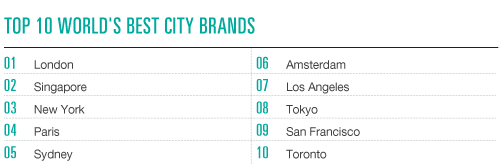
    The entire report is well done and worth a read. It’s also a free download (you’ll need to enter your contact info). But below are the top 10 world’s best city brands. Not really any surprises for me. What about for you?

    image

  • A location intelligence company

    I have written about Foursquare a number of times over the years (here and here) and I continue to be a regular user. I am intrigued by all of the location-based data that they collect through their apps. 

    Below is a recent Recode Decode (podcast) with Dennis Crowley (co-founder) and Jeff Glueck (CEO) of Foursquare. They are talking about what’s next for the company. If you can’t see it below, click here.

    https://art19.com/shows/recode-decode/episodes/aa400a60-ebc1-49bb-96b1-0d7aac7ca9e8/embed?theme=black

    Here’s a content sample from Recode:

    Today, Foursquare makes most of its money from selling that data to big companies, calling itself a “location intelligence company.” But as co-founder Dennis Crowley and CEO Jeff Glueck explained on the latest episode of Recode Decode, hosted by Kara Swisher, they haven’t stopped thinking about everyday users.

    “Imagine a friend is walking alongside you,” Crowley said. “Can we make a personality like that, that talks to you in that sense? It’s not 30 years out. We’re going to be playing with this stuff a year from now.”

    “I want to make that Scarlett Johansson that whispers in your ear, but it’s all about local places and local discovery,” he added. “I want to replicate the experience of walking through the city with a friend that knows the city inside and out, and I want to make that for millions of people.”

    I thought some of you might find this interesting.

  • Place is dead anyway

    Aaron Renn has a few observations up on his blog from a recent trip to San Francisco. Number 2 is as follows:

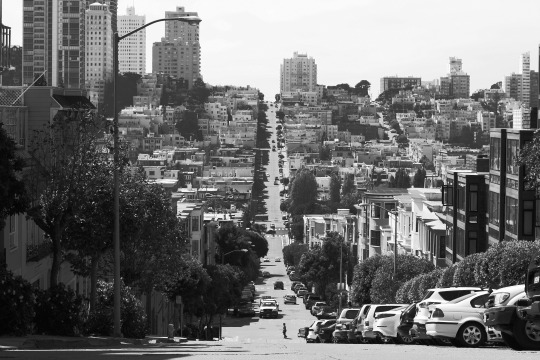
    “A curiously low energy city.  It’s tough to judge any American city’s street energy after living in New York, but San Francisco felt basically dead. Tourist areas around Union Square and the Embarcadero were crowded, and the Mission on a Friday night was hopping, but otherwise the city was very quiet. Haight-Ashbury was nearly deserted and many neighborhoods had the feel of a ghost town. It’s very strange to be walking around a city with such a dense built fabric but so few people.”

    I feel this way every, single, time, I visit San Francisco. I love San Francisco, but outside the main draws, the city feels eerily quiet. I have never understood why that is the case.

    This is something that I am sensitive to because I find it even impacts my own energy levels. For instance, Sundays in Toronto often feel too quiet for me. Fewer pedestrians. Slower drivers. Our collective metabolic rate slows down.

    I love the hustle of a busy city.

  • Crazy home prices

    image

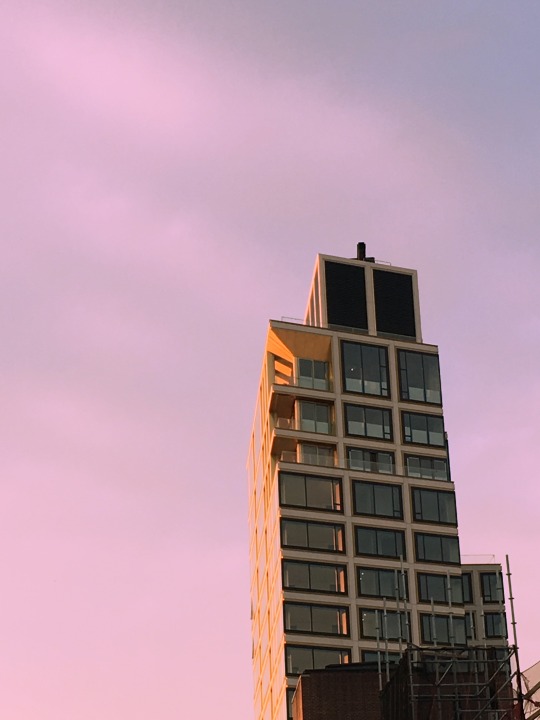
    This afternoon I walked the High Line with a friend of mine who seemed to know everything there is to know about new residential development in Manhattan. 

    She recently purchased a place and so she had done her homework. She was pointing out every building and telling me the price per square foot range; whether the floor plans were well designed (or if they had misproportioned rooms and awkwardly placed columns); and who the architect was. 

    Takeaway: To be competitive in the luxury segment in New York, you really need to have a name brand architect on the project. That seems to be the price of entry.

    As she was telling me about the “competitively priced” building in the low $2,000′s psf and the expensive penthouse that recently sold for $7,000+ psf, I started to wonder about historical pricing in New York. How has it trended? 

    I also told her that you could buy a really great condo in Toronto for $700 psf. She laughed at how affordable that was. It’s all about your point of reference.

    In any case, I found a research report from 2004 called: Why is Manhattan So Expensive? The story is one that you’ve heard before. It’s about the impact of land use restrictions on home prices. But it does also include some historical data on average condo prices.

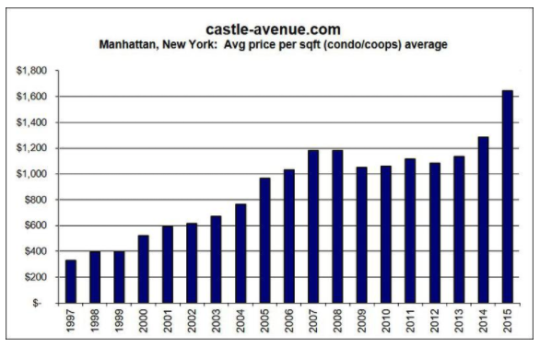
    In 1984, the median price per square for a condo in Manhattan was $359 psf. It peaked in 1987 at $505 psf and then dropped back down to the $300′s in the early 90′s. That was not a great time for real estate. However, by 2002, the median price had rebounded to $606 psf. All USD figures.

    From 2002 onwards, Manhattan saw a dramatic increase in home prices. Below are two charts from Corcoran (Q3 2016 data) and Castle Avenue, respectively:

    imageimage

    Toronto is obviously not New York, but’s interesting to consider that the average price of a downtown Toronto condo, today, is probably in the low $600′s psf. That’s in Canadian dollars and that’s pricing that New York saw decades ago. 

    It reminds me that “crazy pricing” can oftentimes be a psychological reaction to a pricing anchor that we previously set in our minds. It feels crazy. But is it?

    Image: Me