Daily insights for city builders, delivered every morning at 6 AM ET. I’m Brandon Donnelly — a Toronto-based real estate developer and founder of Globizen. I’ve been writing here since 2013.

  • Toronto mayor proposes road tolls, finally

    When I wrote yesterday’s post about road tolls, it hadn’t been announced that Toronto Mayor John Tory was going to call for road tolls on both of the highways coming into downtown. That didn’t leak until late in the evening. So I was just writing another post on a topic that I care about.

    Today, however, that announcement was made and the proposal is a flat $2 toll on both the Gardiner Expressway and the Don Valley Parkway. It is expected that this could bring in close to $200 million a year in new revenue for the city – all of which would be dedicated towards transit and roads. Good.

    First, I want to applaud the mayor for coming out in support of road pricing. I didn’t agree with him on the Gardiner East, but I agree with him on this – mostly. It is a bold move.

    The reason I say mostly is because I hope that we don’t simply default to a fixed and blunt road toll. There are more sophisticated options out there, such as variable pricing models that change based on demand/congestion levels.

    Here’s a post that explains how that works and why I think it’s a good model.

    With this approach, it becomes more of a congestion charge rather than a toll. It also gives commuters the option of driving during off-peak times to save money. And if we implemented something like this, I am sure that we would see employers and office hours adapt. More on this in the above post.

    Still, I absolutely believe that it’s a step in the right direction for this great city. So thank you Mayor Tory.
  • Revisiting road pricing

    Following the Toronto Transit Commission’s approval of a 10-cent fare hike, Cherise Burda of the Ryerson City Building Institute penned an article titled: It’s time for Toronto to consider road tolls.

    I am a big supporter of road pricing and I have written a lot on this topic over the years. There’s even a guest post by Darren Davis on this blog – he is a transport planner with Auckland Transport. 

    I don’t have much to add right now, but I did want to help promote Cherise’s post and I did want to link back to all of my previous posts (including Darren’s). Click here for a list of posts tagged with “road pricing.”

    There’s a mental model in Toronto, and many other cities, that remains centered around subsidized roads and artificially low residential property taxes. Because, well, that’s the dream.

    Nobody wants to pay more for anything – I get it. But I think we can all agree that this region has not solved the traffic/mobility problem. In fact, it’s one of our biggest weaknesses. 

    So what are we going to do about it? I reckon the answer is something other than the status quo.

  • Carriage house disruption

    The Spaces has a post up called: 7 carriage houses on the market in New York City. They’re all quite expensive. The house on East 63rd designed by Paul Rudolph is particularly interesting. But that’s not what I want to talk about.

    As I was going through the photos – that’s what The Spaces does best – I thought of two things.

    First, there’s a segment of the market that is obsessed with living in spaces that were not originally intended to be used as residences. That’s what (hard) lofts are. That’s what carriage houses are. And that’s partially why I would love to live in a laneway house (Toronto vernacular).

    Backhouses, as they are also called, were initially designed to hold horse and carriage. But as horses disappeared from New York City, the structures got repurposed.

    Here’s one theory for how that went about:

    Barry Lewis, an architectural historian, theorizes that rear buildings became residences to accommodate the 19th-century immigrant population that moved into middle-class areas in Lower Manhattan in the 1830’s and into the Village and Brooklyn after the Civil War. “Backhouses seem to belong to the era of houses in Manhattan, not the era of apartments,” Mr. Lewis said. “The property owner probably shoved more immigrant families into the stable or workshed in the back. Other owners may have built a new backhouse just to get the lucrative immigrant rents.

    The second thing I thought about is the potential parallel between this story and the one being written right now. It feels like a transportation revolution is upon us and changes in mobility always seem to rewrite the landscape of the city.

    Hopefully that will mean more laneway houses in Toronto.

  • European cities by rail connectivity

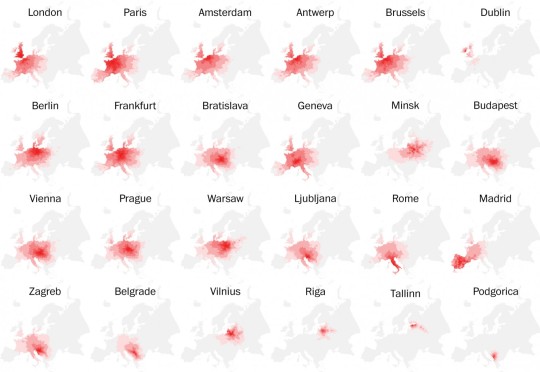
    This is a terrific set of maps published by The Washington Post (2015) using data originally collected and published by Peter Kerpedjiev:

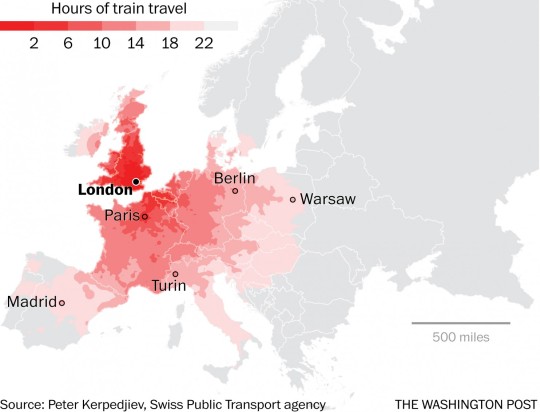
    What they show is how far you can travel in a 24 hour period using only trains and brisk walking from a collection of 28 European cities. In a few cases, such as from London to Dublin, a ferry ride is also included.

    Here’s a zoom in on London:

    The obvious takeaway is that Western Europe is very well connected, whereas many parts of Eastern Europe are not. Some cities, such as Tallinn (Estonia) and Podgorica (Montenegro) are almost completely disconnected.

    Of course today there’s stiff competition from air travel.

  • The link between ancestry and foreign direct investment

    Below is an interesting example of how international migration – and being open to it – can have positive economic impacts by way of increased foreign direct investment (FDI). The excerpt is from the World Economic Forum.

    “…we document that FDI follows the paths of historical migrants as much as it follows differences in productivity, tax rates, education, and other conventional determinants of economic competitiveness – for the average US county, doubling the number of individuals with ancestry from a given origin country increases by 4 percentage points the probability that at least one firm from this US county engages in FDI with that origin country, and increases by 29% the number of local jobs at subsidiaries of firms headquartered in that origin country.”

    Their study also found that these ties are long lasting. That is, even after a few generations of assimilation, ancestry still has an effect on FDI patterns. 

    There are of course many other benefits to open borders. But our collective tolerance toward immigration has ebbed and flowed greatly over time. And my sense is that if often has a relationship with prosperity.

    As long as times are good and I – the incumbent – am winning, then immigration is accepted, if not welcome. But as soon as times become scarce, then I – the incumbent – need to start protecting my nest.

    This may be one of the reasons why Canada seems to fair so well when it comes to diversity. We optimize for the middle more than countries like the US.

    An example of this phenomenon can be found in the mid-19th century California Gold Rush. By 1876, the United States had approximately 151,000 people of Chinese ancestry and about 116,000 of them were in the state of California.

    In the early days of the rush, when gold was abundant, it has been said that the foreign Chinese laborers were well received. But as gold became more scarce and difficult to find, Californians began to believe that the Chinaman was stealing their wealth.

    In 1882, the US signed the Chinese Exclusion Act, which flat out prohibited the immigration of Chinese laborers. It was not repealed until 1943. However, the Chinese still found other creative ways to enter the country (see Lo Mein Loophole).

    I say all this simply to provide a bit more context. We can talk about how disruptive technologies are squeezing the middle class in new and profound ways. But in many ways, we’ve all heard this story before.

  • What could a connected lockbox mean for the residential real estate business?

    image

    I just discovered an interesting Dallas-based startup this morning called TOOR. They were on Shark Tank and haven’t yet launched their product, but it’s essentially a connected lockbox. Lockboxes are a mainstay of the residential real estate industry (they hold the keys so that co-operating agents can show a property) and they are becoming even more common nowadays because of Airbnb rentals.

    What caught my attention about TOOR is the app that goes along with the lockbox that also allows people to search for homes. Once you’ve found a home you can even find an agent for an escorted tour. I’m not clear on the exact workflow, but I am thinking that if you buy this connected lockbox you then have the opportunity to put your home up for sale on their platform.

    This is interesting because the app will also verify user identities and scan people’s IDs, so it helps to solve the security problem that agents today now solve. I could imagine the app storing my credit card so that if I go into a home unescorted and I do something mischievous, it then charges me. It also makes it really easy to just drive around and pop into homes by instantly scheduling appointments.

    In any event, I may have the exact user flows a bit wrong, but it’s fascinating to think about how something as simple as a connected lockbox could start to chip away at the status quo.

  • The Human City

    As a follow-up to yesterday’s post about fluid labor markets and urban density, I thought I would present an opposing view.

    Joel Kotkin is a well known geographer and author. He has published a number of books, the most recent of which is called, The Human City: Urbanism for the Rest of Us. He is also well known as a supporter of the suburbs, which is a somewhat contrarian view in today’s urban-centric world.

    Here is a recent interview he did with Aaron M. Renn (click here if you can’t see it below):

    [soundcloud url=”https://api.soundcloud.com/tracks/257309155″ params=”auto_play=false&hide_related=false&show_comments=true&show_user=true&show_reposts=false&visual=true” width=”100%” height=”450″ iframe=”true” /]

    One of his messages is that the urban core is great for young people without kids, but that we shouldn’t expect it to serve everyone’s needs and wants – particularly those of families. Families need space and affordability, and urban cores are simply not engineered for that.

    Long live the suburb.

  • Your own signpost

    Work Market is an “on-demand talent marketplace.” They connect companies who need work done with skilled freelancers who are looking to do work. Conceptually, we’ve seen this before.

    But this morning, as I was reading this interview with the CEO, the following lines got me thinking:

    “By 2040, I’m pretty confident that every skilled worker will have their own signpost. You will be your own enterprise, in a much more meaningful way than the lip service of today.”

    We are already seeing this phenomenon play out. Social media, for instance, has made all of us our own media brands. So it’s not outlandish to believe that we will also see more, not less, of this in the labor market.

    But what I started thinking about is how this changing relationship between business and labor will ultimately manifest itself in our cities. 

    If we are indeed shifting toward a fluid and dynamic labor market where not only do people switch jobs more frequently, but they have their own signposts, then I have got to believe that urban density will only become more important. We’ll all need to be “plugged in” to the market – both online and offline.

    But what are your thoughts? I think this could make for an interesting discussion in the comments.

  • Snap Inc.

    Snap Inc. (Snapchat) nailed the launch of Spectacles. I want a pair.

    If you haven’t been following, it all started with a pop-up vending machine in Venice Beach. But like Snapchat itself, it was an ephemeral installation that eventually disappeared, moving on to Big Sur, California. At the time of writing this post, the countdown is on to discover where the vending machine will pop up next. It’s a viral marketing play that aligns very well with their brand.

    But there’s even bigger news.

    Earlier this week it was revealed that Snap Inc. has filed for an initial public offering. It plans to go public by as soon as March 2017 and expects to be valued somewhere around $25 billion. Remember when everyone flipped out because Evan Spiegel had rejected Facebook’s acquisition offer of $3 billion?

    Here’s their revenue story from Vanity Fair:

    Last year, Snapchat brought in $59 million in revenue—a low number that reflected the embryonic stage of its business. This year, however, Snapchat predicts it will generate revenues between $250 million and $350 million. And in 2017, the company estimates it will reach revenues between $500 million and $1 billion, based on “bullish sales targets.”

    I’ve been a Snapchat fan for awhile now, so I am thrilled to see the company going public. As Fred Wilson wrote on his blog this morning: “Snap is a great company led by a creative and ambitious founder and they have a loyal and growing use base. I think Snap can be an excellent public company.”

    If you’ve got people’s attention, you can figure out how to monetize it.

  • New political support for laneway housing

    There’s some great news in the Toronto Star this week.

    (Thank you Mike for bringing this to my attention.) 

    Two councillors – Mary-Margaret McMahon and Ana Bailao – have come out in support of allowing laneway housing in Toronto. Some cities call them detached accessory dwelling units (DADUs). 

    If you’re new to laneway housing, check out this post and this post (both are 2+ years old). I’ve been on this horse for over a decade.

    Because going beyond their small space cool factor, laneway housing has the potential to fundamentally alter the housing supply constraint that I wrote about a few weeks ago – namely the yellowbelt. It’s a way to gently allow for new housing, while at the same time preserving the character of our “stable” neighborhoods. 

    And frankly, I can’t think of any other way to add new ground related housing at any sort of meaningful scale within the city limits – not unless we’re willing to give up the “stability” of our neighborhoods. So this is it.

    If you’re on the same page, I would encourage you to reach out to Councillor McMahon and Bailao and let them know that. There’s also a public workshop scheduled for Monday, December 5th at 7pm at the Evergreen Brick Works (550 Bayview Avenue).