Daily insights for city builders, delivered every morning at 6 AM ET. I’m Brandon Donnelly — a Toronto-based real estate developer and founder of Globizen. I’ve been writing here since 2013.

  • Triple-glazed sliding doors (or walls?)

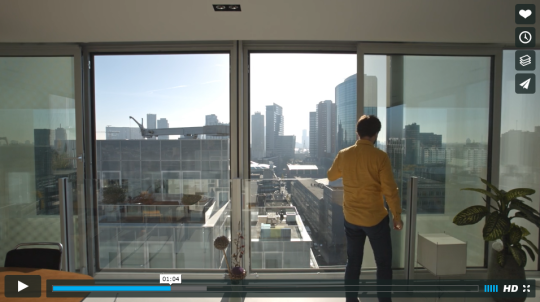
    After my post about “the great balcony debate”, there was a bit of discussion on Twitter. Ken Wilcox then responded with a video talking about the mixed-use Timmerhuis building in Rotterdam designed by OMA

    At the 1 minute mark there’s a clip of one of the residents opening a large set of sliding doors. Here’s a screenshot of what that looks like:
    image

    I did a bit of digging on the project and found this fact sheet. The sliding doors in the residential units measure 1.8m x 2.6m. They go from floor-to-ceiling (~8′-6″). The windows are also triple-glazed! (3 glass panes + 2 air chambers.)

    I think this is a great way to open up a suite to the outdoors. It also looks like the glass balustrades sit inside, which keeps the building’s exterior envelope uninterrupted. Some of the other suites have large terraces where the building steps back.

    In case you’re wondering, the construction costs for the entire project was about €100 million and the total gross floor area (including all of the non-residential uses) is about 45,000 m² (~484,200 sf). Unit rate seems reasonable given that triple-glazing is virtually unheard of in Toronto.

    P.S. I am having some technical difficulties with Tumblr (my blogging platform) and Mailchimp (my email service provider). They both had problems and a few daily emails didn’t get sent out. Sorry about that. Hopefully it’s resolved now. If you missed the last couple of posts, you can read them online.
  • The emotional journey of creating anything great

    Welcome to 2017. (We better have flying cars by 2020 or I’m going to be pissed.)

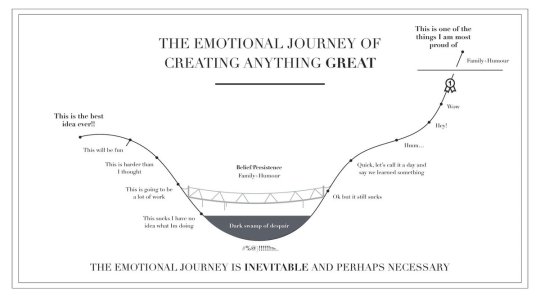
    I found the following chart on Howard Lindzon’s blog. It’s called “The Emotional Journey Of Creating Anything Great" and it’s getting shared around town right now.

    I’m sure that you’ve seen other similar charts before, but it doesn’t hurt to drive home this point, particularly as all of us kickstart the new year and promise ourselves that we’re going to be better, faster, stronger.

    The point of this chart is that when you’re creating anything new and great, there will always be the period of time that this diagram refers to as the “dark swamp of despair.” This is where you question your life decisions and wonder if you’re wasting your time trying to create this new and great thing.

    I never fully appreciated this phenomenon until I worked on a startup. Though for me, it felt more like a manic depressive rollercoaster. One week I was killing it and the next week I was in a dark swamp of despair searching for a way out. 

    And it’s because when you’re creating something new, you have few, if any, points of reference to reassure yourself that you’re on the right path. If it is truly great, then it’s probably something novel. And if it’s new, then by definition it hasn’t been done before. So it is unknown whether it’s truly a dark swamp of despair or if it just feels that way right now because things are tough.

    Because of the emotional nature of this journey, I have found myself really questioning the worth of things like caffeine and alcohol. I used to think the former made me more productive – the latter certainly doesn’t – but I’m not so sure that is the case. So as an experiment, I cut out coffee last month.

    I don’t believe in new year’s resolutions, so that’s not what all of this is about. It’s far better to talk about the things you’ve remained committed to, than to talk about the things you’re planning to do.

    This is simply a reminder that there will always be ups and there will always be dark swamps of despair. The key is to have the confidence and conviction to charge through those swamps any way you can. Onward my friends. I’m really looking forward to 2017 and I hope you all are as well.

  • The great balcony debate

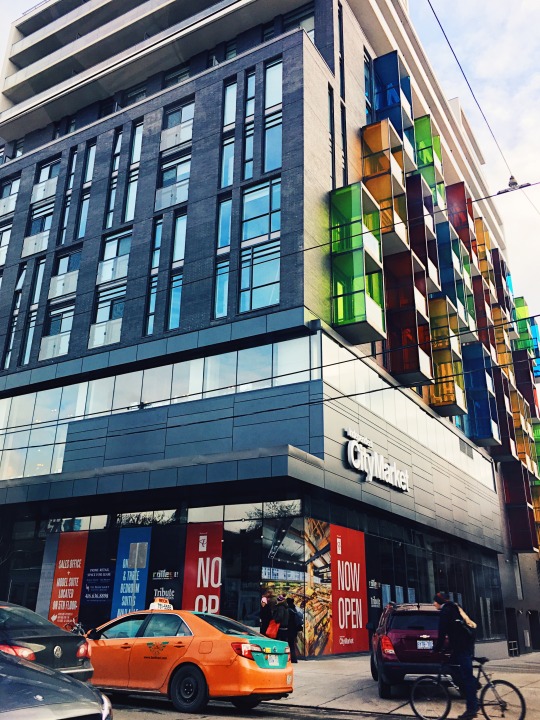
    I snapped this picture on College Street near Spadina Avenue (Toronto) yesterday:

    image

    It’s a picture of “The College” by Tribute Communities. What you’re looking at is the northwest corner of the building and a 20,000 sf grocery store fronting onto College Street.

    I took a picture of the building for really two reasons. 

    1. The colored balcony enclosures on the west elevation (right side of the picture) are not something I’ve ever seen done on a Toronto condo before. I like color. I also wonder if they create interesting interior lighting effects and greater privacy when you’re outside.

    2. I have been noticing more Juliet/French balconies on new builds as of late (could be an availability bias). Here they’re on the north elevation fronting onto College Street. Once the building steps back, you get conventional balconies. 

    I think Juliet balconies create a much nicer streetwall, particularly when used on a building’s lower floors. But I would be curious to get end-user thoughts on this. If you were looking for a place, would you rather more interior space + Juliet balcony or less interior interior + conventional balcony? Are balconies a deal breaker?

    This is something that a lot of people in the industry debate. And it varies by city. In Toronto, conventional wisdom dictates that you need to provide balconies of any size, even if nobody ends up using them, other than to store a bike.

    In other cities – sometimes because of liability and sometimes because exterior balcony space gets counted as part of the building’s overall Gross Floor Area (GFA) – balconies can be a real rarity.

    What are your thoughts? Please leave a comment below. Thanks!

  • Ian Gillespie: It’s not about business

    The founder of Westbank, Ian Gillespie, recently sat down with Bloomberg TV to discuss the Toronto and Vancouver real estate markets; his Mirvish Village (Honest Ed’s) redevelopment project; affordable housing; and the markets he is and plans to be focused on (Vancouver, Toronto, Seattle, Tokyo, San Francisco).

    I like the part where he says that he’s really not that interested in business.

    If you can’t see the video below, click here.

    https://www.bloomberg.com/api/embed/iframe?id=6542ca85-017c-436e-aefc-25d8f4bb9b66

  • Tesla is winning the arms race

    “If we have data, let’s look at data. If all we have are opinions, let’s go with mine.” – Jim Barksdale, former Netscape CEO

    Fred Wilson wrote a post yesterday about Tesla’s data advantage in this self-driving car arms race that we are currently living through. (I found the above quote in the comment section of the post.)

    In their Q3 2016 update, Tesla claims to have logged more than 1.3 billion miles on its vehicles equipped with Autopilot hardware. This is important because the more data it collects – across diverse road and weather conditions – the better the vehicles get at driving without human intervention. As Fred Wilson put it: “more data is better than more software engineers.” So that places Tesla ahead of Google, Uber, GM, et al.

    I spent a lot of time driving over the past week, certainly more than usual, and I couldn’t help but think about how much better it would have been to instead sit in the backseat and read a book (or mindlessly scroll through Instagram).

    I always try and use cruise control on long drives, but unless the road is fairly empty, I find it doesn’t work very well. Everyone is driving at different speeds and so I usually end up having to reset it / adjust it every so often.

    The big question in my mind is still: How does the world look when driving longer distances doesn’t suck so much? What changes when you can get into your / a car (important distinction) at bedtime, fall asleep, and then wake up in a new place?

    A lot, I think.

  • Motion Exposure

    Photographer Stephen Orlando is obsessed with capturing “motion through time and space.” What he does is use long single exposures and LED lights (attached to people and objects) in order to reveal paths of movement. The results are stunning.

    He has done this with various sports, including cross-country skiing, soccer, hockey, karate, and kayaking. His work is art + technology + sport. Check out his gallery here.

    Recently Stephen collaborated with Olympic kayaker Adam Van Koeverden and shot photos of him cruising along Lake Ontario with the Toronto skyline in the background. See above photo. The LED lights were attached to his paddle. The rest of those photos can be found here.

    What I like about these photos is that they’re created by visualizing – in a more permanent way – movement that is already latent within these sports. These are geometries that currently exist, we just can’t see them without Stephen’s help.

  • Dashilar Platform

    I am reading about the Dashilar Platform this evening. I am sure that some of you are already familiar with what’s happening in this Beijing neighborhood since the platform was founded in 2011. But I am just turning my attention to it.

    The Dashilar Platform is an approach to urban regeneration that grew out of a perceived failure, namely the redevelopment of Beijing’s historic Qianmen neighborhood in the lead up to the 2008 Summer Olympics.

    In this latter case, a top-down tabula rasa approach was adopted and the entire precinct was demolished to make way for what – I am told – is now a kitschy tourist area that has lost most, if not all, of its urban authenticity.

    The Dashilar approach runs counter to this and is trying to work bottom-up. Below is a description of their strategy from the Dashilar Platform website. (It feels like it was written using Google Translate.)

    Dashilar Platform is an open platform founded by Beijing Dashilar Investment Limited. As opposed to the conventional concept of blanket development, Dashilar Platform will utilize key nodes which act as catalysts for change in the area. Through research and design investigation, Dashilar Platform will promote certain archetypes, modules, and best-practice examples for both residents and outside investors. The aim is to encourage the community to move independently yet coherently towards the strong yet flexible goal of creating a sustainable community with increasing depth and diversity. All parties are welcome to join Dashilar Platform and participate in our [progressive] Dashilar Project.

    Some view this “urban acupuncture” strategy as simply a way to promote gentrification through small injections of culture and design. But gentrification, without displacement, strikes me as being the point given that the area was in decline. It was also probably one of the only sensible approaches given the fragmented ownership and illegal structures in the area.

    What stands out for me as I read up on the Dashilar Platform, is the acknowledgement that the market alone will not preserve all of which is thought to be currently desirable in the neighborhood.

    Here is an excerpt from a Medium article written by Masha Borak – a journalist and translator based in Beijing:

    Collaboration is not the only interesting thing about the [Dashilar] project. In the words of their representative, the platform wants to take on the role of a “urban curator" that would decide which kind of businesses could get cheaper rent so they wouldn’t be left to the market.

    Given the discussion that is going on in Toronto right now about 401 Richmond Street West – a non-profit and cultural hub in an area of the city seeing significant development pressures – this struck me as being particularly timely and relevant.

    Markets are not perfect.

    If any of you have any familiarity with the Dashilar Platform and what has been happening in this neighborhood, I would love to hear your thoughts in the comment section below.

  • Winter Wonderland (and 3 things to read)

    This is what it looks like in Mont-Tremblant right now:

    It’s currently -11 degrees celsius and it’s expected to snow for most of the day. It’s starting to come down right now. But this evening it’s supposed to warm up to +1 degrees celsius, which means it may turn into (freezing) rain. I hope we see a lot more snow than rain. Nobody wants an icy mountain.

    If you’re looking for things to read this morning, here are 3 pieces:

    1. In American Towns, Private Profits From Public Works. It’s a NY Times article talking about how cash-strapped towns are turning to private equity firms to pay for their infrastructure. 

    2. How Zoning Laws Shaped New York City Over the Last Century. This is about an exhibition being held at The Museum of the City of New York right now. The rules we make shape our built environment. Thanks John for the link.

    3. Authenticity, and how Snapchat is banking on it. I am very fascinated by Snap Inc.’s ability to think differently and adopt counterintuitive business strategies. There’s also a cultural dimension to all of this.

  • 3D printing and de-globalization

    This evening I stumbled upon an interesting article by T.X. Hammes talking about “de-globalization” and the impacts that this may have on international security. (He served 30 years in the US Marine Corps.)

    One of his points is that 3D printing (additive manufacturing) is going to transform not only how things are made, but also where things are made. This is perhaps an obvious point, but it’s valuable to think about what all of this will mean when production moves from global to local.

    Here’s an excerpt from the article:

    “Currently we ship raw materials to one country. It puts together the sub-assemblies, packs them, and ships them to another country for assembly. There they complete the assembly and packaging, then ship the packaged product onward to the consuming country. With the emergence of additive manufacturing, we will ship smaller quantities of raw materials to a point near the consumer, produce them, and then ship them short distances for consumption. Thus reducing international trade. The localization of energy production and return of high value agriculture to developed nations will further reduce global trade.”

    Indeed, UPS seems to be predicting that the international shipping market will be significantly impacted by these shifts and has started investing in 3D printing. But going even further, T.X. Hammes believes that declining trade could dramatically alter the international security picture.

    To me, it’s yet another reminder of what Marshall McLuhan was getting at when he argued: “The medium is the message.” Don’t stop at the obvious changes. Look for deeper structural changes. Look for the unanticipated.

  • Merry Christmas

    Merry Christmas everyone! And, thank you all for reading this past year.

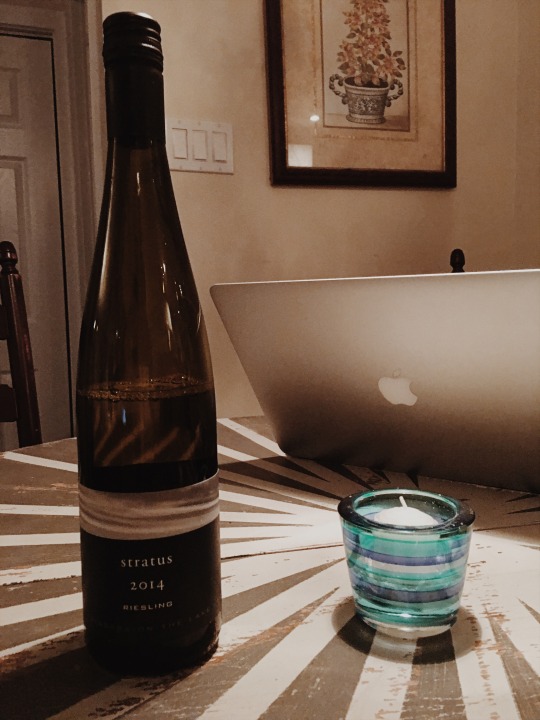
    I just checked into an Airbnb in Mont-Tremblant, Québec and will be spending the next few days here with family and friends. I’ve also brought along some of my favorite wines (see above) and, obviously, my snowboard.

    Hopefully that wherever you are and whatever you’re doing, that you’re with family and/or friends. I know that this time of year can be lonely for some people when things quiet down. So hopefully you have good people to spend it with.