Daily insights for city builders, delivered every morning at 6 AM ET. I’m Brandon Donnelly — a Toronto-based real estate developer and founder of Globizen. I’ve been writing here since 2013.

  • 10 most unaffordable housing markets

    image

    I flew into Vancouver this morning, which means it was only a matter of time before the topic of house prices came up.

    According to the 13th Annual Demographia International Housing Affordability Survey (2017), the 10 most unaffordable housing markets are as follows:

    1. Hong Kong, China
    2. Sydney, Australia
    3. Vancouver, Canada
    4. Auckland, New Zealand
    5. San Jose, California
    6. Melbourne, Australia
    7. Honolulu, Hawaii
    8. Los Angeles, California
    9. San Francisco, California
    10. Bournemouth, UK

    The survey measured the affordability of “middle-income” housing in Australia, Canada, China (Hong Kong), Ireland, Japan, New Zealand, Singapore, the United Kingdom, and the United States. 

    It is based on a “median multiple” approach, which tries to normalize house prices across the world by looking at median house prices over median household incomes.

    The above list probably won’t surprise you, as well as the report’s focus on land supply. But I did want to call attention to the following remark:

    My own housing research focused on this difference: Why did Germany (and similarly Switzerland) provide housing stability where much of the Anglosphere did not? 

    In a nutshell, the answer to this question has a lot to do with the way councils are funded. In jurisdictions where local decision-makers stand to gain from new development, they will be much more eager to make it happen.

    The topic of incentives is not something that is often focused on when we talk about land supply. But it’s a really interesting point. Because the reality is that, in many cases, the incentives probably work in the opposite direction to the one described above.
  • The Art of Design

    I don’t actually have Netflix, but they have a new original documentary series out called, Abstract: The Art of Design. It’s a look at “eight of the most creative thinkers” working in art and design. It premiered at the Sundance Film Festival this year.

    Here are those 8 people:

    1. Es Devlin (stage designer)
    2. Ilse Crawford (interior designer)
    3. Ralph Gilles (Chrysler head of global design)
    4. Bjarke Ingels (architect)
    5. Platon (photographer)
    6. Christoph Niemann (New Yorker cover illustrator)
    7. Paula Scher (graphic designer)
    8. Tinker Hatfield (Nike sneaker designer)

    The trailer feels unnecessarily dramatic for a documentary, but I’d still like to watch it. The reviews also seem to suggest that it’s pretty good. Below is the trailer. If you can’t see it below, click here.

    [youtube https://www.youtube.com/watch?v=DYaq2sWTWAA?rel=0&w=560&h=315]

    If you’ve already seen it, what did you think?

  • The Anti-Portfolio

    In the world of venture capital, it is not uncommon to make most of your money off only a small fraction of your investments. Here’s how Fred Wilson describes his firm’s “batting average”:

    “I’ve said many times on this blog that our target batting average is “1/3, 1/3, 1/3” which means that we expect to lose our entire investment on 1/3 of our investments, we expect to get our money back (or maybe make a small return) on 1/3 of our investments, and we expect to generate the bulk of our returns on 1/3 of our investments.”

    I’m guessing that this is one of the reasons why mistakes are more readily embraced – or even celebrated – in venture capital and in tech. It’s part of the DNA of the industry.

    A perfect example of this is something called the Anti-Portfolio. Venture capital firm, Bessemer Venture Partners, has a page up on their website dedicated to “honoring those we missed.” It is a list of phenomenally successful companies that for various reasons BVP decided not to invest in. That is, they had the opportunity but they decided to pass.

    Here’s a taste (copied verbatim from their site):

    • [Apple] BVP had the opportunity to invest in pre-IPO secondary stock in Apple at a $60M valuation. BVP’s Neill Brownstein called it “outrageously expensive.”
    • [Facebook] Jeremy Levine spent a weekend at a corporate retreat in the summer of 2004 dodging persistent Harvard undergrad Eduardo Saverin’s rabid pitch. Finally, cornered in a lunch line, Jeremy delivered some sage advice “Kid, haven’t you heard of Friendster? Move on. It’s over!”
    • [Google] Cowan’s college friend rented her garage to Sergey and Larry for their first year. In 1999 and 2000 she tried to introduce Cowan to “these two really smart Stanford students writing a search engine”. Students? A new search engine? In the most important moment ever for Bessemer’s anti-portfolio, Cowan asked her, “How can I get out of this house without going anywhere near your garage?”

    As I was going through BVP’s Anti-Portfolio, I immediately thought about how different this sensibility is compared to the real estate industry. I mean, could you imagine a developer celebrating all of the sites she or he passed on and all of the projects that lost or made no money?

    One of the reasons you do this is to learn from your mistakes. So perhaps we could all use some sort of “anti-portfolio.”

  • 2016 Census: Population and dwelling counts

    image

    Today marks the release of the first tranche of Canada’s 2016 Census data: Population and dwelling counts. The next data release is scheduled for May 3, 2017, and will include age and sex, and type of dwelling. For the full release schedule, click here.

    For policy makers, city builders, data nerds, and many others, today is an important day. And that’s because 2016 marked the return of the “mandatory long-form questionnaire”, which had been eliminated in the 2006 edition. The short-form questionnaire was used. That means it’s been over 10 years, since we’ve had access to long-form data about this country.

    Given that the 2016 Census had one of the highest response rates on record (98.4%), I think it’s safe to say that most Canadians understand the value of good data. In fact, when the Census was released it started trending on Twitter, with many people complaining if they hadn’t receive the long-form version. People wanted more survey. They wanted the ability to share more information.

    All of this is important because it helps decision making. Here’s an excerpt from a recent Toronto Star article:

    “The mandatory long-form census questionnaire provided regions and cities and communities with really valuable and reliable long-term information about the changing nature of the city and its neighbourhood that’s not available from any other source,” said David Gordon, an urban planning professor from Queen’s University.

    So stay tuned to the Census Program website. Regardless, I’m sure we will be seeing a surge of infographics and other activity following each data dump.

  • Photographing architecture studios

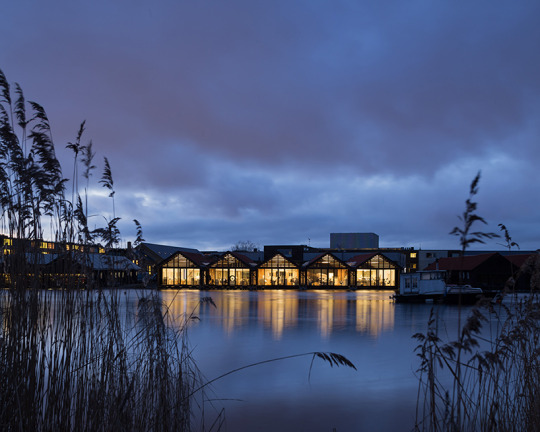
    Marc Goodwin – who is part of a photography studio called Archmospheres – has an ongoing project where he photographs the studios of architects. 

    He has photographed well known practices such as MAD, Renzo Piano, and David Chipperfield, as well as a number of geographic niches such as Paris architecture studios, Nordic architecture studios, and London architecture studios

    He also varies the size of the firm. Some of them only have a few people working out of a small streetfront retail space.

    As an architect, you are pretty much required to have a cool studio space. So this is certainly an interesting photography project to take on. The photo at the top of this post is 3xn in Copenhagen.

    Image: Marc Goodwin via Designboom

  • Important things

    image

    Last weekend I watched Minimalism: A Documentary About The Important Things. I’ve been reading the blog for awhile now (I blogged about it) and so the movie has been on my to-do list since it came out.

    Now, I am not a minimalist to the same extent as Joshua and Ryan, and some of the people featured in the film. I have not reduced all of my personal belongings to 51 things and I have not renounced any sort of permanent residency. I own some stuff.

    But I am very much attracted to the philosophy that less can be more. That less can make us happier. That quality is more important than quantity. And that we actually need far less stuff than we think we do, especially in a consumerist society like ours.

    One word that comes up a lot in the documentary is: deliberate. In other words, we should be more deliberate about the choices we make, the things we buy, and so on. Will it create value in my life?

    And that’s one of the reasons I like this notion of minimalism: It’s a challenge. You have to think. Because if you don’t, you will be told what to do and what to buy, and you will accumulate things without even knowing. It’s essentially a constant battle against excess.

    Perhaps the biggest potential for excess happens with our choice of housing, which is why small homes feature so prominently in the film. A tiny house isn’t going to be for everyone, but many people have certainly come to the realization that square footage alone does not equate to more happiness.

  • And the award for the tallest building of the year goes to…

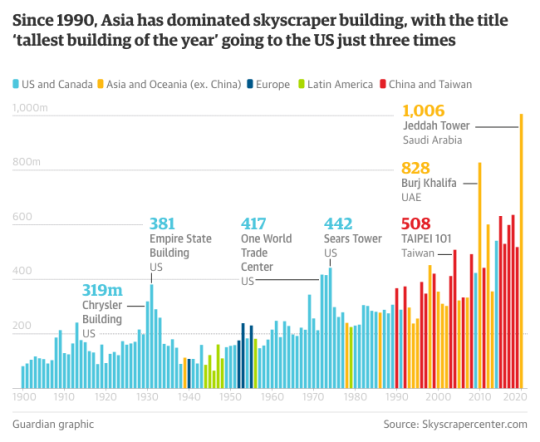
    The Guardian recently published an article on vanity height in skyscrapers. What this is referring to is the unoccupied portions of tall buildings which are built purely for vanity reasons – that is, to increase the face height of the building and claim some superlative title.

    Example: 

    The tallest building in the world is currently the Burj Khalifa in Dubai. It’s 828m tall. To put that into perspective, the CN Tower in Toronto is 553m. But according to the Council on Tall Buildings and Urban Habitat, 29% of the Burj Khalifa’s height is actually unoccupied or “vanity space.” In other buildings, such as the Burj al Arab (also in Dubai), the amount of unusable space is as high as 39%. 

    For the purists out there, this of course raises the question of what should should be counted when assessing building height. Should it only be spaces where humans typically inhabit? The CN Tower has a lot of unoccupied space, which is why it is frequently excluded from these sorts of ego rankings. 

    But semantics aside, this is obviously not a new phenomenon and it’s interesting to think about this race to the sky as a proxy for what’s going on in the world. Below is a chart showing which regions have been able to lay claim to the “tallest building of the year” since 1900. 

    Since 1990, it has been all about Asia and Oceania and China and Taiwan…

  • Designing for families in high-rises

    The City of Toronto Planning Division is working on an initiative called, Growing Up: Planning for Children in New Vertical Communities

    The objective is to better understand how new multi-unit housing can better accommodate families within the city. Supposedly as of 2011, 32% of families within Toronto lived in mid and high-rise buildings. At first I thought this number seemed high, but then I rationalized it to myself by thinking of all the post-war apartment buildings we built.

    As part of their study, the city published a number of case studies from Toronto and from around the world. These are projects that have successfully planned for families. For some of the projects they have floor plan and sections showing how the individual suites were designed and positioned within the building. One feature that they consider desirable is to cluster the family suites on the lower floors of the building.

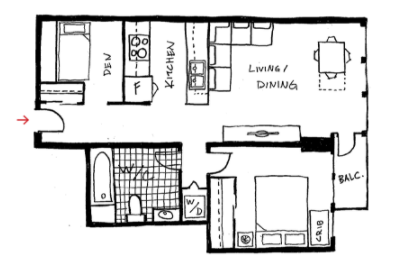
    But perhaps even more interesting is the section called CondoHacks. Here, the study team interviewed 9 families already living in vertical communities to learn about how they have “hacked” their spaces to meets their needs. It’s valuable to see how end-users actually live in specific floor plans. Lots of shared bedrooms and spaces. Here (pictured below) is an example of 2 parents and 2 children living in a 650 square foot one 1 bedroom plus den.

    image

    This a topic that I’m personally very interested in. I’m thinking a lot about how some of the projects I’m working on could better accommodate families. So it’s great to see this initiative underway. If you’d like to receive email updates from the city about this study, sign up here on the bottom right of the page. I did that this morning.

  • Form follows parking

    “Form follows function” is a famous axiom of 20th century Modern architecture. It is based on the rational notion that architecture and its associated shapes, geometries, and spaces should be a direct result of their function. 

    It was a way of trying to eliminate the arbitrary ornament that had adorned previous architectural movements. In this case, if it had no function, then it should be stripped away.

    There have been many bastardizations of this pithy statement over time, but one of my favorites is: “form follows parking.” Obviously derogatory, it is this idea that much of the built environment is a result of parking requirements, rather than of more human factors.

    We see this in suburban building typologies (large surface parking lots), but also in urban infill projects where the below grade parking begins to dictate the structural grid and layout of the upper floors. It is, of course, necessary in many cases, but there’s also something subversive about parking having such a lasting impact on the spaces we occupy.

    That said, we know where the trend line is headed when it comes to parking. Streetblogs recently posted an article about the scarcity of parking in Manhattan and cited number of interesting stats.

    Because of the city’s bike-share program (introduced in 2013) and because of all of the bike lanes that have been added in recent years, the city has (rightly) removed approximately 2,330 on-street parking spaces in Manhattan south of 125th Street.

    Here’s another set of stats: 

    In 1998, New York City had about 810 parking lots and garages south of 60th street. Together, they accounted for approximately 112,826 parking spaces. As of last year (2016), the number of lots and garages had dropped to about 643 and the number of parking spaces to approximately 95,000. That’s a decline of about 16%, during a period of when the population of Manhattan grew by more than 100,000 people.

    I would also imagine that these pressures are increasing. So it is quite possible that “form follows parking” could be on its way toward obsolescence. I certainly feel it waning.

  • Snowboarding day

    Today was a snowboarding day. It was also the first day that I used my new (totally obnoxious) 40″ selfie stick. Note: It wasn’t fully extended for the above photo.

    Internet access and time has been pretty scarce, so there won’t be much of a post today, which actually seems appropriate given yesterday’s post about being so busy. 

    See you all tomorrow.