Daily insights for city builders, delivered every morning at 6 AM ET. I’m Brandon Donnelly — a Toronto-based real estate developer and founder of Globizen. I’ve been writing here since 2013.

  • Housing is a bitch

    I just discovered Steve Randy Waldman’s blog called Interfluidity and, more specifically, a post he wrote called: “Home is where the cartel is.” I am now following him.

    He starts off by saying that housing is a bitch, which is just him saying that urban housing is a difficult problem to solve. A truism for this audience.

    He doesn’t profess to have all of the answers, but he does write a thoughtful piece that covers, among other things: the “market urbanist” (supply-side) solution to solving housing affordability, the reasons why the “housing cartel” will never approve of this, and the inherent contradiction between housing as an investment and housing as a sustainably affordable good.

    He also offers up Singapore and Germany as examples of two very different housing markets. It reminded me of a tweet I retweeted this morning which shows Germany as having the 2nd lowest homeownership rate (45%) among OECD countries.

  • 3 thoughts on employment

    There’s lots of talk these days about how technological innovation and globalization are taking our jobs.

    Of course, these are not unreasonable concerns. The data suggests a hollowing out of the middle class and the threat of automation feels perhaps more real than over with the recent advancements in AI and robotics.

    But here are 3 things to consider and discuss:

    1) It doesn’t feel realistic to believe that the jobs which went overseas will ever return en masse – as nice as it may sound to argue that. They went overseas to take advantage of a particular cost structure and those motives haven’t changed.

    2) It is not guaranteed that technological innovation will destroy more jobs than it creates. In fact, historically the opposite has often been true. The jobs that were lost by technological innovation were replaced by new / more jobs and greater economic surpluses. For instance, think of agriculture.

    3) But could this time be different? If we are indeed entering a new economic period, then it strikes me that 1), above, becomes even further away from the right solution. Some of the proposed solutions include universal basic income and a robot tax (links to interview with Bill Gates).

  • Rational nexus

    In Toronto we have something known as Development Charges. In the US, they are more commonly referred to as Development Impact Fees, which in my view, lends a certain precision to their intent.

    The idea behind these fees is that they account for some or all of the off-site public costs required to serve a new development. Initially this meant utilities, but today these fees usually include everything from transit and parks to child care and pedestrian infrastructure.

    According to Wikipedia, the first impact fees were implemented in Hinsdale, Illinois in 1947. By the 1980s, impact fees had become a universally accepted mechanism for funding the costs associated with growth.

    Not surprisingly, there’s substantial case law around impact fees. One of the concepts that comes up a lot is this idea of essential or rational nexus. That is, can the fee(s) be rationally linked to the impacts of a particular development?

    One well known example is Nollan v. California Coastal Commission (1987)

    The Nollans proposed to build a 2-storey house within the exact same footprint of their current 1-storey house. As an approval condition, the Coastal Commission wanted a public easement across the beach in front of their house.

    The U.S. Supreme Court sided with the Nollans and held that the development exaction (public easement) was not adequately related to their new development (additional storey). A “rational nexus” did not exist.

    If you’re interested in this topic, the American Planning Association has a policy guide on impact fees available on their website.

  • The Green View Index

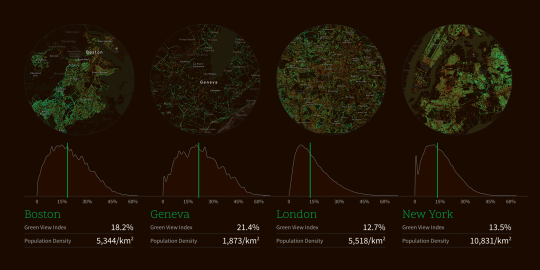
    The MIT Senseable City Lab recently developed something called the Green View Index. It is a measure of a city’s tree canopy. Below are the GVIs for Boston (18.2%), Geneva (21.4%), London (12.7%), and New York (13.5%). You may have to zoom in.

    image

    And here is a screenshot of Toronto. We have a GVI of 19.5%.

    image

    The index was developed by methodically scanning for trees in Google Street View panoramas. The reason street view was used – as opposed to aerial photography – was so that they could capture the human experience at street level.

    All of MIT’s interactive city maps can be found here. It’s also interesting to pan around and see which neighborhoods are the greenest – particularly if you are familiar with the city.

    One thing I noticed is that large green spaces such as Central Park, High Park, and Stanley Park don’t show up as very green. And that’s because the index uses car-based street view data. I feel like these green spaces should count for something though.

  • Die Es

    image

    To celebrate the launch of their Guide to Cosy Homes (2015), Monocle Films produced a number of home tours. 

    Die Es, pictured above, is the home of South African architects Gawie and Gwen Fagan. They started building their home in 1964, just as they were starting their practice. 

    Because of this, they had little money and had to do a lot of the work themselves. They sold their car to buy a concrete mixer.

    Although they didn’t set out to explicitly design a “Cape” house, it ended up that way, with heavy thermal masses, white walls, and so on. 

    The architecture also relates very closely to the surrounding landscape – as it should – in the way in which it frames views of the water and mountains. 

    The mediterranean climate also really comes through in the materiality of the home and the connections to outside.

    If you’d like to watch the 5 minute tour of Die Es, click here.

  • New York, San Francisco, Toronto

    Yesterday it was announced (here, here, and here) that Toronto-based Top Hat has raised $22.5 million (USD) in Series-C funding. The round was led by New York-based Union Square Ventures.

    I am always excited to see Toronto-based startups doing well and I am particularly excited by this remark in USV’s blog announcement:

    “Also worth noting is that Toronto continues to impress us with its quality and diversity of companies. We now have five investments there, placing Toronto third as a location in the USV portfolio after New York and San Francisco.”

    Here is another quote from Fred Wilson’s blog:

    “Toronto is a great place for startups. In addition to five investments of ours that are HQ’d there, I know of at least one other USV portfolio company that has much of their engineering team in Toronto. The talent, mindset, and quality of the people in the Toronto/Waterloo tech/startup community is really top notch and we love investing there.”

    Go Toronto. 

    (Of course, Toronto really means Toronto-Waterloo. That’s the geography of the ecosystem.)

  • 3 pilot options for Toronto’s King Street corridor

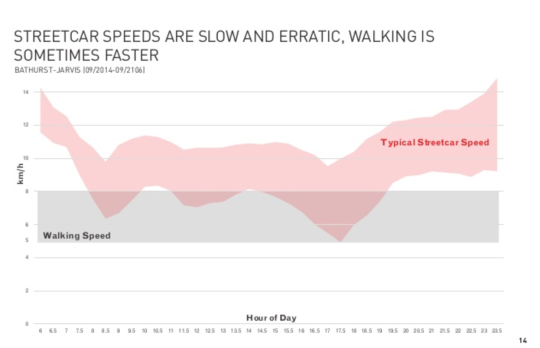
    Anyone who has ridden Toronto’s King streetcar during rush hour can tell you that the service is broken. It’s unreliable. It’s overcrowded. And during peak times it can be faster to walk. Chart below.

    Part of the problem is a misallocation of resources. Only 16% of the people who use the corridor are in cars. And yet 64% of the physical space is allocated to drivers.

    Not surprisingly, this creates a bottleneck for the ~65,000 transit riders who use the service daily. (Busiest surface route in the region.) We are not optimizing for the right variable.

    It’s for this reason that the city is working on a rethink of the corridor. I wrote about this initiative last year, but earlier this week it got a bit more real with the release of the following 3 pilot block options.

    The plan is to launch a pilot sometime this fall (2017). This is good news. 

    If you’d like to go through the full King Street Pilot Study Public Meeting presentation, you can do that by clicking here. The above images were taken from that presentation.

  • Probably the greatest life experience

    I’m in Whistler right now and I went heliboarding for the first time yesterday. It had been on my bucket list for maybe 10 years and so it feels fantastic to check it off. 

    Here’s what I can tell you: WOW. It did not disappoint. 

    It was easily one of the greatest life experiences I have ever had. We also got lucky with a crystal clear bluebird day.

    I don’t do many photoblog posts here on this blog, but I’m going to do one today, because I think the occasion demands it. But of course, even these photos don’t do the experience any justice.

    View from the helicopter:

    View over the pilot’s shoulder as we were about to land:

    Sampling of the terrain and conditions:

    Shot of our helicopter when we broke for lunch:

    Greatest turns:

    I also posted a video of the above to my Instagram.

    Regular scheduled programming will resume tomorrow.

  • America’s urban infrastructure — what to do?

    The Penn Institute for Urban Research recently asked a dozen experts to weigh in on the topic of urban infrastructure in the United States. More specifically: What should the US do? It is a direct response to President Trump’s inauguration speech, where he described America’s infrastructure in terms of “disrepair and decay.”

    The urban experts include Eugénie L. Birch, Saskia Sassen, Susan Wachter, Richard P. Voith, and many others. Richard Voith’s piece is called, Historical Patterns of Infrastructure Funding. (I was his teaching assistant while I was at Penn and I still follow his work.) 

    I found it interesting how infrastructure funding has shifted from the federal level to the local municipal level – especially in the realm of public transit. Given the rise of urban centers, this makes intuitive sense. But Voith also argues that “relying only on local funding of transportation will almost certainly result in an under supply of infrastructure.”

    For the full Expert Voices series, click here. I think many of you will like it.

  • Snapping with Spectacles

    I am testing out Spectacles by Snap Inc. right now:

    They were incredibly easy to sync with my phone (just look at your Snapcode while wearing them). And the case itself charges the glasses when you put them away. Pretty slick.

    I also started using Instagram Stories for the first time. I had been boycotting it because it was such a direct copy of Snapchat Stories, but at the end of the day, the audience is there and lots of people are using it. I capitulated.

    It’s somewhat disconcerting how quickly a product feature can be copied that immediately pulls users away. Or maybe that’s just business. I mean, if I’m already using Instagram, why not just post my ephemeral stories here, right?

    That’s why it’s so important to keep trying new things. And that’s why I think Spectacles are an important product for a company that has just filed to go public. They keep you in the moment while you share.

    I’ll report back once I’ve had more time to experiment with Spectacles. But already I can tell you this: they are fun.