Daily insights for city builders, delivered every morning at 6 AM ET. I’m Brandon Donnelly — a Toronto-based real estate developer and founder of Globizen. I’ve been writing here since 2013.

  • A prototype for low-rise intensification

    Laneway housing is back in the news here in Toronto. Last week the University of Toronto reported that they would like to build 50 laneway houses within the Huron-Sussex neighborhood and that they are aiming to start a 2 house pilot project some time in 2018.

    Here is a drawing from their Planning Study:

    image

    What you see is mid-rise infill (orange) along the main streets and low-rise infill (purple) along the secondary streets and laneways. There’s also a “living lane” that runs north-south through the neighborhood. 

    I know we’ve talked a lot about laneway housing and neighborhood intensification on this blog, but I hadn’t seen the above plan before. And I wonder if we aren’t going to look back at this neighborhood plan as a prototype for low-rise intensification.

  • Shareable cities

    The MIT Senseable City Lab recently looked at which cities are the most “shareable” when it comes to ride sharing services such as UberPOOL. Their goal was determine what fraction of individual trips (inefficient) could be shared or pooled (more efficient). To do this, they developed a single “shareability curve.” Full research paper, here.

    Not surprisingly, New York City does very well in this analysis. Its shareability is well above 95% for a delta of 5 minutes. That’s because the city has a large population, a small geographic area, enormous density, and lots of taxi traffic. (They used taxi data in their research.)

    But New York City also does very well when it comes to transit ridership. Highest in North America. So it strikes me that the characteristics that make a city “shareable” also apply to transit – which is effectively another form of ride sharing. Might we see the distinction between these 2 forms of mobility blur in the future? I think so.

  • Big bad (software) developers

    “There is no higher God in Silicon Valley than growth. No sacrifice too big for its craving altar. As long as you keep your curve exponential, all your sins will be forgotten at the exit.” –David Heinemeier Hansson

    Snap Inc. went public last week. Offering price was $17. Closing price on the first day was $24.48. Given that the company is not profitable and may never be profitable (their caveat, not mine), many people have been asking: Is a valuation somewhere around $34 billion justifiable?

    This is a common question when it comes to tech companies. And the answer usually comes down to something along the lines of this:

    The Snapchat story “is all about growth,” Mr. Nathanson said. “It’s not about economics.”

    It’s about the future.

    I love Snapchat and I think the company is run by a very creative founder. But now that Snapchat Stories was stolen by Instagram, they need, in my humble opinion, something new and killer to stick.

    How else will they meet their growth targets?

    On a related note, I recommend you read a piece by David Heinemeier Hansson called: Exponential growth devours and corrupts. That’s where the quote at the top of this post is from.

    Here is an excerpt:

    What sucker wants to earn $10 million/year at a 52.5% tax rate when you can get away with hundreds of millions in one take at just 15%? Nobody, that’s who.

    It’s hard to argue that boards, founders, and their financiers aren’t just doing exactly what the incentives are coaxing them to do.

    Which is why growth is now everything and residual value is nothing. In fact, the latter can be outright harmful to the former. When you’re being priced on the hopes and dreams of potential, reality can be a dangerous and undesired competitor. Best just to appeal to the exponential curve and let the imagination roam free. An epic capital gains score awaits!

  • Transit Flow

    This is a map of the Bay Area Rapid Transit network:

    And this is an elegant visualization by Ray Luong of ridership levels over the course of one day: February 4, 2016. If you can’t see the embedded video below, click here.

    [youtube https://www.youtube.com/watch?v=owGgbAS7Wq8?rel=0&w=560&h=315]

    Note how the lines speed up as they go through the Transbay Tube connecting San Francisco and Oakland. That’s actually what happens. Within the 10 km-long tube, the trains reach ~130 km/h, which is more than twice as fast as the average speed throughout the rest of the network.

  • Only $800,000 over asking

    Heads-up: This is going to be a Toronto-specific post.

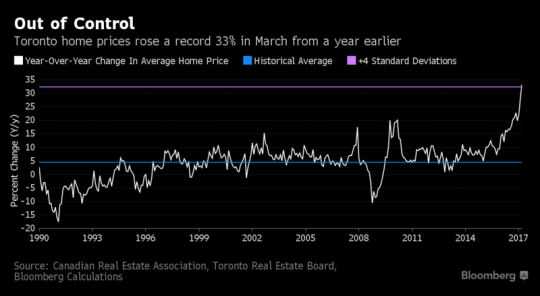
    This week there was a lot of chatter about escalating house prices in this city (though that seems to be most weeks these days).

    Paul Johnston listed a detached house in Dufferin Grove for $1,285,000 and then turned around and sold it for just over $2.1mm, with 17 potential buyers at the table. I also saw my friend post a note this morning that the average price of a detached house in Toronto has now surpassed $1.5mm.

    What I am curious about – and this is a question for all of you who live here and/or follow the market – is what response does escalating house prices trigger for you? I asked this on Twitter (via a poll), but I would be curious to get your thoughts here in the comments.

    Do you feel rushed out of fear that you may get priced out of the market? Are you now turning your attention to out of the city? Or are you looking at other housing types, such as condos? I am sure the responses will be split.

    My response: condos.

  • Big bad developer

    I just stumbled upon an older (2014) article by Oliver Wainwright in the Guardian called, The truth about property developers: how they are exploiting authorities and ruining our cities. In case the title didn’t give it away, it’s a scathing article about the current state of real estate development and city building.

    Here’s an excerpt:

    “Across the country – and especially in superheated London, where stratospheric land values beget accordingly bloated developments – authorities are allowing planning policies to be continually flouted, affordable housing quotas to be waived, height limits breached, the interests of residents endlessly trampled. Places are becoming ever meaner and more divided, as public assets are relentlessly sold off, entire council estates flattened to make room for silos of luxury safe-deposit boxes in the sky. We are replacing homes with investment units, to be sold overseas and never inhabited, substituting community for vacancy. The more we build, the more our cities are emptied, producing dead swathes of zombie town where the lights might never even be switched on.”

    Now, I’m not that familiar with the London market, so I can’t really comment on the dead swathes of zombie town. But I did enjoy the insights into the UK entitlement process.

    At the same time, my overarching thought as I read through the article was that I don’t believe that making money and doing what’s right need to be mutually exclusively. You can do both in development and in business. Making money as a developer does not mean you have to build shitty buildings.

    Part of the development game is managing an endless number of competing tensions. And profitability and responsible city building is just one of them. Of course, you have to want to do the right thing in the first place.

  • Design Canada

    Canada has a rich graphic design history and that story needs to be told. Here is a Kickstarter project that’s absolutely worth checking out: Design Canada.

    https://www.kickstarter.com/projects/1002969621/design-canada/widget/video.html

    Greg Durrell (a graphic designer from Vancouver) and Jessica Edwards and Gary Hustwit (of Film First in Brooklyn) have partnered up, and they are looking for your support to produce the very first documentary about Canadian graphic design.

    As a proud Canadian, I am thrilled to see this project. Because this is obviously not just a documentary about graphic design (though in the 60′s and 70′s we were the best in the world). It’s a story about Canada, our history, and our evolving identity.

    If you can’t see the embedded video above, click here to make your way over to Kickstarter.

  • Toronto’s first condo replacement project

    image

    Last month a deal here in Toronto caught my attention because of how rare it is. 

    It was the sale 39-41 Roehampton Avenue as a development site for a new (proposed) 48 storey condo tower.  What’s unique is that it’s being called the first ever “condo replacement” project in the city.

    What that means is that the existing 27 unit condo building (built in the 80′s) was bought out (along with some other adjoining lands) and it will be replaced by a new condo tower.

    In order for this to happen a minimum of 80% of the condo owners had to agree to the sale. According to Bisnow, the owners received approximately $550 per square foot, which is thought to be above market for the building (though well below market for new construction).

    I wonder how many owners voted no. If everybody had voted yes, they probably would have mentioned 100% buy-in. I also wonder if this could mark the start of a wave of “condo replacement” projects.

  • American optimism

    Below is an excerpt from Warren Buffet’s latest annual letter to Berkshire Hathaway shareholders (2016). It represents an entire section dedicated to American optimism, which is something you’ll notice in most (all?) of his letters. I’m a big believer in optimism, because I find it has a way of creating self-fulfilling prophecies.

    ————————————————————

    Our efforts to materially increase the normalized earnings of Berkshire will be aided – as they have been throughout our managerial tenure – by America’s economic dynamism. One word sums up our country’s achievements: miraculous. From a standing start 240 years ago – a span of time less than triple my days on earth – Americans have combined human ingenuity, a market system, a tide of talented and ambitious immigrants, and the rule of law to deliver abundance beyond any dreams of our forefathers.

    You need not be an economist to understand how well our system has worked. Just look around you. See the 75 million owner-occupied homes, the bountiful farmland, the 260 million vehicles, the hyper-productive factories, the great medical centers, the talent-filled universities, you name it – they all represent a net gain for Americans from the barren lands, primitive structures and meager output of 1776. Starting from scratch, America has amassed wealth totaling $90 trillion.

    It’s true, of course, that American owners of homes, autos and other assets have often borrowed heavily to finance their purchases. If an owner defaults, however, his or her asset does not disappear or lose its usefulness. Rather, ownership customarily passes to an American lending institution that then disposes of it to an American buyer. Our nation’s wealth remains intact. As Gertrude Stein put it, “Money is always there, but the pockets change.”

    Above all, it’s our market system – an economic traffic cop ably directing capital, brains and labor – that has created America’s abundance. This system has also been the primary factor in allocating rewards. Governmental redirection, through federal, state and local taxation, has in addition determined the distribution of a significant portion of the bounty.

    America has, for example, decided that those citizens in their productive years should help both the old and the young. Such forms of aid – sometimes enshrined as “entitlements” – are generally thought of as applying to the aged. But don’t forget that four million American babies are born each year with an entitlement to a public education. That societal commitment, largely financed at the local level, costs about $150,000 per baby. The annual cost totals more than $600 billion, which is about 31⁄2% of GDP.

    However our wealth may be divided, the mind-boggling amounts you see around you belong almost exclusively to Americans. Foreigners, of course, own or have claims on a modest portion of our wealth. Those holdings, however, are of little importance to our national balance sheet: Our citizens own assets abroad that are roughly comparable in value.

    Early Americans, we should emphasize, were neither smarter nor more hard working than those people who toiled century after century before them. But those venturesome pioneers crafted a system that unleashed human potential, and their successors built upon it.

    This economic creation will deliver increasing wealth to our progeny far into the future. Yes, the build-up of wealth will be interrupted for short periods from time to time. It will not, however, be stopped. I’ll repeat what I’ve both said in the past and expect to say in future years: Babies born in America today are the luckiest crop in history.

  • An Honest Farewell

    image

    I spent Saturday evening at Honest Ed’s for An Honest Farewell. It was a lot of fun. There were many familiar faces. And it felt very Toronto. See above photo.

    But part of me felt a bit phony pretending to celebrate the end of 68 years of operations. Truth be told, I’m not sure I ever bought anything from Honest Ed’s. Had it turned into a 3 floor super club sooner, perhaps I would have spent a bit more time there over the years.

    To me, Honest Ed’s was great big signage. 

    When I was a kid, my mom used to work on Bathurst Street just north of Bloor and I would go downtown with her early in the morning before school. It would still be dark out and I remember being so captivated by the bright lights of Honest Ed’s. That’s what the city meant to me. Lights. Flash. Excitement. It was where I wanted to be.

    A portion of the signage is being preserved and moved to Yonge and Dundas. But otherwise, this past weekend was the official end of an era. What matters now is the future of Mirvish Village. And the future is exciting.

    I’ll end with an excerpt from a recent Globe and Mail article by Alex Bozikovic:

    “The new development at Mirvish Village, after two years of conversation between developers Westbank, locals and the city, is inching closer to approval, with a new proposal submitted in January to the city. Westbank paid $72-million for the site, a big number, and yet the result is as good as private development gets in Toronto. It features meaningful preservation of heritage buildings, a serious sustainability agenda, and affordable housing – not to mention an architectural and leasing strategy geared at making the place as lively as possible, even a bit weird.”