
Daily insights for city builders, delivered every morning at 6 AM ET. I’m Brandon Donnelly — a Toronto-based real estate developer and founder of Globizen. I’ve been writing here since 2013.

  • The suburbanization of America continues

    FiveThirtyEight (Jed Kolko) published a post last month called, “Americans’ Shift To The Suburbs Sped Up Last year.” 

    What Kolko did was take recent population estimates from the US Census Bureau and group them into 6 categories based on the size of the metro and its population density. 

    By doing this he discovered something that runs counter to the narrative that we are living through an urban renaissance: lower-density suburbs grew faster than urban counties. The former grew at ~1.3% in 2016. And in the south and west, the lower-density suburbs of large metro areas topped over 2% growth.

    What gives? 

    Well, this urban renaissance is lopsided. Here’s an excerpt from the article:

    That revival is real, but it has mostly been for rich, educated people in particular hyperurban neighborhoods rather than a broad-based return to city living. To be sure, college-educated millennials — at least those without school-age kids — took to the city, and better-paying jobs have shifted there, too. But other groups — older adults, families with kids in school, and people of all ages with lower incomes — either can’t afford or don’t want an urban address.

    Richard Florida is calling this phenomenon: The New Urban Crisis.

  • Betting on electric and autonomous

    On Monday, Tesla surpassed GM in market value, making it the most valuable U.S. automaker. It’s also the first time in modern history that this title was held by a car maker not based in Detroit. The gravitational pull to Silicon Valley is immense, today.

    I subscribe to Alan Murray’s CEO Daily newsletter and his overarching comments were as follows: GM sold 10 million cars last year. Tesla sold 76,230 cars (albeit high value cars – my 2 cents). And Tesla lost three quarters of a billion dollars last year. Are we partying like it’s 1999?

    This is an expectations game.

    Elon Musk crafted an electric sports car that was actually cool and Tesla is certainly one of the leaders when it comes to autonomous vehicle technology. If Tesla is the company that transitions our economy to both electric and autonomous vehicles, then is a current market cap > $51 billion justified?

    I don’t know.

    But given how often we talk about electric and autonomous vehicles on this blog (in the context of city building), I thought it would be worthwhile to also talk about where Wall Street is putting its money and placing its bets.

  • Thickets of haphazardly planned condo towers

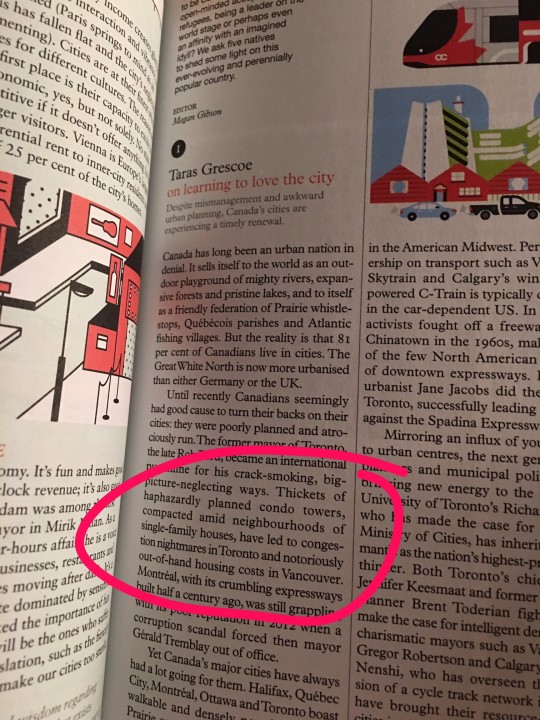
    I couldn’t sleep last night, so I got up and pulled out an old issue of Monocle magazine from my nightstand. I then stumbled upon the following article by Taras Grescoe.

    What really stood out for me was this line:

    “Thickets of haphazardly planned condo towers, compacted amid neighbourhoods of single-family houses, have led to congestion nightmares in Toronto and notoriously out-of-hand housing costs in Vancouver.”

    It bothered me for a few reasons:

    – The frame of reference is the single-family house. It perpetuates the cultural bias that what matters most in cities, like Toronto and Vancouver, is low-rise housing.

    – I don’t get the “haphazardly planned” comment. New tower development has been heavily concentrated in the downtown core, growth centers, along the Yonge subway corridor, and so on. Their built form is also significantly influenced by their relationship to these low-rise “Neighbourhoods.”

    – I believe that building up, as opposed to out, is the way to address congestion nightmares. Though I will concede that our ability to plan and execute on transit in this city is positively deplorable. 

    – How did thickets of condos create an affordability problem in Vancouver? Many factors at play in this city, including a powerful geographic supply constraint.

    Those are just a few of my thoughts from early this morning. What are yours?

  • This river I step in is not the river I stand in

    image

    I was over at the Riverside Bridge yesterday taking photos and I was reminded of Eldon Garnet’s installation called, TIME: AND A CLOCK (1995). 

    The work spans a few physical sites, but perhaps the most well known component is the line of text on the west side of the bridge, which reads in 18″ high letters: “This river I step in is not the river I stand in.” (Photo above from Garnet’s website.)

    If you’re from Toronto, you may be already be familiar with this installation. But I love the message and I think it’s an important one. So I thought I would reiterate it here on the blog. 

    The text is derived from the thinking of the Greek philosopher Heraclitus. Its meaning is a simple one: change is fundamental to the universe. 

    Neighborhoods change. Cities change. Industries change. We change. The river you first step into, is not the same river that you’ll be standing in. That initial river has come and gone, replaced by a new river. In the words of Heraclitus, “No man ever steps in the same river twice.”

    As people, organizations and cities age, there can be a tendency to resist change. I believe in fighting that tendency. 

    Because that’s how established rich companies get destroyed by young poor companies. They – the incumbents – underestimate the importance of change. They forget that the river is constantly flowing.

  • How to achieve peak productivity

    image

    Lately I’ve been finding that I need to divide my time between multitasking and blocks of uninterrupted time. The multitasking phase is doing calls, responding to emails in 3 seconds, going from meeting to meeting, and so on. It’s a mode that many of us probably exist in virtually all of the time.

    But I can’t stay in this mode all of the time. I think of it as short attention span mode. There are times when I need blocks of uninterrupted time so that I can “go deep.” One example would be to review drawings. I really need to focus so that I can think of all of the externalities associated with the decisions being made.

    This is related to my post about managers and makers, but it’s also the focus of a recent book by Cal Newport called, Deep Work: The Secret to Achieving Peak Productivity. You can read more about the book here at Knowledge@Wharton, but I wanted to highlight two concepts. The first is this equation:

    High-Quality Work Produced = (Time Spent) x (Intensity of Focus).

    Obviously the argument here is that if you want to maximize your output, you need to increase the intensity of your focus. Minimize distractions. Ratchet up the intensity. There’s only so much time in the day.

    Newport gives the example of Adam Grant. He is a New York Times bestselling author and the youngest tenured professor at the Wharton School at the University of Pennsylvania. 

    He is so committed to intensity of focus that he batches all of this teaching into the fall semester, allowing him to truly focus on the students. He’s the highest rated teacher at Wharton. At the same time, this lets him focus on research and writing during the spring and summer semesters. He’s also known to regularly use auto-of-office responders when he’s in the office, but needs to focus.

    The second concept is that of “attention residue.” The idea here is that when we switch from some Task A to some other Task B, our attention doesn’t immediately snap over. A portion of our attention remains on the original task and distracts us from fully focusing. There’s residue.

    An example of this would be when you’re working on something and you see an email come in. As soon as you turn your attention to that notification, your attention gets divided. And even if you don’t immediately respond to that email, a portion of your attention now remains with that uncompleted task. It lingers in the mind.

    The above probably makes intuitive sense to a lot of you, but in many ways our work culture today does not encourage intensity of focus.

    Thanks for reading today. There’s lots of evidence to suggest that the best way to learn new things is to not simply read about it, but to share it with others. That’s one of the reasons I blog and hopefully you find that valuable.

  • Case Study: Chophouse Row, Seattle

    The Urban Land Institute recently published an interesting case study for a project in Seattle called Chophouse Row

    It is the last phase in a series of projects that the developer, Liz Dunn, has been involved with in the neighborhood over the last 16 years.

    This particular project has 25,317 sf of office, 6,379 sf of retail, and 4,795 sf of residential (3 penthouses). It also incorporates a heritage building. Good example of fine-grained urban infill.

    Here is the video (click here if you can’t see it below):

    [youtube https://www.youtube.com/watch?v=_PmAMsWEv98?rel=0&w=560&h=315]

    On a related note, ULI’s 2017 Toronto Symposium is coming up later this month (April 24 – 25, 2017). Here is the program. 80+ speakers. If you’d like to register, you can do that there.

  • Free ice cream

    I was out for dinner this evening and the topic of road tolls (road pricing) came up. All of us at the table agreed that this was a missed opportunity for Toronto. Yes we proposed it, but then we got cold feet and backed away.

    Why might this be a good idea?

    City Observatory did a good job explaining this with their post about free ice cream day at Ben & Jerry’s. They argued that this sort of promotion actually provides a great crash course in transportation economics. Nobody is paying, but the lines are real long.

    Here’s an excerpt:

    Substitute “freeway” for “free cone” and you’ve got a pretty good description of how transportation economics works. When it comes to our road system, every rush hour is like free cone day at Ben and Jerry’s.  The customers (drivers) are paying zero for their use of the limited capacity of the road system, and we’re rationing this valuable product based on people’s willingness to tolerate delays (with the result that lot’s of people who don’t attach a particularly high value to their time are slowing down things for everyone).

    What we are talking about is simple, but apparently it’s not easy to execute on.

  • Ingressi di Milano

    A new architecture book, called Entryways of Milan, will be released next month that profiles some of the city’s most beautiful residential entryways. There are 144 of them and they are housed in buildings dating from 1920 to 1970. For a sneak peek of the architecture, click here.

    What makes a book like this interesting is that these are private entryways, which means they are spaces that are largely overlooked within a city. They are the spaces that mediate between public (street) and private (residences). The book also dives into things like materials and the art-historical and social significance of each lobby.

    I am now wondering if similar books or photography projects exist for other cities. I think it would be fascinating to compare residential entrance halls across different cities during the same time period. Although the above Milanese lobbies have set the bar pretty high. 

  • The Millennial Dream [Documentary]

    Back in 2015, I was interviewed for a documentary called The Millennial Dream. I then completely forgot about it until somebody tweeted it at me yesterday. So the documentary is out – it was released last year – and you can rent it or buy it on iTunes.

    The documentary calls into question the [North] American Dream. This idea that you just have to work hard, save up, buy a house in the suburbs, pay off your debt, and then everything will be just fine. For many, that dream is quickly disappearing, if it hasn’t already.

    Enter the Millennial Dream. Our economy is changing. Our jobs are changing. Our cities are changing. And by 2020, the Millennial generation is expected to form 50% of the global workforce. What is this generation dreaming about? That is what this documentary is about.

    But I should probably stop here because I haven’t actually seen the film. I could be overselling it. I’ll watch it this weekend and then report back. If you can’t see the trailer embedded below, click here.

    [youtube https://www.youtube.com/watch?v=CVCNXJk2fT8&w=560&h=315]

  • Knowing how (automated medicine)

    I should read The New Yorker more often. I’m going to subscribe right now (done). The articles are fantastic. In the April 3, 2017 issue, Siddartha Mukherjee wrote a piece talking about automated medicine. It’s called A.I. Versus M.D.

    Here is an excerpt:

    His prognosis for the future of automated medicine is based on a simple principle: “Take any old classification problem where you have a lot of data, and it’s going to be solved by deep learning. There’s going to be thousands of applications of deep learning.” He wants to use learning algorithms to read X-rays, CT scans, and MRIs of every variety—and that’s just what he considers the near-term prospects. In the future, he said, “learning algorithms will make pathological diagnoses.” They might read Pap smears, listen to heart sounds, or predict relapses in psychiatric patients.

    This is a world where you could snap a photo of your unsightly rash, submit it, and then have a machine provide a diagnosis. This is a world where early detection and prevention would become common place. Already, today, there are instances where learning-based algorithms (distinct from rule-based) have proven to be more accurate than raw humans.

    I don’t know how you all feel about this, but I actually feel a sense of comfort thinking about this as the future of medicine. There’s piece of mind that comes with large amounts of data and the discipline of algorithms. At the same time, this is not necessarily about replacing humans. It is also about augmenting human ability.

    If it leads to better health outcomes, then why wouldn’t we?