Daily insights for city builders, delivered every morning at 6 AM ET. I’m Brandon Donnelly — a Toronto-based real estate developer and founder of Globizen. I’ve been writing here since 2013.

  • Today I am N+1

    Today is my birthday. 

    I am one year older, at least at face value. This got me thinking about something I read a number of years ago on Fred Wilson’s blog called The N+1 theory. The basic premise is as follows: whatever it is, there could be one more. It is an optimistic viewpoint that emphasizes continuous improvement and change.

    For example, let’s say you’re designing a building and you’re trying to make it as energy efficient as possible. You might think that you’ve arrived at the most efficient outcome, but in fact you’re probably just sitting at N. Stretch yourself. Go for N+1.

    Let’s say you’re working out at the gym and you feel you’ve done as many reps as you could possibly do. Well, if you stretched yourself, you could probably do N+1. People who lift weights will also tell you it’s that one additional rep that counts the most. 

    The mantra: Do as many or as much as you can possibly do (N), and then do one more (+1). The N+1 theory is a growth mindset. And if you apply this thinking throughout your life, I am sure you would see many benefits.

    At the same time, one could imagine this theory being applied in a destructive way. In a relationship, for instance, is it healthy to think of your significant other as N, meaning that you should be looking for someone better? That N+1. This strikes me as an unhappy way to live. I would prefer to apply this theory in a productive way. 

    Whatever the case may be, today I am firmly N+1. And I feel good about that.

  • Introducing lanewaylove.com — my laneway house is back!

    One of the most widely read posts on this blog is this one here, called: Why it’s next to impossible to get a laneway house built in Toronto. Clearly, there’s a tremendous amount of interest in this housing type both here in the city and elsewhere.

    Since I wrote that past over 2 years ago, I have been bombarded with emails from people asking me the status of the project and if I could help them achieve something similar on their properties. And my response was always the same: sorry, the project is on hold.

    But over the last few years, things have changed. Home prices have risen dramatically in this city. At the beginning of 2017, the average price of a detached house reached almost $1.6 million – representing a year-over-year increase of nearly 30%!

    In part because of this, laneway housing has also entered mainstream consciousness thanks to groups and initiatives such as The Laneway Project, Lanescape, Evergreen, the University of Toronto, and so on. There are now Councillors advocating for them within City Hall, which was not the case even a few years ago.

    Given all of these changes, I decided that it was time to dust off my laneway house design and make a serious go at it. So I called up my architect friend Gabriel Fain and asked him if he would help me pioneer this new housing typology. He immediately said yes.

    Last week a revised version of Mackay Laneway House was submitted to the city, kick-starting the approvals process. Here’s a rendering showing the north elevation (view from existing house):

    image

    The next step will be a trip to the Committee of Adjustment to obtain the necessary variances. But even with all of the momentum building in the city right now around more affordable housing solutions, this will not be a slam dunk. 

    So in parallel to all of this, we have also launched a new website called lanewaylove.com. Here you will find general information about laneway housing, as well as floor plans of the proposal. But most importantly, we hope it will serve as a tool to generate support for this and other laneway houses in Toronto.

    At the bottom of the site is a link that will allow you to support Mackay Laneway House by submitting your name, email, and postal code. The reason it also asks for your postal code is so that we can anonymously match supporters with specific areas of the city. We think this will be valuable information going forward.

    If you believe that Toronto would be well-served by more affordable and sustainable housing solutions, I would encourage you to sign your name at lanewaylove.com and share this post with your network. We would greatly appreciate your support.

    Here we go!

  • Retail tipping point

    Venture capitalist Benedict Evans recently published a post on his blog called, Ten Year Futures. If you haven’t already noticed, I really enjoy this sort of curiosity and line of thinking. Here is an excerpt where he talks about retail being at a tipping point:

    “First, ecommerce, having grown more or less in a straight line for the past twenty years, is starting to reach the point that broad classes of retailer have real trouble. It’s useful to compare physical retail with newspapers, which face many of the same problems: a fixed cost base with falling revenues, the near-disappearance of a physical distribution advantage, and above all, unbundling and disaggregation. Everything bad that the internet did to media is probably going to happen to retailers. The tipping point might now be approaching, particularly in the US, where the situation is worsened by the fact that there is far more retail square footage per capita than in any other developed market. And when the store closes and you turn to shopping online (or are simply forced to, if enough physical retail goes away), you don’t buy all the same things, any more than you read all the same things when you took your media consumption online. When we went from a corner store to a department store, and then from a department store to big box retail, we didn’t all buy exactly the same things but in different places – we bought different things. If you go from buying soap powder in Wal-Mart based on brand and eye-level placement to telling Alexa ‘I need more soap’, some of your buying will look different.”

    I’ve said this many times before, but the way the above excerpt ends is yet another remind that one has to look deeper beyond the obvious change(s). Yes, ecommerce is growing and impacting physical retail. But what other changes might ensue because of this shift?

  • Technology and the city

    Embedded at the bottom of this post is a great rapid-fire talk by Edward Glaeser about technology and the city. 

    Technology has always been a fundamental driver of change within our cities and I like how Glaeser starts by referring to these forces as either centripetal and centrifugal. The car was an example of the latter. It spread us out.

    At the same time, Glaeser points out that the car was really the first time that urban mobility patterns shifted from hub-and-spoke to point-to-point. Transit systems rely on hubs and some walking, which in a world of cars has led to something we call the last mile problem.

    Also worth noting is the fact that Glaeser is terrified about what autonomous vehicles will do to our cities. His point is that the fundamental law of highway traffic has shown that vehicle miles traveled increases basically 1:1 with highway miles built.

    So if all of a sudden AVs are able to decrease the cost of mobility, provide capacity benefits, and increase rider enjoyment (because you’re no longer a driver), vehicle miles traveled are going to go through the roof. This makes a strong case for some form of road pricing.

    But it also means that unlike traditional cars, which were a centrifugal force, AVs could in fact turn out to be a force that further centralizes us within dense urban centers.

    When you listen to Glaeser’s talk, you will quickly understand why so much attention (this blog included) is being paid to autonomous vehicles. They are one of – if not the – next great technology bound to reshape our cities.

    If you can’t see the video below, click here.

    [youtube https://www.youtube.com/watch?v=lbGwhWbuhfg?rel=0&w=560&h=315]

  • 5 decades of condo development in Toronto

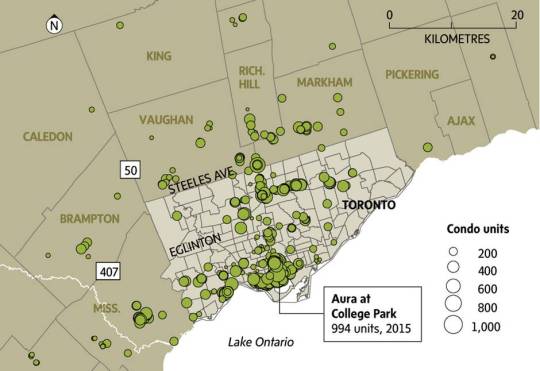
    Jeff Gray and John Sopinski just published a terrific set of maps in the Globe and Mail outlining 5 decades of condo growth in Toronto.

    Ontario first introduced the Condominium Act in 1968. The first condo project was supposedly built by Bert Winberg – founder of Rockport Group – between 1968-1969. He saw what developers were doing in California and Florida and he brought it to Toronto.

    Since then, here is what condo supply has looked like across the Greater Toronto Area:

    • 1970s – 11,697 units
    • 1980s – 30,881 units
    • 1990s – 49,503 units
    • 2000s – 103,683 units
    • 2010s – 109,497 units (up to September 2016)

    And here’s the map for the 2010s:

    We are now a condo city. For the full set of maps, click through here.

  • Instagram Stories has more active users than all of Snapchat

    Instagram has a company chart that shows: Days to Reach the Next 100 Million Users. It is only the chart where they want to see it decline. The first 100 million users took 28 months. And the last took only 4 months. Instagram now has 700 million active users.

    Instagram is also saying that they have 200 million people using their Stories feature – you know, the feature they blatantly stole from Snapchat. This would mean that more people are using Instagram Stories than Snapchat has daily users (~158 million).

    Anecdotally, I can tell you that I’ve almost completely stopped using Snapchat. (Snapchat battery usage over the last 7 days = <1%.) I still prefer Snapchat’s direct messaging functionality, but not enough to continue using the platform. Instagram now provides basically the same functionality – plus my photos – in a single app. 

    But more importantly, Instagram’s network and my network are bigger there. And network effects are clearly the most important thing. In fact, by directly copying Snapchat, Instagram (Facebook) made sure that this competition was only about network size and not about features. Monopoly power.

    In real estate, if you own a property in a great location, your position is pretty defensible. (Though you may not be completely immune.) But in tech, that is clearly not the case. Someone might copy everything you’ve done and beat you at your own game.

    As someone who used to be very bullish on Snapchat, I am now wondering if I need to remove my Snapchat handle from the header of my blog emails. I mean, I’m not there very often anymore. But maybe, just maybe, Snapchat will find a way to compete outside of network effects at a game that Instagram/Facebook can’t play.

    How would you or are you placing your bets?

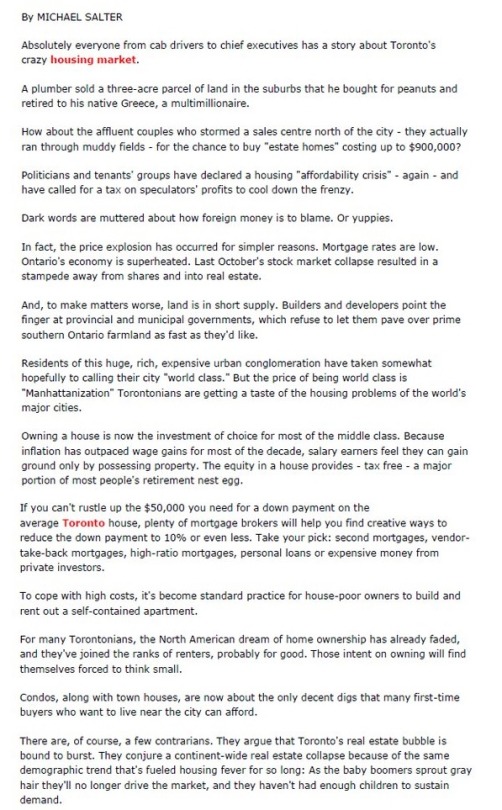
  • HOT, HOT HOUSES

    Below is a piece by Michael Salter from the Globe and Mail. It’s all about Toronto’s HOT, HOT housing market. Michael’s message: Here are the real reasons why home prices are skyrocketing and why they are going to remain high.

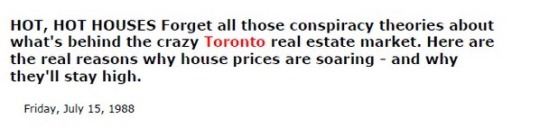
    Did you find yourself agreeing with this article or did you notice that something was off? If you noticed something, it may be because this article was originally published on Friday, July 15, 1988. And by that time, the North American dream of home ownership had already died in Toronto.

    Here’s the header I cut out from above:

    Thank you to Tamsin McMahon for tweeting this out last weekend.

  • Envelope Beta

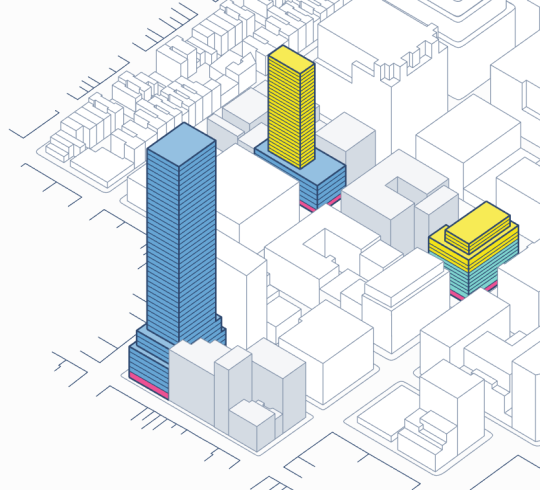
    My friend Bruce of getrefm.com (real estate financial modeling) just introduced me to a new real estate startup called Envelope. Basically it’s 3D mapping software that allows you to quickly visualize the zoning envelope for a particular site. It’s similar to what Flux.io was initially trying to do.

    Now, I think this is very cool, but my first reaction was: What if the zoning is out of date? What if approvals/entitlements are done a site-specific basis? This isn’t the case in every city, but I’ve heard some people in Toronto argue that this city basically has no zoning code. (We can debate that one in the comments, I’m sure.)

    That being said, there are still many design guidelines in this city that shape built form and I could see a tool like this being incredibly useful. They’re still in private beta but I would like to try it out. Hopefully they’ll see this blog post and let me have an early peek.

    Image: envelope.city

  • E20_Private Residence

    The private residence below is located on a quiet street in the village of Pliezhausen – about 30 km south of Stuttgart. Designed by Steimle Architekten, the house is 376 square meters and sits on a 658 square meter property. Its insulated concrete shell is 50 cm thick. All photos by Brigida González.

  • How urban density dictates how we vote

    “It’s remarkable that even as the internet disperses information and enables us to form online communities across great distances, our politics are still highly correlated with physical environments. Who we are is largely defined by where we are. For architects and urban designers, this is an important reminder that space is and always has been political, from the days of the valley section to the postmodern stage of Trump.”

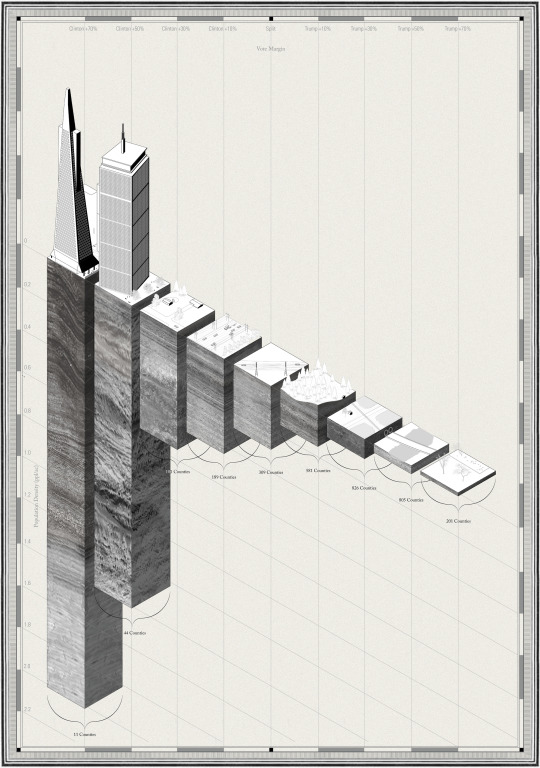
    The above excerpt is from a Places Journal article by Neeraj Bhatia called, Environment as Politics. The premise of the article is that residential population densities have long shaped political outcomes and that that was certainly the case in the 2016 U.S. presidential election.

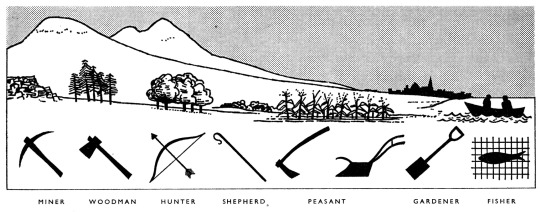
    But before we get into the work and drawings of Places Journal, let’s first talk about one of the inspirations mentioned in the article. In 1909, the pioneering town planner Patrick Geddes drew the following “Valley Section”:

    The point of this section drawing is to make clear the relationship between humans and their environment. In this case, it speaks to occupation. The physical geography of where you lived determined what you did: fish, hunt, mine, and so on.

    For those of us now living in cities, these “natural occupations” may not seem all that relevant. But that same human-environment relationship remains.

    In the 2016 election, 49 of the 50 highest density counties voted for Hillary Clinton. And 48 of the 50 lowest density counties voted for Donald Trump. It turns out that how close you live to your neighbor had/has a tremendous impact on your political views and the way you vote(d).

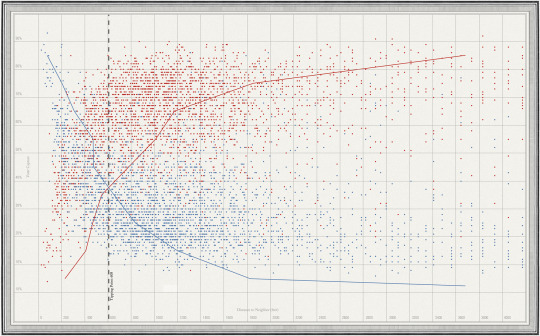
    Below is a chart from Places Journal that plots the 2016 election results for all U.S. counties:

    On the y-axis is “vote capture” by Democrats and on the x-axis is “Distance to Neighbor (feet).” What you see here is a dramatic drop off in liberal voting as distance to neighbor increases. And the tipping point appears to about 608 feet.

    Part of the explanation for this is that living in close proximity to others change how we feel about others. It can reduce fear and prejudice. In other words, it makes us more open. And as Bhatia points out in his article, one could argue that this last U.S. election was in fact a “clash over the openness of society.”

    We often talk on this blog about how space impacts our lives. As Jan Gehl once said: we shape cities and then cities shape us. Today we are reminded that space is also highly political.

    In my case, the distance to my neighbors is likely about 8-10 inches. Sometimes I can hear somebody sneeze. But most of the time I don’t hear anything at all. It’s usually pretty quiet around here. Whether I acknowledge it or not, this distance is shaping me and how I see the world.