Daily insights for city builders, delivered every morning at 6 AM ET. I’m Brandon Donnelly — a Toronto-based real estate developer and founder of Globizen. I’ve been writing here since 2013.

  • Accelerating and compounding Canadian entrepreneurship

    September 24, 2025 · View original


    I was just reading about Simple Ventures. They are a Toronto-based venture builder that has raised $15 million to help create 25 high-growth companies headquartered in Canada by 2030. Some of their investors include TD Innovation Partners, Sun Life, Sobeys, and Harley Finkelstein (President of Shopify).

    Now, I’m not a venture capital expert, but this seems to me like a relatively small amount. (They plan to raise another $5 million by the end of the year.) So I would encourage more institutions and rich people to step up with their wallets, because you have to applaud their mission:

    > “We are coming together to issue a call to action – bring Canadian talent home,” said Rachel Zimmer, exited founder and Co-Founder and CEO of Simple Ventures. “This funding will allow us to build great Canadian Headquartered companies. Now is a crucial time to join our mission to put fire in the Canadian engine.”

    > Canada still has 100,000 fewer entrepreneurs than it did 20 years ago, despite the population increasing by over 10 million during the same period. At the same time, nearly one-third of Canadian immigrant entrepreneurs move to the U.S., citing limited support for scaling businesses at home. Simple Ventures tackles this problem by sourcing new company ideas, validating them, and pairing them with Canadian leaders to co-create ventures.

    There’s absolutely no shortage of smart, ambitious, and entrepreneurial Canadians. Where we need to improve is in commercializing and scaling our ideas. And it’s crucial we do this as quickly as possible because there are powerful compounding benefits to entrepreneurship.

    When a new company scales, it creates jobs, wealth, and knowledge. These ingredients can, and usually are, used to start a growing subset of even bigger companies. Venture capitalist Fred Wilson once referred to this as The Darwinian Evolution of Startup Hubs.

    > If you study Silicon Valley, what you see is something that looks like a forest where trees grow tall, produce seeds that drop and start new trees, and eventually the older trees mature and stop growing or worse, die of disease and rot, but the new trees grow up even taller and stronger.

    > If you drill down a bit deeper, you see that the founders, investors and early employees generate a tremendous amount of wealth from these big successes. The later employees don’t make as much wealth but they do learn a ton and make enough money that they don’t need to work for someone else and so they strike out on their own and are often funded by the folks who made the big money in the prior startup. That’s how the seed drops from the tree and starts a new tree growing. This continues on and on and on.

    When you think of startups and entrepreneurship in this way, you start to see just how important it is for us to keep growing our forests, instead of chopping down our trees and shipping them to the US. This is an exercise in city and nation building. And so I wish the team at Simple Ventures nothing but success.

    LFG, Canada. If you’re working on something and would like to pitch SV, click here.

  • Penn launches new program in property development and design

    September 23, 2025 · View original


    I’m excited to learn that the University of Pennsylvania Stuart Weitzman School of Design has just launched a new master’s program that is intended to fill the gap in education between design and real estate development. It’s called the Master of Science in Design with a concentration in Property Development and Design (or MSD-PDD).

    From the sounds of it, it’s an expansion of the certificate program in real estate development that I did while I was there. Good. It’s also something that I’ve been advocating for at the University of Toronto for over a decade. We need more bilingual city-building professionals who understand both design and real estate development.

    My initial comment is that I hope they’re really drawing on and leveraging the resources of the Wharton School. That’s what will really make this program stand out against many similar programs. When I was there, I remember them having two different real estate finance classes: one for MBAs and one for designers (which had been made deliberately easier).

    I thought this was bullshit, so I met with the program coordinator and requested to be admitted to the MBA one. He strongly advised against it and said that it’s, you know, really hard. But that only made me want to take it even more. I ended up getting an A.

    So my piece of unsolicited advice for this nascent program is: don’t baby the designers when it comes to business and finance. Because the market certainly won’t.

  • Toronto is finally intensifying its neighborhoods

    September 22, 2025 · View original


    > Tweet: It’s happening. Toronto is intensifying its neighborhoods with fourplexes, fiveplexes, sixplexes, and laneway homes. https://t.co/ARCHTjWI65

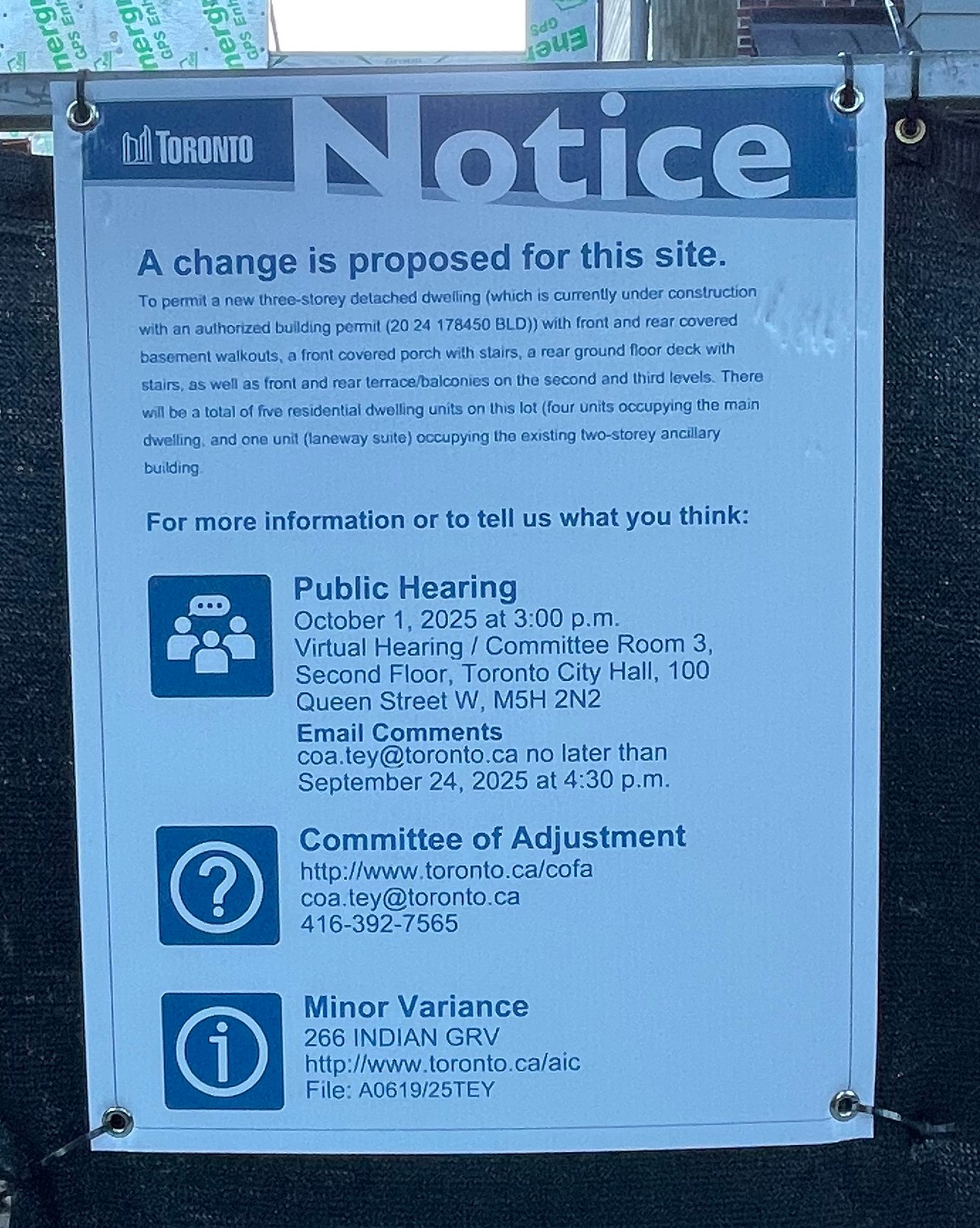
    Bianca and I went for a walk around the Junction over the weekend, as we like to do, and I was pleasantly surprised to find a number of “multiplexes” under construction. That is, small infill rental projects with four or five homes, sometimes including a laneway house at the back. (Sorry, no sixplexes were spotted just yet.) It immediately made me think, “Wow, it’s happening! Toronto is intensifying its neighborhoods.”

    For those of you who haven’t been following closely, many of Toronto’s neighborhoods have been bleeding population over the past few decades. It’s only where we’ve allowed larger-scale new developments that we’ve really seen populations increase. That’s what has precipitated our current push to expand housing options in our low-rise neighborhoods. And already, you can find evidence that it’s starting to work.

    That said, it’s worth mentioning a few things. Some of the planning notice signs that I stumbled upon dated back to 2022, and some were current. This raises at least two lines of questions. One, why is a small project that went to the Committee of Adjustment in 2022 still under construction? Was it because of planning delays, or something else? And two, why are today’s projects still having to go to the CofA? Are we still not there yet in terms of the planning policies?

    I don’t know the precise answers to these questions, but I do know that planning staff actively monitor which variances are requested and ultimately approved. If the same variance continues to show up, then it’s a clear indication that it should just become policy, and not be something that needs to be sought. This should give some comfort that we should only get better at facilitating this scale of housing.

  • US moves to grow tech employment in Canada, India, and China

    September 21, 2025 · View original


    The H-1B visa is a nonimmigrant employer-sponsored program that allows US companies to hire foreign nationals in “specialty occupations,” typically requiring a bachelor’s degree or higher. The vast majority of these occupations are computer-related (69% of petition filings according to 2017 data). And they are disproportionately filled with high-skilled talent coming from two countries: China and India (85% of filings for the same time period).

    So this week’s announcement that H-1B visas will now require employers to pay $100,000 per year per visa is a direct way of saying, “we want fewer people from China and India working in tech in the US.”

    But as with most economic policies, it’s more than that. And we already have the research. In 2020 (and then in 2023), Britta Glennon of the University of Pennsylvania (my alma mater) studied the effects of restricting high-skilled labor on offshoring. More specifically, she looked at two visa supply shock periods: the first being a 2004 cap that lowered H-1B visas by 70% and the second being a 2008–2009 lottery program which generated a random negative shock.

    What she uncovered in the first case was that the 2004 policy change increased foreign affiliate employment by 27%! And in the second case, a random one-percentage-point drop in H-1B visa supply caused an increase in the foreign affiliate growth rate of between 12 and 16%. Said differently, when H-1B visas become harder to get, US tech companies simply hire more people in other countries.

    More specifically, they ramp up hiring in these three countries: China, India, and Canada. China and India are what you might call a direct channel. The company just opens or expands an existing office by hiring the people that would have otherwise come to the US. Canada, on the other hand, largely serves as an indirect channel. We become a conveniently-located conduit through which US firms can hire the same high-skilled humans from China and India (because we don’t restrict high-skilled talent in the same way).

    So another way to interpret this week’s announcement is that the US is making deliberate moves to increase high-skilled tech employment in Canada, China, and India. That’s a good thing for these countries. Of course, the real opportunity is not as an affiliate or back-office location for US firms. The real opportunity is to harness this high-skilled talent and empower them to start their own companies in the countries where they will now live.

    Next to the US, China is likely in the best position to do that. But it’s also Canada’s opportunity to squander.

    Update: After clearly stating that it would be an annual fee of $100k and that the big tech companies all “love it,” it appears the US has backpedaled. It will now be a one-time fee of $100k paid at the time of petition filing. This is still a lot. Currently, the fees are in the hundreds of dollars.

  • None of us should be driving cars anymore

    September 20, 2025 · View original


    About a year ago, I wrote this post saying that autonomous vehicles were already safer than human-driven ones. This claim was based on safety data from Waymo and about 22 million rider-only miles. (Rider-only means no human driver.) A year later, Waymo now has over 96 million rider-only miles across Los Angeles, San Francisco, Phoenix, and Austin (through to June 2025) — and their safety record is only becoming more compelling.

    Here’s an updated data set and a chart showing any-injury-reported crashes (average benchmark vs. Waymo):

    What immediately stands out is that Waymo has virtually eliminated the most common and deadly type of crash: vehicle-to-vehicle crashes within intersections. Compared to the benchmark, they are down 96%. They’ve also reduced single-vehicle crashes by 96%, pedestrian crashes by 92%, motorcycle crashes by 89%, and cyclist crashes by 78%. These are all remarkable figures and evidence that we are solving one of society’s greatest safety problems.

    It also tells me that, as humans, our driving days are numbered. Pretty soon nobody will want us behind the wheel of a car. It will be viewed as too dangerous. And that’s fine by me.

  • Running through New York City

    September 19, 2025 · View original


    YouTube video

    I’m not a runner. I’ve just never gotten into it. But I can appreciate why people love it, and I imagine that some of the things I love about cycling also happen with running. One of those things is the ability to experience a place while working out.

    Here’s an example.

    I think this recent video by Satisfy does a great job of capturing what it must feel like to effortlessly glide through a city like New York. They also picked the perfect song, so turn your sound on. If you enjoy running and/or NYC, you’ll enjoy the video.

  • The Coffee is coming to Junction House

    September 18, 2025 · View original


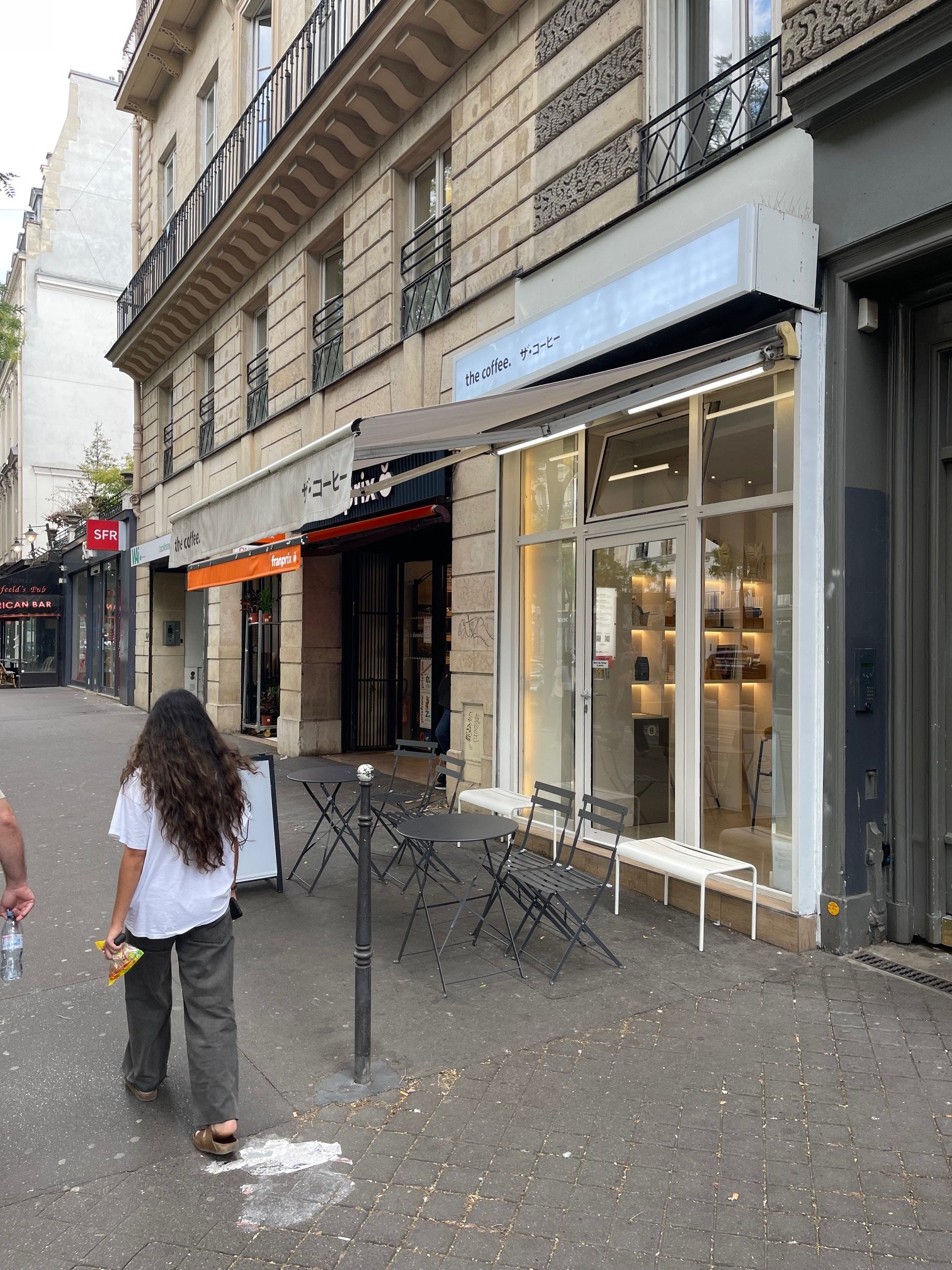
    Last week in Paris, we went to check out the above café called The Coffee. It was our first time. The brand is a Brazilian coffee chain founded in 2017 by three brothers who wanted to combine Japanese minimalism with the best of Brazilian coffee. Brazil, by the way, is the world’s largest producer of coffee.

    Since then, they’ve gone on to open nearly 300 stores around the world — from Rio de Janeiro to Paris and Seoul to Sydney. Earlier this year, they opened their first locations in Toronto: on King Street West, in the Financial District, and in Yorkville. And today, I’m excited to share that their next location will be at the base of Junction House.

    This feels like a perfect fit for the area and the building. One of the things that we tried to do with the design of the project was blend Canadian minimalism with the rich history of the Junction. So I’m happy to see this brand land here, especially since we (the developer) no longer own the retail component and weren’t involved in the leasing. Kudos to Lee Chow Group (the owner) and the JLL Retail Group.

    It’s exciting to see a global brand like The Coffee choose the Junction. They clearly know what’s up. I’m now looking forward to becoming a loyal customer.

    If you’d like to follow them on Instagram, here’s their Canadian account.

  • By 2080, nearly everyone will live in a city

    September 17, 2025 · View original


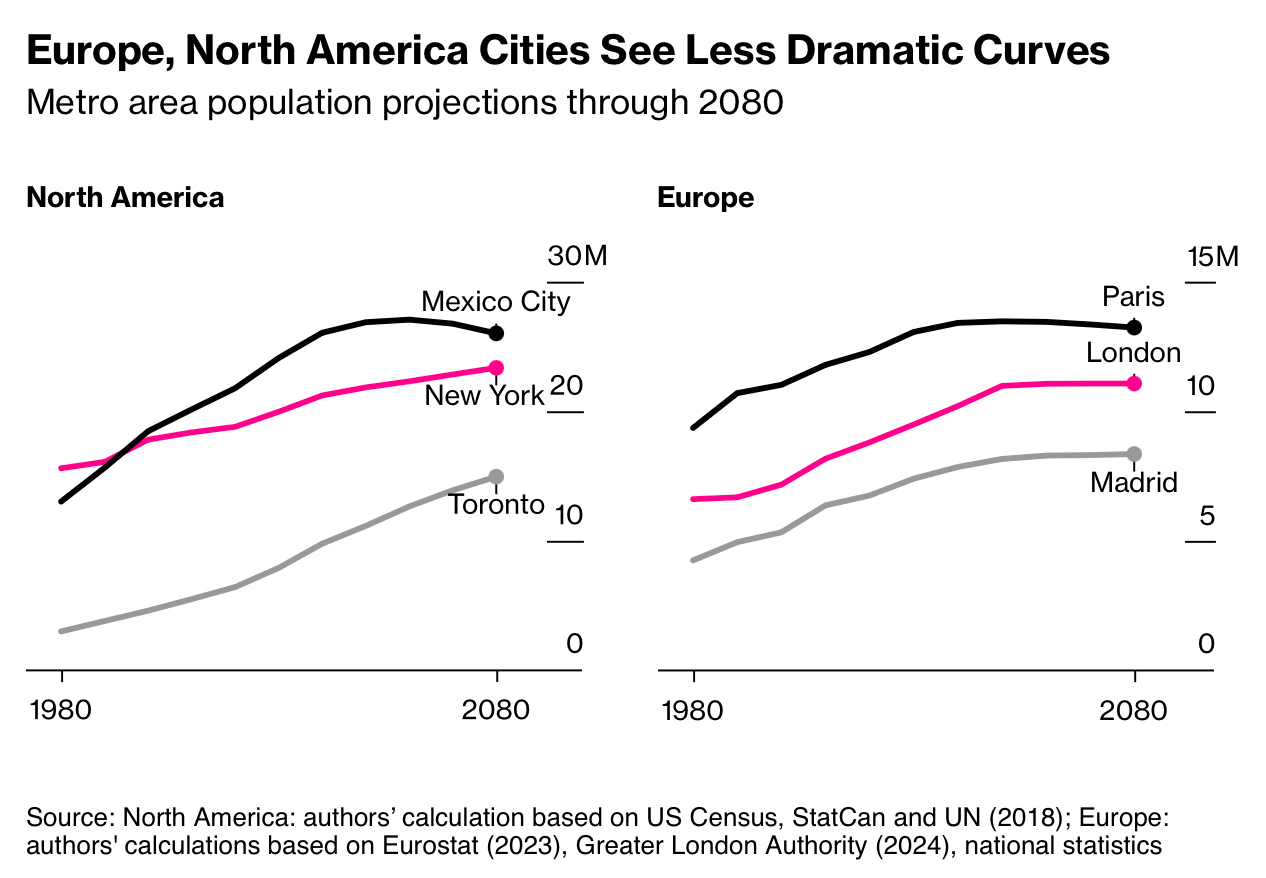
    Cities exist because they offer economic and social benefits. People generally come to cities to make money, find a partner, and interact with other humans. Occasionally, we underestimate this desire to cluster — which was the case during our recent pandemic. But the reality is that this is a human tendency that has existed for thousands of years and that also happens to be accelerating.

    I mean, as recent as 1980, only about 40% of the world’s population was living in an urban area. Today, this figure is closer to 60%, and by 2080, it is predicted that up to 90% of the people on this planet will live in an urban center.

    This will take the number of megacities with over 10 million people from 3 (in 1980) to nearly 100 in 2080 (according to projections from UN-Habitat). But here’s the thing: cities help people become wealthier, but once people become wealthier, they tend to have far fewer children. This inverse correlation is well established. So intuitively, there should be limits to the growth we are seeing.

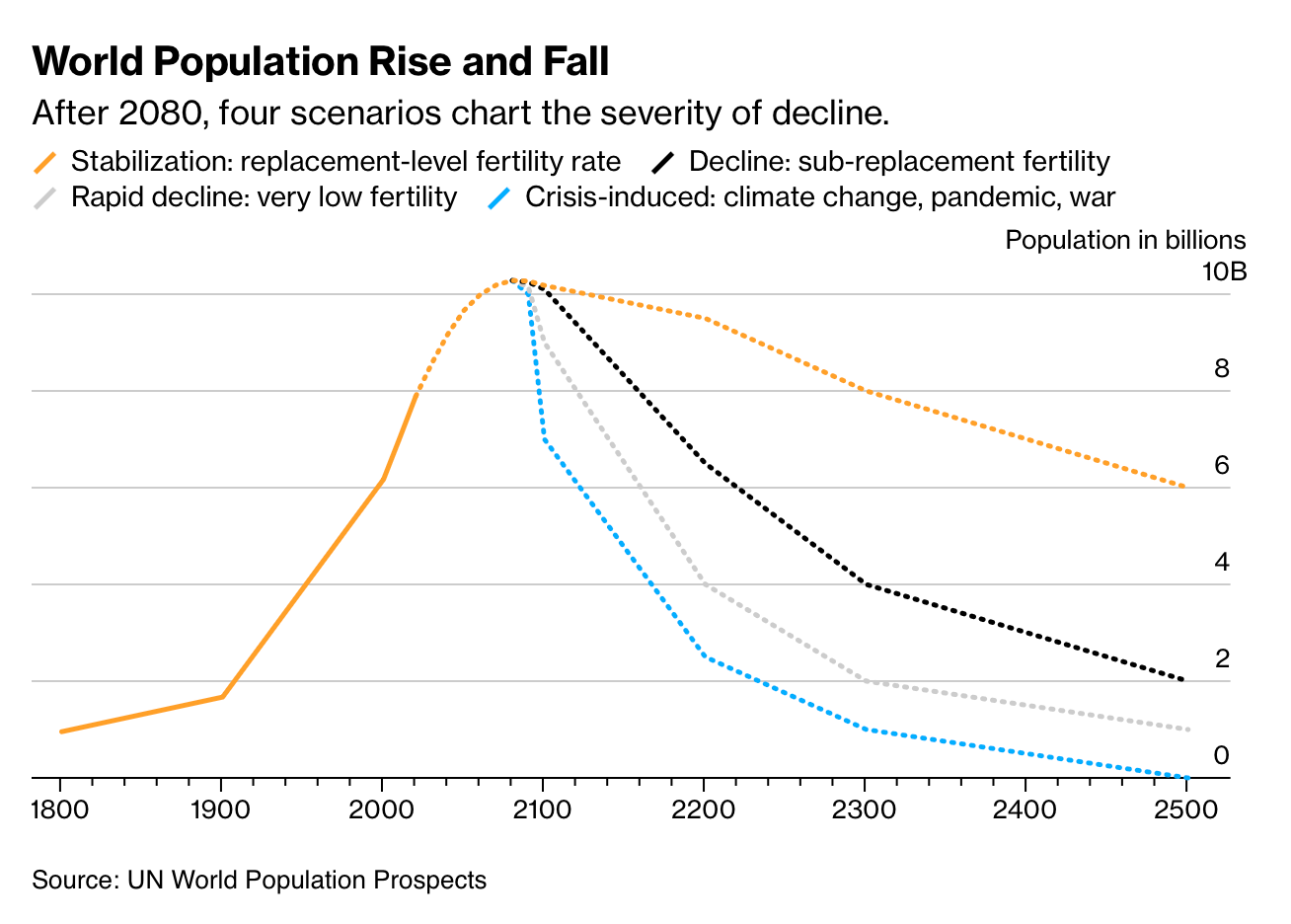
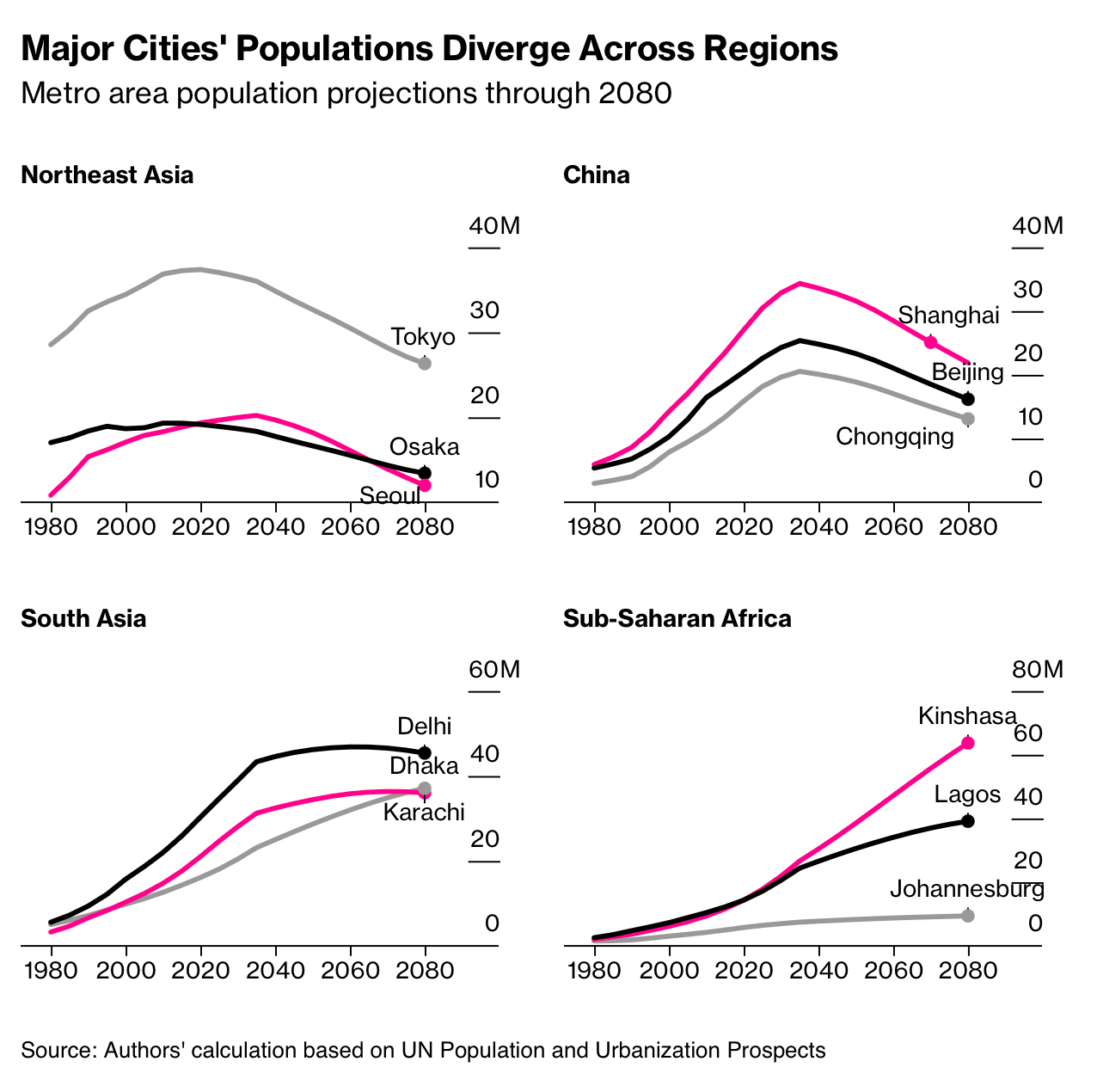
    Here’s an interesting article from CityLab by Greg Clark, Borane Gille and Jennifer Dolynchuk that pegs this peak somewhere around 2080. We will still remain extremely urban, but overall our population will start to decline. And for some cities, like Tokyo, this decline has already started.

    Charts via CityLab

  • Cities are like pomegranates

    September 16, 2025 · View original


    I’ve been trying to think of the right city analogy to explain what it’s like to really experience a place. Onions are perhaps the obvious choice because of the layers you peel back. But that’s not entirely accurate, because the layers of an onion tend to be uniform. I think a better choice would be a pomegranate.

    Pomegranates are a nice-looking fruit. Good colors. They also have high symbolic value in many cultures. They are typically associated with abundance and fertility. And so I would imagine you could enjoy one just by looking at it or by having an artificial replica of one on display.

    But the real benefits of a pomegranate arrive when you dig for its jewel-like seeds, called arils. This is the stuff that tastes good and is rich in antioxidants, fiber, and vitamins. But it requires some work to uncover these seeds and they’re not uniformly distributed. Instead, they tend to be clustered. They are also surrounded by a white membrane that is bitter and generally unpleasant to eat. So most people work around these parts.

    This is a lot like how cities work. It’s easy to experience a city on a superficial and symbolic level. Most cities have a prejudicing brand that gives you some indication of how you should feel while you’re there. But the best parts come when you go digging. There will be bitter and unpleasant parts, no doubt, but that’s just the price you pay to enjoy their hidden jewels.

    If any of you can think of a better fruit or vegetable to use, please let me know.

  • A few observations about Paris (second edition)

    September 15, 2025 · View original


    Our time in Paris has come to an end. It’s time to get back to the greatest city in the world (Toronto). As has become customary around here, I’d like to summarize some of my anecdotal observations from the trip. Here goes:

    – The first one is an obvious one. Paris has transformed itself into a cycling city. Bold planning moves have explicitly prioritized biking, and you can feel it everywhere you go, including outside of the Périphérique. Young and old, families and individuals, everyone seems to cycle in Paris. In parallel to this, it feels like there has been a noticeable reduction in vehicular traffic. Many of the smaller streets around Paris almost feel like they’ve been pedestrianized. But in fact, it’s just because there are so few cars. – Because of this change, I asked an Uber driver this past week if traffic has gotten worse and if it has generally gotten harder to drive in Paris. His response was absolutely. So I then asked him how Parisians generally feel about all of the changes and all of the new cycling lanes. The first part of his answer didn’t surprise me. He said people who live in Paris love it because it’s now easier to get around and they don’t need to own a car. It’s more efficient. But people who drive into the city or pass through it don’t like it. Fair. However, as somebody who drives for a living, the second part of his answer did surprise me. He said, the changes needed to be done — bikes are a more efficient form of transport and they have greatly reduced pollution within the city. I thought this was quite an enlightened and selfless response. – The geography of Paris is changing. Parisians used to think of their city as only existing within the boundaries of the Boulevard Périphérique. (This is technically the boundary of Paris proper, but there is also the Métropole du Grand Paris, which encompasses the greater urban region.) New investments in transit, new developments, and pioneering urbanists are changing this mental model. A New Paris has arrived. And its modal split seems to be skewed toward non-car forms of mobility, to the point that younger Parisians don’t even seem to bother getting a driver’s license. – Anecdotally, I also noticed a big uptick in running, in the number of gyms/fitness studios in the city, and in the number of people walking around in athleisure wear. I view this as North American culture creeping in. Historically, my understanding is that running — and getting sweaty in public — was considered a bit of a faux pas. But at one point this week, I saw a parade of people running in and out of a Drip and doing laps down a busy street filled with cafés. Clearly, attitudes have changed. – Paris is, of course, well known for its cafés and terraces. But I would like to emphasize how beneficial these spaces are for the city. Every terrace comes equipped with a large awning that extends out into the street and creates a kind of outdoor room. These rooms then fill up with an endless supply of people facing outward, adding life, conversation, and eyes on the street. It’s a wonderful way to create urban vibrancy, and you really feel the difference on streets where they don’t exist. More cities need to figure out how to replicate this simple formula. – Food is different in Paris (and in Europe more broadly). There is real concern over the quality of ingredients and what we put in our bodies. We touched on this briefly, here. The difference is that you feel as if you can eat whatever you want, and the end result is that you feel satisfied, not gross. You also don’t feel as if you’ve just ingested a sodium bomb. – On this trip, Bianca and I spent a lot of time exploring the 9ème, 10ème (where we were staying), and 11ème arrondissements, with regular trips south to Le Marais. We’ve now been to Paris enough that we’re starting to figure out which areas we like the most. (If you have a favorite area, please leave it in the comments section below.) – Finally, I would like to end by saying that the trains in Paris are something they should be proud of. When we come to Paris, we always take the train into the city and, on this trip, we took the metro on a number of occasions to get out to places like Pantin and Boulogne. Not once did we wait more than a minute or two for a train. In fact, even during off-peak times, the maximum headway between trains seemed to be 4 minutes. With this at your doorstep, and with all the new cycling infrastructure that has been introduced, I guess it’s no wonder that many Parisians couldn’t care less about driving.

    Until next time, Paris.