Daily insights for city builders, delivered every morning at 6 AM ET. I’m Brandon Donnelly — a Toronto-based real estate developer and founder of Globizen. I’ve been writing here since 2013.

  • Lessons in transit success

    image

    Dylan Reid of Spacing was recently at the International Transport Forum in Leipzig, Germany and has been publishing some interesting posts related to transit. Here is one about what makes transit systems succeed and fail.

    I really like the point that we too often think about transit projects as culminating with a big opening, while overlooking the importance of operations. It’s a bit like focusing on the wedding ceremony and forgetting that the ceremony is only really there to (hopefully) mark the beginning of a lifelong union.

    One of the reasons why this is important is because, as Reid points out, “fares need to provide a strong and consistent proportion of the agency’s funding.” So you need bums in seats, which means you need to build the right transit in the right locations. In other words, a new subway line through a low density suburb will probably result in an abysmal farebox recovery ratio.

    At the same time:

    “…fares will rarely cover all of an agency’s costs. Hong Kong’s Kam noted that, to be truly autonomous, an operator needs an additional dedicated, independent source of revenue. This cannot be based on additional transit-related non-fare revenue (e.g. advertising) – such revenue is helpful but never significant. It needs to be an external source. In Hong Kong, it is based on the agency’s extensive property ownership, but in other cities it could be a congestion charge, a dedicated sales or income tax, or other mechanism. Only with such a source can the agency have the independence to make its own choices for reinvestment and improvements.”

    This is one of the reasons why I am such a strong supporter of road pricing.

    Another point that Reid makes is that transit agencies should always have a consistent pipeline of new projects, rather than erratic periods of expansion. This makes a lot of sense given what it takes to ramp up for a large infrastructure project. But it’s obviously contingent on having sustainable funding sources.

    Click here if you’d like to read the rest of Dylan Reid’s post.

  • MOMO TOKYO

    Last summer, photographer Parker Woods spent two weeks walking over 100 miles in Tokyo with a peach-colored (”momo” in Japanese) backdrop and a metal c-stand. He used this accessory to “contextualize his first encounter with Japanese culture.”

    In some cases, it functions as you would expect: as a backdrop for the new people that he encountered along his walking journey. 

    But in other cases, the backdrop is simply inserted into the urban environment. Sometimes rolled up amongst a pile of metal tubes. And sometimes fully erected in the middle of a busy road.

    This is an interesting photography project based in one of my favorite cities in the world, and so I wanted to share it on the blog. All of his photos were shot on Kodak film. It’s also giving me some ideas for my own photos.

    If you’d like to buy a copy of the book ($40), you can do that here. There’s a limited run of only 250 copies. If you’d like to read a bit more about the project (and see a few additional photos), you can do that here on VSCO.

    Image: Parker Woods

  • The geography of superstars

    We often talk about superstar cities such as New York, London and, in the case of tech, San Francisco. But what about the superstar people that drive these economies?

    Aaron Renn recently wrote a post called “The Superstar Gap”, where he argues that the interior of the U.S. is suffering from a big handicap because of its lack of superstars. Chicago is one example he gives. Very good, but not the best.

    He also cites a 2010 analysis by Carl Wohlt that shows the “100 Most Creative People in Business” predominately living in the West and Northeast, compared to the Midwest and South.

    This is interesting because – if we assume this gap to be true – it gets me thinking about a number of important questions:

    • Is it that the interior isn’t effectively fostering superstar talent?
    • How much superstar talent is actually latent and untapped?
    • Is it that superstar talent is getting sucked into a select few superstar cities, away from other places? Definitely happening.
    • How many superstar cities (filled with superstar people) can sustainably exist in today’s world?

    Now by definition, superstar talent is going to be a smaller segment of the population – it’s one tail of the bell curve. 

    But I do think we should be careful not to assume that the raw talent doesn’t exist in certain cities. People and place are linked, and superstar cities are arguably just empowering new forms of individual superstardom.

    If we are to use successful startups as one measure of superstardom, it’s important to keep in mind that they are incredibly fragile in their nascent stages. The right people need to come together. The right funding has to fall into place. And the list goes on. 

    Below is an excerpt from a 2006 essay by Paul Graham (Y Combinator) called, Want to start a startup?

    Successful startups are almost never started by one person. Usually they begin with a conversation in which someone mentions that something would be a good idea for a company, and his friend says, “Yeah, that is a good idea, let’s try it.” If you’re missing that second person who says “let’s try it,” the startup never happens.

    That someone might have been a superstar.

  • The gentrification cycle — is it a natural outcome?

    image

    Here is the stereotypical gentrification narrative: Rundown neighborhood sees artists (or other cool gentrification catalyst) move in. Area becomes cooler. Other people start to move in. Developers start building. People start to complain about gentrification.

    I don’t mean for this to be pejorative in any way. I was just trying to be matter-of-fact about it.

    When I wrote yesterday’s post about the Drake Commissary and the changes that have and will continue to happen in West Queen West and in the Junction Triangle, I knew in my mind that people would be thinking about gentrification. 

    Sterling Road is home to many artists and creatives. What will happen to them as the area develops? I am sympathetic to concerns around displacement. We’ve also seen what can happen to a neighborhood when even the big brands and big money decide to leave.

    But let’s dig into this narrative a bit more.

    Virtually every private sector building ever built was done with a profit motivation behind it. When that old abandoned brick-and-beam warehouse was built, it made economic sense to do so – or at least somebody believed that to be the case.

    In many/most cases this ends up being true. So when the building eventually loses its utility, it is because something has changed in the world. Manufacturing has gone offshore. People are now shopping online. The city has gone bankrupt. Tastes have changed and nobody wants to lease the building. The list goes on.

    When groups rediscover and repurpose these spaces they are effectively kick-starting a new lifecycle for the building. And under the right circumstances, a new cycle for the neighborhood. These are the artists, the nightclubs (see Berlin club scene), the brewers, and so on. This is a hugely valuable phenomenon for cities because fresh ideas often require cheap space.

    Of course, it may also be the case that the buildings aren’t empty. But new energy is still introduced to the neighborhood and things start to visibly change. 

    Where I think many people take issue is when these early adopters and pioneers ultimately get displaced because of their own actions. They are the ones who made the area desirable again and there’s a sense of ownership: “Hey, I was here first.” I get that. 

    But what we often forget is that what is old was once new. Some developer presumably made money building that abandoned building and many people came before us to lay claim to its spaces. 

    The fact of the matter is that neighborhoods and cities naturally go through cycles. They also ideally grow. That’s why I like when people talk about cities as organisms with metabolic rates. Change is a constant, even if it may not seem that way.

    Take, for instance, the suburban neighborhood where I grew up. We moved in when it was basically a new subdivision and so the area was filled with young families. I had lots of kids my own age to play with. It was loads of fun. The streets were always filled with kids.

    But we’ve all grown up and most of us have moved on, meaning the neighborhood no longer has the same character, despite the fact that the built form has basically remained the same. When I go back to the area, I no longer see any kids playing in the streets. But that’s not to say it won’t happen again.

    This is a subtle example of one of the ways in which neighborhoods go through cycles – this one being a demographic one. Though it can obviously happen through more dramatic changes, such as new development or the abandonment and repurposing of older buildings.

    So if we are to assume that these sorts of natural cycles and changes are happening all around us, here are my honest questions. 

    Can and should gentrification (i.e. investment) be stopped? If so, are we saying that neighborhood cycles should be halted at one precise point in time, perhaps after the early-adopters take root? Or should we try and temper the pace of change? Is it simply a case of too much of a good thing?

    Let me give another example.

    I live in a condo building that is less than 5 years old. It’s 33 storeys, which is one of the higher buildings in the area. I’m sure it was contentious when it was initially proposed.  

    There are people who live and own in my building who today have real concerns about the other developments proposed and underway in the neighborhood. They worry that it will negatively impact the neighborhood, traffic, their views, and so on. But how does that work?

    To me, this is selfish. Because this is not a case of investment with displacement. And less than 5 years ago – before my building was built and occupied – we were the outsiders. I was the guy that current residents were worried about. Who am I to now turn around and say that nobody else is welcome now that I’m here?

    I say all of this not because I profess to have all of the answers. But because these are hot button issues and I think we’d be well-served by more precision in our discussions. Cities change and grow. That’s what makes them incredible and resilient places. Stasis is not an option. 

    So how should we ride the growth and the cycles?

  • Bakery, bar, larder: Drake Commissary opens in the Junction Triangle

    image

    Tonight was the opening party of the new Drake Commissary in the quickly emerging Junction Triangle neighborhood of Toronto. It officially opens on June 12th (2017).

    The concept is a “gastronomic town square.” It’s a bakery. A bar. And a larder. You can get fresh breads, pastas, charcuterie and pantry items, and you can consume them on the spot or take them home.

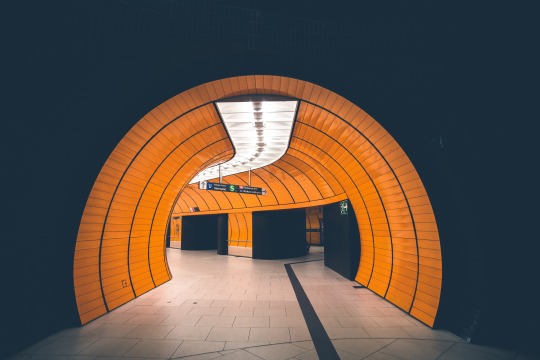
    The space (see above) was designed by + tongtong. Not surprisingly, it’s beautiful. It also very clearly blurs the boundaries between guests and the bakers and chefs.

    From a city building standpoint, it’s interesting to consider what all of this means for Sterling Road (where the Commissary is located).

    The original Drake Hotel was and continues to be a powerful cultural anchor in the West Queen West neighborhood. In fact, it’s my belief that the Drake was the most important catalyst for what eventually emerged along that strip. 

    So I can’t help but think that we are about to witness a very similar transformation in the Junction.

  • The top 10 most suburban cities in America

    According to NewGeography, ~85% of the population in the 53 major metropolitan areas in the U.S. lives in the suburbs or the exurbs. (Data from 2011-2015.) And according to some definitions, a number of these cities could be classified as being 100% suburban.

    NewGeography recently looked at America’s most suburbanized cities using the “City Sector Model” of classification. Here’s generally how it works:

    1. Urban core-CBD: Employment density > 19,999 people per square mile
    2. Urban core-inner ring: Population density > 7,499 per square mile and > 19.9% transit/walk/bike modal split
    3. Earlier suburb: Not urban core or exurb, and median year house built before 1980
    4. Later suburb: Not urban core or exurb, and median year house built after 1979
    5. Exurb: Outside of 2010 principal urban area or under 250 people per square mile 

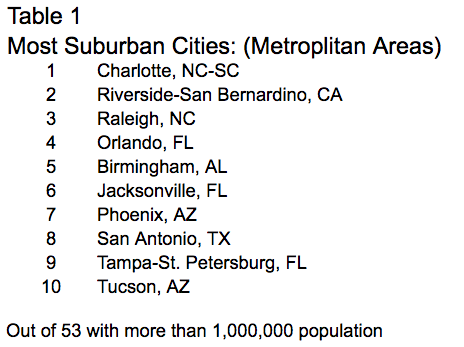
    Based on the above criteria, here are the top 10 most suburban cities in America:

    image

    All of these cities have virtually no urban core. To break the 10 way tie, they were simply sorted based on the size of their exurban population. To see all 53 metropolitan areas, click here.

  • Internet Trends 2017

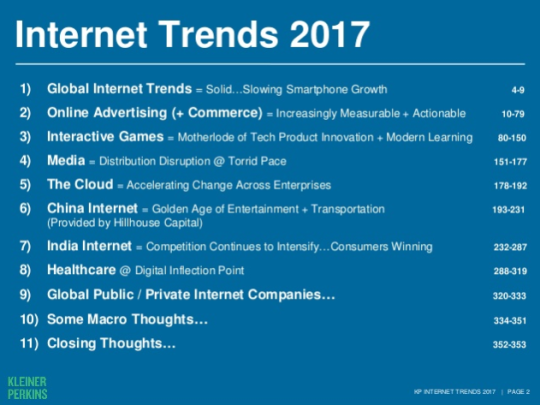
    Mary Meeker – who is a partner in the VC firm Kleiner Perkins – just recently released her annual Internet Trends report. 

    I’ve pasted the table of contents above so you can quickly decide if you’d like to spend your time going through it. The entire report is over 350 slides.

    If you can’t see the embedded slideshow below or if you’d like to access the reports from previous years, click here.

    [slideshare id=KGiWuuYFlhbQBC&w=595&h=485&fb=0&mw=0&mh=0&style=border:1px solid #CCC; border-width:1px; margin-bottom:5px; max-width: 100%;&sc=no]

  • Will Zillow’s new “Instant Offers” disrupt real estate agents?

    Last month Zillow.com launched a new feature called “Instant Offers.” Press real estate can be found here.

    It is:

    “…a way for homeowners to sell their homes quickly by providing them with offers from investors and a comparative market analysis (CMA) from a local real estate agent, as an estimate for what the home might fetch on the open market.

    Here is a bit more about how it works:

    “To participate in Zillow Instant Offers, verified homeowners interested in receiving investor offers confirm information about the home (number of bedrooms, square footage, etc.), highlight any updates and provide several photos of the home. From there, select investors who buy homes in the area can present their offers alongside the CMA from a local real estate agent. Any investor offers and the CMA will include an overview of fees associated with each option, to enable sellers to make an informed apples-to-apples comparison.”

    When I first saw the headline, I thought they were copying Opendoor. But it’s not the same model. They aren’t buying the homes, like Opendoor, they are simply working to coordinate an “instant” transaction. Still, I’m sure that Opendoor provided at least some of the impetus for this feature.

    Of course, the most interesting question with these online real estate platforms is: Will they disrupt real estate agents? Mike Delprete wrote a great post about this in the wake of Zillow’s announcement.

    But ultimately he concludes something that I have felt strongly for years:

    “So, while real estate sites are best positioned to disrupt the real estate industry by displacing agents, they’re also the least likely to do so, because agents are their biggest customers and source of revenue.”

    The irony.

    About 70% of Zillow’s revenue comes from real estate agents. So it seems unlikely that they – at least currently – will be the ones that turn the tables on agents. 

    Some real estate platforms have started diversifying their revenue streams for probably this exact reason. But who knows, it may be a new entrant, rather than an incumbent, who pulls this off. 

  • Rural America is the new inner city

    There’s an argument going around these days that rural America is the new inner city. That is, rural America has replaced inner cities as the geographies facing the greatest socioeconomic challenges. 

    In fact, it’s time for the stigma associated with the term “inner city” to disappear – if it hasn’t already. Blight no longer seems to be the concern. Instead, the concern is that our inner cities are becoming exclusive enclaves for the rich.

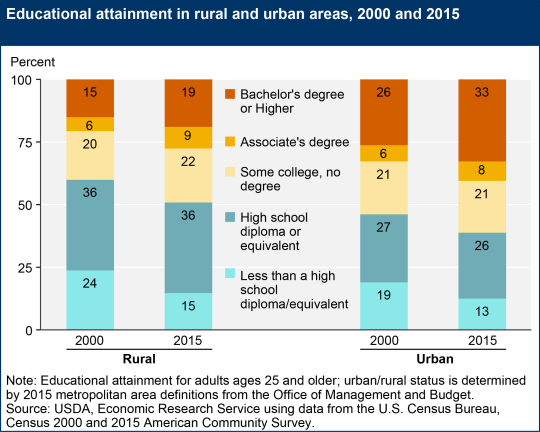
    The United States Department of Agriculture recently published data on educational attainment within rural areas. And since education is one of the biggest drivers of economic prosperity, it’s valuable to look at this data. 

    The first thing to note is that while educational attainment within rural areas is increasing, it still lags urban areas:

    image

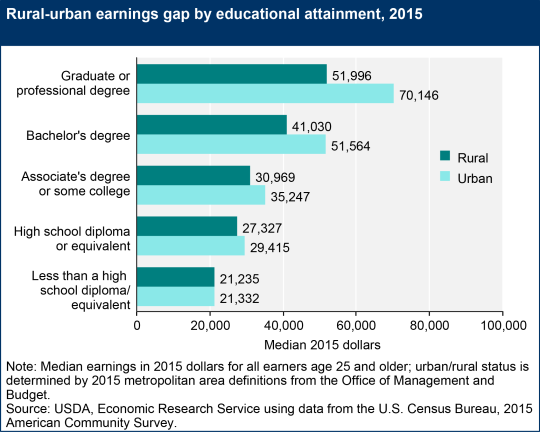
    The second thing to note is that even with the same level of higher education, the labor market will generally pay you more if you live in an urban area:

    image

    However, the spread between rural-urban increases as you move up the education ladder. With less than a school diploma, there isn’t much difference. But with a graduate or professional degree, there’s about a ~35% increase in earnings, on average, according to the above chart.

    So it should come as no surprise that many smart and educated people are choosing to live in urban areas. They should make more money.

    All charts from the U.S. Department of Agriculture.

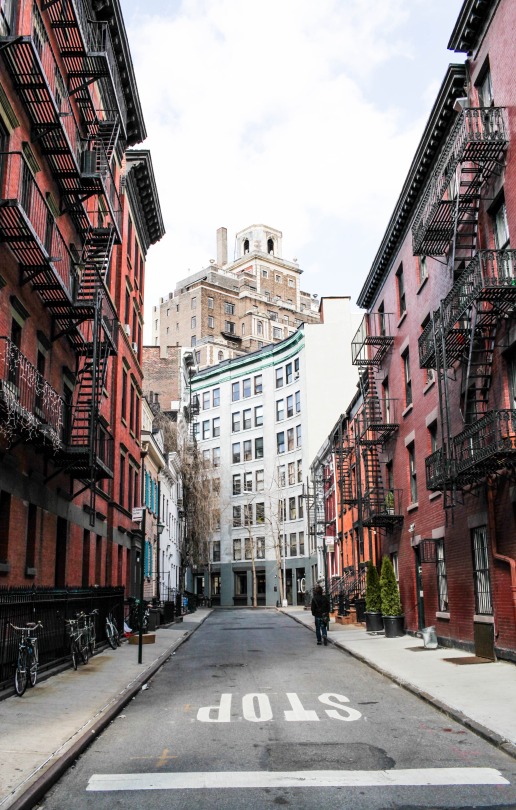
  • Late-stage gentrification on Bleecker Street

    The New York Times ran an interesting piece this past week about the rise and fall of Bleecker Street in the West Village. 

    The synopsis of the story is as follows: 

    Bleecker was once a quaint West Village street. Then the yuppy cupcake shop and big brands (Marc Jacobs) came in to cater to the “Black Card-wielding 1-percenters”. But eventually rents got so out of hand that even the big brands started closing up shop. Now the street is filled with empty storefronts.

    Here’s an excerpt from the article:

    Bleecker Street, Mr. Moss said, is a prime example of high-rent blight, a symptom of late-stage gentrification. “These stores open as billboards for the brand,” he said. “Then they leave because the rents become untenable. Landlords hold out. And you’re left with storefronts that will sit vacant for a year, two years, three years.”

    Nobody likes vacant storefronts. But it is a perfect example of the kind of cycles that neighborhoods and cities can and will continue to go through. Understandably though, there is a real concern that New York could be losing its soul. And really that’s a question and challenge for all global cities.

    What happened to the New York where the artist Donald Judd was able to buy a five-story cast-iron building in Soho for under $70,000 (1968)? It’s gone.