Daily insights for city builders, delivered every morning at 6 AM ET. I’m Brandon Donnelly — a Toronto-based real estate developer and founder of Globizen. I’ve been writing here since 2013.

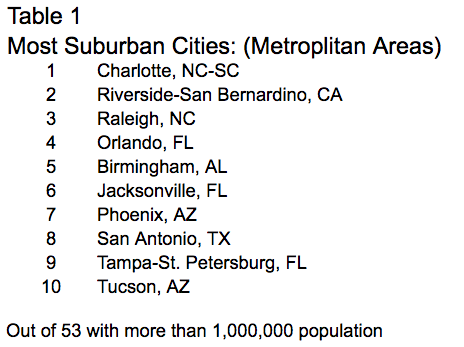
  • The top 10 most suburban cities in America

    According to NewGeography, ~85% of the population in the 53 major metropolitan areas in the U.S. lives in the suburbs or the exurbs. (Data from 2011-2015.) And according to some definitions, a number of these cities could be classified as being 100% suburban.

    NewGeography recently looked at America’s most suburbanized cities using the “City Sector Model” of classification. Here’s generally how it works:

    1. Urban core-CBD: Employment density > 19,999 people per square mile
    2. Urban core-inner ring: Population density > 7,499 per square mile and > 19.9% transit/walk/bike modal split
    3. Earlier suburb: Not urban core or exurb, and median year house built before 1980
    4. Later suburb: Not urban core or exurb, and median year house built after 1979
    5. Exurb: Outside of 2010 principal urban area or under 250 people per square mile 

    Based on the above criteria, here are the top 10 most suburban cities in America:

    image

    All of these cities have virtually no urban core. To break the 10 way tie, they were simply sorted based on the size of their exurban population. To see all 53 metropolitan areas, click here.

  • Internet Trends 2017

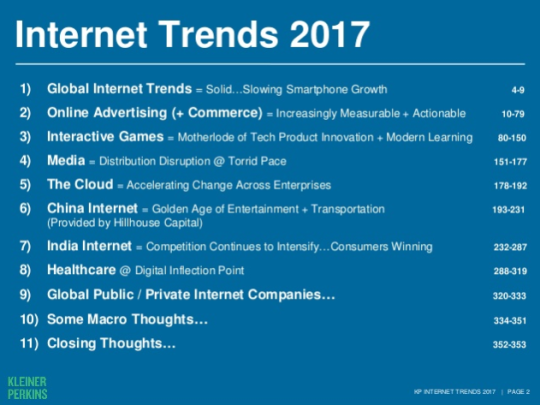
    Mary Meeker – who is a partner in the VC firm Kleiner Perkins – just recently released her annual Internet Trends report. 

    I’ve pasted the table of contents above so you can quickly decide if you’d like to spend your time going through it. The entire report is over 350 slides.

    If you can’t see the embedded slideshow below or if you’d like to access the reports from previous years, click here.

    [slideshare id=KGiWuuYFlhbQBC&w=595&h=485&fb=0&mw=0&mh=0&style=border:1px solid #CCC; border-width:1px; margin-bottom:5px; max-width: 100%;&sc=no]

  • Will Zillow’s new “Instant Offers” disrupt real estate agents?

    Last month Zillow.com launched a new feature called “Instant Offers.” Press real estate can be found here.

    It is:

    “…a way for homeowners to sell their homes quickly by providing them with offers from investors and a comparative market analysis (CMA) from a local real estate agent, as an estimate for what the home might fetch on the open market.

    Here is a bit more about how it works:

    “To participate in Zillow Instant Offers, verified homeowners interested in receiving investor offers confirm information about the home (number of bedrooms, square footage, etc.), highlight any updates and provide several photos of the home. From there, select investors who buy homes in the area can present their offers alongside the CMA from a local real estate agent. Any investor offers and the CMA will include an overview of fees associated with each option, to enable sellers to make an informed apples-to-apples comparison.”

    When I first saw the headline, I thought they were copying Opendoor. But it’s not the same model. They aren’t buying the homes, like Opendoor, they are simply working to coordinate an “instant” transaction. Still, I’m sure that Opendoor provided at least some of the impetus for this feature.

    Of course, the most interesting question with these online real estate platforms is: Will they disrupt real estate agents? Mike Delprete wrote a great post about this in the wake of Zillow’s announcement.

    But ultimately he concludes something that I have felt strongly for years:

    “So, while real estate sites are best positioned to disrupt the real estate industry by displacing agents, they’re also the least likely to do so, because agents are their biggest customers and source of revenue.”

    The irony.

    About 70% of Zillow’s revenue comes from real estate agents. So it seems unlikely that they – at least currently – will be the ones that turn the tables on agents. 

    Some real estate platforms have started diversifying their revenue streams for probably this exact reason. But who knows, it may be a new entrant, rather than an incumbent, who pulls this off. 

  • Rural America is the new inner city

    There’s an argument going around these days that rural America is the new inner city. That is, rural America has replaced inner cities as the geographies facing the greatest socioeconomic challenges. 

    In fact, it’s time for the stigma associated with the term “inner city” to disappear – if it hasn’t already. Blight no longer seems to be the concern. Instead, the concern is that our inner cities are becoming exclusive enclaves for the rich.

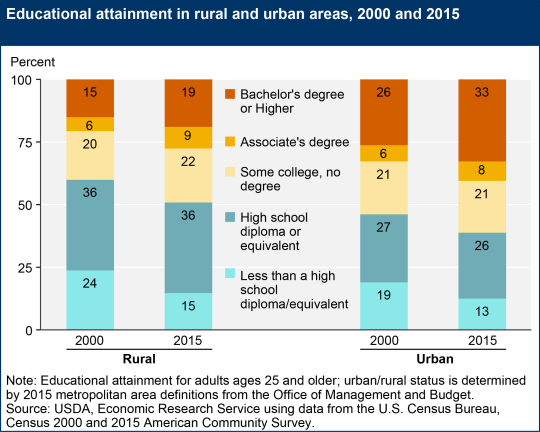
    The United States Department of Agriculture recently published data on educational attainment within rural areas. And since education is one of the biggest drivers of economic prosperity, it’s valuable to look at this data. 

    The first thing to note is that while educational attainment within rural areas is increasing, it still lags urban areas:

    image

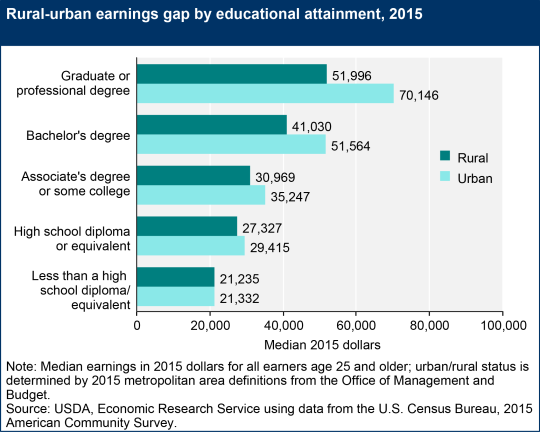
    The second thing to note is that even with the same level of higher education, the labor market will generally pay you more if you live in an urban area:

    image

    However, the spread between rural-urban increases as you move up the education ladder. With less than a school diploma, there isn’t much difference. But with a graduate or professional degree, there’s about a ~35% increase in earnings, on average, according to the above chart.

    So it should come as no surprise that many smart and educated people are choosing to live in urban areas. They should make more money.

    All charts from the U.S. Department of Agriculture.

  • Late-stage gentrification on Bleecker Street

    The New York Times ran an interesting piece this past week about the rise and fall of Bleecker Street in the West Village. 

    The synopsis of the story is as follows: 

    Bleecker was once a quaint West Village street. Then the yuppy cupcake shop and big brands (Marc Jacobs) came in to cater to the “Black Card-wielding 1-percenters”. But eventually rents got so out of hand that even the big brands started closing up shop. Now the street is filled with empty storefronts.

    Here’s an excerpt from the article:

    Bleecker Street, Mr. Moss said, is a prime example of high-rent blight, a symptom of late-stage gentrification. “These stores open as billboards for the brand,” he said. “Then they leave because the rents become untenable. Landlords hold out. And you’re left with storefronts that will sit vacant for a year, two years, three years.”

    Nobody likes vacant storefronts. But it is a perfect example of the kind of cycles that neighborhoods and cities can and will continue to go through. Understandably though, there is a real concern that New York could be losing its soul. And really that’s a question and challenge for all global cities.

    What happened to the New York where the artist Donald Judd was able to buy a five-story cast-iron building in Soho for under $70,000 (1968)? It’s gone. 

  • Tech Time: The ŌURA Ring

    Because my blog emails go out at 6AM every morning, many people think that I am up at 4AM every day typing away at my computer and drinking coffee. I do not get up this early. In fact, I’m naturally more of a night person. But since our world is heavily biased against night people, I do what I can to conform.

    Perhaps because of this, I am very interested in sleep optimization. I have a Fitbit that I occasionally use, but I seem to go through phases with it. I think part of the problem is that the data I get from it doesn’t feel like enough.

    This week I was intrigued to learn about something called the ŌURA ring. Yes, it’s another sleep and activity tracker. But it does some unique things. And because it’s a ring, it’s in constant contact with your finger’s arteries. So presumably the data is better.

    The ring’s output appears to be centered around something called “readiness”, which the company refers to as “an optimal physical and mental state that can be achieved by acquiring the ultimate balance between sleep and activity.” 

    To give a more concrete example, the ring tracks something known as heart rate variability (HRV). Fitbit and Apple devices don’t do this, but supposedly it’s quite a telling datapoint. Professional sports teams are starting to track this so they know how “ready” the players are.

    I’m not yet sure I’m ready to invest in the ring (they start at USD$299), but I am definitely intrigued. 

    If you’d like to read more about “the science” behind it, you can do that here. If you’d like to watch a mini-review, click here. And if you’re ready to pull the trigger, you can use the coupon code “kevinrose” to get 25% off. I discovered the ring via his newsletter.

    Image: OURA

  • Laneway suites are happening

    image

    Today I learned that Councillor Ana Bailão and Councillor Mary-Margaret McMahon have put forward a motion to the June 13, 2017 Toronto and East York Community Council. It asks the Chief Planner and City Planning to undertake further public consultation and report back in Q1 2018 with an implementation strategy for laneway suites in this part of the city.

    This is an insanely great step forward. Here is the summary from the motion:

    We have been working with Lanescape and Evergreen since early 2016 to advance the dialogue around ‘laneway suites’ in order to put forward a set of responsible performance standards that address the aspirations, sensitivities and needs of residents in our communities.

    As part of the work undertaken by the team, we engaged with over 3,000 residents though an extensive consultation process that included an online survey, written feedback, in-person consultations in Wards 18, 32 and a public consultation at the Evergreen Brick Works. The feedback received has been overwhelming positive and the team has taken steps to address the key issues raised by residents as part of the recommended performance standards.

    Throughout this process, the team met with relevant City Divisions to seek feedback on how best to address the technical requirements for laneway suites and we have also sought to include your feedback into the performance standards that have been developed. We are also grateful to the City Planning and other Divisional staff who have provided their advice and feedback as the team worked to prepare this independent report and set of performance standards.

    Toronto has more than 2,400 publically owned laneways, covering more than 250 linear kilometers of public space, which have the potential to become much more active, useful spaces in our urban fabric. Laneway suites can transform underutilized spaces such as rear garages and parking pads, into sensitively scaled housing, utilizing existing infrastructure and respecting the form and character of the dense, walkable neighbourhoods in the Toronto and East York District.

    Laneway suites represent an important step forward in addressing the need for more “missing middle” housing and have the potential to add much needed rental units into the market. They can reshape our thinking about secondary suites, looking beyond the traditional basement apartment as a way to provide extra income or as a place for adult children, empty nesters and care-takers to live close to their family support networks.

    We want to eliminate the excessive red tape and unnecessary costs associated with building a laneway suite in the current context by proposing thoughtful and sensitive policy changes for Toronto to join the other municipalities in Canada who have already allowed for laneway suites to be built.

    We believe that the time has now come for Toronto to allow for laneway suites and therefore recommend the following.

    What they are recommending is a set of performance standards for laneway suites. You can download the full report here. It’s called Laneway Suites: A new housing typology for Toronto, and it was prepared by Lanescape and Evergreen. I’ve mentioned both groups many times before on the blog.

    I haven’t read through the entire report yet, but I’m thrilled to see this housing typology moving forward. I’ve been arguing for over a decade that laneway housing is an inevitable outcome for this city and it’s finally starting to feel a bit more real.

    A big kudos and thank you to Councillor Ana Bailão, Councillor Mary-Margaret McMahon, their teams, and the folks at Lanescape and Evergreen for putting in the effort and sticking their neck out around this important initiative. We’re going to look back on this one day and wonder why it took so long.

    But keep in mind that it’s still early days. So I would encourage you to visit this page, click “Submit Comments” on the top, and fire off a comment directly to Community Council. Tell them you love laneway suites to bits.

  • Zaha Hadid’s Miami condo is on the market for $4,350 psf

    Today, Google is celebrating the famed Iraqi-born British architect Zaha Hadid, who died last March (2016) in Miami of a sudden heart attack.

    She was the first woman ever to receive the Pritzker Architecture Prize, which is the prize of all prizes for architects.

    Here is Google’s front page:

    The building that is featured is the Heydar Aliyev Center in Baku, Azerbaijan. It’s an extraordinary piece of architecture. And in case you aren’t familiar with it, below is a Red Bull video of Maksim Kruglov skateboarding the building and its grounds. The building is just screaming to be skated. (Click here if you can’t see it below.)

    [youtube https://www.youtube.com/watch?v=J7lEGbAIU6M&w=560&h=315]

    I’m not exactly sure why Google chose today to feature Hadid. Initially I thought it might be the anniversary of her death, but she died in March. Whatever the case may be, a quick search revealed that her Miami condo was just listed for $10,000,000. That’s probably not what they are celebrating.

    It’s located at 2201 Collins Avenue (Unit 730) in the W Hotel Miami Beach. It’s 2,299 sf and features a totally separate guest apartment, which itself has one bedroom. The main suite was initially 2 units, but Zaha had them combined into a generous one bedroom.

    Only $4,350 per square foot.

    Below is a quick video prepared by the broker. You don’t need the sound on for this one. (Click here if you can’t see it below.)

    [youtube https://www.youtube.com/watch?v=9CD_xwYPbf8&w=560&h=315]

  • Neon rooftops of LA

    I am absolutely obsessed with the below video by Drew Ganyer called Neon Rooftops of LA. If you can’t see the embedded video, click here.

    [vimeo 158929583 w=640 h=360]

    The story is that Gayner was playing around with his new drone at a friend’s apartment next to “The Embassy” sign. This peaked his interest and so he went searching for more of these signs. This brought him to PublicArtInLA.com, which provides a comprehensive list of “buildings with historic neon signs” in the Los Angeles area.

    And so a movie was born.

    I’ll end with the below snippet from the opening paragraph of Public Art In LA. I don’t know about you, but I love these signs. I think they really do give rise to the magic of the night.

    “Sometimes, urban renewal can be as simple as the relighting of a neon sign on Wilshire, Hollywood or Sunset boulevard, lights that recover the past and point to an equally bright urban future. Remnants of a lost Los Angeles, city of the mind, remembered and yearned for, the neon lights of L.A.–celestial fires of another sort, green, gold, ruby red, electric blue–guide us down the Wilshire corridor, up through Hollywood and out along Sunset Boulevard west. If Paris is the City of Lights, L.A. is the City of Neon, possessed of a comparable (yet antithetical) beauty and capable as well, like all great cities, of giving rise in the magic of the night to hungers of body, mind and spirit.” (Kevin Starr, “Landscape Electric; A program that renews the city’s urban spirit by relighting Philip Marlowe’s neon L.A.” Los Angeles Times, July 4, 1999. 

  • So is this Brutalism or not?

    image

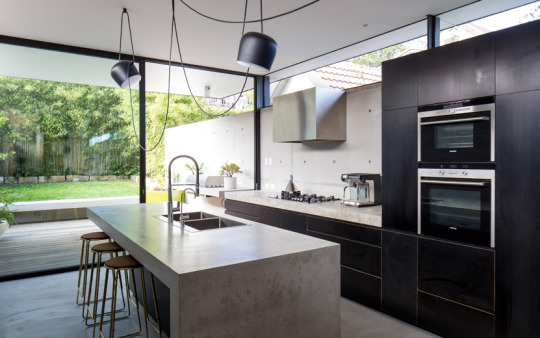
    The Spaces just featured 21 Scott Street in Bronte (a suburb of Sydney) as its property of the week. (The home is currently listed.)

    Designed by MCK Architects, the home is also called the “Upsilon House” and was supposedly designed for a fashion-industry couple.

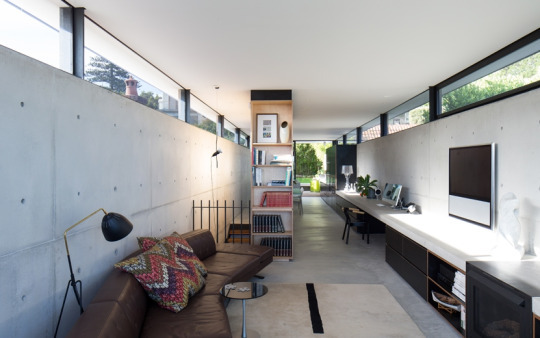
    Two things should immediately stand out to you about the house. One is how long and narrow the site and house are.

    Here is a lengthwise view of the main living floor:

    image

    Based on the plans provided by The Agency (listing agency), the house is about ~3.9m wide. That’s because of its tight site. However, the clerestory windows that run the length of the house would provide ample light.

    The other thing that should stand out is all of the exposed concrete. The Spaces calls it “soft brutalism.” I personally love it, but I recognize that it’s not for everyone.

    In any event, it reminded me of a recent blog post by Witold Rybczynski in which he responded to the New York Times calling Habitat in Montreal a brutalist building. His rebuttal: that’s a gross over-simplification. Brutalism, in its truest sense, is about dramatizing the “rough character of concrete.”

    But I particularly enjoyed how he ended the post:

    “There is another litmus test of Brutalism. Buildings like Habitat remain popular with their users. If people don’t hate it, it can’t be Brutalist.”

    If that’s the case, then 21 Scott is certainly not Brutalism in my book.

    Images via MCK Architects