Daily insights for city builders, delivered every morning at 6 AM ET. I’m Brandon Donnelly — a Toronto-based real estate developer and founder of Globizen. I’ve been writing here since 2013.

  • Screw Toronto

    Hamilton, Ontario is on the rise. It’s no secret. 

    In fact, Toronto Life just ran a piece called The New Hamiltonians, where it profiled ex-Torontonians who have made the move west for more affordable housing and a higher quality of life.

    What stands out for me about the article is how there’s already growing resentment toward both developers and the local business owners who are helping to revitalize the city. Here is an excerpt:

    As builders encroach on Hamilton’s old neighbourhoods, a simmering resentment is building toward the upstart businesses that make rundown areas attractive to developers in the first place. Dave Kuruc, who owns Mixed Media, says that last year, the front door of his and neighbouring shops got slapped with a sticker that read “FUCK YOUR BOUTIQUE. DEFEND HAMILTON.” Last June, a bus tour for ­developers—branded “Try Hamilton!”—was interrupted by masked activists spraying sour milk out of water pistols and wielding signs that read “Developers + Investors = Predators.”

    So it’s not just developers. It’s also those damn boutiques. But the City of Hamilton eliminated development charges and put in place many other incentives for a reason. It wants to see more new construction. 

    Some people clearly aren’t happy about that.

  • The roots of the tree

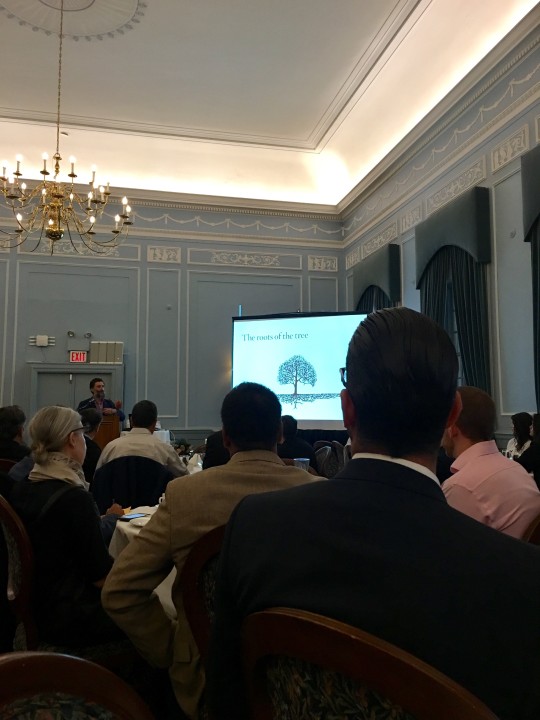
    Yesterday morning I attended a CTBUH (Council on Tall Buildings and Urban Habitat) breakfast event called The Story of Marketing Tall Buildings.

    It consisted of a talk by William Murray, who is Group Director of the UK-based creative agency Wordsearch, and then a panel discussion with some of Toronto’s leading developers. (David Wex of Urban Capital was one of the panelists. Many of you will probably remember him from this BARED post.)

    Shown above is one of William’s slides. The title is: The roots of the tree. And I thought it was a great metaphor for what tall buildings, well really all buildings, should aspire to do.

    The tendency is to think of buildings as objects. Here, look at how beautiful this thing is. That’s obviously important, but what about its roots? What about the way in which it interfaces with its context and hopefully gives back? Is it a catalyst for positive change?

    I thought it was a good slide.

  • Visualizing the origins of MIT’s international students

    “Like the United States, and thanks to the United States, MIT gains tremendous strength by being a magnet for talent from around the world. Faculty, students, post-docs and staff from 134 other nations join us here because they love our mission, our values and our community.” -L.Rafael Reif, MIT President

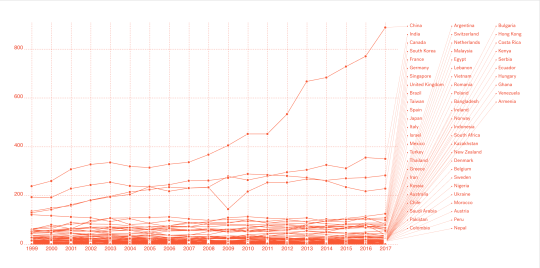
    The MIT Senseable City Lab recently analyzed nearly 20 years of ethnographic student data in order to visualize the origins of its international faculty, students, and researchers from 1999 to the present.

    The above chart may be a bit small (larger version here), but it shows all students (undergraduate, graduate, and visiting/others) by country. The top 5 countries are China, India, Canada, South Korea, and France.

    To give you some sense of the math, there are 3,808 international students at MIT as of 2017. 888 of them alone are from China – mostly at the graduate level (688 out of the 888). So China represents almost ¼ of MIT’s international student population.

    Another thing that stood out for me was the drop off in Canadians in 2009. You can see that “V” roughly in the middle of the chart. Canada went from 233 to 144 students. I wonder if this had something to do with the economic climate at the time. Not sure.

    Click here to see all of the visualizations. 

    Note that you can toggle by region and country, as well as by “Trump’s EO Countries.” That feature, as well as the quote at the beginning of this post, should give you an immediate appreciation for some of the motivations behind this exercise.

    Images: MIT Senseable City Lab

  • Video: New York 1911

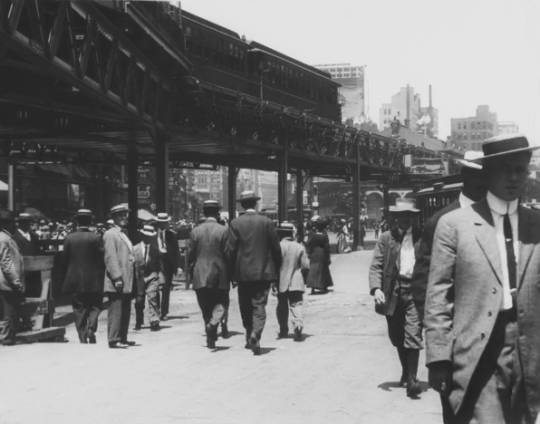
    The Museum of Modern Art (MoMA) recently restored and published a “documentary travelogue” of New York City from 1911. 

    It was originally filmed by a Swedish company, called Svenska Biografteatern, that went around the world filming noteworthy places such as Niagara Falls, Paris, Monte Carlo, and Venice.

    Not surprisingly, New York City is a vibrant and bustling place at the beginning of the 20th century. But it somehow feels serene. Maybe it’s the soundtrack. It’s also interesting to think that this was filmed only 3 years before World War I broke out.

    I particularly enjoyed seeing all of the streetcars (trams) and elevated rail running through the streets.

    Below is a screenshot of a young girl – clearly bored and/or disinterested – being chauffeured down Fifth Avenue in what was almost certainly a fancy convertible at the time.

    MoMA doesn’t allow you to embed the video, but you can watch it here through July 14. It’s 9 minutes and, if you’re a city nerd like me, I think you’ll really enjoy it. The street life footage kicks in around the 3 minute mark.

    Screenshot Images: MoMA

  • Autonomous vehicles will strengthen the case for road pricing

    Joe Cortright of City Observatory recently published a post about the types of policies that cities should be looking to adopt in response to autonomous vehicles. It’s called: Pricing roads for autonomous vehicles.

    Many have argued, including urban economist Edward Glaeser, that autonomous vehicles are going to be positively disastrous for cities. Once you remove the labor costs associated with the driver and the overall price per kilometer plummets because of pooling/technological advances, we are going to see an huge surge in demand – well beyond the capacities of our roads.

    Of course, there are solutions. We can accurately price the roads, which is something that more cities should be doing today even before autonomous vehicles arrive. Here is an excerpt from Cortright’s article:

    “With modern electronics, and especially with autonomous vehicles, position and speed is monitored with great precision. There is no reason why they [drivers] should not pay for exactly the amount of roadway that they use. And we know that the cost of the city’s roadway varies substantially across space and over time. Use of road capacity in less dense neighborhoods at off-peak hours imposes nominal costs on the city’s road budget. In contrast, peak hour use of city streets and arterials, particularly in and near the city center, imposes huge costs on the city and its residents. Those who use the system at peak hours in congested locations should pay the costs associated with creating, maintaining, and where necessary expanding that infrastructure.”

    This isn’t a novel concept, which is why when Toronto was looking at a flat road toll I argued here on the blog that it was a step in the right direction but that it was too blunt a tool. 

    It’s a moot point now because sadly the province ended up pandering and rejecting the plan, but we should have been considering something that could achieve the above objectives. It needed more finesse.

    But in all likelihood our cities will have to face that reality sooner rather than later.

  • The grocery wars: Why Amazon bought Whole Foods

    The big news on Friday was that Amazon has agreed to buy grocery chain Whole Foods for $13.4 billion.

    Some people – such as Bruce Berkowitz, who manages the $2.3 billion Fairholme Fund and who is the second largest shareholder of Sears Holdings Corp. – believe that this says to the market that “there is a need for physical space in retailing.” Everything can’t be online.

    I obviously agree that there’s value in real estate / physical locations, but I don’t see this as Amazon capitulating in any way. This is not Amazon saying to itself: “Well, AmazonFresh hasn’t grown as quickly as we’d like, so let’s forget this ecommerce thing.” No, Amazon is determined to win.

    Indeed, the fact that shares of supermarket operators tumbled across the U.S., Canada, and Europe, probably signals that the market is expecting something other than the status quo following this acquisition. 

    All of this is a big deal because grocery is a big deal

    There’s a reason Wal-Mart ramped up grocery (and now derives over half of its revenue from it). There’s a reason why drug stores are proliferating across our cities (and expanding their grocery offerings). In Toronto it’s Shoppers Drug Mart and Rexall. In New York it’s Duane Reade.

    We buy groceries frequently and we overwhelmingly still buy them in person. So online grocery is the holy grail of ecommerce of right now. Everyone wants to nail it first.

    How does this acquisition help Amazon do that? Here are two thoughts.

    1) The real estate still matters. 

    Even in a world where most groceries are purchased online, you need still need physical distribution centers in close proximity to lots of customers.

    Whole Foods has more than 460 stores across the U.S., Canada, and Britain. Their formatting would obviously evolve, but the bones are there for Amazon to leverage.

    Startups such as Instacart have tried to circumvent this requirement by fulfilling only the delivery portion. And arguably their pitch to other grocers may now be stronger: “You need to offer this to compete with Amazon/Whole Foods.” (Instacart currently provides this service Whole Foods.) But you can bet Amazon will want to squeeze/control this part of the supply chain.

    2) The data.

    Many analysts are already assuming that Amazon will work to automate away cashiers, similar to what it’s trying to do with its Amazon Go concept store. If you combine this with other offerings such as 15 minute pickup (Amazon Fresh PIckup), you can easily imagine a world where us customers get weaned off of in-person shopping.

    For example, if my regular grocery store made better use of its data, it would probably come to the conclusion that I generally buy things like orange juice, milk, and avocados (I’m a Millennial) every X days. I’m sure if you look at my shopping habits, I’m pretty predictable. Whenever I go to a new store it always takes me 100% longer to shop because I don’t generally wander. I target my stuff.

    Now if I could get somehow prompted to re-order my regular items every X – 1 days, chances are I would gladly tap order. And now I’m shopping for groceries online. Get ready for the grocery wars.

  • Toward larger condo units

    One of the things that I’ve been following over the years (and writing about a lot on this blog) is average condo/apartment sizes, specifically in Toronto. I’m interested in this topic because I think it tells you a lot about what’s going on in the market and who is buying/renting.

    Developers are often criticized here for building tiny “shoebox condos.” It wouldn’t be unusual to see a building with an average unit size somewhere in the range of 600-700 square feet.

    But it’s important to keep in mind that the pull toward smaller units is largely because of one important reason: affordability. All things being equal, I’m sure that most people would gladly take an expansive 2,000 sf apartment. But how many people can actually afford a place that large? And for those who can afford it, many seem to opt for ground-related housing instead. So for the most part, the market has said: not many.

    But I’ve suspected for awhile that it was only a matter of time before we saw unit sizes start to creep upward. And indeed today there seems to be a trend toward larger units. I can’t tell you the exact percentage increase for average unit sizes across the city, but you don’t have to look very hard to find a proposed project with average unit sizes in the range of 1,000 to 1,500 sf. I spent this morning looking many of them up and going through their data sheets. If any of you have a larger sample size, please share it in the comment section below.

    To me this feels like a maturation of the market. More of us are deciding to move up, instead of out, which is absolutely what we need to do. Affordability, perhaps more than ever, is still a concern. But the confluence of a couple of factors seem to be expanding the multi-family market in this direction.

    One, empty nesters are starting to cash out of their large houses and they still want/need space. Two, the price of low-rise housing has increased so dramatically that it’s now out of reach for many and/or it no longer feels cost competitive on a per square foot basis. Three, Toronto’s status as a global city continues to increase and this is making it more of a magnet for foreign capital. And four, central and transit-adjacent housing is incredibly desirable for a large segment of the population. Horrible traffic is probably helping this one.

    If there’s any truth to my logic, then I wonder if we won’t see a bit of a bifurcation in the market, if we aren’t already. On the one end, there will still be the pull to shrink unit sizes and maximize affordability. See micro-units. But on the other end, there will be a product segment that now acts as a substitute for low-rise housing.

    I’ve said this before, but I’ll say it again: I think more families in condos and apartments would be a positive thing for the city.

  • New Slate website

    Earlier this week, we (Slate Asset Management) launched our new website. You can check it out at slateam.com. It’s now much clearer who we are and what we do. (There’s also a neat drone video of the Toronto skyline.) 

    On the landing page and in the very first tab (What We Do) it shows our different business lines: Private Equity, Institutional Separate Accounts, and Public. This is all about matching the right capital to the right real estate.

    Lots of people in our office worked very hard on this website and so I’m excited to share it on the blog. Let me know what you think in the comment section below. You can also subscribe to the Slate newsletter here and follow on Twitter here.

  • The U.S. cities that gained the most workers over the last 12 months

    One of the great things about social media is that it gives us access to data that previously didn’t exist or was difficult to collect.

    Take, for example, LinkedIn’s monthly report on employment trends called the Workforce Report. They look at which industries are hiring, where people are moving for jobs, and so on. Click here for the June 2017 edition. 

    Note that architecture/engineering hiring appears to be up nationally, which is usually a positive leading indicator.

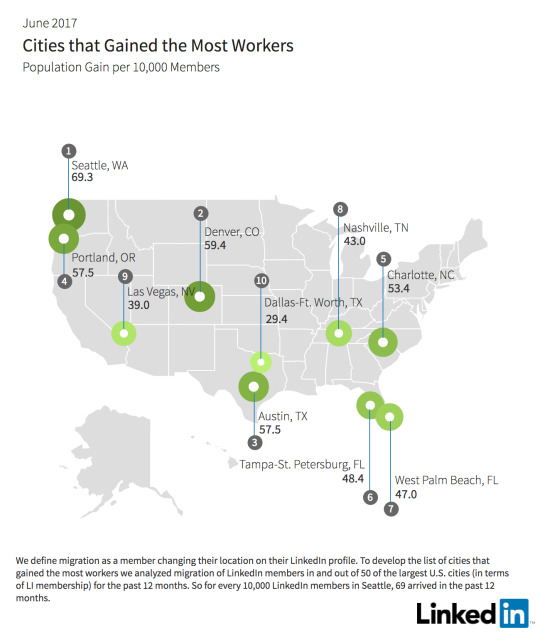
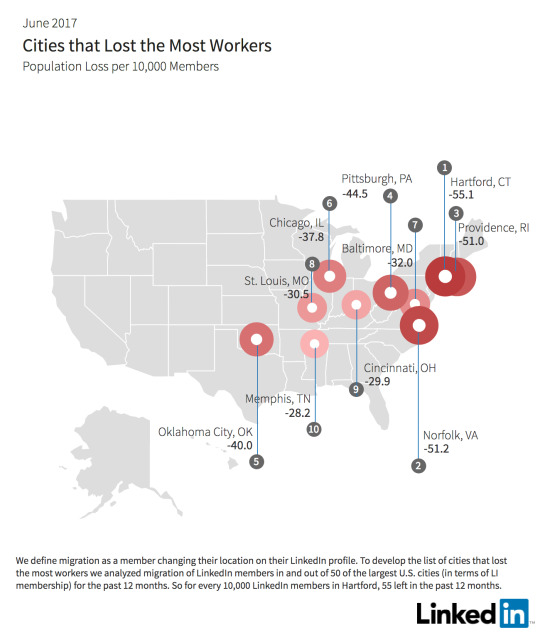
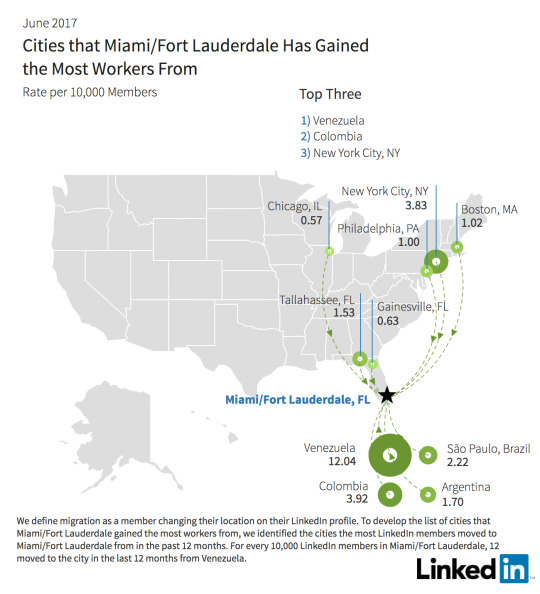
    I’ll leave you all to go through the report, but I did want to pull out a few of their maps and one of their takeaways. Below are maps of the cities that lost the most workers and gained the most workers over the last 12 months.

    The established trend of people moving from colder northern cities to warmer amenity-rich cities seem to play out here.

    That said, one of their “key insights” is that fewer workers today are moving to the San Francisco Bay Area. Since February 2017, there has been a 17% decline in the net number of workers.

    They blame housing affordability (ahem, lack of supply). People are simply turning to other great cities like Seattle, Portland, Denver, and Austin. They’re growing and cheaper.

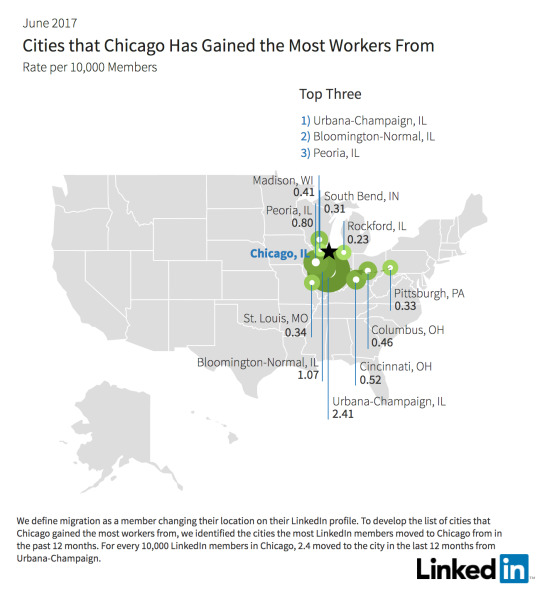
    One of the other cool things about the report is that you can drill down into individual cities to see where people are moving from. I looked up Miami and Chicago just to do a quick comparison. 

    Not surprisingly, Miami is seeing a significant contingent from South America. What’s interesting about this random comparison is how international Miami is and how regional Chicago is in terms of their draws.

    I would love to see similar data for Canada. This is valuable stuff.

  • The death of Big Oil

    Designing a building for 5+ years into the future can be tricky. The pace of change in the world today is astounding.

    Last month Seth Miller published a Medium article called: This is how Big Oil will die. His argument is that the cost of running an electric self-driving vehicle will be so low – simpler technology and no labor cost – that the personal vehicle as we know it will come to an end. People are inevitably going to give up their cars, which will result in a peaking of oil consumption.

    We’ve talked about this future many times before on the blog. But Miller’s argument ties it back to oil and also comes with a set of predictions taken from a report prepared by the consulting company RethinkX:

    – Self-driving cars will launch around 2021.
    – A private ride will be priced at 16¢ per mile, falling to 10¢ over time.
    – A shared ride will be priced at 5¢ per mile, falling to 3¢ over time.
    – By 2022, oil use will have peaked.
    – By 2023, used car prices will crash as people give up their vehicles. New car sales for individuals will drop to nearly zero.
    – By 2030, gasoline use for cars will have dropped to near zero, and total crude oil use will have dropped by 30% compared to today.

    If all of these predictions prove to be true, then what should we be doing today to prepare our cities for this future?