Daily insights for city builders, delivered every morning at 6 AM ET. I’m Brandon Donnelly — a Toronto-based real estate developer and founder of Globizen. I’ve been writing here since 2013.

  • My prediction for Amazon HQ2

    “Now the trick is that we gotta look like we don’t need this shit and they give us the shit for free.“ –Mike Peters

    This is a line from one of my favorite movies, Swingers. Short video clip here. Mikey and Trent are in a Las Vegas casino trying to play it cool. They’re looking to make a scene at a table and Mikey throws out this gem of a line. He knows that people want what they can’t have and that confidence matters.

    I was reminded of this line today after Amazon announced its HQ2 Request for Proposal (full RFP document here) and every city, from Chicago and Toronto to Philadelphia and Dallas, started swooning over the prospect of housing Amazon’s second headquarters in North America. 

    But to be clear, I do not think this is a bad idea. I actually think Amazon HQ2 is an incredible city building opportunity that would generate countless positive externalities for the selected city. I’m thrilled that Mayor John Tory will be personally “leading the charge” with respect to Toronto’s response.

    Over $5 billion in construction and as many as 50,000 employees making on average over $100,000 per year. Amazon is looking for about 500,000 sf of space in phase 1 (2019) and up to 8,000,000 sf in total. Based on the RFP, they seem to be pegging their capital investment at somewhere around $600 per square foot.

    If I’m being as objective as possible, I honestly believe that Toronto is the city to beat in his competition. I think it will come down to access to talent. Human capital is the lifeblood of a company and Trump’s immigration policies simply put U.S. cities at a disadvantage in this regard.

    Of course, Toronto is also awesome. So that’s my prediction: Amazon HQ2, Toronto.

  • REM

    image

    “A building has at least two lives – the one imagined by its maker and the life it lives afterward – and they are never the same.” -Rem Koolhaas

    Tonight I went with a developer friend to see the documentary REM at the Hot Docs Cinema on Bloor Street. It’s a documentary about the Dutch architect Rem Koolhaas, directed by his son Tomas Koolhaas. Trailer here.

    The film is essentially 75 minutes of introspection on the part of Rem. It’s him ruminating over a continuous piece by the American composer Murray Hidary. At times it was hard to hear what Rem was actually saying.

    If you’re looking to learn the specifics of his designs and process, then this movie is not for you. Though there’s lots of footage of his buildings. It also does not make clear just how much influence he has had professionally. I mean, everyone from Bjarke Ingels to Jeanne Gang once worked at his firm.

    The film is really about getting inside the mind of Rem as he travels the world. What struck me is Rem’s profound curiosity for seemingly everything. He really is obsessed with analyzing, documenting, and reporting. He refers to it as a compulsion.

    I also like the idea put forward that architecture represents a particular moment in time. If you’re precise about things, you may be right the moment the building is complete.

    But from that point onward, everything begins to change around it and you will be wrong. That’s what the quote at the top of this post is getting at.

    So I enjoyed it – but probably because I’m an architecture geek and Rem is arguably the most influential living architect today. But I’m not going to tell you that this film is a must-see.

    P.S. Who knew, Rem Koolhaas flies economy.

    Photo by Pavan Trikutam on Unsplash

  • MONAD, Vancouver

    image

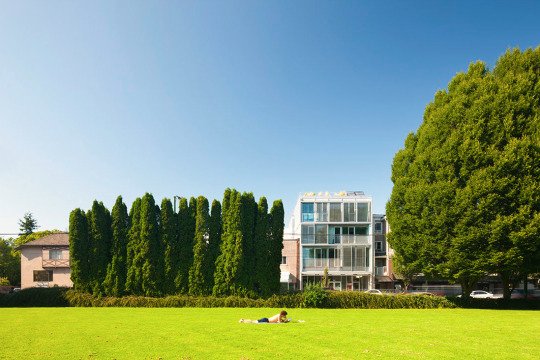
    Earlier today, Nithya Vijayakumar, of The Pembina Institute, pointed out the above housing project to me on Twitter through this 2013 Dwell article (worth a read).

    The project is called MONAD and it’s a 4-unit, 12,600 square foot prefabricated multi-storey building in Vancouver on West 4th Avenue. 

    The site itself is 33′ x 110′, which just so happens to be the same size as a typical single family lot in the city. However, this one sits on a main street.

    Completed in 2011 and designed by Lang Wilson Practice in Architecture Culture, the development was intended to be a pilot project and a rethink of urban living.

    There are real diseconomies when you develop at this scale, but if you make it high-end enough the math just may work. What a beauty.

    Above image from LWPAC. More photos here. 

  • Thoughts on labor, and the end of summer

    Well, just like that, the unofficial end of summer. Labor Day weekend. But I agree with Shawn Micallef: “Defy the crowd and keep enjoying summer.” There are still weeks of it left.

    But given that it is Labor Day weekend, here are two things to think about. 

    The first is a Financial Times article by Lawrence Summers where he argues that America needs unions more than ever and that, indeed, the central issue of American politics today is the “economic security of the middle class.”

    Here is an excerpt that speaks to declining bargaining power on the part of labor:

    “But I suspect the most important factor explaining what is happening is that the bargaining power of employers has increased and that of workers has decreased. Bargaining power depends on alternative options. Technology has given employers more scope for replacing Americans with foreign workers, or with technology, or by drawing on the gig economy. So their leverage to hold down wages has increased.”

    It’s also worth mentioning that only about 6.4% of private sector workers in the U.S. are in a union today. This is a decline of almost two-thirds since the 1970s and is a good segue into the second thought of this post.

    Two years ago Fred Wilson wrote a post on his blog (which he reblogged today) where he argued that “labor needs a mechanism to obtain market power as a counterbalance to the excesses of markets and capitalism.” 

    But, that this mechanism needs a refresh. He calls it Union 2.0.

    “However, like all bureaucratic institutions, the “Union” mechanism appears anachronistic sitting here in the second decade of the 21st century. We are witnessing the sustained unwinding of 19th and 20th century institutions that were built at a time when transaction and communications costs were high and the overhead of bureaucracy and institutional inertia were costs that were unavoidable.”

    This makes perfect sense to me. 

    At the same time, we can’t forget – and this is how Summers ends his article – that, today, “the most valuable companies are the Apples and the Amazons rather than the General Motors and the General Electrics.”

    That tells me that what may have worked in the past will likely not work in the future.

    Photo by Jonas Viljoen on Unsplash

  • LESS IS MORE OR

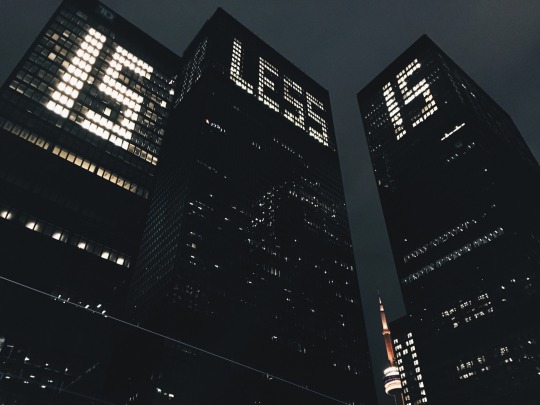
    Last night I went by the Toronto-Dominion Centre to check out the above public art project by French artist Aude Moreau. The message on the buildings is “LESS IS MORE OR”, which is a play on the architect Mies van der Rohe’s famous adage: “Less is more.” Here, the “or” is meant to make you question it.

    All of this is to celebrate the 50th anniversary of the Centre. The first tower was completed in 1967 and is one of Mies’ last projects before he died in 1969. His original plan included two towers and the banking pavilion at the corner of Bay and King, but three more towers were later added.

    This is Toronto architecture at its absolute best. And it may not have happened without people like Phyllis Lambert. I am so glad it did.

  • Clean disruption of energy and transportation

    I just came across the below talk by Tony Seba about the coming “clean disruption” of energy and transportation. The talk follows his book of the same name. Click here if you can’t see it below. It runs about an hour, but I would encourage you to give it a watch. 

    [youtube https://www.youtube.com/watch?v=2b3ttqYDwF0?rel=0&w=560&h=315]

    The first few minutes will be things I’m sure many of you have heard before, such as the failure of Kodak to embrace digital cameras (film business considered too valuable), Moore’s Law, and so on. But he then moves on to cost curves, battery storage, solar power, and autonomous electric vehicles (A-EVs).

    You all know that I am fascinated by these topics, so here’s one piece that stood out for me: 2021 is his prediction for the year in which A-EVs become real and disrupt both internal combustion engine (ICE) vehicles and individual car ownership.

    Obviously this won’t happen overnight, but Tony’s belief is that 2021 will be the year that the economics of A-EVs become so compelling (10x) that it will crush our current business models.

    The argument is that on-demand ride hailing/sharing and A-EVs will converge and that Transportation as a Service (TaaS) will provide our mobility needs at a fraction of today’s costs. We’ve talked about this prediction before on the blog, but never has a timeline been attached to it.

    All of this reinforces two thoughts that I’ve been having over the past few years. One, I will probably never buy another combustion engine vehicle. And two, I should probably avoid buying another vehicle, period, until the next wave of business models becomes clearer. Leasing likely makes more sense at this stage if you need a car.

    In fact, Tony believes that with the collapse of individual car ownership, the resale value of cars could become negative. That is, you’d have to pay people to take a car off of your hands, because everyone will recognize the cost advantage of just using TaaS.

    We are doing everything we can to future proof our development projects so that they are ready for electric vehicles. But if A-EVs and TaaS completely erase individual car ownership within the next 5 years, then all of us in the industry are going to need to do much more to ready our buildings and cities.

  • Two-hour grocery delivery

    Today it was announced that Amazon is planning to launch its “Prime Now” service in Vancouver and Toronto this November and January, respectively. 

    The pilot program will offer two-hour deliveries for members and, according to the Wall Street Journal, will be be heavily focused on groceries. 

    It’s worth noting that most of Whole Foods’ stores in Canada (now owned by Amazon) are in and around Vancouver and Toronto. And that Amazon has already started lowering prices to make those stores more competitive.

    Right now a “Prime” membership in Canada costs CAD$79 per year. I’m not sure if the price will change at all for “Prime Now”, but let’s assume for the sake of argument that it won’t. 

    If this service was available to you today (or if you’re in a city that currently has it), would you (do you) use it? I would love to hear your thoughts in the comment section below.

    Two common objections around online grocery shopping are that many people want to touch and feel the goods before they buy and that perishable deliveries are a challenging thing to coordinate.

    I think I can work around those objections and would certainly try this today if it was available in Toronto. What about you?

  • Smart sewers may soon analyze our poop

    On September 2, 2017, a research project by several MIT laboratories – called Gangnam Poop: Underworlds in Seoul – will debut at the Seoul Biennale of Architecture and Urbanism.

    Here’s an excerpt from the exhibition description:

    A vast reservoir of information on human health and behavior lies in our sewage, and this resource is untapped. We imagine a future in which sewage is mined for information that can inform policy makers, health practitioners, designers, and researchers alike. Such is the idea behind Underworlds: a cross-disciplinary data platform for monitoring urban health patterns, shaping more inclusive public health strategies, and pushing the boundaries of urban epidemiology.

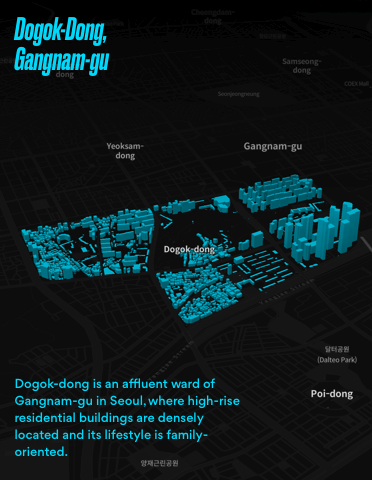
    For this exhibition and “proof of concept”, they analyzed three distinct neighborhoods in Seoul, using an aptly named sewer robot called Luigi. 

    Gangnam-gu (shown above) is an upper-class high-rise residential area. Mapo-gu is an emerging artist and designer enclave. And Seongbuk-bu is a hillside village with detached houses and an older demographic.

    In each case, they mapped out the bacterial populations found beneath each neighborhood. Interestingly enough, the different areas revealed different bacterial occurrences. You can see those diagrams here.

    I often think of healthcare as being very reactive. A future like the one this exhibition is imagining would be far more proactive. And that would be a very good thing.

    Image and project by MIT Senseable City Lab. Gangnam Poop: Underworlds in Seoul. Commissioned by Seoul Biennale of Architecture and Urbanism

  • Frontier city

    Opposition to new development is nothing new in this city. In fact, it’s the norm in almost all cities, regardless of how big or small the project might be.

    But the battle happening right now in Toronto with respect to the proposed 8 storey condominium project at 321 Davenport Road is certainly taking things to the next level. All over 16 units.

    Some of the most recognized names in this city have their hat in the ring and virtually every media outlet has covered the topic. See here, here, here, and here, for a small taste.

    Just this evening I saw that Shawn Micallef (yes camp) had sent a copy of his recent book to Margaret Atwood (no camp) in the hopes that she would read it and better appreciate why it behooves our neighborhoods to move past this “village mentality.”

    If you haven’t yet read it, it’s called Frontier City: Toronto on the Verge of Greatness. I’ve just moved it to the top of my reading pile. I hope more folks do the same.

  • Is sprawl to blame (at least partially) for the flooding in Houston?

    What’s happening in Houston right now is devastating. Ian Bogost of The Atlantic is calling the flood a “disaster of biblical proportions.” Harvey has unloaded 9 trillion gallons of water.

    It is once again reminding us of the importance of resiliency when it comes to our cities.

    One emerging argument is that this is an almost inevitable outcome for Houston, brought on by the multiplicative effects of climate change, unfettered urban sprawl, and poor design decisions.

    The barriers to development are famously low in Houston, which allows the city to quickly add housing and people. There are many benefits to this. 

    But it also means that there has been, among other things, a dramatic increase in the amount of impervious surface.

    This matters because impervious surface creates runoff.

    According to The Texas Tribune, impervious surface in Harris County (third most populous county in the U.S.) increased by 25% between 1996 and 2011. 

    And it replaced things like the below prairie grass (switchgrass), which are highly absorbent as a result of their deep root system. 

    But much like climate change, not everyone believes this is to be blamed. 

    For more on this, check out The Texas Tribune’s full interactive piece. It’s called “Boomtown, Flood Town” and it’s worth a read.

    Image from The Texas Tribune